Let me try this again, this time with a 1" supply pipe. Surely that will cause trouble!
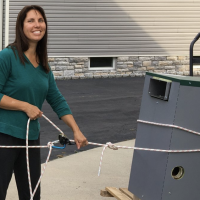
You may find this video to have a clearer message it's communicating than my last one, thank you for the feedback on that one.
In this one I run all my steam through a 1" pipe to feed my system. We'd be concerned if a homeowner came here looking for help and they had a single 1" supply pipe going to their header, right?
NJ Steam Homeowner.
Free NJ and remote steam advice:
https://heatinghelp.com/find-a-contractor/detail/new-jersey-steam-help/
See my sight glass boiler videos:
https://bit.ly/3sZW1el


Comments
-
Thanks for the video .. Thinking the increase of system pressure caused by the smaller supply condensed the steam .
There was an error rendering this rich post.
 1
1 -
Nice experiment Paul. I'm just a lowly homeowner/engineer who doesn't have any experience with steam heat, but I have read LAOSH. As I understand it, the whole question of near-boiler piping size is an attempt to regulate the exit velocity of the steam as it leaves the boiler.
Dan talks about this question on pp 42-43 of LAOSH, and he quotes early steam guru Ara Marcus Daniels from 1928 saying "Steam boilers are not provided with means for assuring dry steam…hence velocity of flow through outlets of such boilers should be relatively low—not over 15 feet per second—if the carrying over of water with steam is to be avoided." Dan then looks at specs of some older boilers and lists the exit velocities for them. All but one are below 15 fps.
Then Dan notes that a book from 1936 says excessive steam velocity will interfere with the backward flow of condensate. And you showed that in your video with the condensate film on the walls of the sight glass being blown upward by the steam velocity. Dan follows that book quote with a table showing the maximum recommended velocity for different size riser pipes on a 1-pipe system, based on condensate flow. The max recommended velocity for a 3" riser is 29 fps, and Dan observes that Ara Marcus Daniel's 15 fps max is only half that, which is very conservative.
Dan then looks at the specs of some modern boilers. The 7 modern boilers he choose have exit velocities ranging from 25 to 37 fps, in some cases more than double Daniel's 15 fps max. Dan then observes that this means most modern boilers have exit velocities that exceed the max velocity against which condensate can drain, meaning that the headers and equalizers must separate out the condensate before it gets out into the system.
But it seems what your video showed is that, if no water droplets are being generated inside the boiler by surging, the exit velocity doesn't really matter. As Dan showed, modern boilers already have exit velocities above the condensate backflow limit, so they're already pushing the condensate up the walls even with correctly-sized near boiler piping. And as you showed, even higher velocities don't matter if there are no water droplets leaving the boiler in the first place.
It sounds like this is another instance of a very conservative "rule of thumb" (don't exceed 15 fps) having been established back in the day when boilers may have been more likely to generate water droplets due to poor water quality, maybe different boiler geometry, maybe less control over water lines levels, etc. Apprently modern boiler mfrs have learned that they can safely exceed 15 fps but are still trying to keep velocities reasonable enough so that if there is surge, keeping the velocity down minimizes the effects.
It reminds me of the Mythbusters episodes about dropping a penny off the Empire State Building. They built a small vertical wind tunnel to find the terminal velocity of a penny, which turned out to be around 65 mph. or about 95 fps. The Ara Marcus Daniels' 15 fps limit is presumably the terminal velocity of a water droplet, so if the surrounding steam is traveling slower than 15 fps, the droplet will fall, and if higher than 15 fps, the droplet will rise. But as with many old heating "rules of thumb," this may be conservative.
What I take away from your video is that, if the boiler isn't surging or producing water droplets some other way, excessive steam velocity isn't a problem. So the important factor is having water clean enough, and the water line low enough, that water doesn't get carried out of the boiler exit in the first place.
Dan mentions seeing many steam guys using anti-surge tanks. I assume like this:
Does anyone ever recommend those to homeowners with surging problems? That might be less costly than replacing all the undersized/badly installed near-boiler piping. Because as you showed, if you have clean dry steam, pipe size doesn't matter much.
2 -
Nice summary! I have a feeling it won't necessarily stop folks from telling homeowners they have to repipe their boilers but I hold out some hope 🙂
NJ Steam Homeowner.
Free NJ and remote steam advice: https://heatinghelp.com/find-a-contractor/detail/new-jersey-steam-help/
See my sight glass boiler videos: https://bit.ly/3sZW1el 1
1 -
I would appreciate if someone clarified what good water quality means. If it means no oil on the water surface and a PH above 7 then I have it in my 63-03 boiler. The next term I seek clarity on is surging. If it means the water line fluctuates more than +/- 0.25” when the boiler is operating then I have no surging, but my water line is approx 2.5” from the bottom of the sight glass. Does this mean I have significant carryover? I do get a fair amount of rust despite using 8-way. I am using distilled water to refill after draining the rust once a month. Could the carryover be caused by suspended rust particles?
It is important to note that none of these conditions are causing any heating issues.
Lastly, if undersized takeoffs cause carryover due to a high steam velocity, then Bernoulli tells us that oversized pipes should lead to a lower carryover at the same pressure. In my case I have a 3” single takeoff to a 2” header. The spec is 2” takeoff and 2” header. The 3” takeoff gives me a 44.4% greater cross sectional area, consequently this should result in a velocity that is 44.4% of the velocity with a 2” takeoff. Yet, despite a 55.6% reduction in exit steam velocity, I get wet steam- steam that is not 100% vapor.But wait, that is not all. My 3” takeoff is 25” tall from the boiler cover to the header, which is at least 10” higher than the min (24” from the boiler water line). I point out this because I thought that a lower exit steam velocity and a taller takeoff would result in negligible carryover, all else being equal. Alas, that is not the case. I know this might come across as a contrarian viewpoint but it is what it is- a healthy mix of empiricism and stoicism.
I had an oversized Burnham that died after 34 years. It had a drop header and it too operated with the water level nearly at the bottom of the sight glass. It needed to be blown down every other week but no heating problems whatsoever. I am beginning to believe there are elves in every boiler.
0 -
The Thermoflow thing is just a "slow place in the road" to let the steam rise and the water to drop out. Same thing a header does.
I have always felt that riser size may be more important than the header. Why use the header to separate the water and steam/? Keep the water in the boiler where it belongs.
The funny thing about steam is there are probably more boilers piped wrong than right that still work fine.
But we know big risers and big headers work "all the time"….almost.
So, when to cut corners and when not to?
I say pipe to the mfg. minimum and skim it good.
1 -
My opinion is the header is there for a similar reason as the equalizer and Hartford loop.
The Hartford loop is to keep the wet return from siphoning out of the boiler. In order for this to work you need to break the siphon with a vent, the equalizer. Since we have that there anyway, we might as well pipe a header into it that will drain any water that blows out right back into the boiler rather than it having to make the long journey down the main(s) and back. Water leaving the boiler rapidly via the mains is also bad, so if we can slow it or prevent it…..
None of it is needed if everything is correct, but it all helps when things aren't correct.I've personally watched an improperly piped boiler (no header at all) blow a ton of water up into the main and shutdown on low water. Would this happen if it had a proper header and equalizer, or would it all return quick enough to prevent the LWCO from tripping? @ethicalpaul Have you tested that yet? I can't remember.
Single pipe 392sqft system with an EG-40 rated for 325sqft and it's silent and balanced at all times.
1 -
If headers are successful at removing water, why did Dan say in LAOSH that many of the steam guys he met were using anti-surge tanks? Maybe in theory headers were supposed to be removing all the water, but in practice apparently they weren't. Maybe the surging was so bad due to poor water quality that it would overwhelm even properly sized/designed risers and headers, and the anti-surge tank was just a band-aid for dirty water?
A 12-inch diameter anti-surge tank has 4x the diameter of a 3-inch riser or header, which means the steam velocity will be reduced by a factor of 16. That's a huge drop that should be highly effective in allowing the water to drop out, and apparently it works well, and better than whatever header arrangement was being used by the steam guys Dan referred to.
You said "keep the water in the boiler where it belongs," but @PhilKulkarni posted above that even with an oversized riser (3-inch vs. recommended 2-inch) he gets wet steam. So evidently there are some cases where even oversized risers can't keep the water in the boiler. That's also a case where an anti-surge tank that reduces steam velocity by a factor of 16 right at the exit should be effective.
0 -
I didn't see where @PhilKulkarnihad any problems at all?
Can you point out where because I keep missing it. The amount his water moves in the gauge glass seems perfectly normal, I think he was asking for confirmation more than anything.
The only question I have is where his water level is. Does it start out normal and drop to that, or is it always low?
Single pipe 392sqft system with an EG-40 rated for 325sqft and it's silent and balanced at all times.
1 -
@ChrisJ I was commenting on @PhilKulkarni 's third paragraph where he was commenting on the effect of using a 3-inch riser vs. the 2-inch spec, and he said "Yet, despite a 55.6% reduction in exit steam velocity, I get wet steam- steam that is not 100% vapor."
Phil did also say that none of the things he mentioned in his post were causing problems. He was just observing that even a larger riser that significantly reduced steam velocity didn't give him dry steam.
So there are two different points being made, one by Paul and one by Phil, that:
- Higher steam velocity doesn't necessarily cause carryover (Paul)
- Lower steam velocity doesn't necessarily eliminate carryover (Phil)
 2
2 -
Great video. What's next?
0 -
You know, I thought this too at first but I changed my mind. I'll tell you my reasoning, see what you think.
I think the only place where the pressure increases is below the constriction (in the steam chest). I believe inside the 1" pipes the pressure is actually less due to the increased flow through there. So that would tend to increase vaporization instead of condensation. So I think it's just condensation from the pipe surfaces.
NJ Steam Homeowner.
Free NJ and remote steam advice: https://heatinghelp.com/find-a-contractor/detail/new-jersey-steam-help/
See my sight glass boiler videos: https://bit.ly/3sZW1el0 -
I just remember the Weil McLain video with the glass piped boiler that is still (probably) circulating on you tube it's probably 15-20 years old. That thing was throwing a lot of water.
It is a mystery I have seen horribly piped boilers with no kind of water treatment or blow down work absolutely fine. You stare at them and say it can't work but it does.
The ones that are piped right usually have no issues that can't be tweaked out.
But when they are bad you don't know where to start.
According to @ethicalpaul video we should try fixing the water quality first and if that doesn't work attack the piping.
I have seen boilers piped right that you couldn't keep the water in them until they were skimmed so maybe its true.
1 -
Need to be totally honest. I didn't watch the video (yet). I have long wondered about the 15 ft per second rule. That rule was "established" in a previous generation, when steam boilers had humongous steam chests. If those boilers needed piping that would sustain 15 ft per second, then what would our boilers, with their relatively tiny steam chest, need. 10 ft per second, 5 ft per second..... We all know that's not the case. I think a lot of the old rules of thumb, were instituted to cover all types of situations. The idea is basically give blanket rules for everything, and then you will always be safe. Will cover for bad water quality, overfired boilers, under piped or poorly boilers, undervented systems, tiny residential and humongous commercial and everything in between. Sort of like the speed limits. They don't always make sense. We all know that when it's 2:00 in the morning and the roads are totally empty and clear and straight, the rush hour speed limit doesn't make much sense. But it's one blanket rule to cover all scenarios.
1 -
OK, so let's take @PhilKulkarni 's case. He says he has a 63-03 boiler, and with a 3-inch riser he's still getting wet steam. According to the following table, worst case velocity for a 63-03 is 14 fps for a single 3-inch riser. That's even below the probably-conservative 15 fps target, and yet he still says he gets wet steam. So there has to be some other factor like chamber geometry, water line height, etc, and/or a combination of the above, that makes some boilers more likely to generate wet steam than others, even at low exit velocities. For whatever reason, Paul's boiler doesn't seem to have that problem even with a high water line and high exit velocity.
1 -
It does make you wonder when we see all the horribly piped boilers that run with no issues. Opposing supply risers, undersized headers, undersized risers.
All the old Weil McLain glass piped boiler videos are still on u tube.
Amazing what steam does. In one video he closes the steam supply valve and lets the boiler build some pressure when he opens the valve the water flashes and sucks water out of the boiler because of the velocity increase.
1 -
It looks like this is one of the videos you mentioned, Ed. He lets the pressure build to 5 psi, and even with the burner off, when he opens the valve, the superheated boiler water flashes to steam and throws massive amounts of water up into the clear pipes.
That is a dramatic demo, but it doesn't really represent normal operating conditions which are more or less steady-state. During the steady-state portion of the video around 5:30, you can see the boiler water frothing through the glass window, and with the water line about halfway up the sight glass, the steam in the clear pipes appears dry. You can even hear someone say "that's dry steam." So again the question is, why do some boilers produce nice dry steam like that, and some boilers like Phil's produce wet steam even with oversized risers? Is it just water quality, and some people cannot or do not get enough oil out?
0 -
Thanks for all the replies everyone. I have a few of your questions to answer, I'll hit them all in one reply here
https://www.tfi-everhot.com/anti-surge-steam-separator.html
Does anyone ever recommend those to homeowners with surging problems? That might be less costly than replacing all the undersized/badly installed near-boiler piping. Because as you showed, if you have clean dry steam, pipe size doesn't matter much.
I personally wouldn't recommend this item. I find it unnecessary because every boiler can run cleanly without carryover if it's just piped with the manufacturer's recommendation. And as my videos are showing, you can be way below those recommendations and still be fine.
PhilKulkarniMember Posts:97December 24I would appreciate if someone clarified what good water quality means. If it means no oil on the water surface and a PH above 7 then I have it in my 63-03 boiler.To me, it means water that boils cleanly—no oil, and no other contaminants that would cause carryover.
The next term I seek clarity on is surging. If it means the water line fluctuates more than +/- 0.25” when the boiler is operating then I have no surging, but my water line is approx 2.5” from the bottom of the sight glass. Does this mean I have significant carryover? I do get a fair amount of rust despite using 8-way. I am using distilled water to refill after draining the rust once a month. Could the carryover be caused by suspended rust particles?
I think you should start another thread with your issues listed and your questions. There is kind of too much to unpack and address here in my thread. But I will say this: If your water line varies less than an inch during your call for heat, then you aren't surging/carrying over to a significant degree and you are probably OK. Don't drain your boiler once a month. I think carryover can occur due to too much "gunk" in your water. And why is your water line 2.5" from the bottom of the gauge glass? That is lower than I like to have it for sure.
EBEBRATT-EdMember Posts:19,553December 24The Thermoflow thing is just a "slow place in the road" to let the steam rise and the water to drop out. Same thing a header does.I have always felt that riser size may be more important than the header. Why use the header to separate the water and steam/? Keep the water in the boiler where it belongs.This is a great point. It is my belief that if you pipe it as recommended, the header will never even be necessary. I have a ton of videos showing no water even getting into the risers, let alone the header. This is why tons of boilers don't even have headers and still work great.
ChrisJMember Posts:17,067December 24edited December 24I've personally watched an improperly piped boiler (no header at all) blow a ton of water up into the main and shutdown on low water. Would this happen if it had a proper header and equalizer, or would it all return quick enough to prevent the LWCO from tripping?@ethicalpaulHave you tested that yet? I can't remember.If the boiler was carrying over a bunch of water then my experiments show it had "bad water". In all my videos, we can see that when the water is OK there is nary a drop that appears in the supplies where my sight glasses begin. On my old boiler it could run with bad water getting carried over to the main and returning back via the return without triggering the LWCO, but depending on the amount of main and amount of water the LWCO could definitely trigger during heavy carryover.
jesmed1Member Posts:1,277December 24edited December 24If headers are successful at removing water, why did Dan say in LAOSH that many of the steam guys he met were using anti-surge tanks? Maybe in theory headers were supposed to be removing all the water, but in practice apparently they weren't. Maybe the surging was so bad due to poor water quality that it would overwhelm even properly sized/designed risers and headers, and the anti-surge tank was just a band-aid for dirty water?Just because Dan said many steam guys were using anti-surge tanks doesn't mean those tanks were necessary or a good idea.
If the water is good, the header doesn't even see any water. My videos have been showing this for several years, since I installed my new boiler. Those guys were either experiencing, or were afraid of bad water causing carryover. In my video where I added a little cutting oil into my boiler, the carryover was pretty bad (not bad enough to overwhelm my drop header's ability to separate the water). If the water is REAL bad, like sudsy or really oily, it can definitely overwhelm a manufacturer-specified header with carryover. In my opinion, all those guys had to do was properly wash out and skim every new boiler and they wouldn't have any problem.
jesmed1Member Posts:1,277December 24@ChrisJ
I was commenting on@PhilKulkarni's third paragraph where he was commenting on the effect of using a 3-inch riser vs. the 2-inch spec, and he said "Yet, despite a 55.6% reduction in exit steam velocity, I get wet steam- steam that is not 100% vapor."I saw that and forgot to mention it. My question to @PhilKulkarni would be: how do you know you get wet steam that is not 100% vapor? As I hope you all know, I do not like the term "wet steam"—please state the behavior or phenomenon that you are observing instead of this term that is at best a catch-all and at worst, completely erroneous.
EastmanMember Posts:968December 24Great video. What's next?Thank you but dang it's Christmas haha
EBEBRATT-EdMember Posts:19,553December 24I just remember the Weil McLain video with the glass piped boiler that is still (probably) circulating on you tube it's probably 15-20 years old. That thing was throwing a lot of water.It is a mystery I have seen horribly piped boilers with no kind of water treatment or blow down work absolutely fine. You stare at them and say it can't work but it does.The Weil-McLain guys were just putting on a show. They ran the PSI up to 5 or 10 and then threw open the exit valve. No boiler could ever avoid carryover with that practice. When the interior of the boiler went from whatever pressure it was to atmospheric pressure, all the water in there which was well above 212F more or less instantly flashed to steam and shot out.
I think if there were a sight glass on those poorly-piped boilers, you'd see that there was simply no water being thrown up the supply just like we see on my boiler.
STEAM DOCTORMember Posts:2,509December 24Need to be totally honest. I didn't watch the video (yet). I have long wondered about the 15 ft per second rule. That rule was "established" in a previous generation, when steam boilers had humongous steam chests. If those boilers needed piping that would sustain 15 ft per second, then what would our boilers, with their relatively tiny steam chest, need. 10 ft per second, 5 ft per second..... We all know that's not the case. I think a lot of the old rules of thumb, were instituted to cover all types of situations. The idea is basically give blanket rules for everything, and then you will always be safe. Will cover for bad water quality, overfired boilers, under piped or poorly boilers, undervented systems, tiny residential and humongous commercial and everything in between. Sort of like the speed limits. They don't always make sense. We all know that when it's 2:00 in the morning and the roads are totally empty and clear and straight, the rush hour speed limit doesn't make much sense. But it's one blanket rule to cover all scenarios.This exactly matches my thinking. I think their engineers were quite conservative in order to give everything the best possible chance to work. And when the water is good, we see boilers with even crazy bad piping work. When the water is pretty bad, boilers still work. Only when the water is really bad (oily, sudsy, gunky) do we see carryover that is bad enough to make the level in the gauge glass drop.
NJ Steam Homeowner.
Free NJ and remote steam advice: https://heatinghelp.com/find-a-contractor/detail/new-jersey-steam-help/
See my sight glass boiler videos: https://bit.ly/3sZW1el 2
2 -
(part 2):
jesmed1Member Posts:1,277December 24edited December 24OK, so let's take @PhilKulkarni 's case. He says he has a 63-03 boiler, and with a 3-inch riser he's still getting wet steam. According to the following table, worst case velocity for a 63-03 is 14 fps for a single 3-inch riser. That's even below the probably-conservative 15 fps target, and yet he still says he gets wet steam. So there has to be some other factor like chamber geometry, water line height, etc, and/or a combination of the above, that makes some boilers more likely to generate wet steam than others, even at low exit velocities.
First, to repeat myself, I would like to know why he thinks he has "wet steam" and also what does "wet steam" mean to him. I hope he tells us without using the term "wet steam".
If he has carryover resulting in a big drop in his gauge glass, then it is clear to me that he has bad water. He should skim, then drain then see if there's improvement. But I couldn't tell if he had carryover from his earlier messages. I'd like him to make a new thread for his particular boiler since this thread isn't really about one given boiler.
jesmed1Member Posts:1,277December 24edited December 24So again the question is, why do some boilers produce nice dry steam like that, and some boilers like Phil's produce wet steam even with oversized risers? Is it just water quality, and some people cannot or do not get enough oil out?
I think it's just water quality (I know I've said that already). I have been to several people's houses who had boilers installed within the last 4-5 years and they had water that was black with an oil slick in their gauge glass. Their installer never washed out or skimmed their boilers. It was hard to tell if they had carryover because the water in their glass moved maybe 1"-2", so they might have had a little carryover into the header which then ran back down the "equalizer" giving them OK performance.
When I see that, I tell them how to skim so they or their trusted plumber can do it for them.
NJ Steam Homeowner.
Free NJ and remote steam advice: https://heatinghelp.com/find-a-contractor/detail/new-jersey-steam-help/
See my sight glass boiler videos: https://bit.ly/3sZW1el2 -
@ethicalpaul I agree Weil was 'putting on a show".
But its only point to me is to show what can happen if the water quality or bad piping or a combination of the two throw a boiler out of wack.
Its nice to see it barfing water something you can't see with black pipe and no sight glass. The only clue is the gauge glass, what you can hear and how the system behaves
1 -
yes I agree with you Ed. I re-watched it and another thing they were demonstrating is that if you have zone valves they need to be slow-opening so that you don’t flash the whole boiler content at once (which they then demonstrated).
That is a valuable thing to see
NJ Steam Homeowner.
Free NJ and remote steam advice: https://heatinghelp.com/find-a-contractor/detail/new-jersey-steam-help/
See my sight glass boiler videos: https://bit.ly/3sZW1el0 -
Steam sure is fun. Makes HW and HA boring.
 2
2 -
LOL. Sometimes boring is good. I was imagining what would have happened if one of the glass pipes on that demo Weil McLain boiler had cracked.
0 -
i've only read the first like 30 comments but:
in a 2 pipe system the equalizer isn't just a "drain" and "vent". It allows the pressure between the mains and return to equalize so that the water can return to the boiler.
the 15 fps is the average. if the boiler is surging, if the steam isn't erupting from the surface briefly then the vapor pressure builds and it breaks surface tension and erupts a spurt then the vapor pressure falls and it doesn't steam for a moment as the vapor pressure builds again. each spurt is greater than 15 fps and propels water with it,.
0 -
I've never seen this issue of steam not erupting from the surface. I see the water get sudsy/foamy, like when you boil oily water on the stovetop. Then it carries over, again, just like milk boiling on the stove. Not saying it couldn't be happening, but have you seen it?
I think I'd have to have a 2-pipe system in order to fully understand if the equalizer does anything, but at this point, I remain skeptical since it was with just as much fervor that people, books, and boiler makers too, argued what the equalizer does in a one-pipe system, and they were completely, utterly mistaken.
NJ Steam Homeowner.
Free NJ and remote steam advice: https://heatinghelp.com/find-a-contractor/detail/new-jersey-steam-help/
See my sight glass boiler videos: https://bit.ly/3sZW1el0 -
something causes the water line to bounce with surging but i don't know exactly the scale of the higher surface tension and erupting and not erupting, if it is over the whole surface or on a thousand different spots sequentially and if that produces and averaged velocity or many oscillations. it could be that it starts with eruptions and the violence mixes the oil in and changes the behavior to more that of an emulsion
i do know i saw the episode of the galloping gourmet where he was boiling water with lard on top of it for pate choux and it just suddenly decided it had enough pressure to emerge and it all blew up in his face.
people like @EBEBRATT-Ed or @RayWohlfarth that do commercial steam probably have stories about equalizers not working right and condensate not getting back in to boilers on 2 pipe systems.
on vapor systems if people knucklhead the differential control device and don't keep the boiler pressure very low they see what happens if the main and the returns aren't equalized.
1 -
I can definitely picture some wild things happening with the boiler pressure being too high with some of the 2-pipe diagrams that I have seen, but the equalizer is just another connection parallel to the boiler itself, like a hollow mug handle on a mug. I can't see how it does anything, but again, I find that watching these things run and seeing what they do is my best way to learn so I could be missing something.
I definitely learned something in my next video that involved the equalizer that surprised me but in hindsight after some thinking it wasn't surprising at all. In that one I piped 1/2" steam supply and definitely found the limit LOL
NJ Steam Homeowner.
Free NJ and remote steam advice: https://heatinghelp.com/find-a-contractor/detail/new-jersey-steam-help/
See my sight glass boiler videos: https://bit.ly/3sZW1el0 -
the equalizer is based on the premise that the supply pressure will always be greater than the return pressure which i'm guessing is what you learned
0 -
no that wasn’t it. In every 1 pipe system they are the same
NJ Steam Homeowner.
Free NJ and remote steam advice: https://heatinghelp.com/find-a-contractor/detail/new-jersey-steam-help/
See my sight glass boiler videos: https://bit.ly/3sZW1el0 -
but the main will be less than the boiler pressure if you restrict the outlet enough which will back water out of the boiler through the equalizer to equalize the main with the boiler.
1 -
yes sorry that is true. But it caused a very weird result. I’ll try to post it before you can figure it out!
NJ Steam Homeowner.
Free NJ and remote steam advice: https://heatinghelp.com/find-a-contractor/detail/new-jersey-steam-help/
See my sight glass boiler videos: https://bit.ly/3sZW1el0 -
Build yourself a Tudor system. As a bonus, it has the fewest moving parts of any system out there:
All Steamed Up, Inc.
Towson, MD, USA
Steam, Vapor & Hot-Water Heating Specialists
Oil & Gas Burner Service
Consulting1 -
I think I’d have to try that minitube system I’ve heard about
NJ Steam Homeowner.
Free NJ and remote steam advice: https://heatinghelp.com/find-a-contractor/detail/new-jersey-steam-help/
See my sight glass boiler videos: https://bit.ly/3sZW1el1 -
The Mini tube goes against all the established rules.
- they run higher pressure
- usually piped in copper
- they use small diameter tubing
I only ran across 1 minitube heating system in an old church in Hartford in the early 80s. They had a bunch of little fan coils with no fan motors but did have a small squirrel cage. The steam went through the coil and the heat coming off the coil rose up and the cooler air came in the bottom like a chimney and made the fan rotate. You wouldn't think it would move much air but it did..
They also had a pressure regulator on the steam main and kept the pressure at about 5 psi i think.
2 -
That was the classic Iron Fireman system. @gerry gill based his system on that.
All Steamed Up, Inc.
Towson, MD, USA
Steam, Vapor & Hot-Water Heating Specialists
Oil & Gas Burner Service
Consulting1 -
we are more concerned about the arrangement of the connections to the header and the size of the header rather than the size of the risers to the boiler although i'm not sure your test applies in all cases. you have a boiler that matches the connected edr, if the boiler is also oversized and building pressure it may behave differently.
0 -
and youtube started playing your other videos. is your foundation pyrobar or are they just large structural clay tile?
0 -
I'm not sure what you're seeing, but I don't really know what pyrobar is even after googling it, and I think my foundation is concrete block
NJ Steam Homeowner.
Free NJ and remote steam advice: https://heatinghelp.com/find-a-contractor/detail/new-jersey-steam-help/
See my sight glass boiler videos: https://bit.ly/3sZW1el0 -
pyrobar is a block made out of gypsum. the blocks behind your laundry tub looked bigger than concrete blocks. pyrobar was commonly that larger format although i think structural clay tile was also made in that format too(structural clay tile is a clay tile block that is laid like concrete block but is usually different dimensions. that glazed block that was used in halls and bathrooms of mid century schools was a glazed form of structural clay time that was usually in similar dimensions to concrete block)
also the old style of concrete laundry tub that had the faucets come in through the back of the tub before there were cross connection prevention rules.
0 -
Are you just a homeowner with a boiler or do you work on boilers? On a two pipe, with no equalizer, the water without a doubt will siphon itself out. The higher pressure is going to go up to meet the atmospheric pressure on the steam trap side. I’ve worked on one pipe systems with no equalizer at the boiler but I’ve never seen a working two pipe without an equalizer. When steam traps fail, the steam equalizes and prevents flow on all the radiators that are upstream of the failed radiator trap. After replacing the traps, the system works normal again. The wet return is like a p trap, they both need vents to work and the equalizer is the vent on a two pipe system.
 0
0 -
Do you have a diagram showing this topology? If not, no problem but I’d love to see it
NJ Steam Homeowner.
Free NJ and remote steam advice: https://heatinghelp.com/find-a-contractor/detail/new-jersey-steam-help/
See my sight glass boiler videos: https://bit.ly/3sZW1el0


Categories
- All Categories
- 87.5K THE MAIN WALL
- 3.3K A-C, Heat Pumps & Refrigeration
- 59 Biomass
- 429 Carbon Monoxide Awareness
- 124 Chimneys & Flues
- 2.2K Domestic Hot Water
- 5.9K Gas Heating
- 118 Geothermal
- 168 Indoor-Air Quality
- 3.8K Oil Heating
- 78 Pipe Deterioration
- 1K Plumbing
- 6.6K Radiant Heating
- 394 Solar
- 15.9K Strictly Steam
- 3.5K Thermostats and Controls
- 56 Water Quality
- 50 Industry Classes
- 50 Job Opportunities
- 18 Recall Announcements