Age of vintage pressure gauge?

Last spring I replaced the old compression-type expansion tank shared by our condo building's two WGO-5 boilers with a new SX-40V diaphragm tank. The old tank was a 30-gallon, and I went up one size with the 40V to reduce the max pressure. I have the cold pressure set at 15 psi, and with both boilers running, the max pressure stays under 20 psi which gives us good margin on the pressure relief.
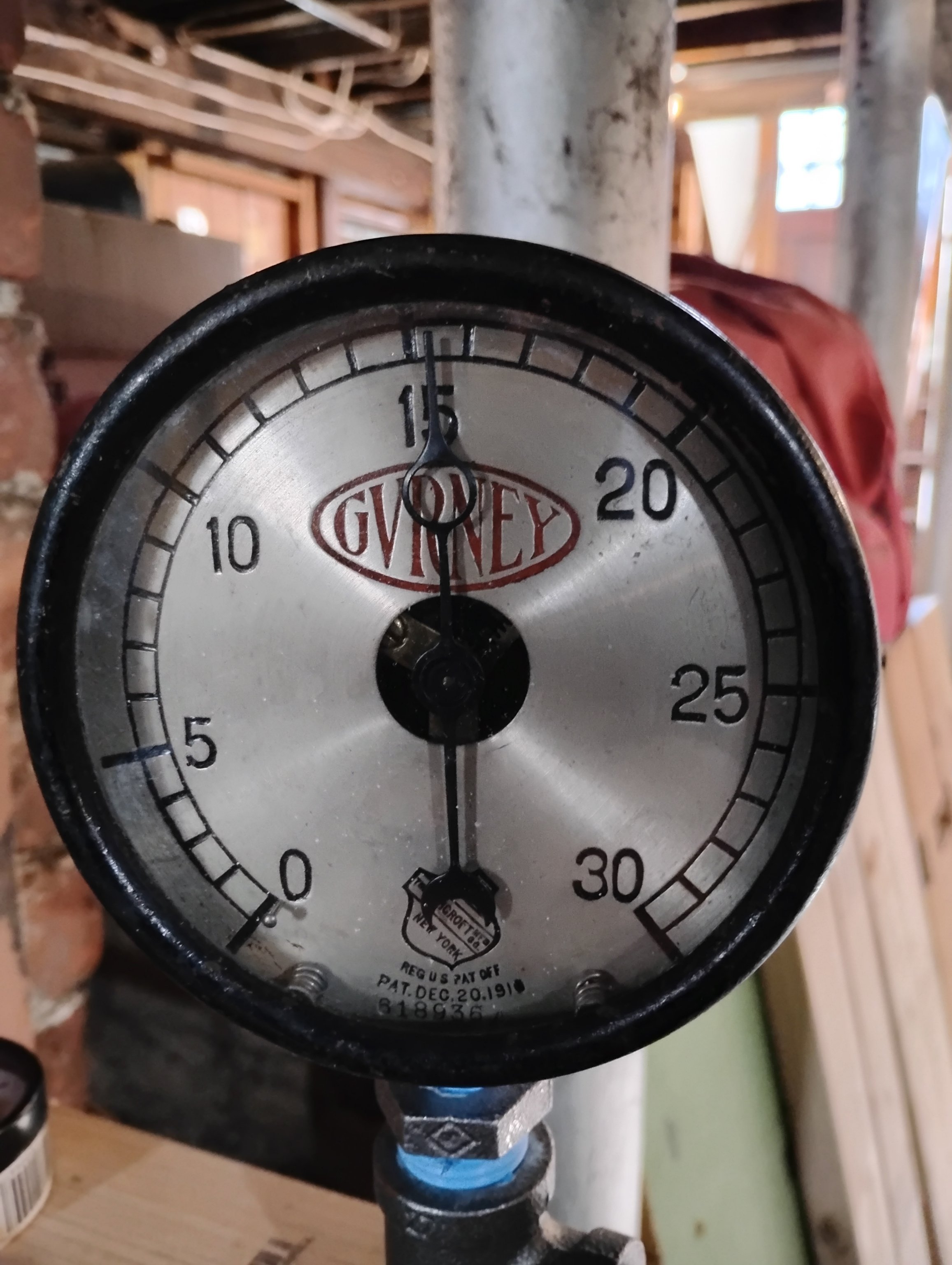
When I installed the 40V tank I put a new pressure gauge on the tank feed line where it's easily visible when pressurizing the tank. But the gauge was small and hard to read. So yesterday when I came across a bigger (4-inch) old Ashcroft/Gurney 0-30 psi pressure gauge that looked to be in good condition, I bought it on the chance it still worked. I took it home and checked it on my compressor, where it agreed with my compressor gauge, so I swapped it into our system where it seems to be working fine.
Apparently Gurney was a prominent but now defunct boiler and radiator manufacturer. Ashcroft still makes pressure gauges. I've seen some other old Ashcroft gauges that look like mine for sale on eBay with different boiler company names on the dial. I assume Ashcroft made the gauges for the boiler companies and put the various boiler company names on them. I'm curious to know the age of this gauge and wonder if any HHers would know. The patent date on the dial is 1910.
Comments
-
I don't have a clue, but I would guess 1920s. Ashcroft gauges are among the best. I never herd of Gurney though.
1 -
Thanks, Ed. Our condo building near Boston was built in the 1920's, so a 1920's gauge on the heating system is a nice period-correct retrofit. There are some Gurney Heater Mfg. Co. catalogs for sale on eBay, one from 1913 and one from 1924. Both list the company address as Boston, with branches in NY and London.
The 1913 catalog has the same distinctive Gurney logo on the cover, with the Gurney lettering inside an oval and the "u" in Gurney having the same "v" shape. By 1924, their catalog shows a different style for the Gurney logo. So it looks like this gauge is pre-1924.
0 -
That looks like it just came out of its original box! Really nice. Never heard of Gurney either, but all the old ones were well made. Mad Dog
1 -
@Dan Foley posted this some years ago about an old coal fired Gurney boiler he replaced in VA:
0 -
the scale is just held on with a couple screws. the manufacturer or the oem can put a custom scale on it. it was very common in the days of analog meters for manufacturers to put custom scales and graphics on meters made by someone like simpson. i would say that could be anywhere from the teens to the 50's. if you find out when gurney existed that could narrow it down.
1 -
The patent info on the gauge reads December 20, 1910 (although the last number isn’t certain). That would be consistent with the Gurney boiler line.
Retired and loving it.1 -
Thank you, Dan. You may have seen a few of those boilers. I just bought a 1913 Gurney catalog from eBay and will be interested to read up on the "state of the art" circa 1913.
0 -
Looked up the Patent # but couldn't find the gauge. Comes up as a hasp for a lock.
0 -
Yes, by 1910, the patent #'s being issued were in the 900,000 series, not the 600,000 series, which goes back to the late 1890's. I'm thinking the number may be a serial number. I just found a photo of another similar-era Ashcroft gauge with a 6-digit #260486 in the same location, just below the patent date, which can't be a patent number.
0 -
The patent referenced by date on the dial is probably patent #978,833, which was issued on December 20, 1910, and describes an improved method of securing the glass dial cover inside the housing of gauges. Apparently breakage of the glass on gauges due to vibration/shock was a common problem, and this inventor devised a spring mount for the glass to allow the glass to move without breaking under shock/vibration. When I bought the gauge, I noticed it had three small springs around the perimeter of the dial, behind the glass. Apparently those springs are part of the shock mount covered by this patent. If you zoom in on the photo you can see two of the springs at bottom, one on either side of the patent lettering. The other spring is hidden by the bezel at the top of the dial.
0 -
Nice thread. Interesting stuff.
Edward Young Retired
After you make that expensive repair and you still have the same problem, What will you check next?
1 -
When stuff was built to last.
1 -
That gauge on that system may not meet Code.
I'm pretty sure that gauge was for a steam system. Since Code requires (and has for many decades) a gauge capable of reading twice the boiler's maximum allowable working pressure, and since your WGOs are probably rated for a MAWP of 30 PSI on hot-water, you would need a gauge reading at least 60 PSI. It looks good, but an inspector might cite you for it.
All Steamed Up, Inc.
Towson, MD, USA
Steam, Vapor & Hot-Water Heating Specialists
Oil & Gas Burner Service
Consulting1 -
OK, thanks for the heads-up on code. MAWP on these boilers is 50 psi for water, so in theory we'd need a 100 psi gauge for 2x. The stock gauges on the boilers only go to 75 psi max, but are so small and wonky as to be virtually useless. I'd be more concerned about safety if the system was able to generate pressures over 30 psi, but even if the PRV stuck closed, the cold start boilers never get hot enough to exceed 20 psi with the larger 40V tank. But I'll keep the smaller 60 psi gauge on hand just in case.
0 -
it would get up to the relief valve pressure if the gas valve stuck open. more if the relief valve got stuck
0 -
They're oil boilers with aquastats set to 170-180 F upper limits, which they never hit because there's so much water volume in the system, even after long recoveries from overnight 3-degree setback. So it would take a combination of three factors/failures to exceed 30 psi: (1) different Tstat setting with more setback, (2) aquastat upper limit failures, and (3) PRV sticking. Possible, but not something that's going to keep me awake at night.
0 -
or the relay welding shut in the primary control, unless the aquastat is 120v and in series with the burner
the point is that the relief valve and the prv are safety devices in part to protect against a runaway burner
0 -
I wouldn't loose any sleep over it either. The old gauge would probably take 200psi to blow it up. The "new" gauges don't work if you look at them funny.

 2
2






Categories
- All Categories
- 87.6K THE MAIN WALL
- 3.3K A-C, Heat Pumps & Refrigeration
- 59 Biomass
- 429 Carbon Monoxide Awareness
- 124 Chimneys & Flues
- 2.2K Domestic Hot Water
- 5.9K Gas Heating
- 119 Geothermal
- 168 Indoor-Air Quality
- 3.8K Oil Heating
- 78 Pipe Deterioration
- 1K Plumbing
- 6.6K Radiant Heating
- 394 Solar
- 16K Strictly Steam
- 3.5K Thermostats and Controls
- 56 Water Quality
- 51 Industry Classes
- 50 Job Opportunities
- 18 Recall Announcements