Replace: TPR valve or hot water heater?

My wife and I spend most our time in a large condo we bought a couple years ago. It is a brick building built 1820’s. Plumbing seems to have been done first half 20th century, plus refits and configurations over time. All units shares cold water but have separate gas hot water boilers and stand alone gas domestic hot water tanks. Our unit is unusual in that it is two units that were combined about 50 years ago, so we actually have two separate heating boilers and two separate hot water tanks. DHW tanks are about 20 years old. Condo rules is that each unit responsible for maintaining their own systems.
At the time these were installed code did not require any expansion tank, but new code requires it for replacement systems. One of the units replaced their hot water tank a year ago, so this one added a smallish expansion tank.
One of our units domestic hot water tanks is producing hot water fine, but occasionally it blows a couple gallons through its temp pressure relief valve then returns to normal mode with no dripping. Occasionally means no leaking for a week or two, then next trip to the basement shows a couple gallons purged into collection pan.
Is it reasonable that this could be a fault in TPR valve, so screw on replacement would be sufficient until we finally need to replace whole water tank? I will attach a couple pics but can take more.
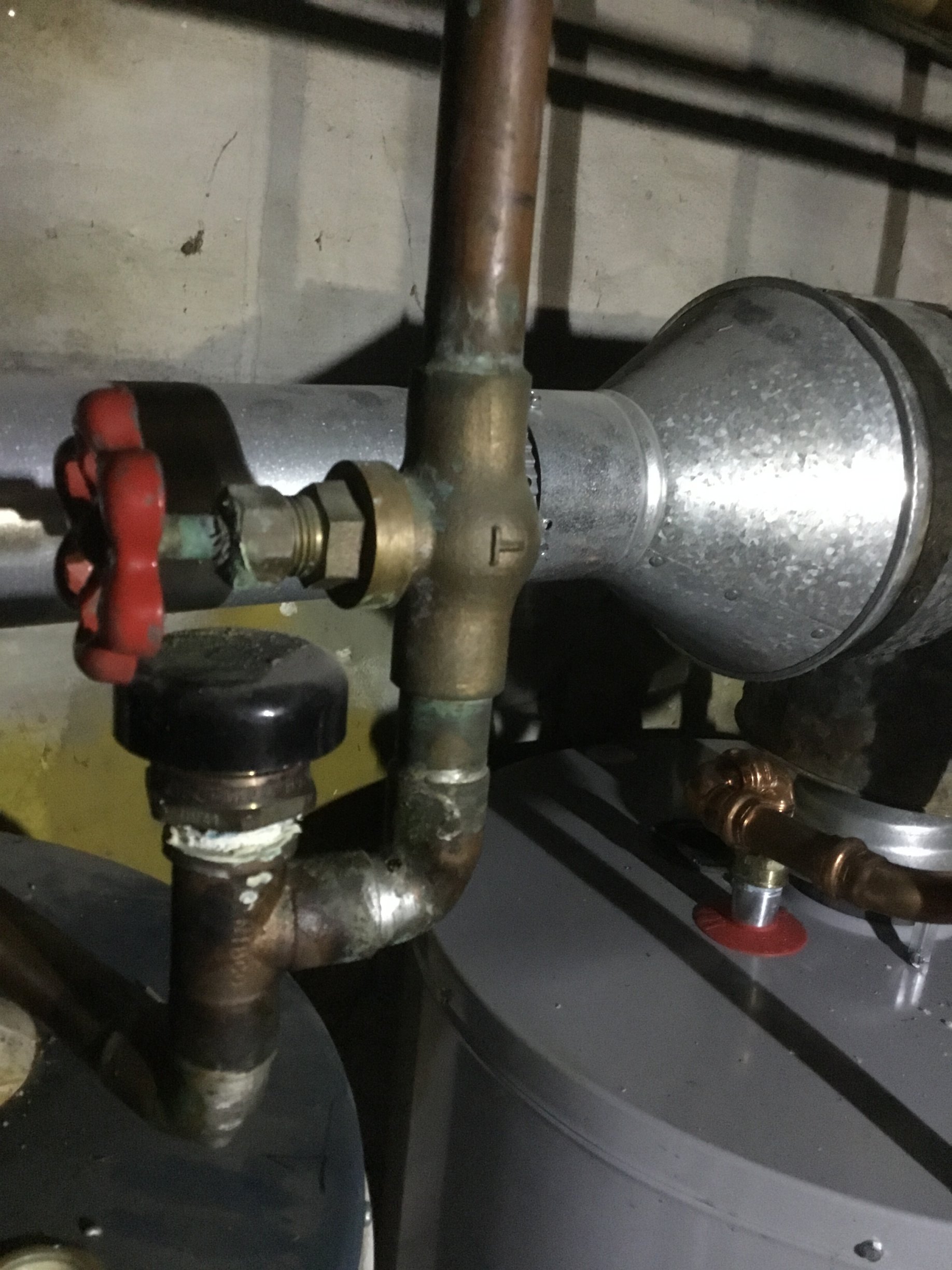
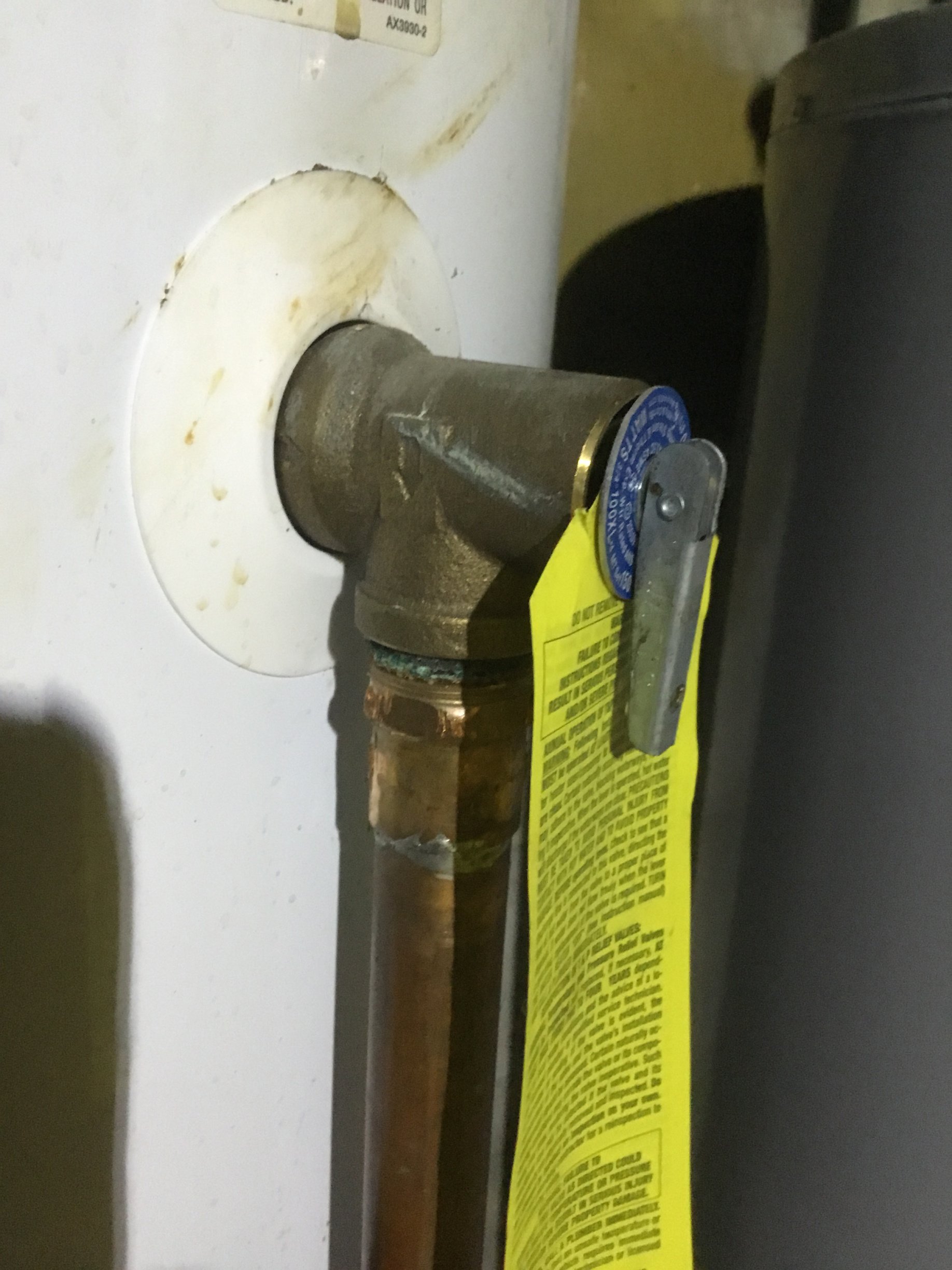
Comments
-
Put a pressure gauge on the tank for a few days/ week to see where the pressure goes. This type screws onto the drain valve.

A T&P valve doesn't usually seep or discharge unless temperature or pressure has exceeded the limits.
If there is a back flow device on the main line to the building, no BFD in individual units, in the units, then the expansion tank needs to be sized to accomodate all the expansion. Add up the total water heat tank volume.
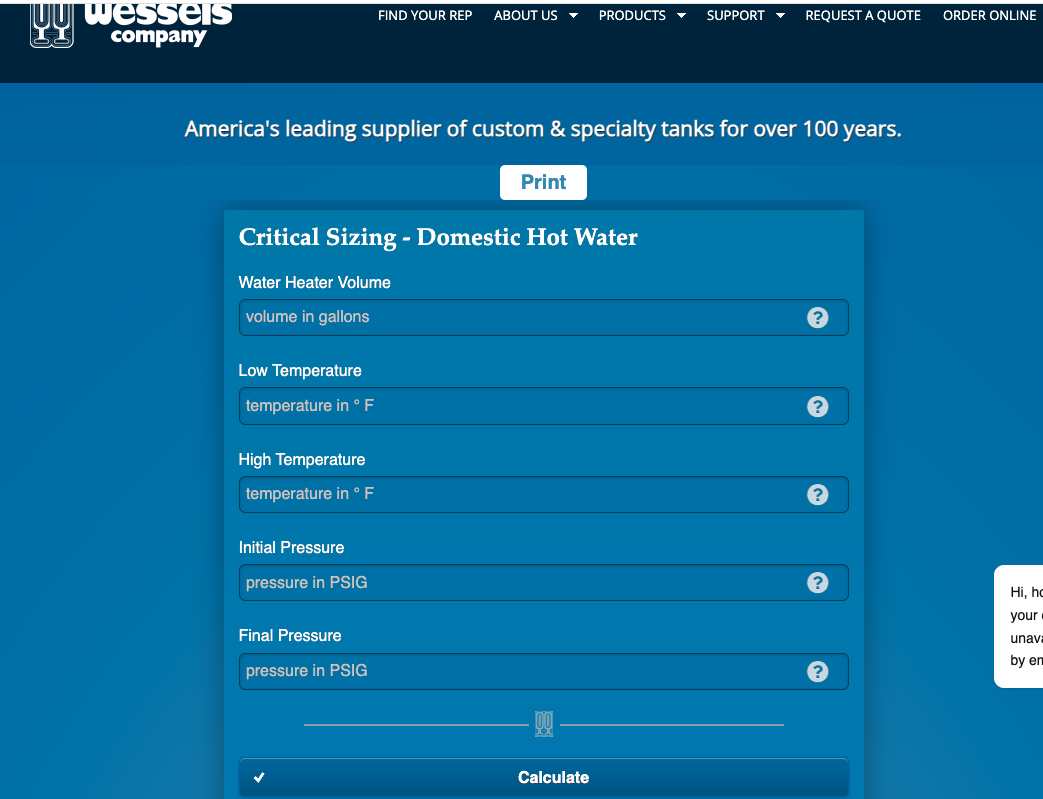
Here is a tank sizer
https://www.westank.com/calculator/
 Bob "hot rod" Rohr
trainer for Caleffi NA
Living the hydronic dream 1
1 -
Thank you. More info. First, there are five of these tanks lined up, each with their own TPR valve, and this one is the only one that triggers occasionally (though all tanks valve discharge pipes do show corrosion on discharge end). Also, the tank next to this one that was replaced so has an expansion tank. I highly doubt this was sized for all five water heaters, but it does look like it will be shared with its neighbors (pic below). I don’t believe there is a whole building back flow.
That said, I agree there should be better cooperation between units for shared plumbing, but that isn’t something I can mandate as an individual owner. Attitude of most owners, who rent out their units, is that it worked well enough when I bought it, so I will fix my personal piping but don’t want to pay for an unnecessary upgrade to system as a whole.
I will order the lazy pressure gauge, but given the fact that this one heater is the only one blowing and that there is a (probably undersized) expansion tank, is replacing the TPR valve (quick and cheap) likely to solve this or is it a waste of money?
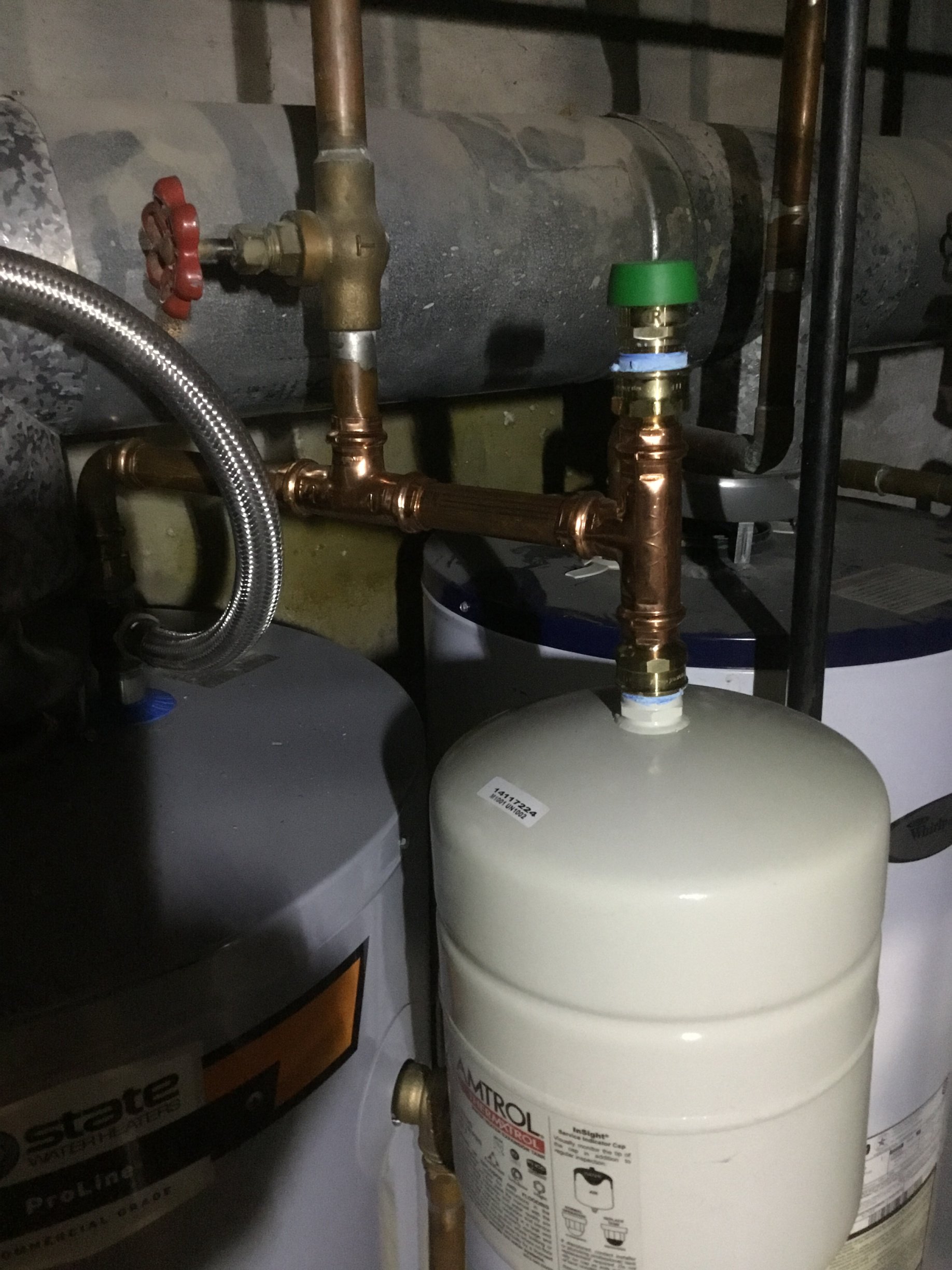 0
0 -
Replacing the relief valve may be only treating a symptom. It the pressure is in fact going over 150 psi, you really want to address that. That is far too high for all your plumbing valves, toilets, etc.
The gauge will take the guess work out of the solution. It is a simple inexpensive first step.
You could call the water provider and ask if they have installed a BFD on the supply, or can you see one in the building where the main water?
If so the "community" should address this with proper protection.
You might hire a licensed plumber and get his opinion in writing for the owners to agree on.
Your gauge readings, take pictures, should answer all the questions.
Bob "hot rod" Rohr
trainer for Caleffi NA
Living the hydronic dream0 -
Hi, @hot_rod said it all better than I could. I'll add that the relief valve is not an operational control and is likely to fail if exercised too much. Measuring pressure is the only way of really knowing what's going on.
Yours, Larry
 1
1 -
I knew that lesson, so have never tested the valve, although mfgs instruct you to.
I suspect it is highly unlikely that pressure is that high, but I agree it should be tested so have ordered the gauge. And I’ll search for backflow valves on water main line. I have had a hot water heater TPR valve fail by slowly driping constantly, but one that waits then blows a couple gallons is new to me.
As to shared responsibility, so far I haven’t even gotten agreement that pipes that leak (supply and drain) hidden in common walls that damage other units should have joint responsibility.
0 -
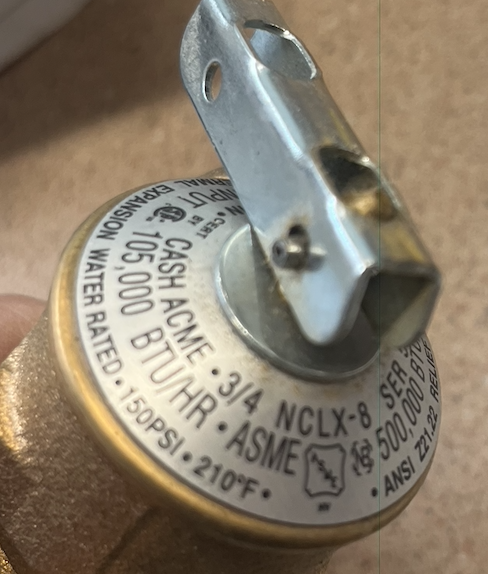
Two conditions that cause the valve to discharge, temperature over 210°F, or pressure over 150psi.
They start to seep at the 150 psi, full discharge as pressure keeps rising.
Sometimes if the discharge on temperature, over 212°F they may not reset.
There is also a BTU/ hr rating, this is how much the valve can discharge, Of course that number needs to be higher that the water heaters input, more of a concern with commercial sized WHs.
 Bob "hot rod" Rohr
trainer for Caleffi NA
Living the hydronic dream0 -
Yes, those are the only two reasons the valve will open IF it is functioning correctly. But we know that is not always the case. Clearly these valves can also leak water if they fail (which is why I have heard you should not test them - it increases the chance of them leaking).
I will not be able to give you the pressure reading until the gauge arrives on Thursday. But I tested the water temp by hand, and it is not hotter than normal, certainly no where near 210deg. Nor is the water pressure noticeably high. So yes, I understand, we want to make sure whether or not it is keeping me safe by doing its job correctly. But until I can properly test it, I would like to know whether you have seen this failure mode as I asked initially?
When I got home tonight it was leaking again, and this time kept leaking producing more than 10 gallons, so I turned it down, put it on pilot and shut off the cold water input to stop the leaking.
Is there any reason to not replace the TPR valve while it is shut off, waiting for the pressure gauge and thermometer to arrive?
BTW, my statement “blows a couple gallons” is unfortunate and highly misleading. When it is leaking it is a slow trickle of water, not a forceful push but more than a slow drip, drip, drip.
0 -
Hi, Residential relief valves don't cost all that much, so I'd replace it. I have tested many thousands of these and about 1/4 of the valves fail the test in some way. Of those one in ten was plugged, so the valve could not work. It's risky to not check them!
Yours, Larry
 1
1 -
You could look and see if in the main water (cold supply) to the building if they have a pressure reducing valve. I most cases if you do not have a PRV and excess pressure in the water tanks will simply "back up" into the city water main to reduce the pressure. With a pressure reducing valve (they have a built in check valve) the water can't back up into the cold water supply to reduce pressure.
T & P valves as you probably know can open on high pressure over 150 psi or on overheated water 212 deg.
Opening on overheated water would be…..slightly violent if the water was 212 degrees. Over pressure at 150 would also probably be noticeable.
Have you observed the water being really overheated? If so the burner may have a defective thermostat?
Your pressure gauge will tell the pressure story.. Its possible it could be the T & P
At 20 years…..thats a long life for a gas HW tank.
With your water usage you could probably get by on one tank. If so you could disconnect the misbehaving tank depending on what you find and tie the two HW pipes together. Cap the unused CW pipe.
0 -
my experience is T&P failures are most often failure to release. Plugged, disc stuck closed.
Rare to see one discharge at a lower pressure than indicated.Not much intelligence inside, a spring, washer and thermal element.
More often than not when you test them they fail to reseat.
It is one of the least expensive but most critical safety valve on a plumbing system. Most pros just replace them on an inspection.
The plumbing code states a thermal expansion device is required, it doesn’t have to be an expansion tank, other options are available. Either absorb it in a tank,or discharge it somewhere safe, but that could be a huge water waste!
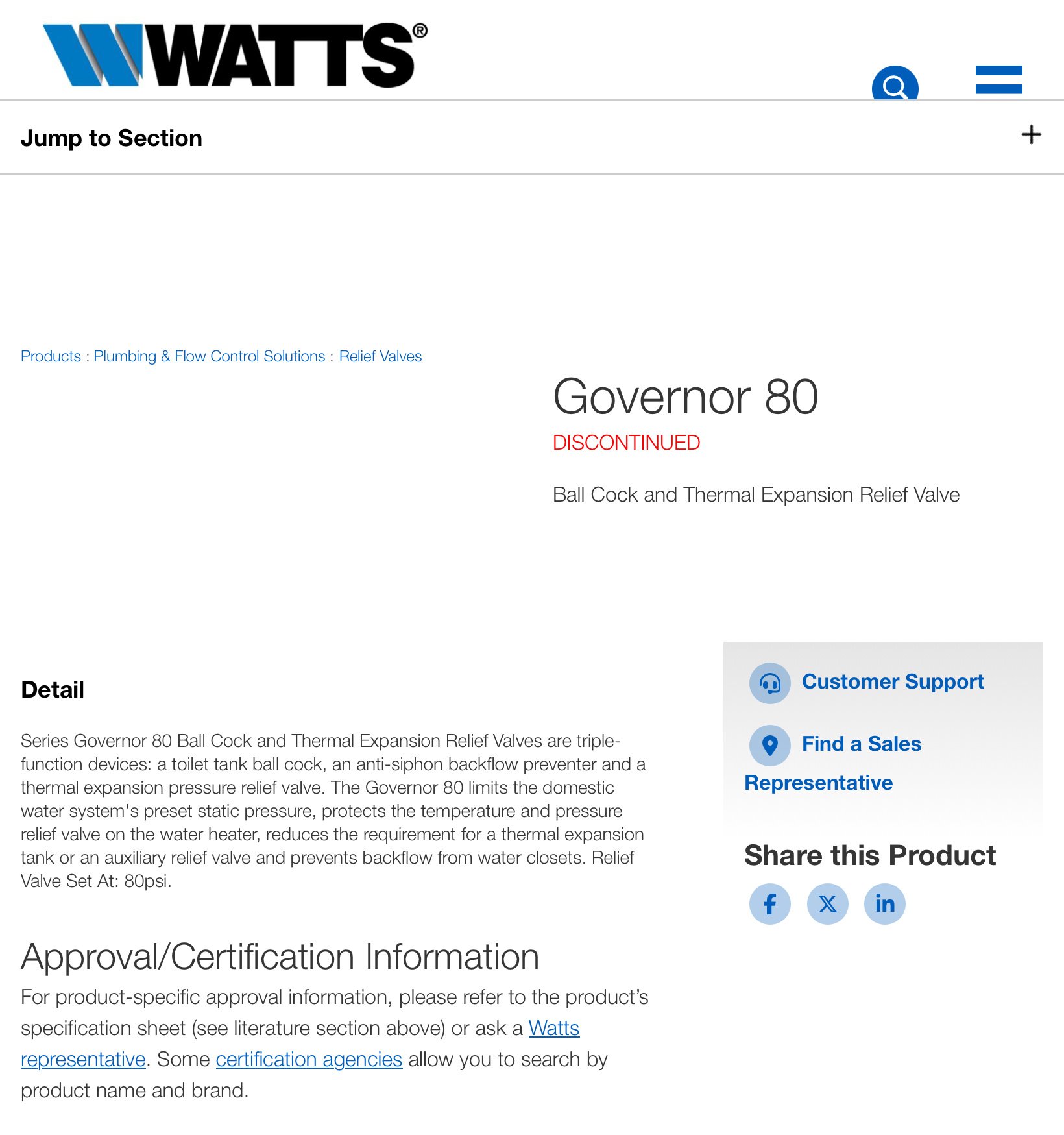
Watts used to make a “governor 80” ballcock for toilets that had a pressure relief function. It dumped flow down the overflow tube as a thermal expansion device. You can still find them for sale, e bay occasionally, but production has been discontinued.”
it really depends on the type/ brand of pressure reducing valve the building might have. Some brands are “bypass” type which allows pressure to push into the main, others do not allow flow or pressure to push back
Bob "hot rod" Rohr
trainer for Caleffi NA
Living the hydronic dream0 -
I followed the main coming in and didn’t see any pressure reducing valve, once it goes through the meter I don’t see anything other than direct routes to various units and appliances. I do wonder why new building code calls for expansion tanks if back up into city water is allowed.
Anyway, I bought a replacement TPR valve at HomeDepot because Lowe’s doesn’t seem to keep them in stock. I don’t know how retailers can keep Amazon at bay if they don’t stock a common part like this.
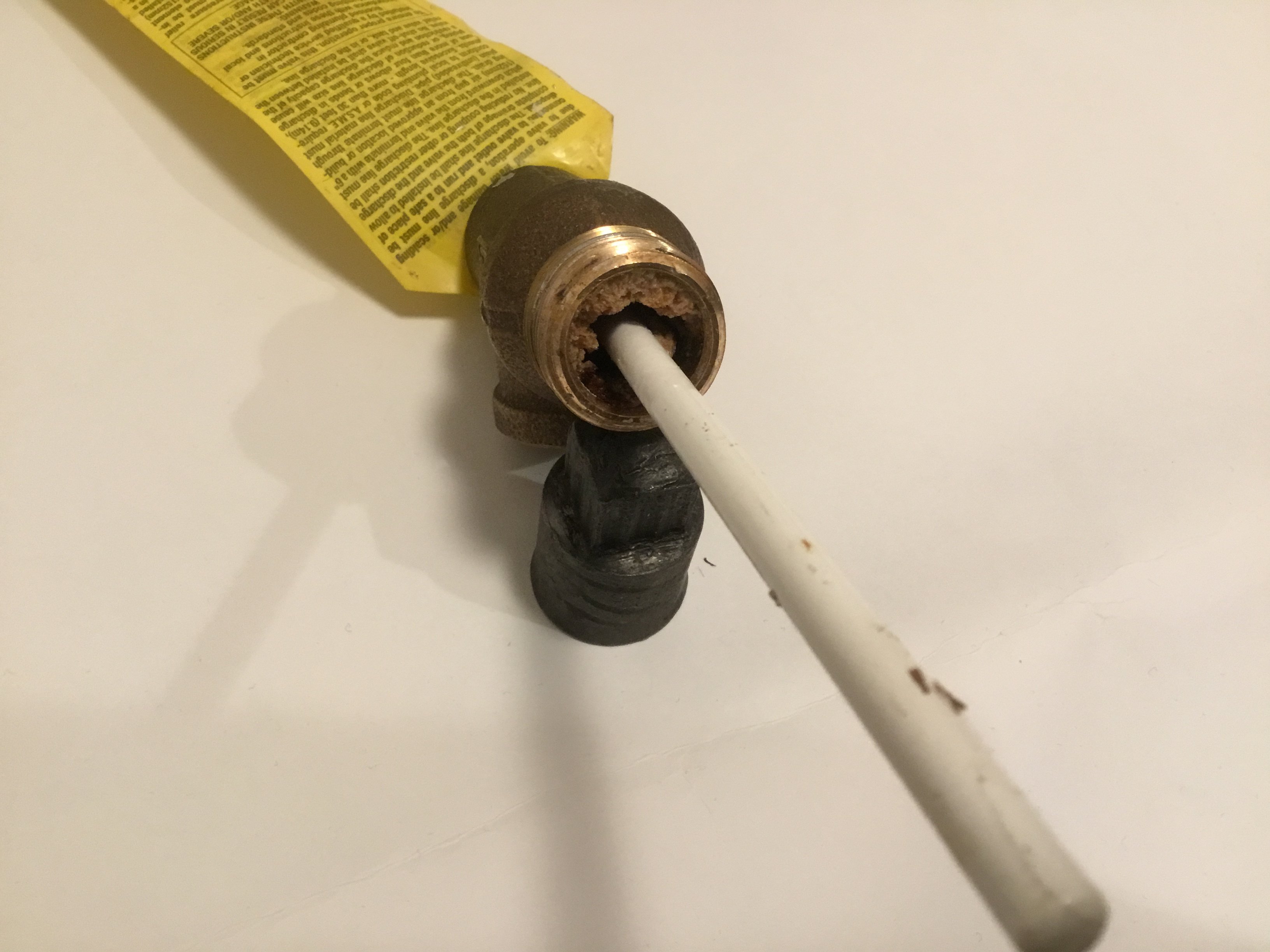
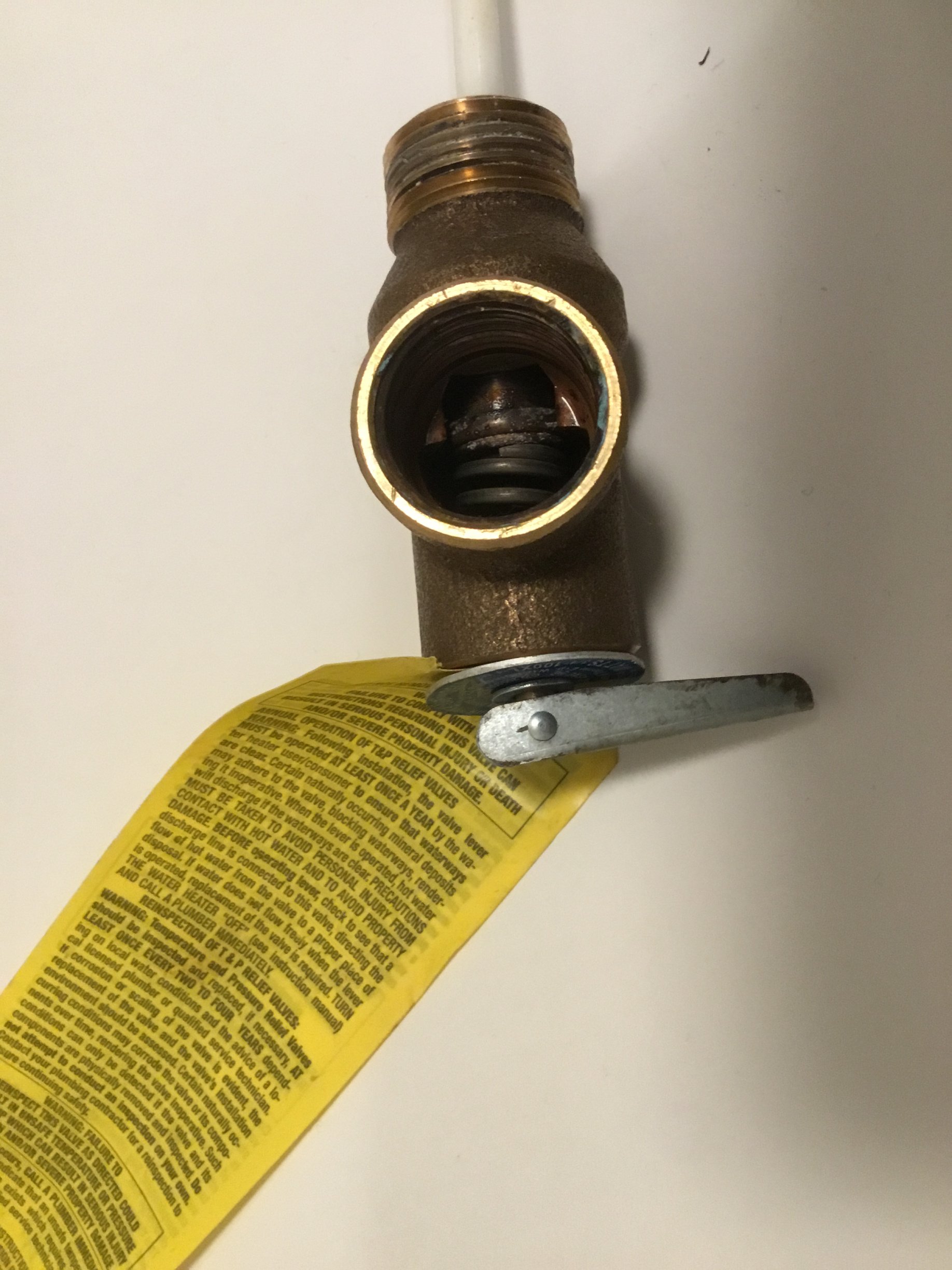
Here is the one I removed, dated 2008, so 17 years not 20. Crud visible, but no obvious reason for it to be leaking on its own. Still strange. At least the new one is not actively leaking, but need to watch the new one for eventual leaks, and hook up the pressure gauge when it arrives.
 0
0 -
Hi, Just because I seem to like bees in bonnets, I'd like to mention the sacrificial anode rod. Your tank has one and it certainly is time to replace it… or maybe past time. The anode is what essentially prevents rusting in the tank. I can assume the anode on your tank is mostly gone and there is some damage to the tank. But if there is no evidence of leakage at fittings or in the combustion chamber, it's worth replacing the rod instead of simply waiting for the tank to leak. I've gotten over 50 years from tanks by doing this. 😊
Yours, Larry
1 -
Do you know for sure that the pressure in the expansion tank was checked? It might not be set for the correct pressure needed for your system. Also, I have had new bladder tanks where the bladder was stuck to the side of the tank, and therefore not working. One way you can possibly check that is to close the feed valve to the water heater and open a hot faucet. If you have good pressure for a few seconds, and then it just dies, then the tank is probably fine.
Rick
1 -
Update, I finally got a pressure gauge, and baseline pressure is about 60psi, overnight max 65. After two weeks max reads at 80psi. This is street pressure, unregulated, measured at the hot water heater drain. I will leave gauge on and check occasionally if max goes higher.
So assuming 80 is the max, what is everyone’s reaction? No need for regulating street pressure?
BTW, replacing TP valve seems to have fixed the occasional flushing through the old valve I was seeing, no water through the new valve so far.
0 -
That's really a judgement call. My own feeling is that if the 80 psig was a one off spike, and the pressure normally sits at 60 to 65, I'd ignore it.
Br. Jamie, osb
Building superintendent/caretaker, 7200 sq. ft. historic house museum with dependencies in New England3 -
80 psig is a little high but if it was just a surge from some change in system conditions, probably not a big deal.
0 -
Hi, It could be simply that closing a hot tap quickly could cause that spike. Might be interesting to watch the gauge when the dishwasher or clothes washer is in use. 😺
Yours, Larry
0 -
Im wondering if there had been some unforeseen work done that started this relief valve to discharge. Of course it could be and probably is just old and needed to be replaced.
When a domestic cold water system becomes closed, meaning there has been a type of check valve device, BFP etc. installed, but an expansion tank is not added. The relief valves will discharge as you mentioned above. An open system has no check on the main, and will not cause this type of discharge.
I think you may have corrected your problem with the relief valve replacement.
0



Categories
- All Categories
- 87.6K THE MAIN WALL
- 3.3K A-C, Heat Pumps & Refrigeration
- 59 Biomass
- 429 Carbon Monoxide Awareness
- 124 Chimneys & Flues
- 2.2K Domestic Hot Water
- 5.9K Gas Heating
- 119 Geothermal
- 168 Indoor-Air Quality
- 3.8K Oil Heating
- 78 Pipe Deterioration
- 1K Plumbing
- 6.6K Radiant Heating
- 394 Solar
- 16K Strictly Steam
- 3.5K Thermostats and Controls
- 56 Water Quality
- 51 Industry Classes
- 50 Job Opportunities
- 18 Recall Announcements