Pumps at risk of flood damage.

Hello. This is a steam system but my question is about pumps so I'm putting it on the wall.
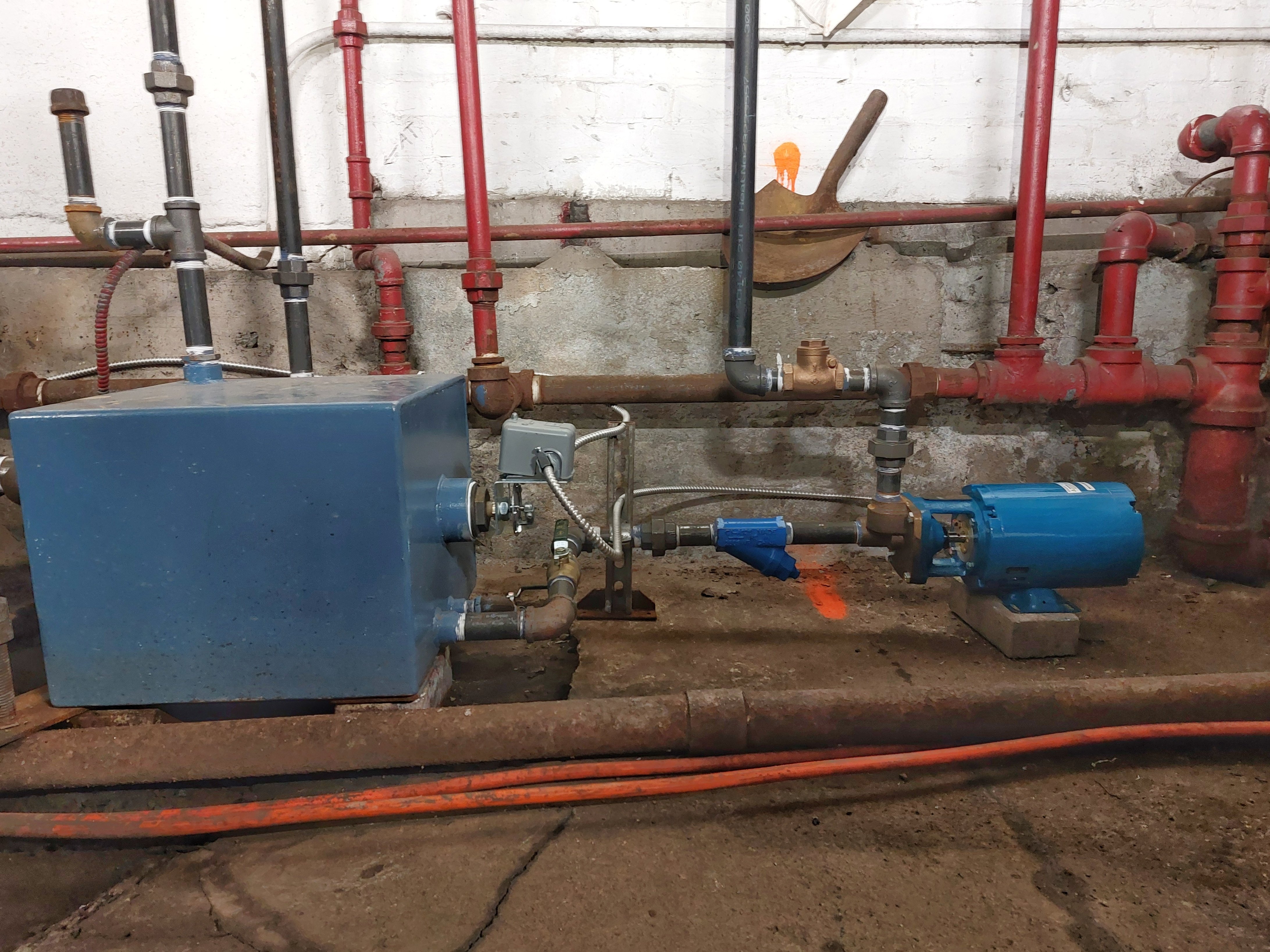
This is an 1890s building on the ocean. The boiler room has no history of flooding but storm surge in November resulted in sea water claiming this pump. There are various solutions being discussed but our boiler contractor says the pump itself can't be raised and I'm wondering if someone can explain why.
Thanks
Comments
-
The pump can't be raised because it needs a gravity flow between the tank outlet and the pump's inlet. I.E. water doesn't flow uphill.
We'd have to take a look at all that return line piping and the outlet height of the lowest steam trap on this system. If the outlet of the lowest trap is considerably above the return line, then the return lines could be raised, which would allow the condensate tank to be raised, and then the condensate pump too.
Dennis Pataki. Former Service Manager and Heating Pump Product Manager for Nash Engineering Company. Phone: 1-888 853 9963
Website: www.nashjenningspumps.com
The first step in solving any problem is TO IDENTIFY THE PROBLEM. 2
2 -
Unfortunately there are return lines that drop into that red horizontal pipe and rely on the tank vent. There's also the discharge from a remote condensate tank that returns by gravity to the tank pictured before being lifted to the feed tank. We were considering a flange mounted vertical pump on top of the tank but a replacement for the one pictured had already been purchased and installed.
I don't know much about pumps but I thought perhaps a check valve in the tank outlet would allow the pump to be raised without losing prime.
0 -
A chcke valve on the inlet, at the tank level, would be considerably more reliable than one on the outlet. That said, neither one will be completely reliable against losing prime. I wouldn't risk it…
Br. Jamie, osb
Building superintendent/caretaker, 7200 sq. ft. historic house museum with dependencies in New England0 -
Yes, I think we meant the same thing. Check valve at the level of the outlet from the tank so water can't drain back into the tank. I take your point though. I'm not inclined to trust check valves generally. Not much point in saving the motor and burning up the pump.
0 -
Your idea about a top mounted vertical submerged impeller type condensate pump is a good one. Sorry I didn't think about that. Of course it would take some doing to modify the tank top to accommodate the pump's mounting flange. You would also have to determine the pump's impeller shaft column to have the correct length for this tank.
Dennis Pataki. Former Service Manager and Heating Pump Product Manager for Nash Engineering Company. Phone: 1-888 853 9963
Website: www.nashjenningspumps.com
The first step in solving any problem is TO IDENTIFY THE PROBLEM.1


Categories
- All Categories
- 87.6K THE MAIN WALL
- 3.3K A-C, Heat Pumps & Refrigeration
- 59 Biomass
- 429 Carbon Monoxide Awareness
- 124 Chimneys & Flues
- 2.2K Domestic Hot Water
- 5.9K Gas Heating
- 119 Geothermal
- 168 Indoor-Air Quality
- 3.8K Oil Heating
- 78 Pipe Deterioration
- 1K Plumbing
- 6.6K Radiant Heating
- 394 Solar
- 15.9K Strictly Steam
- 3.5K Thermostats and Controls
- 56 Water Quality
- 50 Industry Classes
- 50 Job Opportunities
- 18 Recall Announcements