I'm trying to learn

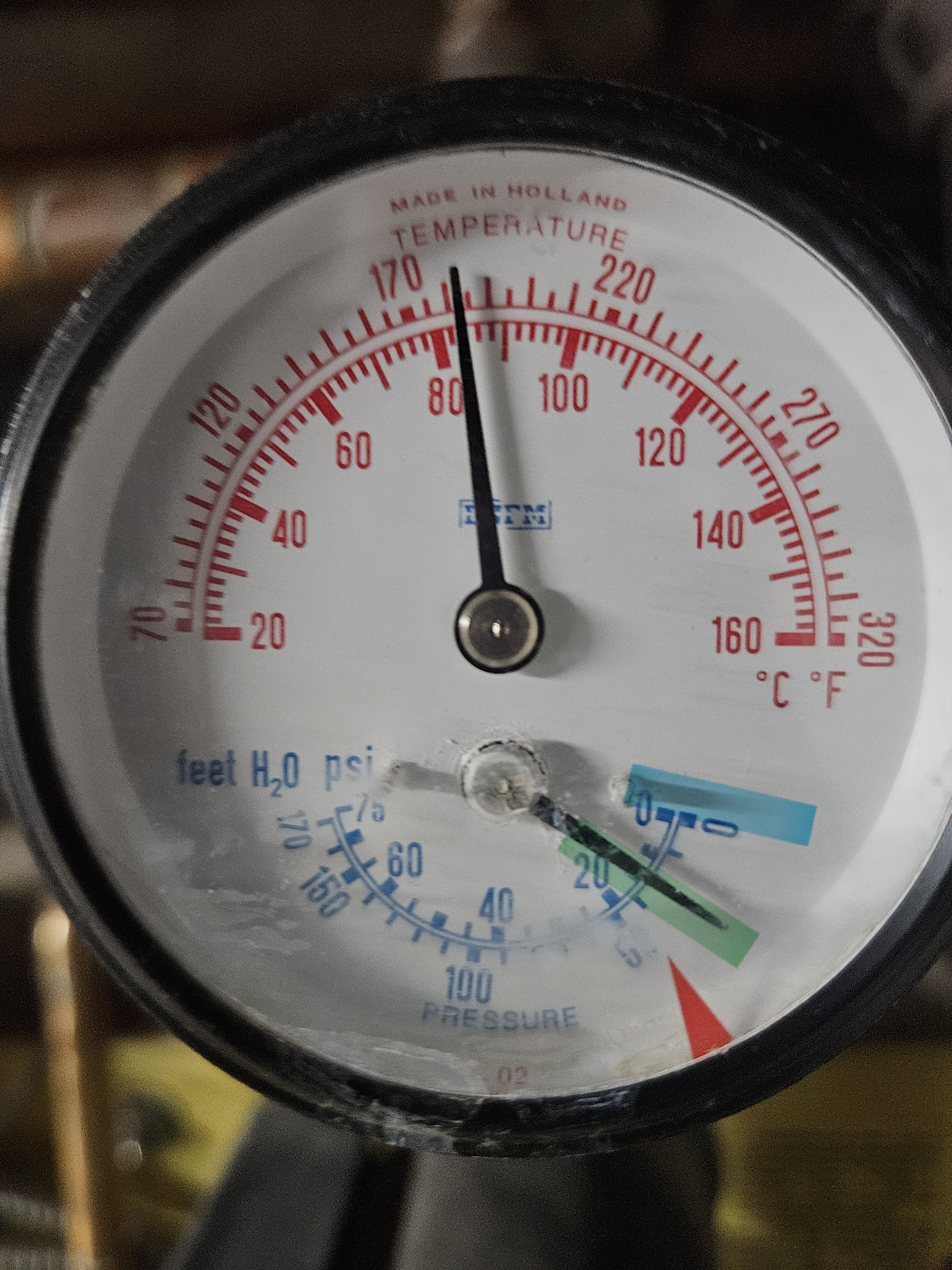
I'm trying to educate myself about my boiler, how it's setup & how it works. I've been using AI to explain some points I don't understand but one argument we keep ending up in is about how to read the psi. I don't know if it's not interpreting my image correctly, but i've tried it on several different models & I keep getting the same thing. It's saying this system has no pressure, reading zero. I highlighted them blue and green because blue I believe, is the shadow of the actual gauge, and the green is the actual gauge.Can someone please just make me feel not crazy or confirm I just don't know how to read the gauge. Lol
Comments
-
From here is looks like 15# .. Look a little crusty , Drop the pressure and see where the needle falls …
There was an error rendering this rich post.
1 -
Having A I interpret what a photo of a gauge is reading is subject to interpretation.
Are you using A I Artificial Intelligence or A I Actual Intelligence
I prefer Actual Intelligence myself.
With the information from your gauge I can see that the static pressure in your system at the boiler location is a hair under 15 PSI. Static pressure is the pressure that equals the weight of one square inch column of water will exert on a one square inch section of that gauge location.
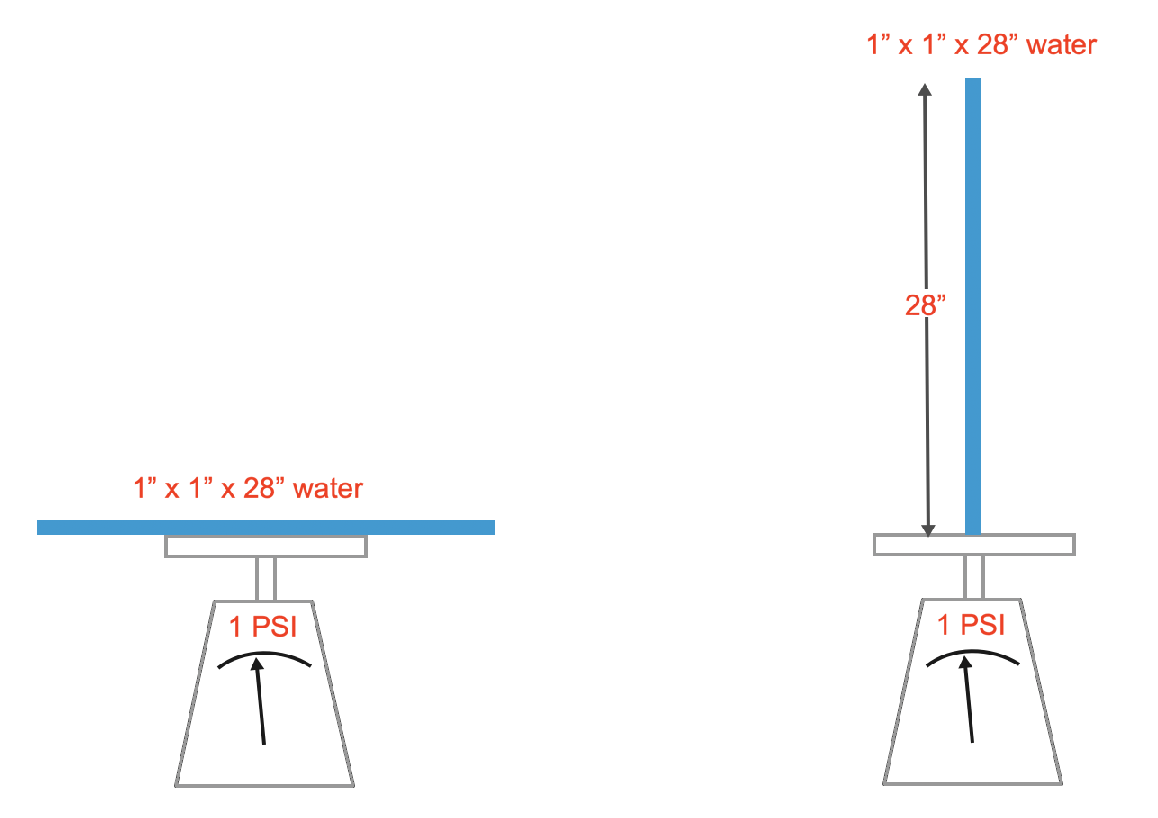
Here is an illustration that helps understand Pounds per Square Inch (PSI). If you take one pound of water and place it in a container that is 1" x 1" it would fill that container up to the 28" mark. That is one pound of water whether it is horizontal or vertical or in any other position. That is always going to be one pound of water regardless of the dimensions.
Edward Young Retired
After you make that expensive repair and you still have the same problem, What will you check next?

 3
3 -
Looks like 15 ±20 lbs, guessing about the parallax error. With the crusties, I wouldn't expect any accuracy (hence the ±20), but if it's working it has sufficient pressure.
What do you want to know about it? If you noticed the "feet H₂O" scale, that's the highest vertical point that the water will be at in your pipes—you want that to exceed the highest point of your piping by a margin. If the pressure (height) is lower than the highest point of your piping, water won't be able to fill those parts of the piping and you won't be able to get water to flow through them. There is one more important detail: the fill pressure should be set with the system cold (or at least, not hot). That's because water expands a little when it is heated, and that also increases the pressure in the system and could conceal a low fill pressure.
1 -
The upper scale is temperature. It reads Fahrenheit on the top (about 182 deg and Celsius on the bottom about (84 deg).
Lower scale reads pounds /square inch gauge pressure above the line (about 15psi) and below the line it reads in Ft of head (about 35')
1 -
Your AI is mistaken, you have almost 14 feet in water gauge pressure in PSIG and 183+- degrees water temperature in Fahrenheit.
1 -
-
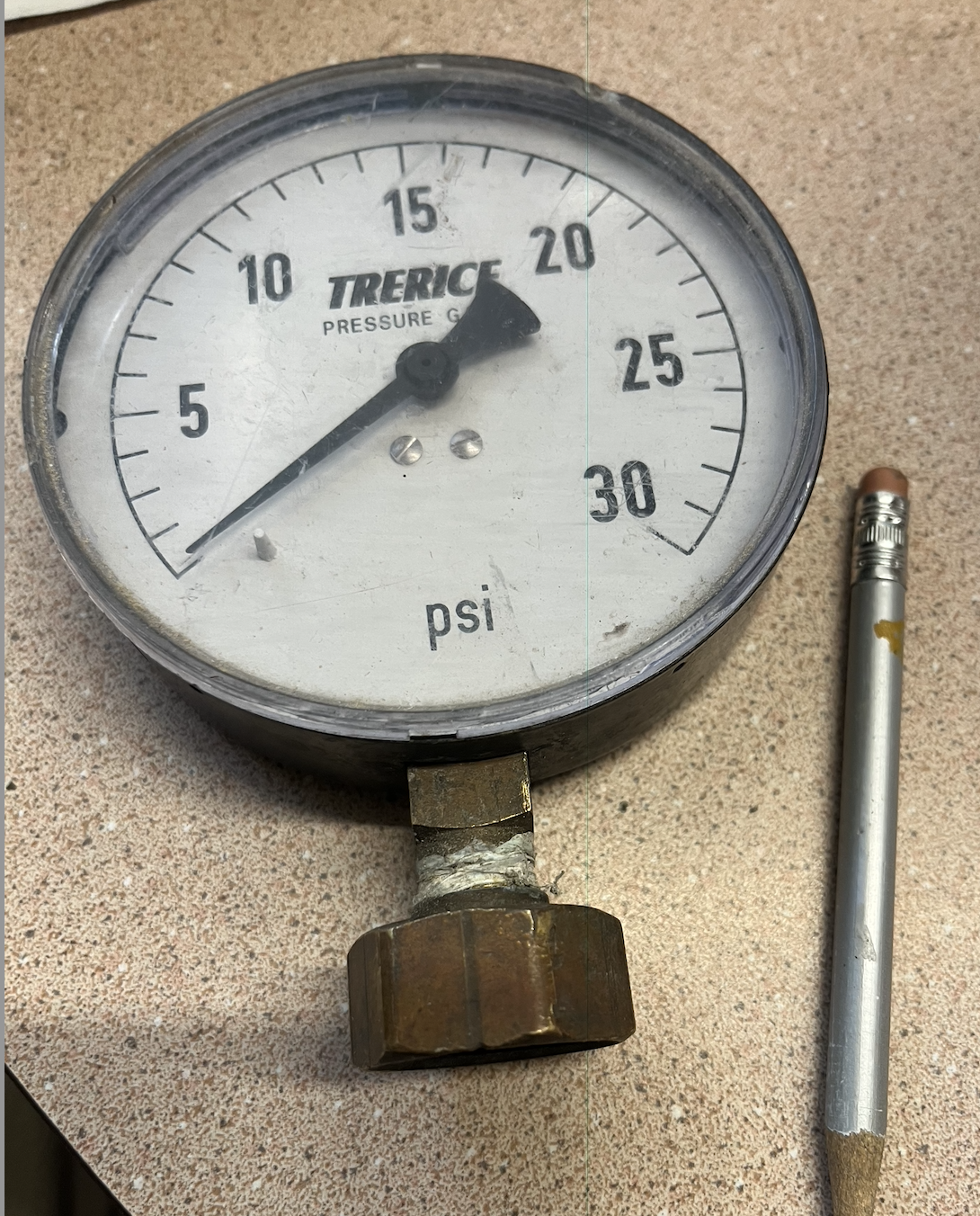
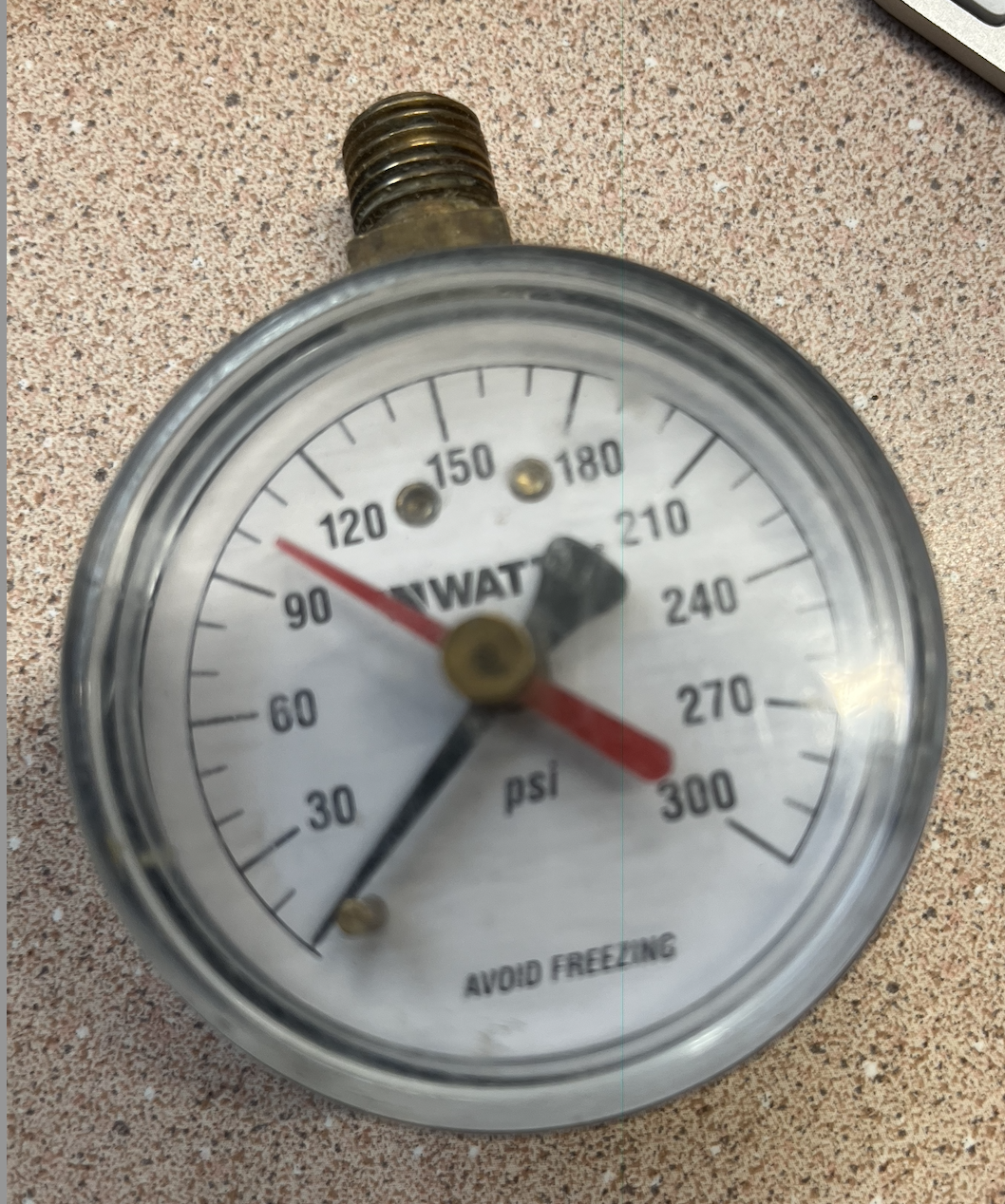
You can buy/ build a test gauge that connects to any hose connection, like a boiler drain.
Online you can order gauges with the "lazy" indicator hand also.
Those boiler tridicator gauges are not all that accurate or good quality.
Although this 30 lb example didn't take the fall so well :)
 Bob "hot rod" Rohr
trainer for Caleffi NA
Living the hydronic dream1 -
"AI" says one thing, your gauge says another. This is an example of how "AI" is not a good resource for all things. Go with the gauge reading. It seems to me all is well with your gauge.
0 -
i'm not sure what the markings between the numbers are on that gauge. they don't seem to be every 5 or 10 or something that makes sense like that. The upper marks may be a generic normal pressure range between about 7 psig and about 14 psig. That gauge isn't very precise in the pressure range of interest for a residential hot water boiler but the exact pressure isn't super important either, just that it is between 10 psig and 20 psig or so.
1 -
Looks about 12psi to me guessing at the parallax, but those gauges can also be inaccurate.
If you don't hear any gurgling and there's no delay getting hot water to your emitters, it's probably fine. If you want to be sure, replace it (shut down, cool, and drain).
1





Categories
- All Categories
- 87.6K THE MAIN WALL
- 3.3K A-C, Heat Pumps & Refrigeration
- 59 Biomass
- 429 Carbon Monoxide Awareness
- 124 Chimneys & Flues
- 2.2K Domestic Hot Water
- 5.9K Gas Heating
- 119 Geothermal
- 168 Indoor-Air Quality
- 3.8K Oil Heating
- 78 Pipe Deterioration
- 1K Plumbing
- 6.6K Radiant Heating
- 394 Solar
- 15.9K Strictly Steam
- 3.5K Thermostats and Controls
- 56 Water Quality
- 50 Industry Classes
- 50 Job Opportunities
- 18 Recall Announcements