Intermittent vs. Interrupted

What is the difference between Intermittent & Interrupted Ignition?
Comments
-
Good question.
Let's see if I can get this right because the terminology has changed over the years.
with gas: standing pilot, a pilot that burns 24 hours a day. That hasn't changed
with oil, constant ignition an ignition transformer powered all the time the burner runs This is now called Intermittent.
Intermittent for oil, the spark comes on with the burner and after the flame is established it shuts off. This has been changed to interrupted
With gas in addition to the standing pilot above
Also, gas has hot surface ignition and direct spark ignition which come on to light main fuel and then shut off those would be interrupted ignition.
Gas with a pilot flame can be done several ways.
spark and gas pilot come on, main flame lights and spark and pilot are shut off or—-interrupted
spark and pilot come on main flame lights and spark is shut off and pilot stays on——I guess that would be interrupted as well
0 -
For oil, Interrupted ignition: the ignition spark remains on for only a short time at the beginning of each burner operating cycle, and is turned off once flame is established. Intermittent ignition: the spark that ignites the oil vapors remains on as long as the burner runs.
Don’t know why it’s not just constant and interrupted.
0 -
From the little bit of experience I had it seemed like interrupted was quieter. It also probably wears the electrodes less and uses less electric, no?
Single pipe 392sqft system with an EG-40 rated for 325sqft and it's silent and balanced at all times.

 2
2 -
Short answer is in the last paragraph.
75 years ago the oil industry was the king of home heating taking over from Coal from 100 years ago and older. Since all the gas boilers and furnaces used standing pilots, that was just the way it was back 75 years ago, so it did not need a name like "constant ignition". All the heaters had pilots. The oil heat controls were set up so that the ignition transformer was always on with the burner motor. That meant whenever the burner motor was on the ignition was constant. So the RA116 stack mounted relay was used for constant ignition. And it said constant ignition right on the box.
Some oil burners operated better if the ignition transformer was not on the entire call for heat, so the RA117 Stack mounted relay was used to let the burner operate without ignition. That was called intermittent ignition and it said that right on the box. Once the burner flame was lit, the sensor in the stack dropped out the relay that operated terminal 4 and the ignition transformer no longer was powered, so no spark.
Now fast forward from the 1950s to the mid 1970s and you have an energy crisis. Gas furnaces were made with spark ignition and hot surface ignition and spark to pilot ignition. And all sorts of other configurations. Some oil heat folks were also doing gas heat work and vice versa. This became confusing so Honeywell and other oil burner control manufacturers decided to fix it.
Now you have a constant ignition that is a standing pilot that is on constantly 24/7. That was inefficient. So constant on oil controls were not the same as constant on gas controls. But that was the way it all used to be, and we now need to call constant ignition on the oil burners where a spark is involved something else.
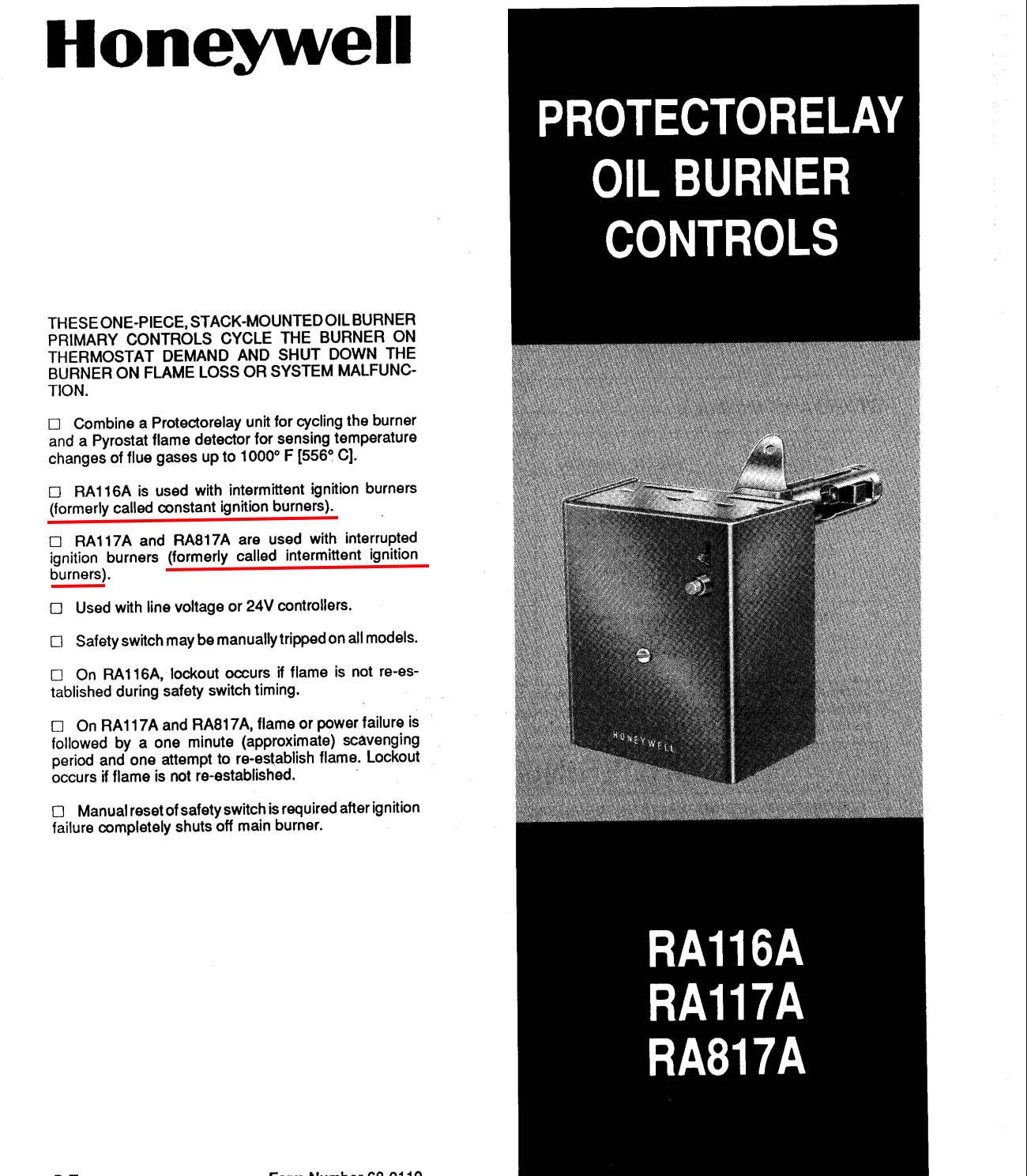
Spark the whole time the burner is operating is now intermittent ignition (Formerly constant ignition) and it said that right on the new boxes of the R116A relay and any other control (like the R8184G relay for oil heat) This was confusing for the old timers that only worked on oil heat but eventually they got over it, (or died off).
Then there were gas controls that sparked or heated up only until the flame was proven, then the ignition dropped out as the flame continued to burn. On oil burners that is now called interrupted ignition (formerly intermittent ignition) and it said that right on the box for the RA117A oil heat control and many other oil heat controls that performed the same way.
It has been long enough that the “Formally constant" and “Formally intermittent” are no longer printed on the box because all the old heads that remember the old names are retired by now.
- Constant ignition = 24/7 ignition (standing pilot)
- Intermittent ignition = ignition lit as long as the main burner is fired (spark to pilot or Spark for oil burner on the entire time the burner is flaming)
- Interrupted ignition = Spark or HSI to get it started, then ignitor or spark goes off when main flame is proven.
Hope this makes it as clear as mud!
Edward Young Retired
After you make that expensive repair and you still have the same problem, What will you check next?
 1
1 -
No, i haven't died off……yet. lol
As far as I am concerned it became more confusing than less. Oil was constant and interrupted as you said.
Gas had a standing pilot or was interrupted. They could have (and should have) left it that way.
And then you have the other issue with large commercial burner both gas and oil. They all light main flame with a gas pilot and then they shut the spark off. But some burners shut off the pilot gas with the spark and others leave the pilot gas on and shut the spark off.
What are those called?
Some of the old oil burner would not stay lit unless ignition stayed on (constant). Other burners ran better when the ignition was off.
The thing with stack switches was I always preferred the 117 because you could use it for both constant or intermittent. Also, with a 116 you couldn't tell when the flame was proven. With a 117 you knew it was proven when ignition dropped out.
 1
1 -
@EBEBRATT-Ed asked: "And then you have the other issue with large commercial burner both gas and oil. They all light main flame with a gas pilot and then they shut the spark off. But some burners shut off the pilot gas with the spark and others leave the pilot gas on and shut the spark off.
What are those called?"
I think they are called constantly being interrupted by someone intermittently pushing the reset button.
Edward Young Retired
After you make that expensive repair and you still have the same problem, What will you check next?
0 -
Yes, all true. Riello always had interrupted and I've never replaced their electrodes in over 30 some years. Actually come to think of it, I don't think I've ever replaced electrodes on any burner with interrupted ignition.
Here's an article for those who want to read a little more into it: 1
1 -
I am sure there is something to what George says. But the old burners the transformers lasted weather they were on constant tor intermittent. I don't remember changing transformers on burners with constant ignition more often.
The problems got worse when the electronic ignitors came out.
1 -
True. I never replaced an old transformer twice. But I've replaced a number of electronic ones
0

Categories
- All Categories
- 87.6K THE MAIN WALL
- 3.3K A-C, Heat Pumps & Refrigeration
- 59 Biomass
- 429 Carbon Monoxide Awareness
- 124 Chimneys & Flues
- 2.2K Domestic Hot Water
- 5.9K Gas Heating
- 119 Geothermal
- 168 Indoor-Air Quality
- 3.8K Oil Heating
- 78 Pipe Deterioration
- 1K Plumbing
- 6.6K Radiant Heating
- 394 Solar
- 15.9K Strictly Steam
- 3.5K Thermostats and Controls
- 56 Water Quality
- 50 Industry Classes
- 50 Job Opportunities
- 18 Recall Announcements