Oil to Gas Boiler Upgrade - Which Boiler to Choose?

Hi everyone,
I live in a 150 year old house that’s been heated for the last 50 years by a Crane 70-98 hot water boiler running on fuel oil. It’s been solid for decades, but I've had some troubles beginning last heating season.
I have the chance to connect to natural gas and I’m looking at gas boiler options. From what I’ve read, Weil-McLain seems to be one of the top brands.
Questions:
- Sizing the boiler:
- Current unit is rated at 85,200 BTU/hr per the nameplate.
- I’m not sure what nozzle is in it now, but used replacements laying around range from 0.65–0.85 GPH.
- On the coldest days, it runs almost constantly, so it feels about right.
- I did a Manual J years ago when installing mini-splits for cooling, and the heating load was ~50,000 BTU.
- Any thoughts on how large of a unit I want? I'm guessing the 1970s era rated load is excluding the efficiency loss, so 65% of 85,200 = ~55k seems to line up about right.
- Combi unit for hot water?
- Most combi units seem to start around 110,000 BTU (except AquaBalance 2 at 80k) which is considerably higher than my heating load.
- Would a combi make sense for my load, or is that too big?
- I know modulating units can throttle down, but it feels odd to run one at <50% on the coldest day.
- Model recommendations:
- EcoTec 2 looks like the top-of-the-line option, but it’s pricey.
- Is it worth the extra cost? I don’t mind paying more for quality if it makes sense.
Any advice or experience would be greatly appreciated!
Comments
-
Contractor is the most important thing. Lots of hacks around so beware. You could check Find a contractor on this site & post your location.
The decision is a choice between a Condensing boiler or Combi and a standard CI boiler.
Depends on what you have for heat emitters. Baseboard will not give you much better efficiency with a condensing boiler over a CI boiler. CI rads on the other hand are better with a condensing boiler.
There are a lot of issues that have separated contractors into 2 camps. The CI camp and the condensing camp.
CI lasts longer
Almost anyone (within reason) can work on a CI boiler
Less expensive install
Requires service less often and parts are available and less expensive
Condensing
More efficient (but sometimes not as much as they claim)
flame modulates (a nice thing)
May require more service and is more "technical"
Runs quiet
Some MFGs change models frequently
after 15ish years parts may be difficult to source,
As far as sizing you can size to what your Manual J tells you. No need to add for domestic water.
There are plenty of good people on this site that will comment from both camps so hang tight.
 1
1 -
@BrennanU , where are you located? We might know someone who can help you……………
All Steamed Up, Inc.
Towson, MD, USA
Steam, Vapor & Hot-Water Heating Specialists
Oil & Gas Burner Service
Consulting0 -
combis will be around that 100,000 range so they can generate DHW at a 2 gpm or more flow
If your incoming water drops below 50 degrees, I would go with a 120 or larger
Combis and mod cons will have a 10-1 turndown. So the 100,000 boiler can run down to a 10,000 output. As such it will not be oversized in heating mode
You would do a heat emitter assessment to see how low of a temperature you could run. Perhaps 80% of the heating season you are below design condition, and the boiler can run lower temperatures
Bob "hot rod" Rohr
trainer for Caleffi NA
Living the hydronic dream0 -
I wouldn't even consider a combi for several reasons. They usually are ridiculously oversized for heating in order to be able to make hot water on demand. Why buy a 199K BTU or 155K BTU boiler when you only need 50K BTUs? They get a lot more wear and tear in the parts because they are cycling on and off constantly. That equals more service and repair
Installing a combi is always a compromise for someone who doesn't have enough room for a proper indirect tank or they can't afford to do it right.
I would look into the boilers from Energy Kinetics. The EK-1F with a Carlin gas burner is about as solid and reliable as it gets. Also pretty efficient. EK also makes a very nice modulating condensing gas boiler as well.
I prefer to see a cast iron boiler installed when the heat emitters are high temperature baseboard or radiators. I like condensing boilers for low temperature radiant floor heating. It's like picking the right tool to do the job.
1 -
If you buy a mod con with a good control you can lock in a heating output, use ramp control, ODR and anti cycling. It's possible to get near constant running if you take the time to use and dial in the all the functions.
Micro loads will still lead to some short cycles, but nowhere near what a fixed output cast boiler will see on a zoned or micro zoned system.
The only time a properly sized cast boiler runs non stop is design or below design days. How many do you see in your area? Maybe 10% of the heating season.
A few posts up we see a boiler with 6 minute run cycles. A mod con might make that number disappear:)
If you have a 50K load an 80K mod con and indirect give you great DHW recovery. With the right indirect you can condense during part of the DHW call, so 90% efficiency generating DHW.
And the boiler can modulate down around 8,000 btu/hr.
Bob "hot rod" Rohr
trainer for Caleffi NA
Living the hydronic dream0 -
@hot_rod ,
I like where you are going with this. Your basic description is what I though I could do with a mod con. But as I read some of the other comments, I was leaning back towards CI. All that to say, I'm pretty much completely on the fence now.One of the topics that others have mentioned (and I have read elsewhere online) is the mod con is less effective with hot water baseboard, which is what I have. Does that change your thoughts any?
I was playing around with my Manual J calculation, and if I'm doing this correctly (happy to share my math in more detail, but didn't want to waste anyone's time). Looking at the BTUH ratings for Slant Fin baseboard for a given water temp and back calculating based on design temp, it looks like outdoor temps < 40F would require water temps >130F, meaning I would run in condensing mode if its >40 outside, and non-condensing at < 40. Does my logic check out here? I'm in Northeast Ohio for what it's worth.
My understanding that the efficiency gain of the mod con comes into play when it is able to run in condensing mode. If we run it at non condensing temps, it is the same efficiency as a CI?
You had mentioned the ability to adjust water temperature such that it would run continuously. That makes sense based on the math I was doing above, but are there other savings here other than the condensing/non-condensing efficiencies? In my head the boiler is running more consistently, but it is still converting the natural gas to BTUs, just in spurts with CI, and consistently with mod con.
0 -
Mod cons are more efficient but less so with baseboard. You will be in condensing mode some portion of the heating season so that is a +.
Mod Cons also modulate the flame so less starts and stops and smoother operation. Mod cons don't care about low return water temp or flue gas condensation which is something you want with a modcon.
No right or wrong decision between CI and mod con. Personal choice, finances, length of time you live in house etc.
0 -
it’s the return temperature that enables it to condense. So 140 swt, 20 delta puts you in condensing mode. Lower SWT or wider delta gets you there
Fin tube charts are going down to 120 in some cases to show low temperature output
Collect some data and assemble a graph like this to answer questions Idronics 25
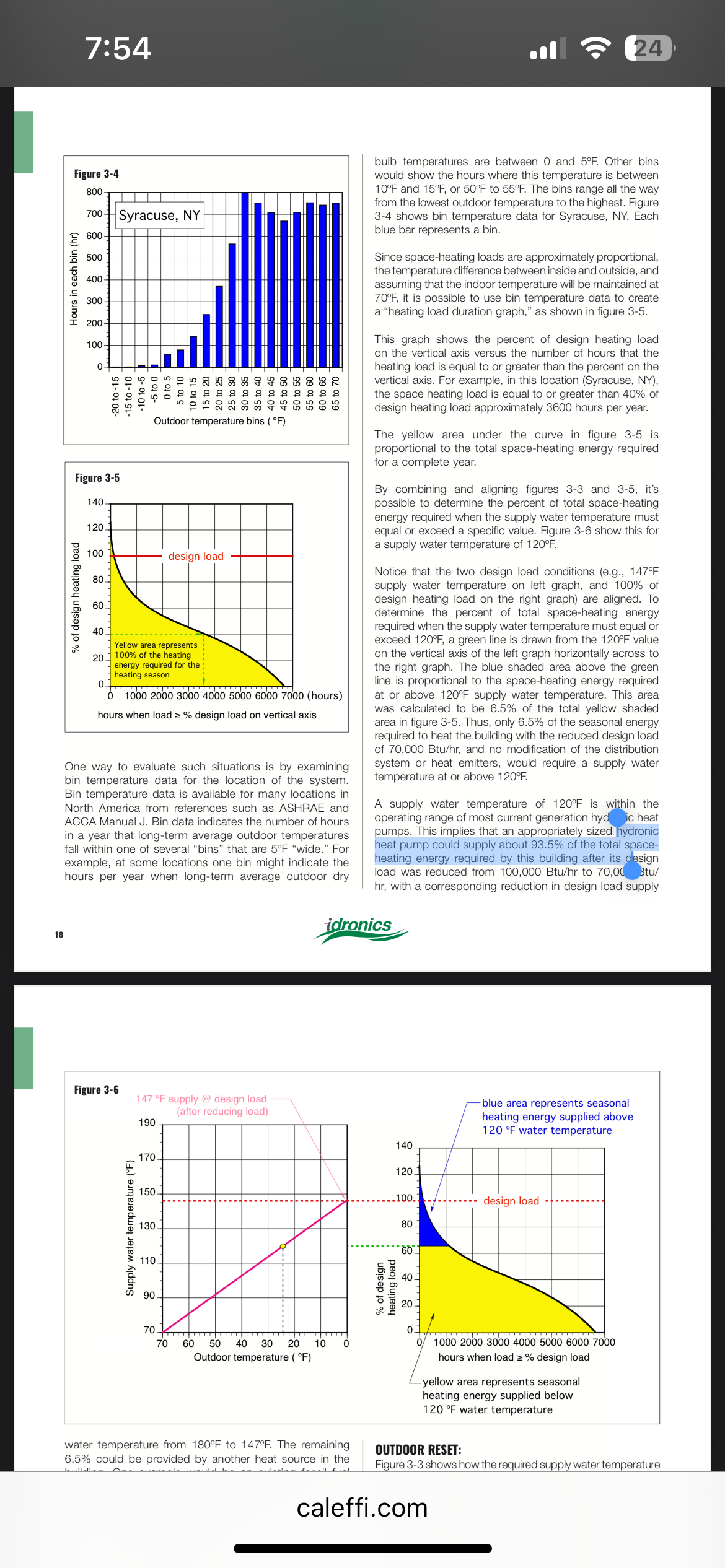
The modulation is a big deal, especially on a zoned system
Bob "hot rod" Rohr
trainer for Caleffi NA
Living the hydronic dream0 -
@hot_rod, thanks for that info. I will do a little more calculating.
One more question… venting might be the thing that pushes me one way or the other. My current boiler vents through a chimney with a clay liner. In order of ease of install, obviously using the existing chimney is the easiest. Installing the PVC venting for a mod con is second easiest, and most difficult/expensive would be installing a liner inside the old chimney.I've read varying opinions… can I vent a 85% gas boiler through the old clay lined chimney?
0 -
You still need to add a liner ,If you are running constant circulation with a properly size boiler venting up a chimney . You don't want the combustion to condense in the flue… The outside chimneys on the NW wall would be the coldest … Cold chimneys do not work …
There was an error rendering this rich post.
0 -
But, once the liner is in, it will last for decades since it has no moving parts. Can't say that about sidewall venting, which requires a fan…………….
All Steamed Up, Inc.
Towson, MD, USA
Steam, Vapor & Hot-Water Heating Specialists
Oil & Gas Burner Service
Consulting0 -
Quick update in case anyone finds this thread later…
I ended up with the Weil-Mclain EcoTec Series 2 which seems to be working quite well. I got the smallest model available (80-H) and it has BTUs to spare, even on our recent 7deg days (7deg is the design temp for our area, and what I used in the Manual J calculation).
What finally put me over the edge to the modcon was the exhaust size for the CI boiler.
Upon reviewing the manual for the CGI-4 boiler, I found that it requires a 5" liner. My current chimney is 6" diameter, and has a long horizontal run of clay pipe (2-3' at least), before turning to go vertical. I figured fishing a liner through was going to be very difficult, if not impossible. This compounded knowing that I had to make this switch during heating season, with the goal of doing the swap in a single day before the house got too cold. The modcon allowed me to prerun the PVC venting through the sidewall making the boiler install day manageable.
The other factor was cost, with the extra chimney liner, and circulation pump that is included with the modcon and sold separately on the CI, the CI boiler was going to be more expensive. There is also a $600 tax credit on the modcon which with the aformentioned factors makes it considerably cheaper than CI.
Obviously I know the modcon will have more annual maintenance, more electronic equipment to fail, and overall won't last quite as long as a CI, but it was the logical choice for my current circumstance.
 1
1 -
Good luck with it. Get it serviced annually.
0



Categories
- All Categories
- 87.6K THE MAIN WALL
- 3.3K A-C, Heat Pumps & Refrigeration
- 59 Biomass
- 429 Carbon Monoxide Awareness
- 124 Chimneys & Flues
- 2.2K Domestic Hot Water
- 5.9K Gas Heating
- 119 Geothermal
- 168 Indoor-Air Quality
- 3.8K Oil Heating
- 78 Pipe Deterioration
- 1K Plumbing
- 6.6K Radiant Heating
- 394 Solar
- 16K Strictly Steam
- 3.5K Thermostats and Controls
- 56 Water Quality
- 51 Industry Classes
- 50 Job Opportunities
- 18 Recall Announcements