Air to Water Heat Pumps for Radiant Heating And Cooling
Comments
-
Luke this assumes there is much sensible cooling load left over after the FCU is done with dehumidifiying the air. In most places on the east coast, there is pretty much no sensible cooling left. In a lot of places even a low SHR coil setup is not enough to remove all the moisture without overcooling thus the ubiquitous dehumidifiers. Adding in the controls and complication for the radiant cooling gets you pretty nothing except a lot of cost.
I'm in pretty cold climate but with hut/muggy summers. I really wanted to make radiant cooling work as it would have saved an air handler on a reno I'm planning but it simply doesn't work.
0 -
Luke,
You can always run the water temps at a higher point. But then in a humid environment, the output of the floors would be to low to do any real cooling. If a door opens or the dehumidification ever turns off then you will end up with a condensation problem. When doing radiant cooling and radiant fan coils it is always going to be a better design to have two different water temps.
The flow rate through the fan coils are to low for the radiant slab. Some water is going to have to bypass the fan coil. The fan coils will need to be piped before the radiant slab. Yes a system can be designed to do that.
The biggest problem you would have is the manufacturers warranty. I don't think any manufacturer will warranty a system unless it is installed to factory specs. A mixing valve and dewpoint sensor are required for that if you do radiant cooling by most Heat Pump manufacturers in a humid location..
I am the walking Deadman
Hydronics Designer
Hydronics is the most comfortable and energy efficient HVAC system.0 -
The hyper heat Mitsubishi units are EVI, their marketing speak for the two stage compressors.
If you look at how EVI works, it uses some of the refrigerant to lower the temperature going to the outdoor coil. This refrigerant was already compressed once, so doing this does cost energy. It does significantly increase the temperature range as well as the max system output temperature so it is definitely a good thing in cold climate.
0 -
You guys have to keep your minds open. Radiant cooling does work on the East Coast. Messana has been selling and installing radiant cooling into many homes on the East Coast. They have been doing it for decades now. I have radiant cooling in my own house installed back in 2007.
When you say things like it won't work, you close off your minds to learn something new.
https://radiantcooling.com
I am the walking Deadman
Hydronics Designer
Hydronics is the most comfortable and energy efficient HVAC system.0 -
And to follow up on this thought, it's not like you can say to an air conditioner, "give me latent cooling only." Sensible cooling and latent cooling always go together, you can't get latent cooling without also doing sensible cooling. How much of each you get depends upon the temperature and humidity, and the temperature inside the air handler.
With conventional air conditioning there's a pretty good degree of self-regulation, the more humid it is inside, the more latent cooling you get. Let's say it's 77F inside your house and your air handler is at 50F. If the air is at 70% RH you get an SHR of 48%, if it's at 50% RH you get 72% and if it's at 30% RH you get 100%. So long as you have enough of a sensible load to get the thermostat to turn on you'll pretty much get the dehumidification you need.
0 -
One of the things about humidity control is that humidity is really hard to model. Heat loss is easy, sensible gains are easy although solar can be tricky, but I'm not aware of any methodology for modeling humidity.
Counter to the folk wisdom, the hottest days aren't the most humid. At least around here, the most humid days are when it's not super hot. We had a day this summer when the dew point hit 77F: outdoor temperature of 78F, raining, outdoor humidity 99%.
If your thermostat is set at 77F, on a day like that your AC is hardly going to run at all. It's rainy out so there's hardly any solar gain, and the outdoor temp is right around the thermostat setpoint. There's almost zero sensible load, so the AC doesn't run. But the humidity is thick.
Hence the popularity of dehumidifiers. But the thing about dehumidifiers is they are quite efficient space heaters, they return to the space all of the latent heat that is extracted by removing humidity, in addition to the heat from the energy required to run them. So not only do they extract humidity, they also provide a sensible load that encourages the house AC to run more.
Now, from an energy perspective running a dehumidifier just so that you can run a 100% SHR cooling source like radiant cooling makes no sense. It's like leaving your windows open in the winter to get your radiant heat to run more so you can have toasty toes.
0 -
Back 15 years ago the Europeans developed a new energy efficiency standard. They tested all the different HVAC equipment and put them into categories. The R and D happened with Eco-boiler.org who worked for the Euro Union. I called Belgium and found someone who spoke english that explained everything to me. Below is the results of the study done back then.

And below is a ATWHP with EVI that is now rated in the A+++ category. Europe is most definitely ahead of the USA with there energy standard.

That is a jump from the A and B categories to the A+++. It is a huge jump!!! Many ATWHP in Europe are in the A+++ category. You need to have an average yearly efficiency of over 300% or above a COP of 3 to be A+++ rated and be a electrical system. See how they rate electric resistance at 40% and not 100%. That is because they are applying a 2.5 conversion factor. 120 times 2.5=300.
EVI is a big reason for this huge jump in yearly average efficiency. That is huge!!!! Of course other ATWHP improvements could have contributed to this also.
I am the walking Deadman
Hydronics Designer
Hydronics is the most comfortable and energy efficient HVAC system.0 -
I don’t like standards based on features and not performance. So I reject the European method. Moreover, what makes this different than air-to-air?
0 -
Take a look at the COP graph bellow. Most EVI air to water units are similar. There is a drop in COP around 2C which is when vapor injection kicks in.
Most recent efficiency improvements have come from change to R32 or R290.
 1
1 -
Some R410A units are at A+++ too.
I dont see any specs on that unit from that website.
I am the walking Deadman
Hydronics Designer
Hydronics is the most comfortable and energy efficient HVAC system.0 -
https://cdn.myshoptet.com/usr/www.spa-components.com/user/shop/big/1152-4_heat-pump-module-one-20-kw-monoblock.jpg
0 -
I put together a sample of what I think is the most comprehensive way of looking at performance. It's based on the performance data for the Arctic 050ZA that you sent me, with the temperature distribution data for Washington, DC from NEEP.org.
It's based on a theoretical house with a 30,000 BTU/hr heating load at 22F, which is what NEEP has for the DC heating load.
For each degree of temperature I estimated heat pump capacity and COP. I assumed outdoor reset, water temperature of 95F at 5F and 86F at 44.6F. I just extrapolated from the full-load data give; NEEP has performance at minimum output which allows you to estimate part-load performance.
The model shows a weighted average COP of 4.6 for the heating season.
You can see it here:
usp=sharing
I hope it's self-explanatory, if not please ask.
0 -
I do see a drop at 2c but look at -25c. That is -13f and the COP is above 1. Without EVI you won't even be running at -25c. At 20F COPs on EVI are higher than non evi at 20F. I don't understand the Mitsu tech. They may have developed something new that works in cold temps. It would be doing something similar to EVI just newer technology. Running a HP at 5f is going to use way more energy than 50F. At 51f and above my house doesn't even need any heat at all. My house is at warm weather shut down at 50F right now and my wife and kids aren't even aware this happens. They don't complain. So looking at a COP at 50f is mostly useless.
I am the walking Deadman
Hydronics Designer
Hydronics is the most comfortable and energy efficient HVAC system.0 -
I'm with Kaos here. I spend an unnatural amount of time looking at heat pump performance curves. For the most part they're straight lines. I know the Mitsubishi vapor injection models have curves with a kink, it's really two lines depending on whether they're in vapor injection mode or not. This is true of both the capacity curve and the COP curve. In vapor injection mode the capacity curve is flatter, more capacity is retained. But the COP curve is steeper, COP suffers.
0 -
DCContrarian,
Thanks for crunching the numbers on the HP. I will dive into some day when I get free time. My workload is high now going into heating season.
I am the walking Deadman
Hydronics Designer
Hydronics is the most comfortable and energy efficient HVAC system.0 -
I see there are now a number of Air to water HPs available including Mitsubishi.
I have a radiant floor heat system (staple up) and low temp baseboards that operate well with a max HWS temp of about 130. This is now within the range of some of these HPs.
My remaining issue is water quality. Some iron in the water and ph 6. Also the radiant tubing is effective but has no O2 barrier. With water like this, a plate Heat Exchanger in the HP is going to clog up quickly. I may be able to fill the closed loop with pristine water and even keep topping it up with same. If I can do that, is the lack of an O2 barrier going to still cause problems for the plate to plate Heat Exchangers?
If so, are there some HPs that use a coaxial or other more forgiving Heat Exchanger?
Any recommendations of how to proceed? BTW probably need 32 - 40K heat at design temp.
0 -
With non barrier tube it is a good idea to use a hydronic conditioner, check and boost it as needed. Fernox has the fluid plus the test kit.
The Fernox handles the O2 that enters with an oxygen scavenger component. But it gets depleted over time.
The Mitsubishi ECODAN is a system that is not yet in the US, supposed to be a good high temperature version, it is a split system.
If you can stay in the 120SWT range, numbers look better for any of the A2WHP brands.
Bob "hot rod" Rohr
trainer for Caleffi NA
Living the hydronic dream
 2
2 -
thanks hot_rod,
"Protector F1" — It sounds like you think this will keep the water clean enough to avoid a problem with clogging a plate heat exchanger, correct?
Also, the Ecodan has apparently been recently introduced for sale in U.S. I expect to be quoted on it shortly. From the curves I've seen on other systems, I agree that COP and capacity do look better at 120 hws. From the econdan calculator I can't see COP but I do see the 4 ton unit is supposed to put out 29K BTU at 130 but jumps to 42K at 120 under certain conditions at 2 def F outside DB.
It would be possible to increase emitter area to probably make it all work with 120 deg HW. Encouraging!
0 -
Ideally all hydronic systems would get cleaned first, with a hydronic detergent.
Then good water, good water as in low hardness below 7 gpg, low TDS, low chlorides neutral ph. DI, RO or distilled water would be best. Which you can buy or make on site with an Axiom DI cartridge filter.
Then and only then add the conditioner F1 or others.
The conditioners prefer good water. Or else you use up the inhibitors the first day fixing bad water.
The test kit tells you what condition your conditioners are in.
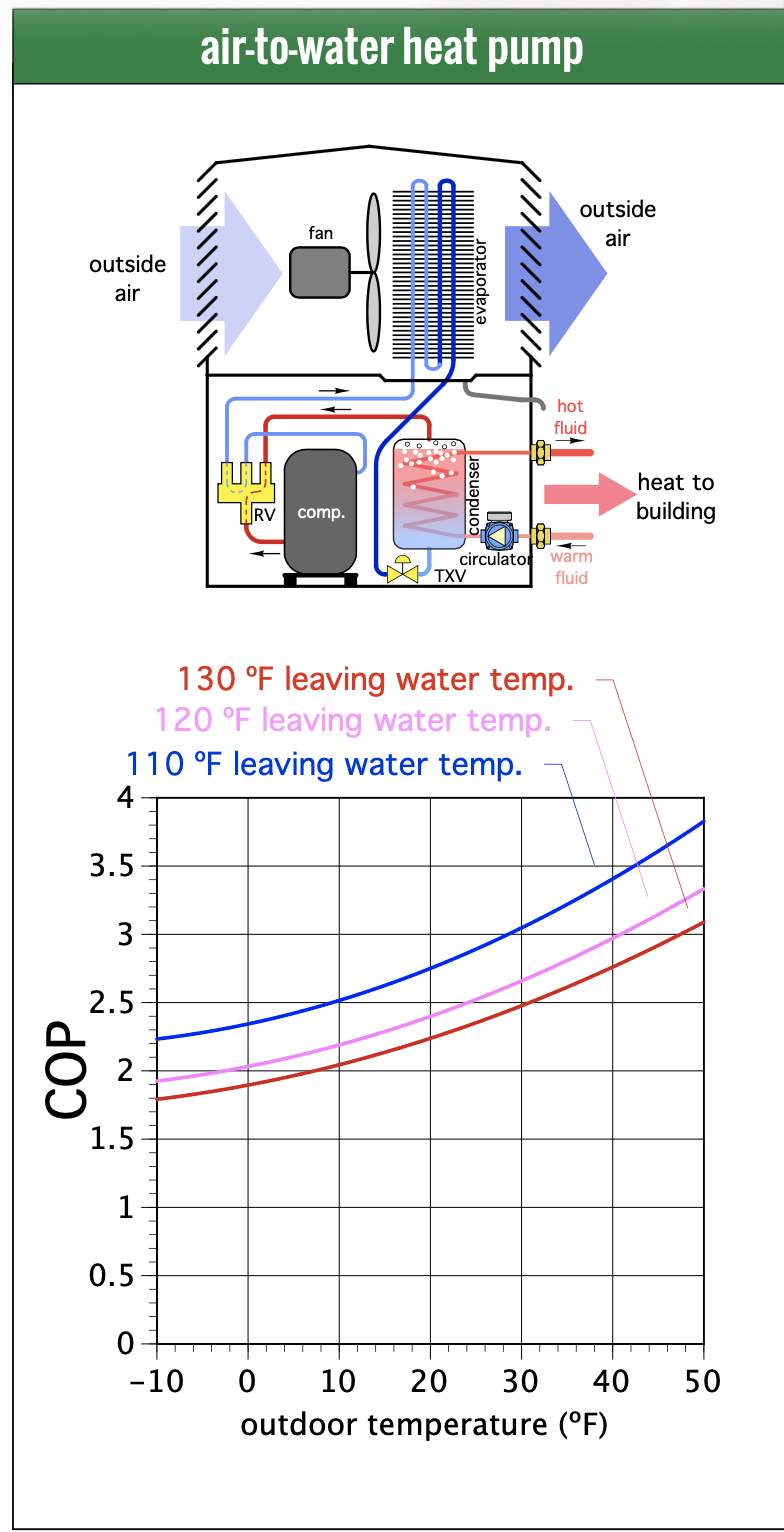
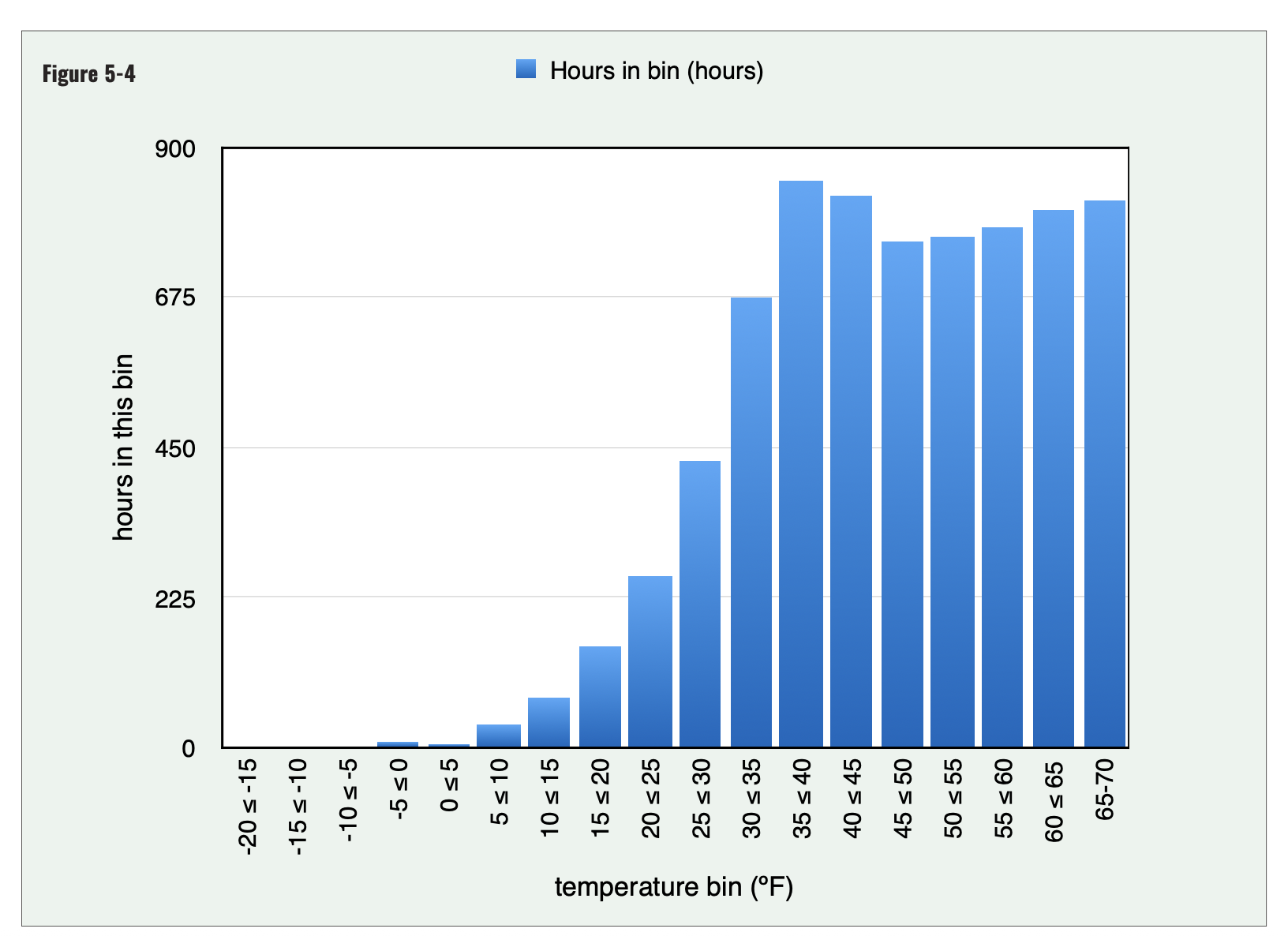
If you can get the system to operate on a design day with 120or so AWT. And run ODR, you will be in good COP most of the heating season. Most areas are at design less than 10% of the year
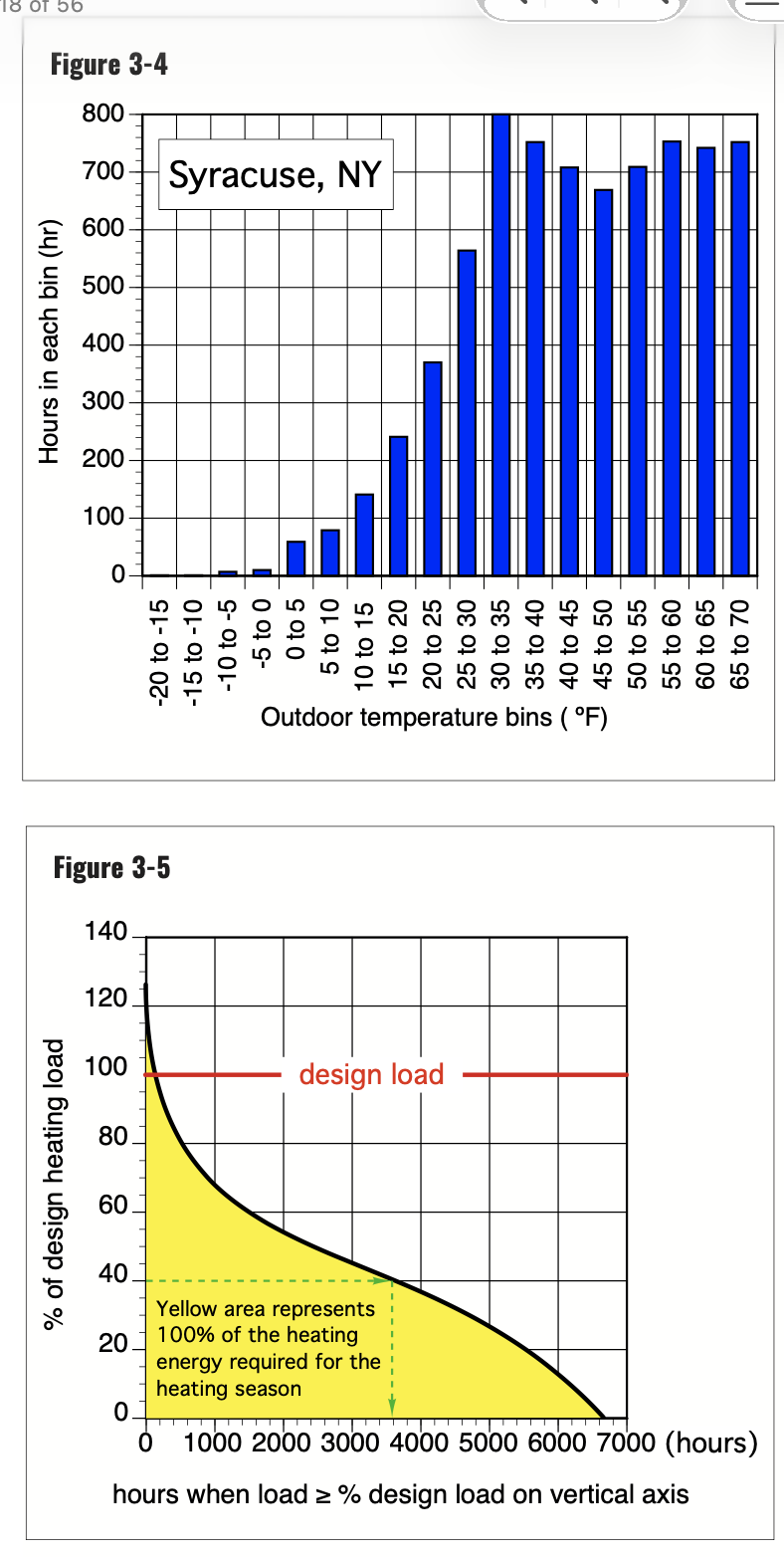
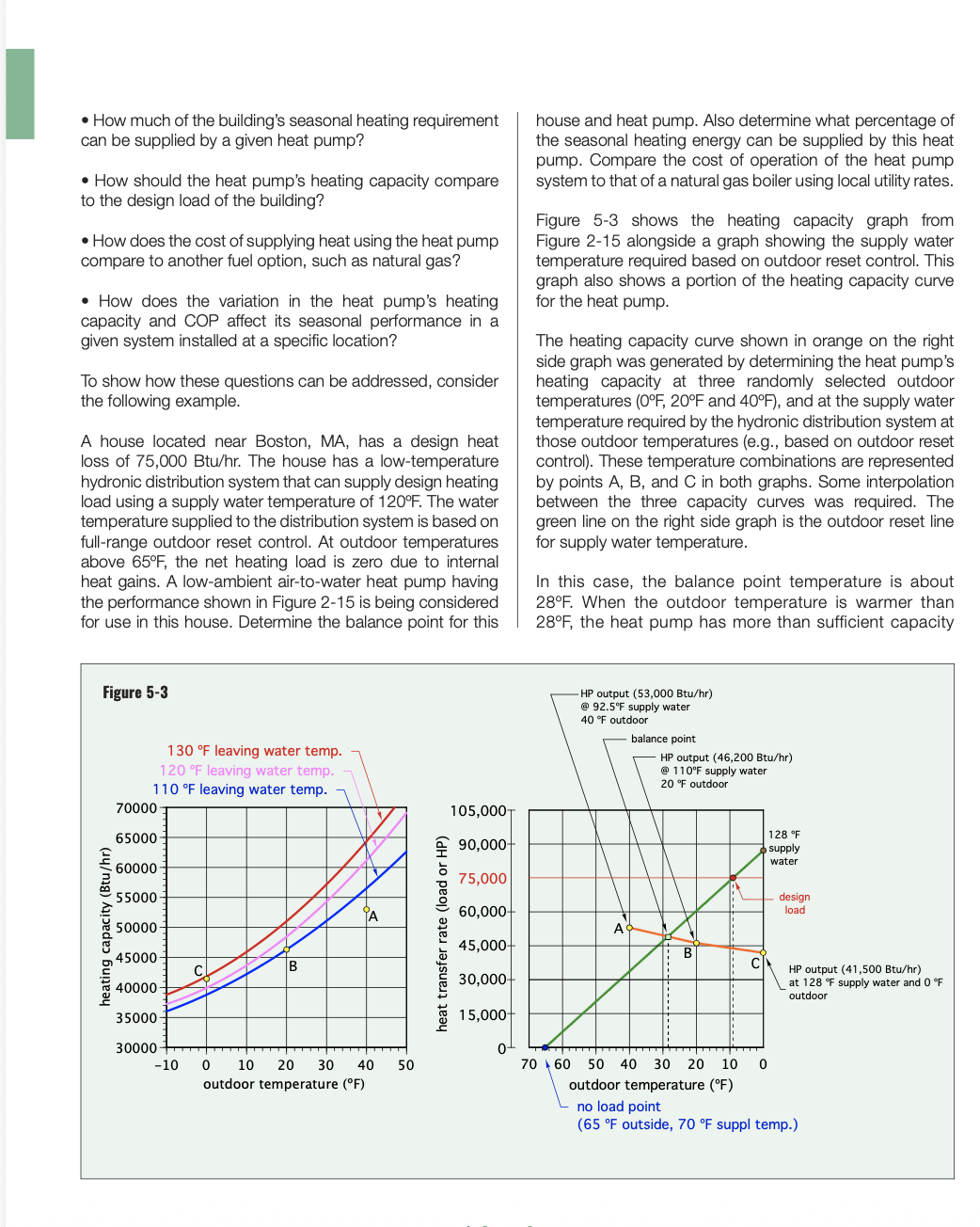
You can download temperature BIN files for your area to get a idea how the COP would look throughout the season.
A couple examples, and a page showing how to calculate "balance point"

 Bob "hot rod" Rohr
trainer for Caleffi NA
Living the hydronic dream1 -
thanks Bob, that is is very helpful.
So we would clean the whole system with detergent, get out as much crap as possible.
Then run better water through it to flush it out as much as possible.
Then remove all that water and put in clean, purchased water, then treat that water with F1 or similar. TEST.
Ideally, then we would have some way of adding the small amounts of required make up water from a small tank of clean water as well. Then keep testing annually or on some schedule.
0 -
Make sure you have a good magnetic dirt separator.
If you wanted to be extra careful you can run a filter just before your heat exchanger as well. This one doesn't add to much resistance to flow, double check what micron size particles you are willing to allow. But once the water gets cleaned up and treated, ongoing sediment catch will be minimal.
1-1/4-140-HT-F - Rusco 1-1/4-140-HT-F - 1-1/4" Hot Water Spin-Down Filter System (140 Mesh)
0 -
thanks bJohnhy
I looked over the filters in my case I assume I’ll be looking for possible products of corrosion caused by the no O2 barrier tubing. Plus any old junk that wasn’t loosened at the initial cleaning.Do you think the 140 mesh would be the best size to use?
Thanks again, this is a great add to the above system.
0 -
The Caleffi XF was designed specifically for the HP conversion market. With two filters, magnet and rotating scrubber
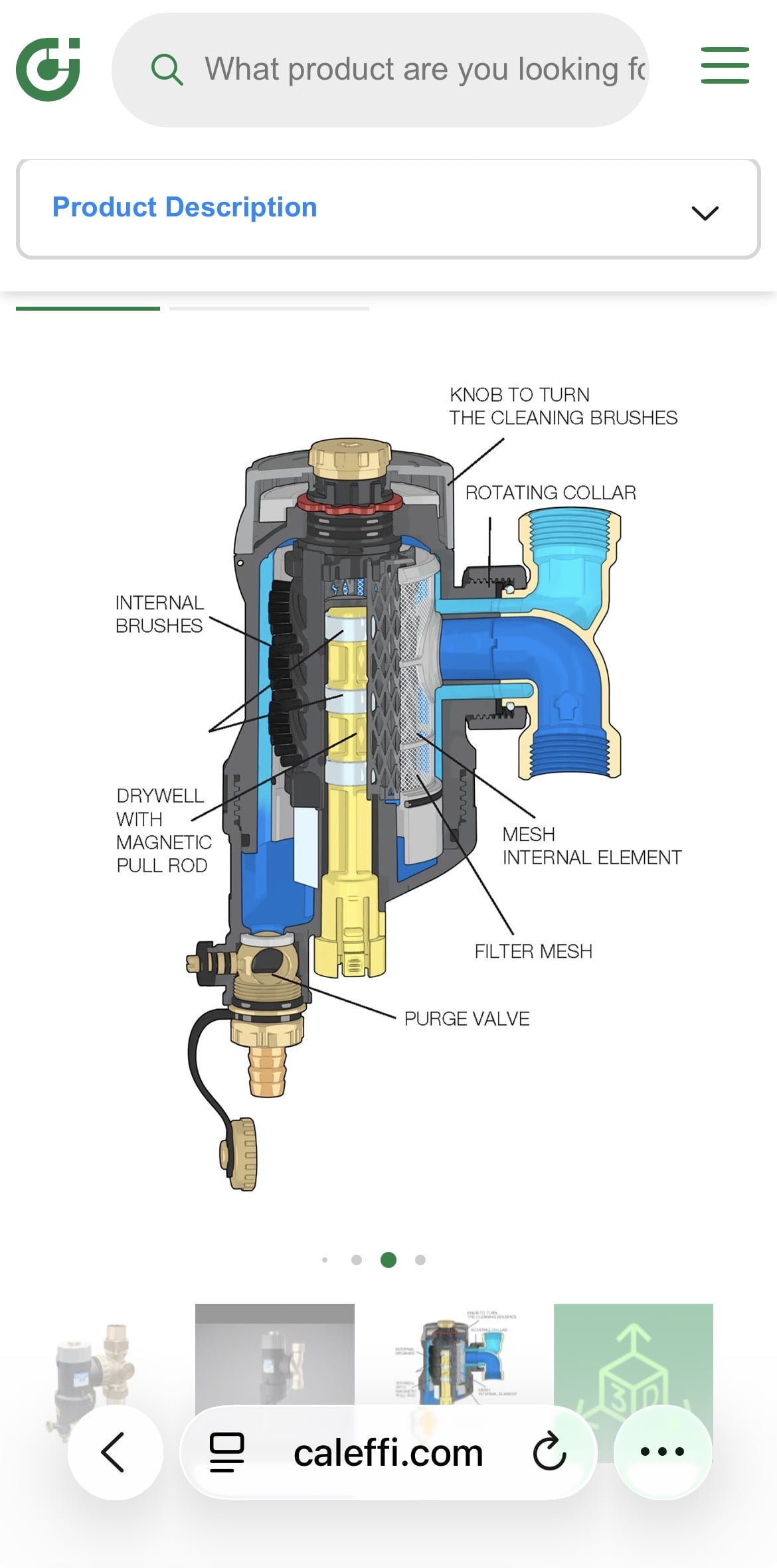 Bob "hot rod" Rohr
trainer for Caleffi NA
Living the hydronic dream0 -
Yes, this looks very good!
BTW could I have a significant amount of water stored in a large expansion tank that could be my reserve to add more clean water as needed? This could expensive feeder tank.
If so, how much water might be stored here —more than one or 2 gallons?
0 -
After a few days to a week of operation at the highest operating temperature, with a good microbubble air purger, the system should not need more fill water.
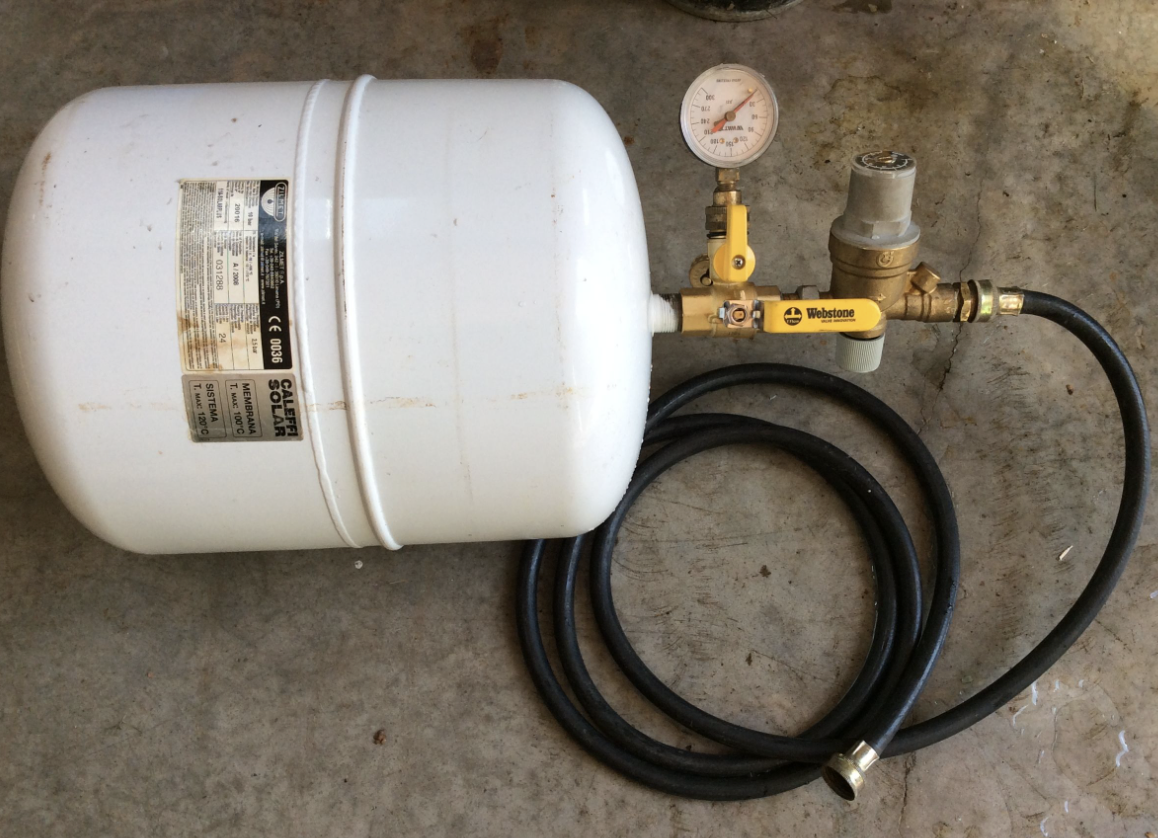
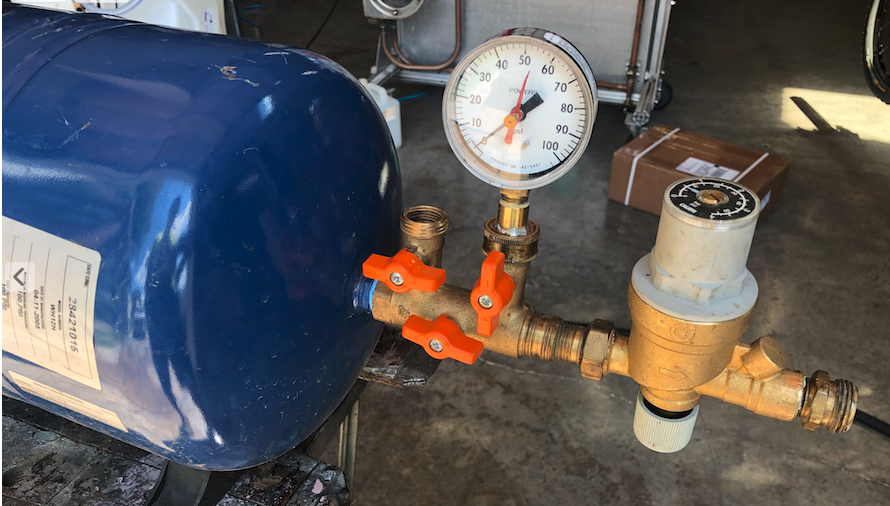
A small #30 expansion tank can hold about 4 additional gallons for a back up, if you don't want to invest in a fill tank. Pressurize the tank to 30 psi, add a fill valve set to the desired fill pressure.
This solar version was a portable tank to top off solar thermal systems.
A low water or in the case of HPs a low pressure cutout switch is a good idea.
 Bob "hot rod" Rohr
trainer for Caleffi NA
Living the hydronic dream0 -
yes, that’s the idea. The system still has the existing pressure reduction valve for the original make up water connection piped to the house system.
I guess I would just need to take it off of the house water and feed a new expansion tank into the existing pressure reducing valve at 12–15 psi.
Sounds like this part could be a fairly inexpensive change, great!0 -
An air to water heat pump needs to have a glycol mix. The outside part needs to be protected from freezing if there is a power outage. If you're using it for cooling the heat exchanger also needs to be protected.
Hooking it up to an auto fill system with plain water is asking for trouble.
0 -
just to be clear, this would be a split system with water only inside the house and refrigerant piping going to the outdoor unit, like a typical air to air heat pump.In that case would we still be OK sticking with treated but not glycol water ?
Thanks for any ideas.0 -
yes the split system can run straight water inside the distribution piping in the home
Bob "hot rod" Rohr
trainer for Caleffi NA
Living the hydronic dream0 -
Are you doing cooling too? Here's the problem I've run into: you can't let the heat exchanger freeze or it will crack. On my unit, a Chiltrix CX34, the default lower limit is 35F, if it goes below that it throws an error and shuts off. I found that if I set the aquastat below 50F the temperature would occasionally dip below the lower limit and the unit would shut off. But with the aquastat that high the fan coils weren't as cold as I wanted to get as much dehumidification as I wanted.
The only safe way to set the lower limit lower is to have a glycol mix.
0 -
I am not planning on doing cooling initially because I don’t have any fan coils and with the staple up radiant floor and low temperature baseboards I would expect to have condensation problems.However, I was keeping it open as a future possibility with the addition of one or more fan coils.
I’m going to try to keep these notes so that is good to think about, glycol may be required for the heat exchanger. I see there are fan coils available now that look like various types of mini split heads. And we’re getting used to seeing those in all kinds of rooms, it may not be that big a deal to add a few of those.
0 -
When you're doing cooling condensation is a major issue, every pipe, fitting, valve, etc., has to be insulated. And you have to do a much better job than with heating, the insulation has to be 100% and airtight.
So if you think you'll be doing cooling in the future, think about which parts of your system will be carrying cold water, and make sure you'll have the ability to insulate them. You'll probably want to separate the hot-only part of the system from the hot-and-cold part close to the heat pump, and have the ability to isolate both with valves on both the supply and the return.
2 -
The extra mesh filter is a bit overkill if there is going to be good dirt mag separator. That "140 Mesh" has openings of 100 microns. You can go to the "200 Mesh" with 75 micro openings for bit more filtration. But it may require more frequent cleaning, backflushing 2-3x in first part of heat season, then 1x at the end. I suggest putting a valve somewhere close on the inlet side (and outlet) to allow backflushing (blowdown) of the mesh filter and potential removal for more aggressive cleaning. That manufacture suggests putting a valve on the outlet side for forward flush cleaning; that doesn't make as much sense to me.
https://www.supplyhouse.com/Rusco-1-1-4-200-HT-F-1-1-4-Hot-Water-Spin-Down-Filter-System-200-Mesh
1 -
thanks!
0 -
One last question – if I’m going to fill my hydronic system with clean water, should I be using spring water that comes in 5 gallon jugs or something else? Any ideas would be appreciated.
0 -
@hot_rod outlined it well above. I would go with distilled water for your final filling of the system. Although the spring water could be good water relative to some city supply, go with distilled if your going through that effort.
Nice concept article below, although subscription website, I believe you get to read 1-2 articles for free. Distilled water is even better than the "demineralized" water referenced in artical.
0 -
yes, I guess I didn’t know what DI or RO water were! For instance, has RO water been run through reverse osmosis?
Problem is my starting water is much worse than regular city tapwater. So bottled spring or filtered water would be a big improvement.
My water has iron and other minerals like manganese and a pH of about 6.
If it were distilled water, that would be a lot of distilled water as I have a 50 gallon tank in the system as well as the piping and radiant tube.
0 -
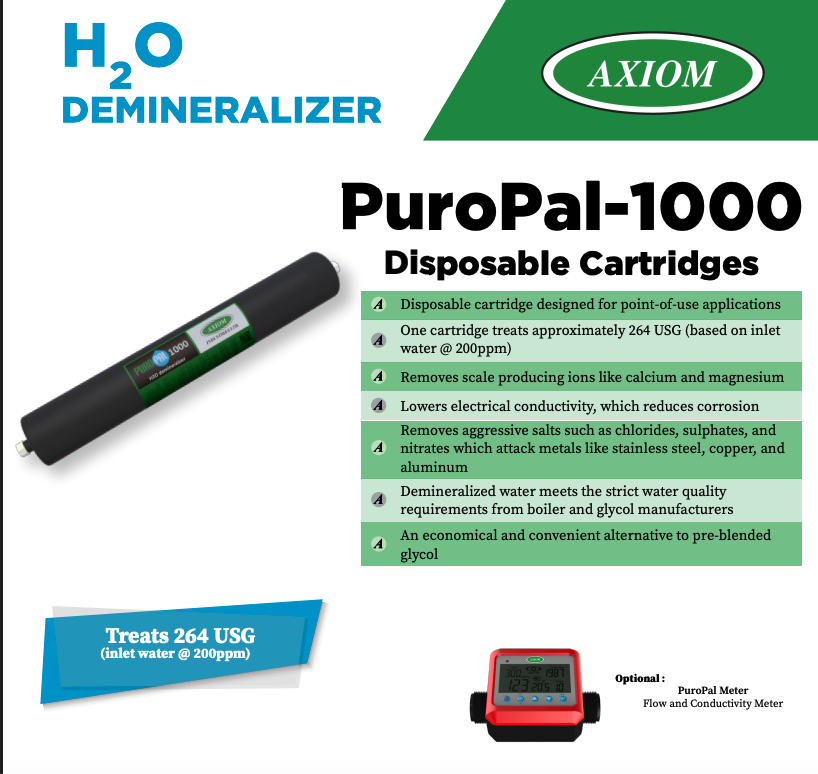
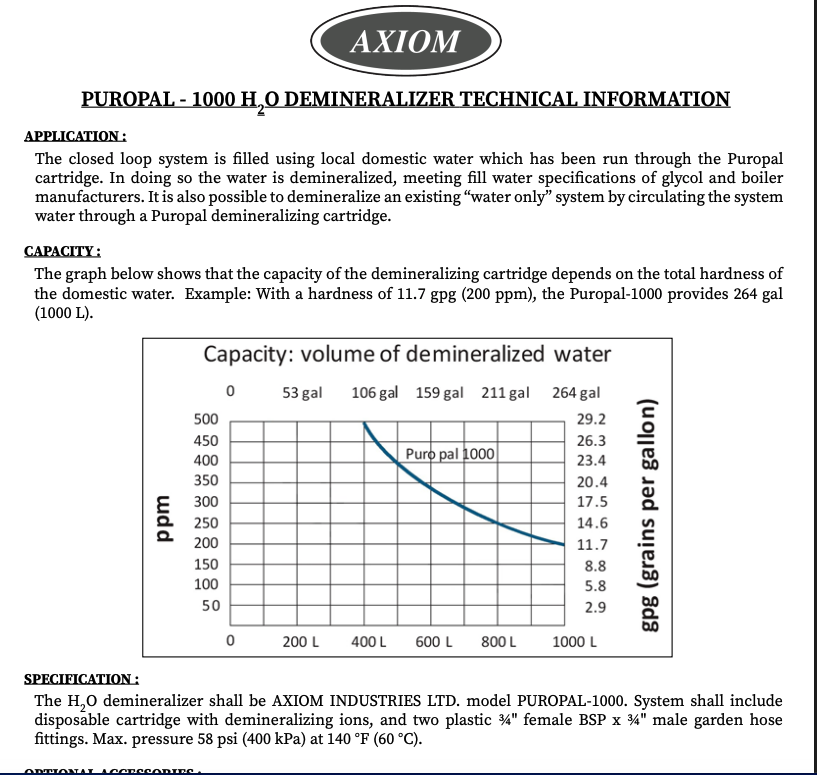
Probably the easiest way is to filter the water on site. This cartridge does about 264 gallons. Depending on how bad the water is.
This is a DM demineralizer cartridge, it has a one use resin inside. RO uses a small membrane to filter out water. Distilled water is boiled, the condensate collected on a stainless plate.
You end upo with about the same purity regardless of the method. RO and Distillitation is a slower process.
That should be plenty to fill most systems.
 Bob "hot rod" Rohr
trainer for Caleffi NA
Living the hydronic dream2 -
thanks Bob, that’s a big help – now I know what each type of purified water is!
0



Categories
- All Categories
- 87.6K THE MAIN WALL
- 3.3K A-C, Heat Pumps & Refrigeration
- 59 Biomass
- 430 Carbon Monoxide Awareness
- 124 Chimneys & Flues
- 2.2K Domestic Hot Water
- 5.9K Gas Heating
- 120 Geothermal
- 168 Indoor-Air Quality
- 3.8K Oil Heating
- 78 Pipe Deterioration
- 1K Plumbing
- 6.6K Radiant Heating
- 394 Solar
- 16K Strictly Steam
- 3.5K Thermostats and Controls
- 56 Water Quality
- 51 Industry Classes
- 50 Job Opportunities
- 18 Recall Announcements