Welcome! Here are the website rules, as well as some tips for using this forum.
Click here to Find a Contractor in your area.
If our community has helped you, please consider making a contribution to support this website. Thanks!
Controlling radiant floor, with a wood stove.

Getting ready to go into the third season with my current heating system setup. Overall I am very pleased, but the thermostat controls I am not overly happy with.
I have approximately a 2400 square foot ranch with a daylight basement. Radiant floor heating throughout the basement slab along with first floor, and a forces hot water modine in the garage, and firedplace/woodstove in the living room.
Also have heat pump mini splits, but those I just use for AC, not heat.
On the first floor, I have two zones. The first zone is everywhere except for the master bedroom. The master bedroom has its own zone, which generally speaking I keep set at 60° with the door closed in the winter (we like it cold to sleep)
The radiant for heat is primarily operated by a wood boiler with 500 gal thermal storage. Usually, I am able to run the wood boiler enough in the evening to accumulate enough thermal storage in the tank that it will take it throughout the whole next 24 hours when I'm gone to work. If for some reason the thermal storage or wood boiler can't keep up with the demand, the oil boiler will take over. In the living room of the first floor, we have a wood stove that we run uses a primary heat source in the fall and spring when it's just the night time that we need to heat. We also use it throughout the winter on the colder evenings. Not because the radiant can't keep up, more as a convert/ambiance type of thing. I am only marginally satisfied with my current thermostat control setup. Through reading a lot of suggestions, I ended up going to the tekmar thermostats with the in slab sensors along with the outdoor sensors. (I have no radiant water temperature control other than manual mixing valves. Simply on or off.
I figured I would post on here what I'm unhappy with, and either you guys will tell me a solution, or tell me it's just how it's going to be given my setup
1- the thermostats turn on and off way too much in my opinion. They will click on for 1-2 minutes at a time and then shut off. They aren't even on long enough to cycle the hot water from the thermal storage throughout the floor. If I'm running on oil, it's bad enough that it will shut off before the boiler even gets fully to temp. I have tried adjusting the settings multiple times, but it hasn't seemed to make a difference. Major short cycling, like it is set up for a modulating condensing boiler, and not an oil boiler.
2- with the above statement being said, there is very little rises and drops in temperature for the set point. Which honestly, I don't mind if there is a minor change in temperature within the room, if it increases efficiency of the system by not short cycling it
3- I wish there was an easy way I could set the thermostat on 65 (the temperature we typically keep the house at) and have the system know the woodstove is running, because occasionally in the evenings we'll start the wood stove and it hasn't gotten to the point of putting out a lot of heat and the radiant floor will kick on, and before we know it the system overshoots because of the two sources of heat.
Again, it's probably stupid to run the wood stove with a reading floor heat, but the wood stove we have is extremely efficient and once it gets hot it pumps out he tremendous amount of heat with the minimum would consumption and nothing beats a feeling of a wood stove when it's cold out. However, we are gone throughout the day, I don't want those cooling down to the region it's going to take over. And I know you're not supposed to keep adjusting and floor up and down
4- one thing that drives me nuts about the tech car thermostats is the inability to shut them off. The thermostat I have in my garage will turn the heat on if the garage hits below 40, regardless of what mode the thermostat is set on. I already have freeze alarms in place, so I never worry about the garage dropping the little 32. However, when I'm working on equipment out there with the doors open in the fall, it regularly will get down into the 30s but not in danger freezing. As soon as it hits below 40, regardless of the thermostat setting, the tech bar thermostat kicks on the heat, which drives me nuts when I don't want it to be on.
5- I know the tekmar thermostat seem to be all the rant and rage, but I am just not sure they are truly the best thing. Between the short cycling in the inability to turn them off. Also, apparently I got ones that need a bridge to be controlled with wifi, which I have never done. I don't have much interest in connecting them to Wi-Fi for control, more as monitoring thing since most weekends I am gone.But that's another stupid feature of them in my opinion.
Comments
-
You need to control the water temperature to the floor with Outdoor Reset.
A smart mixing valve or variable speed injection mixing are options.
Bob Boan
You can choose to do what you want, but you cannot choose the consequences.1 -
@TuckerTerra: "If for some reason the thermal storage or wood boiler can't keep up with the demand, the oil boiler will take over."
What exactly signals the oil boiler to fire?
From reading your description, it sounds like your complaint is that the oil boiler fires more often than you would like? That the system keeps the space comfortable.
0 -
Temperature overshoot is often caused by the heat in the thermal mass of the radiant system. Is the tekmar stat set to respond to floor sensors or air temperature? What model stat?
With a wood stove in the space also it can be hard to maintain a steady ambient temperature.
Does the system track accurately when just the radiant is running?
As @Ironman mentioned running any hydronic system on outdoor reset helps temperature overshoot, and provides long consistent run cycles.
But it takes some fiddling to get the curves ad slopes set for ODR. It is specific to you system and comfort wants.
Often the backup boilers are piped in series with the wood boiler, but they should be separated with hydraulic separation, or parallel piped.
If not the oil boiler may be heating an unfired wood boiler. Not good!
Bob "hot rod" Rohr
trainer for Caleffi NA
Living the hydronic dream0 -
Would this all be done through the tekmar controls? I assume I would need more than just the tekmar thermostats and a mixing valve?
What exactly does this accomplish? Not trying to be ignorant, asking out of pure curiosity how it would help my system with short cycling (my main complaint) I probably should have been more clear, I don't care quite as much about overshooting as I do the thermostats short cycling. I run into overshooting more when I run the wood stove which might be hard to avoid anyway.
0 -
Yes sir, my main complaint is the thermostat seem to Short cycle. Among other things with the thermostats I'm not overly happy with, such as the inability to shut them off.
I built and programmed a PLC system. The algorithm works as follows:
When any radiant zone calls:
If the wood boiler is that operating temperature the radiant pulls from the wood boiler.
If the wood boiler is not at operating temperature, but the thermal storage tank is above 120°, it will pull heat out of the tank.
If neither the wood boiler or storage tank is above 120°, it fires the oil system.
If the garage heat or domestic calls:
The wood boiler being operational is no factor due to the increased temperature needed.
If the thermal storage is above 150° it pulls from the tank. If it is below 150°, it fires the oil.
Note: there are also electrically actuated valves that isolate the thermal storage, wood boiler, and oil boiler from each other. These valves open and close according to where the Heat is going to or from. This eliminates any loss of heat from circulating water through systems that are not in operation.
The TLC has a screen on it so I can manually overide any valve or circulator closed/open or on/off if needed. It also shows temperatures throughout the system.
To be 100% honest with you, I actually added to the PLC algorithm last winter a short cycle eliminator for the oil boiler because I got tired of the thermostats calling for 1-2 minutes when I wasn't running my wood boiler. Basically, within the plc, once the thermostat calls and the oil fires, I have it so it has to fire for at least 5 minutes, regardless of what the thermostat is calling for. At least at that point it will allow the oil boiler to come up the full temp before shutting off, unlike before.
0 -
you mentioned
The thermostats turn on and off too much
Are the thermostats reacting to slab temperature or ambient air temperature?
Usually there is a 1.5- 2 degree differential, adjustable in some thermostats.
The same for the slab sensor, it would work around a differential.
Which model thermostat do you have so we can look at setting options. 519 or 516, 557?
Bob "hot rod" Rohr
trainer for Caleffi NA
Living the hydronic dream0 -
They are the tekmar 554 thermostats.
When I don't run the wood stove, the system actually functions completely flawlessly except for the constant short cycling. In fact I think that's part of the problem, I think that it tries to keep the temperature too perfect at the set point. I couldn't care less if through fluctuates a a degree or even a little more. I just hate hearing the thermostat click on, and then within one or two minutes it's clicking off because I know it's not hardly getting the hot water to cycle throughout the system before shutting back off.
Actually, that's a really good question. A lot of times when I home and running the wood stove, I have it maintain a specific floor temperature. I actually prefer this method, however, the problem being is I find it creates larger fluctuations in the ambient temperature as the outdoor temperature rises and falls. Again, not as big of a deal if I'm running my wood stove, it's more if I don't feel like running the wood stove that running a specific floor temperature creates that issue. That's why I was wondering if there was a way to incorporate the wood stove into the system, but I'm sure it's not feasible to try to come up with that in any control fashion.
Back to your question though, usually what I do is set the thermostat to the minimum temperature I would want the room (lets say 65).
Then I set my floor minimum temp to 66 and max to 78. The reason for this is I find it works better to keep the floor warm even when the wood stove is running and keeping the house at 66 or 67. Otherwise, after the wood stove goes out, if the floors aren't already somewhat warm, then by the time thermostats see the house has dropped below 65 it takes a lot longer for it to warm the colder floors up. By the time the floors of heated up to a point they're putting off heat, the house is cooled down even more. So it runs the system longer which then makes it overshoot more.
You guys will probably laugh at how I do this, I'm clearly not a heating professional, and everything I know is self-taught, or read about on this forum. Don't hesitate to criticize how I operate the system, if you think I'm being retarded, I'd love to hear your opinions on it.
I guess overall I'm just trying to gain as much efficiency out of the system as I possibly can.
Regarding how the system is plumbed:
The oil system and wood system with thermal storage are plumbed in parallel. When one system is operational, the others system is automatically isolated through the use of electric actuated valves. That's why if the wood boiler has been operational for significant amount of time or a zone hasnt called for a long time, and then that oil boiler ends up needing to fire, it can be at room temperature when it fires. At that point it takes a while to heat the oil boiler up to a point where it's putting out heat. So when a thermostat is short cycling, it's pointless.
0 -
Have to figure out on which sensor it is cyling on. Which mode you run the Tekmar in?
If using air only, you can adjust the differential in the installer menu.
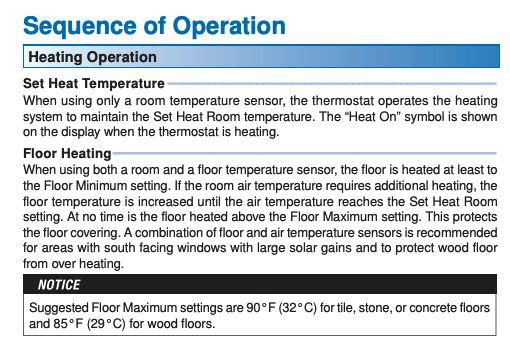
If you are using air/floor, it could be hitting the floor max on each call which will cause it to cycle. In that case, you need to reduce the water temp or bring up the floor max.
0 -
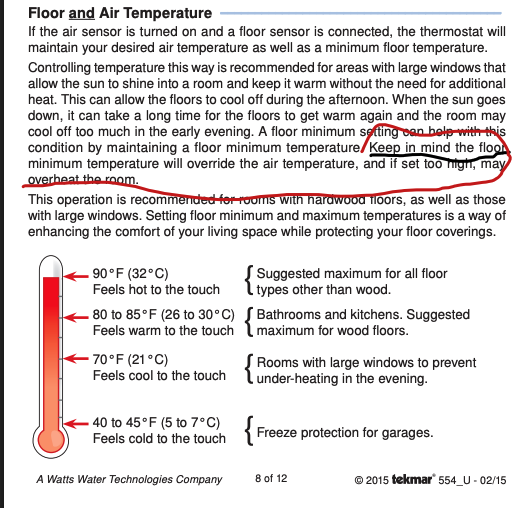
When you use both air and surface temperature, one needs to have priority.
So if you want the room temperature at 65° but the floor at 78 the 78° floor will over shoot the 65 ambient.
You get about 2 btu/ degree difference between surface temperature and ambient. So with 78 floor- 65 ambient 78-65= 13 X 2 =26 btu/ sq. ft. the floor is adding to the space. So it will over run the ambient setting.
If you set it so the ambient never goes over 65, then the floor may not reach 78.
This is noted in both the installation and Operation manuals.
The control also does some data logging, shows how warm the floor has been. So if you have solar gain through south glass that floor may exceed the settings.
You might try air only setting.
I have not had much luck with floor sensing only, maybe if you dial in the ODR perfectly. But internal gains are hard to compensate for, like the wood stove adding heat. Also any solar gains.
The floor only "feels warm" if it is above skin temperature. A 66, even 78 floor surface will not feel warm to the touch. The surface needs to be above skin temperature to feel warm.
A 66 degree floor can only add heat if the ambient drops below 66, but you don't want a 60° space temperature!
I believe the stat does have some indoor reset function also. Maybe that is why it clicks so often.
You have 3 things trying to get on the same page. Ambient temperature from the hydronic. Floor temperature at either min or max, maintained. And the wood stove, probably without any temperature control, as far as room ambient temperature?
It has to be a tiny relay inside the thermostst, must be a very quiet clicking noise?
In some cases the thermostat gets mounted by the boiler, or anywhere out of the room, and a room sensor RTU, and slab sensor wire to it. That would eliminate the noise in yout rooms. Maybe not the comfort issue.
A call to tekmar may answer some fine tune settings.
 Bob "hot rod" Rohr
trainer for Caleffi NA
Living the hydronic dream0 -
@TuckerTerra: "I just hate hearing the thermostat click on, and then within one or two minutes it's clicking off because I know it's not hardly getting the hot water to cycle throughout the system before shutting back off."
Is the thermostat sensor in the air or in the slab?
0 -
Outdoor reset would be most helpful. You asked what it does.
https://www.supplyhouse.com/Tekmar-374-Universal-Reset-Control-Two-Mixing-Two-Stage-Boiler-DHW-Setpoint-4812000-p?utm_source=google_ad&utm_medium=DSA_SKU&utm_campaign=Search_SKU_Heating_X_DSA_New&utm_campaignid=21004902424&utm_adgroupid=163851388292&utm_targetid=dsa-2273379459260&utm_product_id=&utm_matchtype=&utm_keyword=&utm_adtype=&utm_category=Heating&utm_adgroup=&utm_adname=&gad_source=1&gad_campaignid=21004902424&gbraid=0AAAAAD_WAyuyWLOxlC5xj8Xz989y3ggN-&gclid=EAIaIQobChMIjc2VzuvYlwMVuTUIBR3xsBtLEAAYASAAEgK4y_D_BwE
For one you probably need a reset curve from 90 when it’s mild out to 120 on your coldest day. The injection mixing or a mixing valve will take your water stored in your tank, and only send that properly mixed, lower temperature water to the zones calling. In an ideal setting, your zones will running almost non-stop, with your wood stove, or your oil boiler maintaining buffer/storage tank temperature.
A boiler control that has a setpoint for your buffer tank/boiler loop, and 1 or 2 mix temps is what you may need. The Tekmar 374 boiler control, might work for this.0 -
Thank you for all the replies! I think you guys might be on to something regarding the floor sensor setting.
I will try is eliminating any minimum or maximum floor temperatures.
I also want to be clear, it's not the noise of the clicking on and off it drives me nuts, I'm not that petty. It's more of me knowing that the thermostat is only calling for heat for short amount of time. The reason I know it's the thermostat actually calling for heat cuz when it clicks on I can hear the boiler start (if it isnt already up to temp) when it clicks off again the boiler shuts back off ( because sometimes the thermostat cancels the call before the boiler reaches its upper limit). I have also been working in my basement seeing the start calling, and within 1-2 minutes stop calling.
The boiler goes through on this effort of firing up and starting to produce heat for a very minimal amount of time, not even long enough to cycle a little more floor. It's not the noise of the clicking that bothers me, it's how inefficient I feel the system is being.
This isn't an issue when I'm running my wood boiler, because I couldn't care less if it cycles on and off pulling the heat from my storage. Running on oil and having it do it makes no sense to me.
Also, Although I do not have a true outdoor reset system tied into the boiler control that adjusts the water temperature, (boiler is all controlled with Taco), I do have the outdoor Tekmar temperature sensors tied into the thermostats so they can see the outdoor temperature within the thermostat network.
I can see how an electronic mixing valve might help the situation though.
I am pretty sure the thermostat is set to operate with the air temp sensor within the unit, and the floor sensor is just in addition and helps proper operation (and keeps the floor within the min/max settings, if set)
0 -
you could always try a different thermostat.. if it is the air sensing component is it possible there is a draft at the thermostat location? Pull it off the wall and try it. Make sure there isn’t cold air coming up the wall.
Using the slab sensor as a minimum makes sense. If you set a not to exceed temperature on the slab sensor, it can overshoot the room temperature.
In any case an ODR control help limit temperature swings. It attempts to send just the right amount of heat to the zones.
Bob "hot rod" Rohr
trainer for Caleffi NA
Living the hydronic dream0 -
It's important to find out where exactly the heat is being shut off.
The boiler puts heat into water, water puts heat into the floor, the floor puts heat into the room. Somewhere in that chain is something that can't absorb heat as fast as the boiler can put it out. When that happens, the temperature of that something rises until a high limit is hit, and the boiler shuts off.
What's weird about this situation is that I would expect both the floor and the room to have pretty high heat capacity and ability to absorb heat.
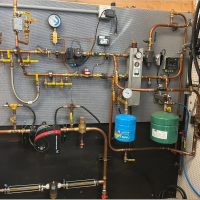
Is it possible that your water flow is blocked? That the boiler is just heating up the water in the boiler, and then hitting the high limit and shutting off? Have you tried watching the temperature gauge on the boiler during a cycle?
 1
-
Well, @hot_rod has given me a "disagree" badge, so let me throw out some numbers.
Imagine you have a house with a heating load of 30,000 BTU/hr. Imagine further that there is radiation that is capable of emitting 30,000 BTU/hr when provided with water at around 170F, so the house is kept at a steady 70F. Imagine still further that you have a boiler capable of putting out 150,000 BTU/hr, and that this boiler has a high limit of 180F, a low limit of 160F and contains 15 gallons of water.
When the water in the boiler reaches 160F, the burner will turn on and start producing 150,000 BTU/hr. The house will be absorbing 30,000 BTU/hr, so 120,000 BTU/hr is being absorbed by the water in the boiler. The water will keep absorbing heat until it reaches 180F, at which point the burner will shut off. That 15 gallons weighs about 125 pounds, it takes 2500 BTU to increase its temperature by 20F. At 120,000 BTU/hr it would take about 75 seconds to hit 180F. Once the burner shuts off the boiler will cool as heat continues to be removed, in about six minutes the boiler will drop back down to 160F and the cycle repeats.
0 -
With the setup I postulated above, no matter what the burner is going to run 20% of the time. If you want fewer, longer runs — say 12 minutes out of every hour — you need two things: someplace to store the heat, and a way of moving the heat out of the boiler.
How much heat do you have to store? If you're running 12 minutes per hour, you have to store 48 minutes worth. At 30,000 BTU/hr that's 24,000 BTU. Traditionally the way you do that is by storing the heat in the house. If you have a house with a heat capacity of 24,000 BTU/F — which would be a reasonable value for a 3-bedroom house — you could store that heat by letting the interior temperature fluctuate by 1F over the course of an hour. But in order to do that you have to have radiation that can move the full output of the boiler into the house.
A heated concrete slab is probably not going to be able to do that. It's certainly not going to be able to do that for 12 minutes and then stop, the way other kinds of heat might. You might be able to use the slab itself as the storage medium, it depends on whether the piping can support transmitting enough heat so that the slab can absorb the full output of the boiler. Just as a rough estimate, if you had 1000 square feet of 4" concrete it would weigh about 40,000 pounds, which would have a heat capacity of about 10,000 BTU/F, so you'd have to swing the temperature by 2.4F in 12 minutes — which seems like a lot to me.
Another option would be to have a buffer tank of water to absorb the heat. If it had the same 20F swing as the boiler, you'd need 1200 pounds of water to store 24,000 BTU, or about 150 gallons.
0 -
Sorry about the disagree badge, it was not intended. I think I changed it?
Bob "hot rod" Rohr
trainer for Caleffi NA
Living the hydronic dream0 -
I'm chuckling.
0



Categories
- All Categories
- 87.9K THE MAIN WALL
- 3.3K A-C, Heat Pumps & Refrigeration
- 60 Biomass
- 430 Carbon Monoxide Awareness
- 135 Chimneys & Flues
- 2.2K Domestic Hot Water
- 6K Gas Heating
- 124 Geothermal
- 170 Indoor-Air Quality
- 3.9K Oil Heating
- 80 Pipe Deterioration
- 1.1K Plumbing
- 6.7K Radiant Heating
- 397 Solar
- 16.2K Strictly Steam
- 3.5K Thermostats and Controls
- 56 Water Quality
- 52 Industry Classes
- 51 Job Opportunities
- 18 Recall Announcements