Welcome! Here are the website rules, as well as some tips for using this forum.
Click here to Find a Contractor in your area.
If our community has helped you, please consider making a contribution to support this website. Thanks!
Buffer Tank Questions

Will be installing a much oversized (for the application) Lochinvar mod-con, KHB-155/Propane.
Issue - Preventing short cycling, even though there are programs available on this boiler such as ramp delay, after reading many similar scenarios the general consensus from all the great contributors on this forum is the use of a buffer tank, just rehabbed my boiler room and now have space for one.
1,100 sq' ranch over a finished walkout, 4 different types of heat emitters, fan coil, heats entire main floor, fin tube base board, (heats half of basement, family room, laundry room and a mud room entrance, a 30"x30" Runtal panel (used as a point of use towel warmer) and radiant under 3/4" engineered hardwood over Warmboard, this is in the most recently finished second half of the basement, a small gym 12'x'22'. The radiant, 250' of Pex-Al-Pex has the lowest estimated figure of 7.5k btu/hr. This boiler has a 10-1 turndown (15.5K), sizing with a run time of 20 minutes comes up with a tank size of 16 gals, 10 minute run time yeilds 8 gallons. SupplyHouse offers two Zilmet Buffer tanks, one at 14 gals and another at 7 gals.
Questions:
1 - With the goal of eliminating short cycling, which tank (7 or 14 gals) do you think would be a better fit with relation to the varied emitter array? I'll be utilizing all three available loop temperature inputs highest at 155f and lowest at 110f
2 - 2 or 4 pipe configurations? Idronics #17 gives a great overview of the two scenarios especially with respect to liquid flow rate and path through the tank. Would the two pipe config be a better fit with the three different types of heat emitters? I don't think a delay in heated supply is a concern in such a small dwelling. The fan coil gets the most use during the heating season, fan coil target temp will be at 155f, I'm thinking the 4 pipe might give a lower return temp?
Some points: 1. Domestic hot water will be from a Lochinvar Squire SIT-040 pumped direct, not through buffer. 2. 3 variable speed circs will be used on the system loops (radiant and towel warmer will share a circ utilizing two separate zone valves. 3. Total estimated capacity of all zones and equipment including boiler and indirect is approximately 17.2 gals, the buffers at 7 and 14 would bring it to 22.72 and 29.72 respectively.
Install will follow the Lochinvar manual; the manual doesn't address buffers directly but does list closely spaced tees or a low loss header, the manual depicts placement of the system return temp sensor just before the low loss header, I'm assuming this sensor obviously would now be installed in the center thermowell of the buffer tank, and the boiler firing rate and primary pump speed will react to the rising and falling thermocline?
The boiler includes a Grundfos UPMS primary loop pump, this will be wired to and controlled by the boilers 0-10v output.
Sorry in advance if a little long winded.😒
Comments
-
Having only 7 or 14 gallons is very small amount of buffer tank for the storage and use of thermal mass in the scheme of things.
0 -
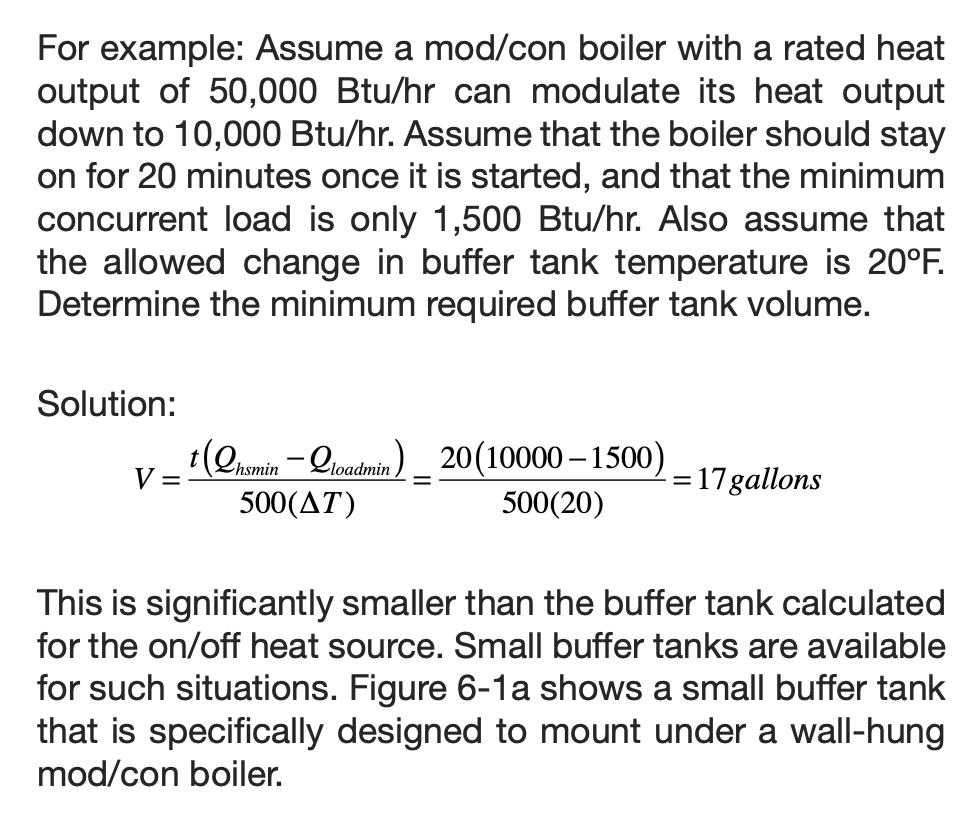
Here is the math to answer the question. Basically the lowest turndown which should be around 15,000 for that boiler, the manual will tell you.
Against the smallest load (zone) it could see.
Shoot for at least a 10 minute run time.
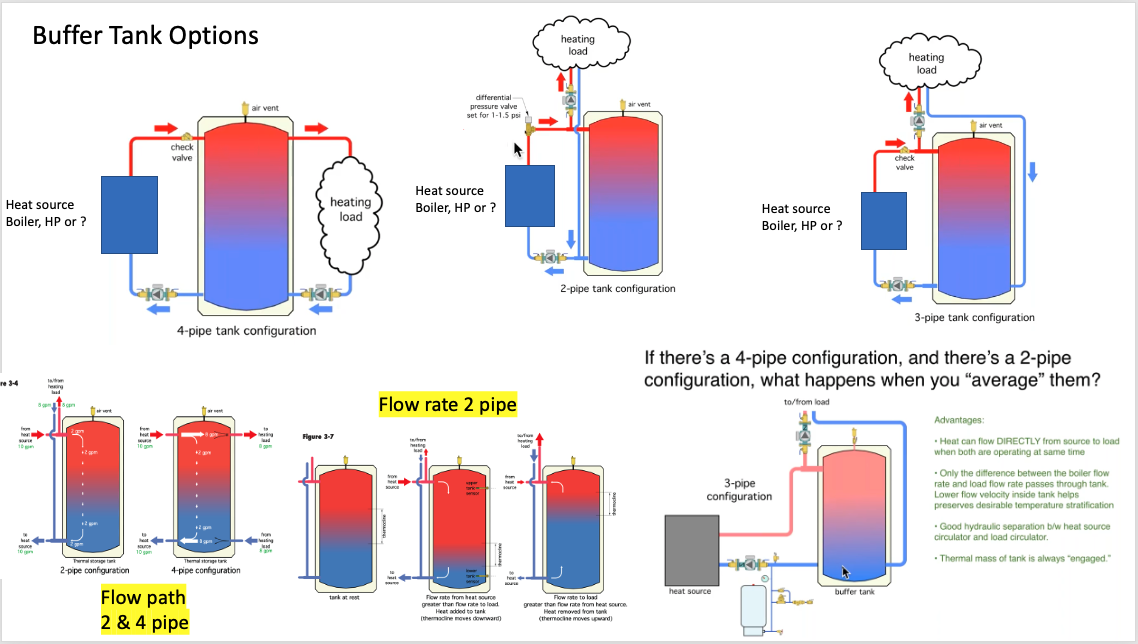
I like the 3 pipe buffer piping. The Zilmet tanks work nicely, good connection size and location, well insulated with a wall mount bracket. I like everything except their piping diagram :)
Direct to load, 3 pipe buffer piping bottom right here.
 Bob "hot rod" Rohr
trainer for Caleffi NA
Living the hydronic dream0 -
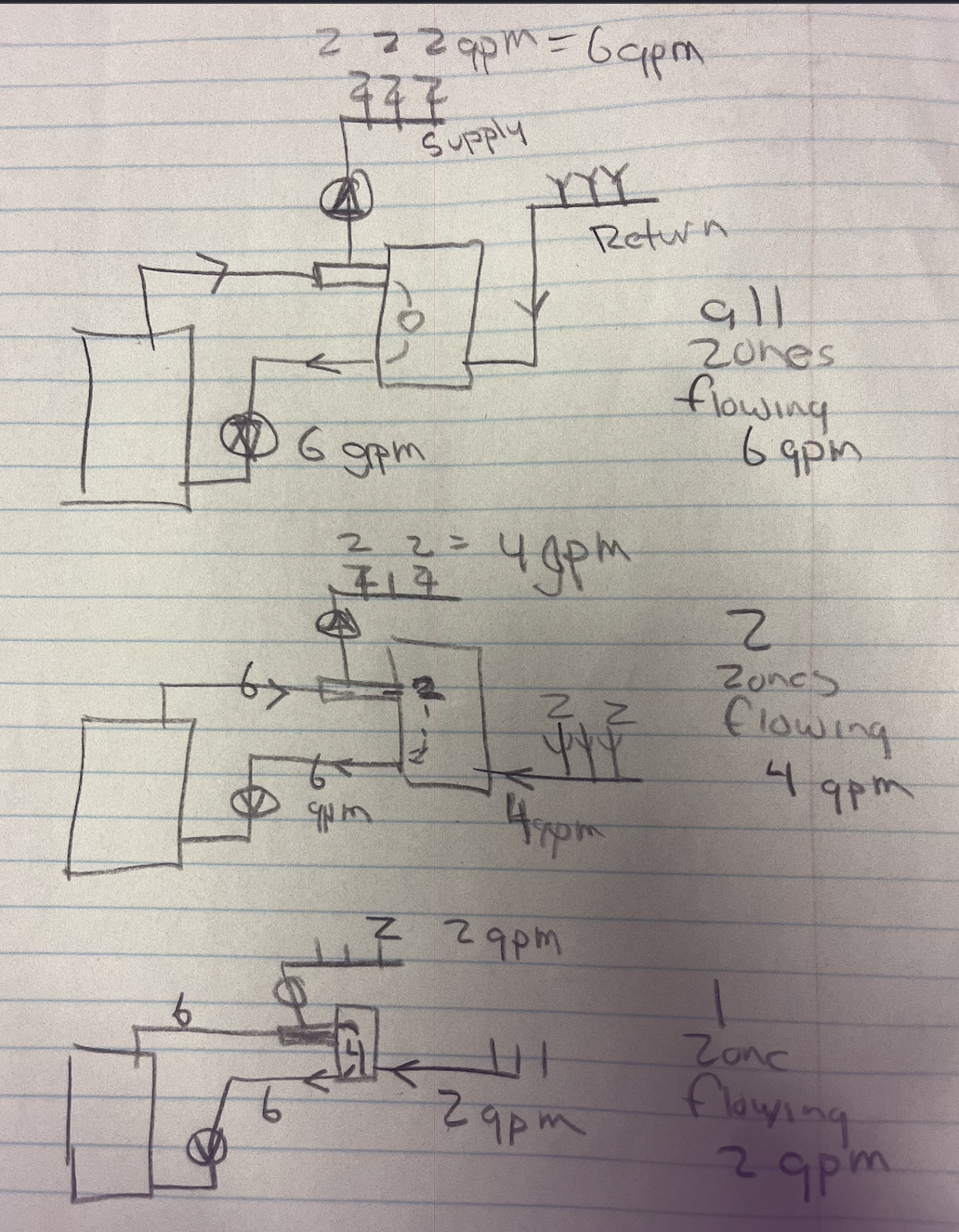
A 3 zone system with zone valves. 2 gpm per zone
Boiler pump is 6 gpm constant, system pump is 6 gpm.
With all zones calling 6 gpm from boiler goes to system, no flow movement through the tank. The large pipe at the tank is a hydraulic separator.
With two zones calling 4 gpm total goes to zones, 2 gpm moves down through the tank.
With 1 zone calling 2 gpm load, 4 gpm moves through the tank.
When all zones are off 6 gpm moves through the tank until it reached the desired temperature. It will stratify a bit.
Next heat call flow comes only from the tank, until it drops low enough to call on the boiler. This is the buffer function at work. The wider that control delta the more tank buffer you get. Try 30 delta. If the system under-heats on the coldest day, try a 25 delta.
 Bob "hot rod" Rohr
trainer for Caleffi NA
Living the hydronic dream0 -
Bob we just fires up a system this week- my guy sent the boiler supply to the bottom and the boiler return at the top. It’s just a 20 gallon tank.
the system supply is at the top and the system returns at the bottom
Boiler is 85k and the heat loss of the home is maybe 1/2 of that. 8 heating zones. Seems like we are “mixing” the entire 20 gallons. Should we swap the boiler pipes ? Won’t take long. It’s heating the home (it’s barely cold here in New England).0 -
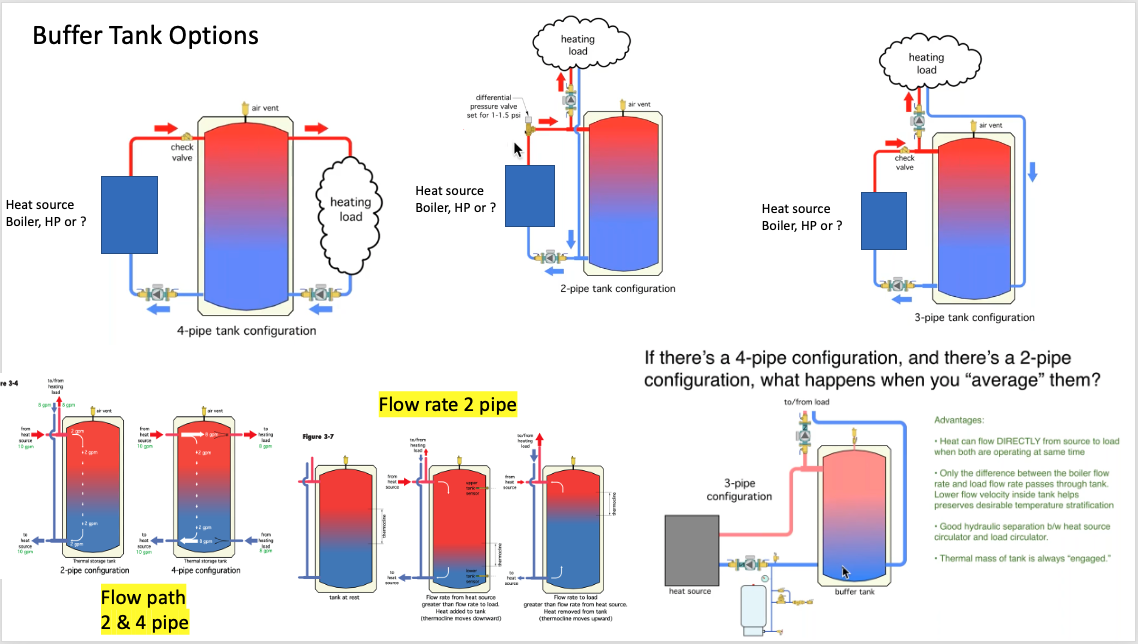
I would suggest the repipe change. Sounds like a 4 pipe buffer?
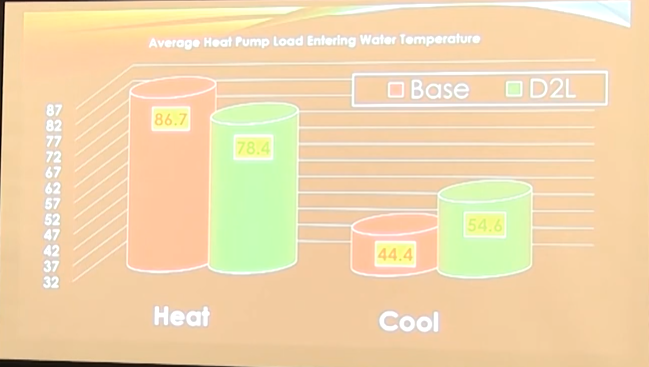
Consider the 3 pipe direct to load, you can pick up about 10% efficiency on the HP. Going from a 4 to maybe 4.4 with a 3 pipe.
The 4 pipe blends the return temperature lowering efficiency. Both with a HP and mod con.
 Bob "hot rod" Rohr
trainer for Caleffi NA
Living the hydronic dream 1
-
Don't know if it will matter much with a small tank like 20 gallons.
1 -
With 6 GPM on the primary loop and 2 GPM on the secondary there's 4 GPM flowing into the buffer tank. With a 20 gallon tank it's turning over every five minutes, there's no stratification happening, it's all going to be at the supplied water temperature. Even with 4 GPM on the secondary it's turning over in 10 minutes.
If you're overpumping and doing, say, 8 GPM on the secondary, that's 2 GPM into the buffer. It's going to stabilize at the return water temperature very quickly.
0 -
stratification happens when loads are off and the boiler takes the tank to setpoint
Granted on these small tanks, it doesn’t add much
It could be argued to just let a small tank like 7-21 gallons cold start, no need to maintain temperature in it, since the volume offers so little stored energy.
The value of a 3 pipe is direct to load and lowest return to the hp or boiler, and a small buffer across the bottom. Its not much piping difference from a 4 pipe
If the goal is to maximize this expensive equipment efficiency and investment.
Regardless of the tank piping choice it should be correct and what the customer paid for.
I think that is GWs question?
Bob "hot rod" Rohr
trainer for Caleffi NA
Living the hydronic dream0 -
"stratification happens when loads are off and the boiler takes the tank to setpoint."
When the loads are off the full 6 GPM is going through the buffer tank, it changes over in a little over 3 minutes. Absolutely no stratification is going to be happening then.
0 -
hot_rod,
Thanks much for your replies and insights on different buffer pipe options, I like your suggestion of the three pipe set-up, Ive been following several similar discussions and you suggested and drew up a diagram to jesmed1 that would mimic my system.
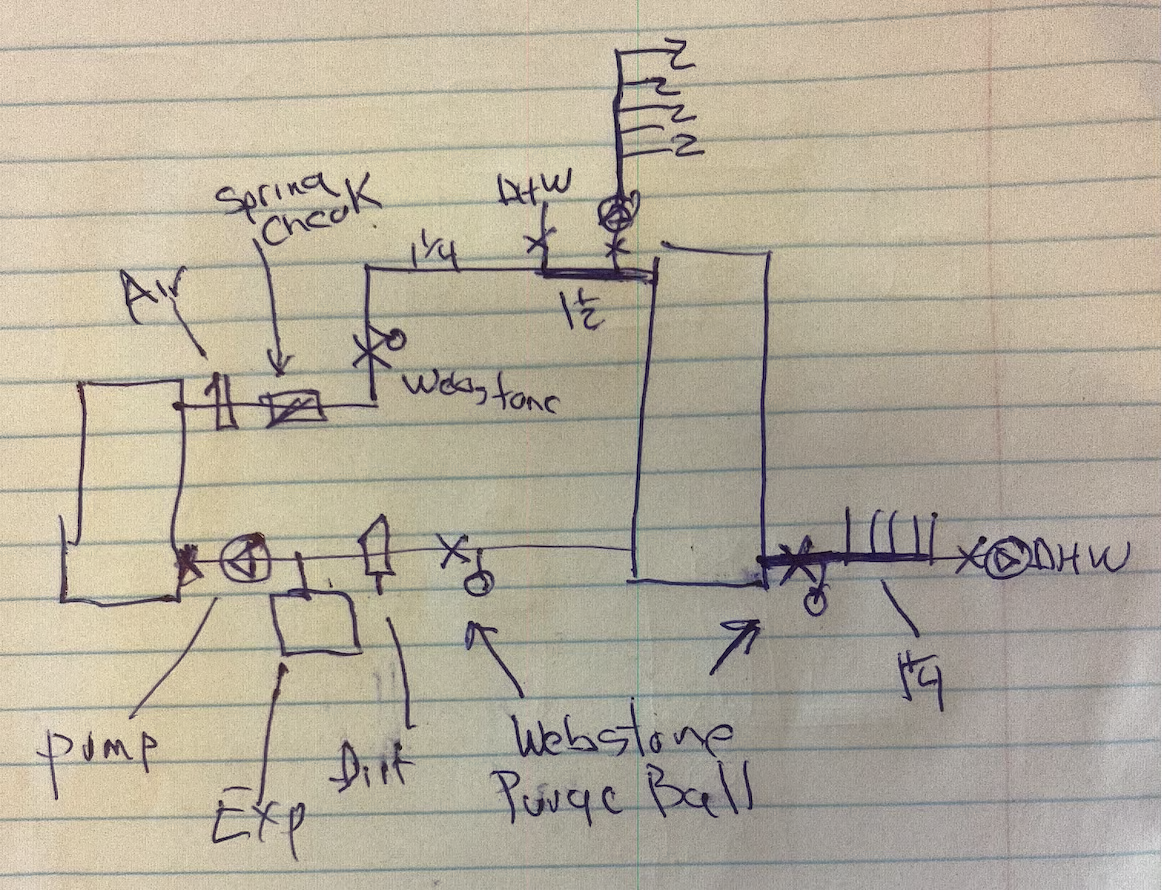
Question: If my Lochinvar supplied boiler pump (Grundfos UPMS 20-78) has an internal check valve, is the spring check you show on the supply line in between the air sep and purge valve necessary?
The large 1-1/2 header will have just two pumps, one going directly to an indirect and another feeding four separate zone valves (I've decided to go ZV in stead of circulators, these two pumps also have internal checks.
0 -
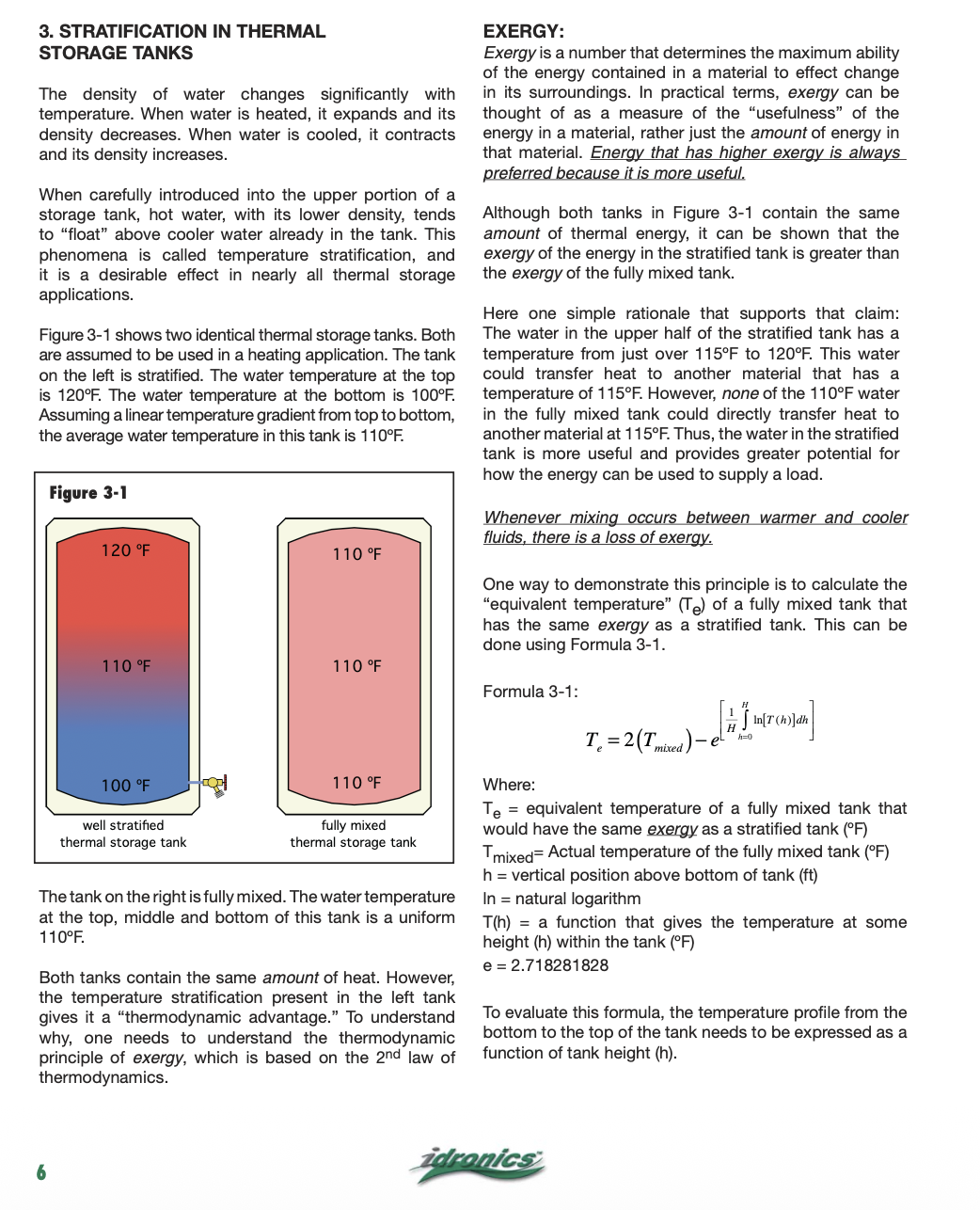
When the loads are off and the boiler/ tank reaches setpoint, no circs are running, no flow through the tank. Hotter water rises just as it does in a gas fired water heater. The boiler side pump runs off the boiler pump relay. No need to run that when no load is present.
In larger tanks there is some value to this exergy available in a stratified tank. It may be worth the chase..
There are a number of way to pipe and control depending on how far you want to take it.
The small tanks are often considered inertial hydraulic separation and have some content for defrost cycles.
When a single tank is used for heating and cooling, flow can be reversed to maximize the tank. A number of piping control options in various Idronics issues.
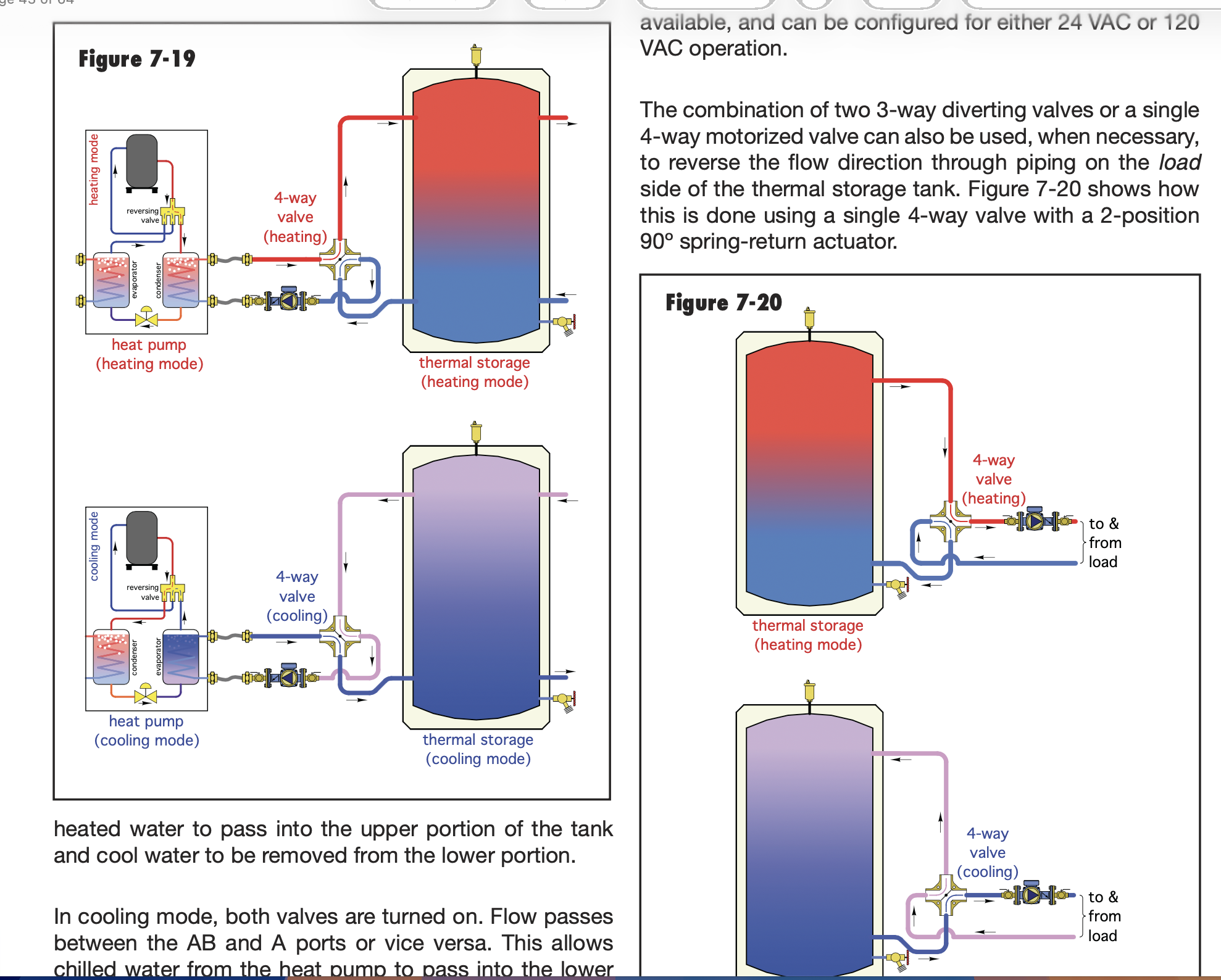
you would not beed an additional check on the boiler loop if the boiler pump has a check
You would need a check in the zone valve pump.
Bob "hot rod" Rohr
trainer for Caleffi NA
Living the hydronic dream0 -
If the tank were a thousand gallons I'd agree with you. But twenty? Come on.
 1
-
I guess you missed where I suggested
 Bob "hot rod" Rohr
trainer for Caleffi NA
Living the hydronic dream0



Categories
- All Categories
- 87.9K THE MAIN WALL
- 3.3K A-C, Heat Pumps & Refrigeration
- 60 Biomass
- 430 Carbon Monoxide Awareness
- 133 Chimneys & Flues
- 2.2K Domestic Hot Water
- 6K Gas Heating
- 124 Geothermal
- 170 Indoor-Air Quality
- 3.9K Oil Heating
- 80 Pipe Deterioration
- 1.1K Plumbing
- 6.7K Radiant Heating
- 397 Solar
- 16.1K Strictly Steam
- 3.5K Thermostats and Controls
- 56 Water Quality
- 51 Industry Classes
- 51 Job Opportunities
- 18 Recall Announcements