Welcome! Here are the website rules, as well as some tips for using this forum.
Click here to Find a Contractor in your area.
If our community has helped you, please consider making a contribution to support this website. Thanks!
Failed Buderus LT200/2 under G215/4 — replacing with vertical indirect, sanity check on plan

Westchester County NY, 1890 house with a 2004 extension. Original hydronic install was done well; I've had trouble finding anyone competent since.
Current setup:
- Buderus G215/4 oil boiler (2004), stacked on a Logalux LT200/2 horizontal indirect (53 gal)
- Radiant: basement slab, entire first floor (aluminum plates screwed to subfloor, 3/8" PEX, ~2000 ft, oak and tile above), master bath(Heatlink manifold for 1st floor (MBR bathroom manifold and slab manifold replaced weith Upinor 6 years ago after HeatLink manifold for those loops failed.
- Baseboard: Runtal panels, 2nd floor, currently 180°F design; Wirsbo PEX supply and return from baseboard
- HeatLink 31320 injection mixing control with outdoor reset on the radiant loop; StatLink thermostats/zone modules
- Two high-temp zones: 2nd floor baseboard, DHW. Third zone roughed in for 3rd floor, not commissioned
- Three Taco 007s, all original
The failure: Tank perforated. Water along the whole jacket seam, saturated insulation, drips across the length. First symptom was a weeping drain nipple with green crusting — dezincified brass. Anode was serviced once at year 16 and came out a stub. Nobody would service it again: it's behind a 12-16 bolt gasketed flange and every contractor refused or wanted a waiver on broken bolts.
Three things I've discovered along the way:
- No mixing valve, tank aquastat set to 150°F. Undiluted 150 to every fixture for 22 years. I assume that's what killed the brass.
- Expansion tank teed ~15 ft (PEX, including a 7 ft vertical riser to the ceiling) from the water heater cold inlet. PRV was added ~10 years ago with no expansion tank; T&P started discharging; a tank was added at that distance and the discharging stopped — but since then all cold taps run hot briefly after a boiler cycle. Plumbers blamed hot and cold pipes touching. My read is that ~0.9 gal of expansion overshoots the tee and charges the cold distribution. Amtrol ST-12, 50 psi precharge, untested against actual static.
- No DHW priority. The tank is just another high-temp zone.
The plan:
- Vertical stainless indirect (~52 gal) beside the boiler — leaning Lochinvar Squire SIT050, Weil McLain AquaPro (633-500) or HTP SuperStor Ultra
- Leave the dead LT200 in place as the boiler's stand, drained and capped, wet foam stripped
- Boiler does not move
- Re-tee expansion tank within a foot of the cold inlet, replace it, precharge to measured static
- Heat trap nipples; coil tied in before the mixing valve with 16" thermal drop
Possible modifications:
- ASSE 1017 mixing valve, store 140-150, deliver 120
- DHW priority via DPDT relay on the tank aquastat, NC contacts breaking the baseboard demand and the StatLink DC demand at 31320 terminals 3-4, with a timeout
Questions:
- Anything wrong with leaving a dead LT as a pedestal long term?
- 316L vs 444 for this — my water dezincified brass at 150°F. Preference?
- Better way to do priority given the StatLink DC bus (or is it overkill to do this)?
- The 31320 has a boiler-return protection setting defaulting to 135°F. The G215/4 is Thermostream with no minimum return temp. Should that be disabled?
- Boiler is 22 years old, plate says 196 MBH input / 149 MBH net IBR, combustion tested recently (March/April). Keeping it — anything that would change your mind?
Thanks.
Comments
-
Your Buderus is a cast-iron boiler, so even with the Thermostream design, I would still protect the boiler from extended periods of low return-water temperature—say, longer than 10 minutes. I like 135°F as a minimum return temperature for Buderus cast-iron boilers.
Using the abandoned water heater as a stand is no problem. I have done that before, and an empty tank will still support the weight of the boiler on top of it.
Remove that tank when it is time for a new boiler in 20+ years or so.
I will check out your other queries and get back to you
Edward Young Retired
After you make that expensive repair and you still have the same problem, What will you check next?
1 -
If you go stainless check your chloride levels, on the SuperStor
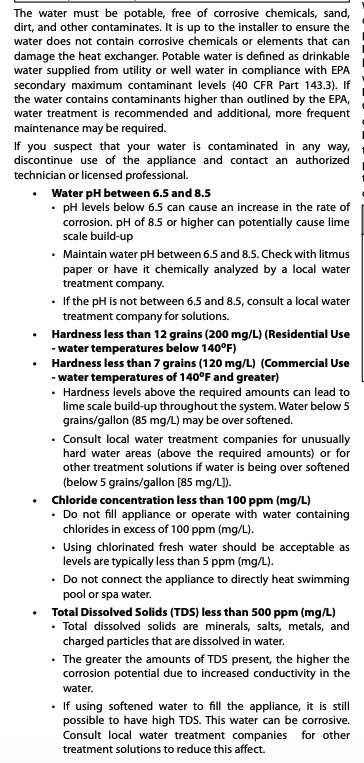
Glass lined steel tanks can last a long time, they are not so sentive to Ph, chloride and TDS.
I think the Buderus is a steel tank?
Bob "hot rod" Rohr
trainer for Caleffi NA
Living the hydronic dream0 -
If the water chemistry isn't agreeable with the stainless, a glass lined tank with a powered anode is another option.
what controls does the buderus have built in? might be able to do the dhw priority directly or with a module. The relay and timer is probably cheaper if you have to buy a module but integrated in to the boiler would be easier to troubleshoot and for the next person that looks at it to understand and would be neater.
0 -
If you are going to keep the domestic hot-water temperature above 120°F, then I believe 140°F is acceptable, but you should use a mixing valve whenever the stored water temperature is set above 120°F.
For the DHW expansion tank, locate it as close to the water heater as practical on the cold-water inlet. Keep the pipe from the tee fitting to the expansion tank as short as possible.
The air pressure in the expansion tank should be set to match the incoming water pressure from the street. This air pressure must be measured with the tank isolated from water pressure on the system side.
For example, if the tank is precharged to 40 PSI and you connect it to a 60 PSI water system, the 60 PSI water pressure will compress the air side of the tank until it also reaches 60 PSI. If you then measure 60 PSI at the air valve while the tank is already partially filled with water, that does not mean the tank was properly precharged to 60 PSI. It means the system pressure has compressed the air charge.
If the tank is already partly full of water, there is less air volume available to accept thermal expansion.
Edward Young Retired
After you make that expensive repair and you still have the same problem, What will you check next?
 2
2 -
the hot water needs to be 15 degrees hotter than the mixed outlet for the 3 way thermostatic valves to regulate proper
It varies from brand to brands , some require as high as 27 degrees, check the installation instructions
Bob "hot rod" Rohr
trainer for Caleffi NA
Living the hydronic dream0


Categories
- All Categories
- 87.9K THE MAIN WALL
- 3.3K A-C, Heat Pumps & Refrigeration
- 60 Biomass
- 430 Carbon Monoxide Awareness
- 133 Chimneys & Flues
- 2.2K Domestic Hot Water
- 6K Gas Heating
- 124 Geothermal
- 170 Indoor-Air Quality
- 3.9K Oil Heating
- 80 Pipe Deterioration
- 1.1K Plumbing
- 6.7K Radiant Heating
- 397 Solar
- 16.1K Strictly Steam
- 3.5K Thermostats and Controls
- 56 Water Quality
- 51 Industry Classes
- 51 Job Opportunities
- 18 Recall Announcements