Welcome! Here are the website rules, as well as some tips for using this forum.
Click here to Find a Contractor in your area.
If our community has helped you, please consider making a contribution to support this website. Thanks!
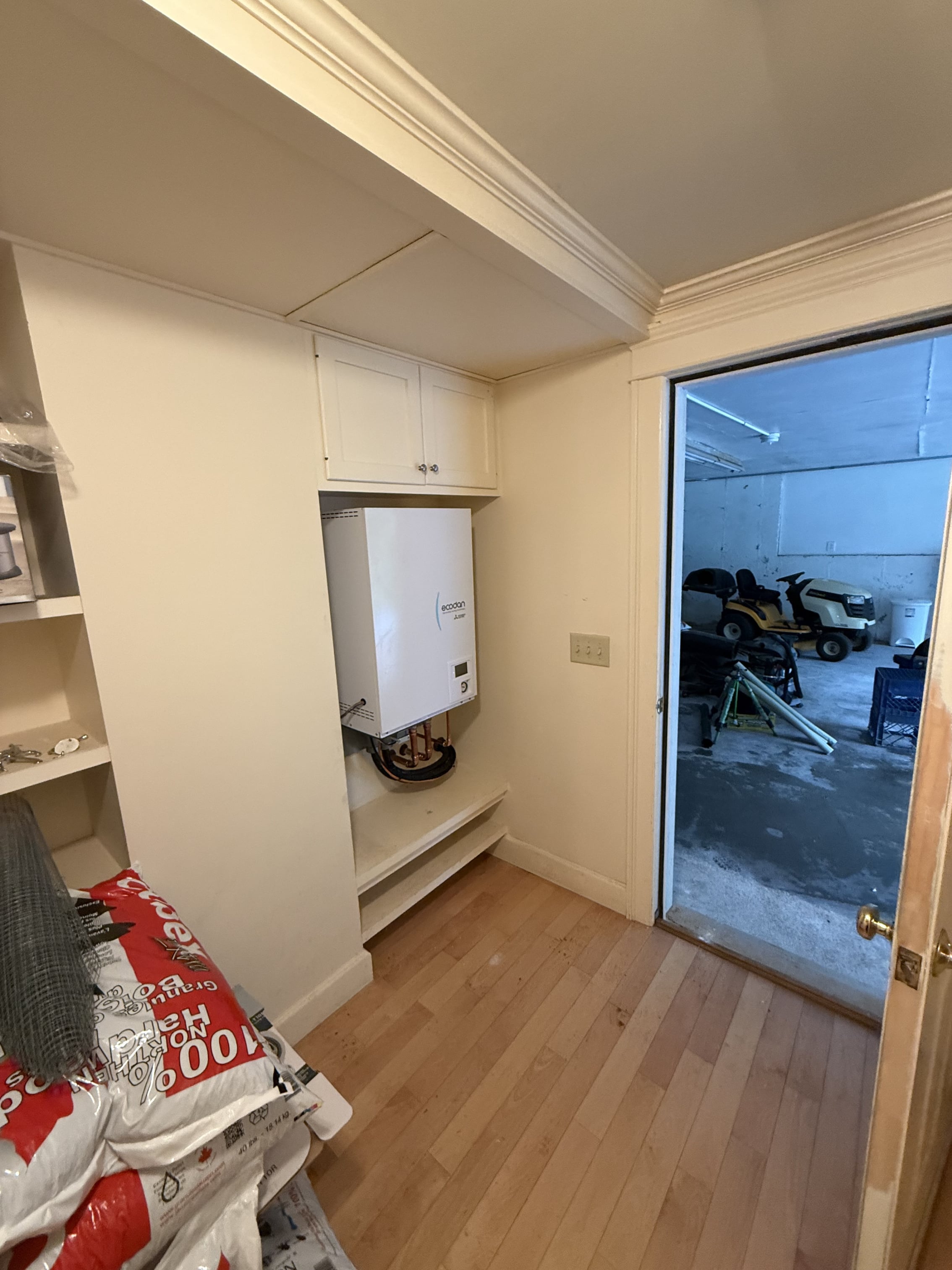
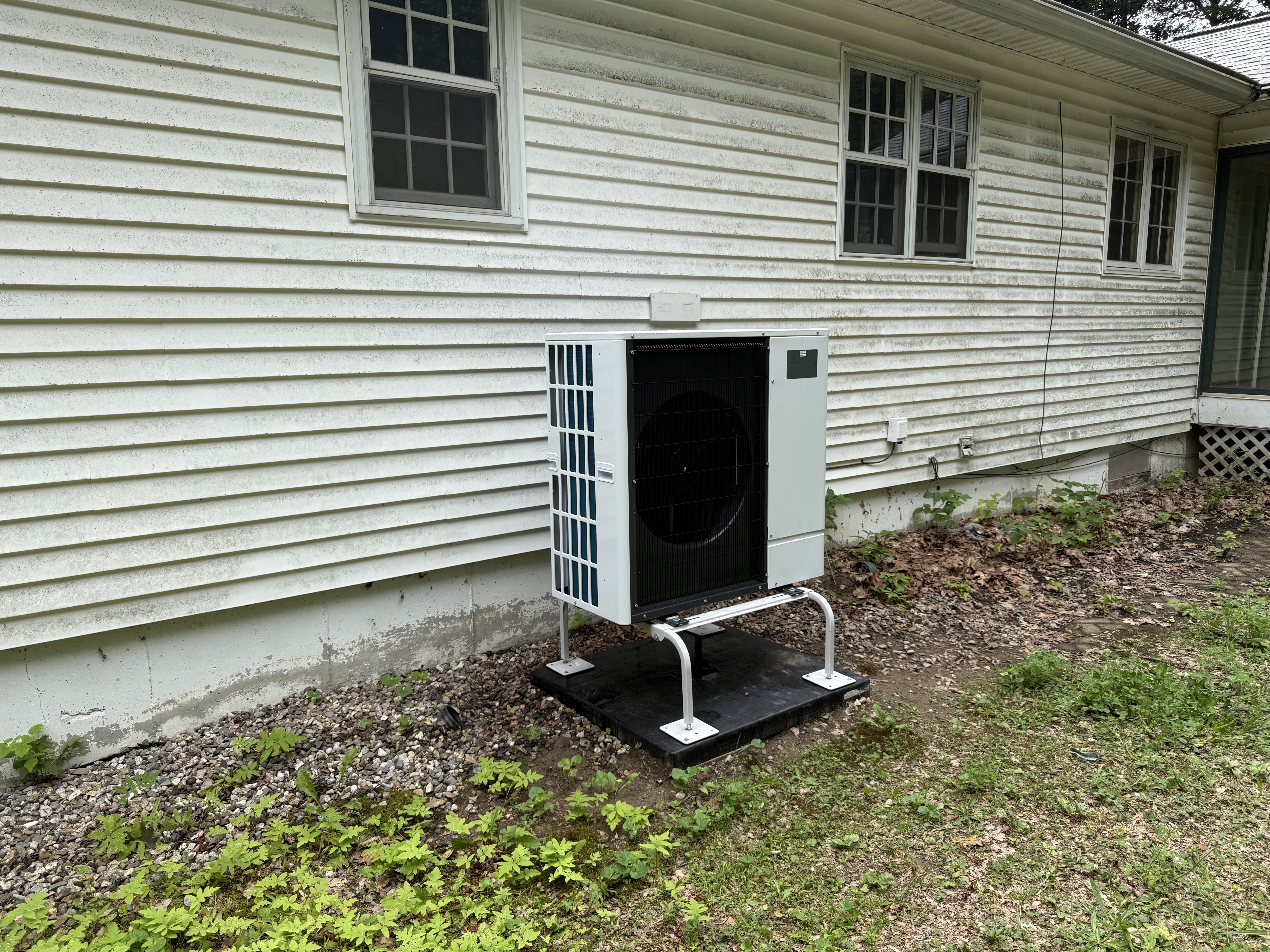
Mitsubishi EcoDan heat pump
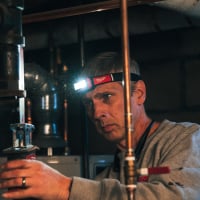
“first time for everything”, as they say. The nice homeowner did not seem too phased with the fact that I hadn’t installed one of these yet. I told him I could do it, and he believed me!
We found a place for the Hydro box in the hallway of this raised ranch style home. I think it tucked in there pretty nicely. We could’ve put it in the mechanical room but that would’ve forced the need for some ventilation grilles. Plus, the room is getting a little stuffy.
https://youtube.com/shorts/ay4SxMp3Iaw?si=1CXq2B4wCR1gfHs7


Comments
-
Never mind it’s right
0 -
That’s clean! Can you tell us a little more about the application and how it started up?
0 -
Matt yes it was a Vitodens 100, I’m guessing 8 years old. Propane. Baseboard, late 1980s home. Max temp is 158 which is always a concern with air to water. homeowner also wanted more heat emission so we replaced Sterling Kom Pak in two rooms and installed Senior. Two bathrooms we pulled 3 feet and installed Runtals. The smaller bathroom was a three tier and the bigger bathroom was a four tier.
Day one was figiting the new heat emitters. I can just about install baseboard (installed thousands of feet in the 90s) in my sleep but sure enough the living room gave me a little problem because somehow there was a bump in the Sheetrock.
day two was setting the outdoor unit, indoor hydrobox, ran the AC piping.
The Electrician went over there and wired up
day three I yanked the boiler and piped everything in, buffer , connected to existing zones. Had to hustle, got the existing water heater going. I was by myself, but the local vendor/rep offered a hand here and there. He flipped the dip switches, I made some notes. System fired up, water heater started warming up.
day four we swapped out the indirect water heater for a new one, and did a bunch of loose ends, tidy things up.
did not break any speed records, but all in all everything came in where I expected, numbers wise. But all in all a good time
 1
1 -
Nice! Did you use the EcoDan zone controls or tie it in with the existing zone setup?
0 -
-
Matt not sure if you clicked the youtube. We kept the existing Taco zone control. There seems to be some confusion regarding zone controls- HO thought we needed Mitsubishi controls too. We simply ran the end switch from the Taco to the hydro box.
0 -
HVAC- nothing was wrong with the Viessman. He just wanted to go Electric, take on some rebate money.
0 -
nice install! What temperature are you running for heat? Does it have ODR control?
Bob "hot rod" Rohr
trainer for Caleffi NA
Living the hydronic dream0 -
HR I need to better understand how the unit is working with outdoor temperature. I told the rep guy that I wanted pedal to metal when there was a call for heat.
0 -
The wiring for the indirect goes to the Taco panel or to the Mitsubishi? I would assume there's a DHW connection in the Mitsubishi so it can go pedal to the medal for DHW. You said you only ran a wire from XX in the Taco panel to the hydro box. So simple on/off controls just tell the Mitsubishi to supply heat. Heat based on all its thermistor readings. Including outdoor. Unless there's a "pedal to the metal" dip switch for heat.
0 -
it is not unlike a mod con in that the lower SWT you run the more efficient they are. So on a design day find the max. Temperature required, the set the IDR curve from there. It may take some trial and error to find the sweet spot.
You want an indirect with a huge coil surface to use with a hp, as you will not get boiler type temperatures to re over the tank. Viessmann, HeatFlo and others have tanks that work well with heat pumps.
Bob "hot rod" Rohr
trainer for Caleffi NA
Living the hydronic dream0 -
HR yes, I will look into that. Baseboard as you know is a high temperature system, so sweet spot is the correct terminology. If the temperature is too low, the heat pump will go and go, and not produce the necessary level of heat. Both ends of the spectrum can waste energy.
HVAC- sorry, I wasn’t clear, the Mitsubishi has a dedicated DHW sensor. It also has sensors on the supply and the return, at the buffer tank
0 -
Glad to see more of these out there, they are the cheapest heat source if your electricity is reasonable or have solar.
Another thing to watch is over-pumping the secondaries. Looks like each zone has its own pump, it is very easy for those types of setups to have 2x to 3x the primary flow rate on the secondaries.
What this does is essentially mix down the supply water from the heat pump with the return water from the zone, so zones effectively are getting colder water than what the heat pump is putting out.
Not a huge issue with a modcon, just crank up the curve, but with a heat pump it means you have to supply higher temps which hurts COP. This is not a small effect at design day, you could be using 25% to 30% more power to essentially over-heat the water to satisfy the emitters.
Good check is to run all zones and heat pump at max till steady state. You want the secondary delta equal or higher than the primary loop.
0 -
I also love the idea of A2W heat pumps, and hope I can use one some day in my home, but I want to point out that this claim is not really true in most parts of the country with reasonably priced natural gas:
they are the cheapest heat source if your electricity is reasonable.The stated COP on this unit, even in fairly mild outdoor temperatures (say, 35F) is still under 3. Lets call it 3 for the whole season. For this to beat an appropriately sized mod-con in energy cost terms, you need the total electricity consumption to deliver a fixed BTU output to be cheaper than this heat output in gas terms. Suppose your load is 50,000 btu. At a COP of 1, that requires 14.65 kwh of electricity, so at a COP of 3 it requires 4.88 kwh of electricity. In my neck of the woods (suburbs north of Chicago, where gas and electricity are both reasonably priced), marginal electricity prices are about $0.18/kwh, and marginal gas prices are about $0.85/100000 btu. So at a COP of 3, this unit costs almost twice as much to operate as a 95% efficient modcon.
In Massachusetts, both natural gas and electricity are about 50% more expensive than in Illinois, so I think these comparisons probably hold?
The math is probably better if you are comparing against propane or oil (and in oil's case you would have an additional efficiency loss most of the time), or if you do indeed have nearly free electricity from your own solar PV panels, but heat pumps still have a ways to go in terms of being cheaper to use and unfortunately they are still much more expensive to buy and install in the first place.
0 -
85 cents per therm after taxes fees etc puts you into the cheapest natural gas rates in the whole country though, thats not just reasonable price, thats in the lowest possible bracket. only 2 states in the whole country average that rate or approximately one half of one percent of all americans would fall into that price range. if that marginal price doesn't include taxes fees etc then that would make sense, but its also not a usable number.
0 -
Yes MA has very high elec rates. He jumped off propane. Some people want Electric heat- I just nod my head. Not my job to say no.
I have Nat at my home, I will be staying with what I have
0 -
Note that I said "marginal" and not average, and marginal prices will be lower than average prices. Its true that there are other parts of a natural gas bill, but many of these do not vary with your consumption, and that is what is relevant for thinking through the heat pump vs. boiler/furnace question.
The general formula is this: if
gis your price of natural gas per 100,000 btu, andeis your price of electricity per kwh, you neede < (g * COP) / (0.95 * 29.3)in order for a heat pump to deliver heat less expensively than a 95% efficient gas device (a mod-con boiler, or a high efficiency furnace, for example). With a COP of 3 (which I think is generous) this means your price per kilowatt hour needs to be 11% of less of your price per therm.You can find average delivered retail electricity prices (per kwh) here and average delivered natural gas prices (per MCF, so divided these by 10 to get price per 100,000 btu) here. If you use these you will see that there are many states where average prices are at ballpark break-even, heat pump wise. However, its important to remember that these aren't actually marginal prices, and its similarly important to remember that you don't actually get a COP of 3 across the heating season.
1 -
I think an error in calculations come in when you look at the mod con efficiency.
85- 87% is a more realistic number if it does DHW, and heating with SWT say 150 or so.
As soon as the mod con stops condensing, that efficiency drops. I think a low temperature radiant, below 120 SWT is about where you get into 90%
My only thought on this job is what SWT will be needed on design days. Hopefully the radiation allows below 158° SWT, or else resistance may kick in and now you have 1 COP! That will get $$.
It might be worth looking in to disconnecting the resistance element. Or at least understang how and when the element kicks in to help. On my system you can do that in the programming.
Maybe it wasn't doable on this job, but I would encourage buyers to keep the fossil fuel backup. At least for a season to get some actual run time data.
I'm glad to see pros like @GW taking the plunge. Properly applied they are a wonderful heat source.
Now sell some PV to go along with the install!
Bob "hot rod" Rohr
trainer for Caleffi NA
Living the hydronic dream2




Categories
- All Categories
- 87.8K THE MAIN WALL
- 3.3K A-C, Heat Pumps & Refrigeration
- 60 Biomass
- 430 Carbon Monoxide Awareness
- 133 Chimneys & Flues
- 2.2K Domestic Hot Water
- 6K Gas Heating
- 124 Geothermal
- 170 Indoor-Air Quality
- 3.9K Oil Heating
- 79 Pipe Deterioration
- 1.1K Plumbing
- 6.7K Radiant Heating
- 397 Solar
- 16.1K Strictly Steam
- 3.5K Thermostats and Controls
- 56 Water Quality
- 51 Industry Classes
- 51 Job Opportunities
- 18 Recall Announcements