Welcome! Here are the website rules, as well as some tips for using this forum.
Click here to Find a Contractor in your area.
If our community has helped you, please consider making a contribution to support this website. Thanks!
Black pipe to Cast iron

Are the compatible? Working on a 100-year-old heating system. I am going to go from old cast iron to black pipe if it will work. After that copper to the new furnace. And what's up with malleable iron pipe?
Comments
-
Cast iron is typically DWV pipe, I have not seen threaded cast pipe? The fittings may be forged type however. Most fittings are malleable steel now also.
Common black steel pipe schedule 20, 40, and 80 is the same OD and will take a NPT thread.
Bob "hot rod" Rohr
trainer for Caleffi NA
Living the hydronic dream0 -
So the pipes going to the cast iron radiators are not cast iron? But the elbows and such might be? I think people have suggested the fittings will crack if that's what it takes to remove them. Maybe I misunderstood?
0 -
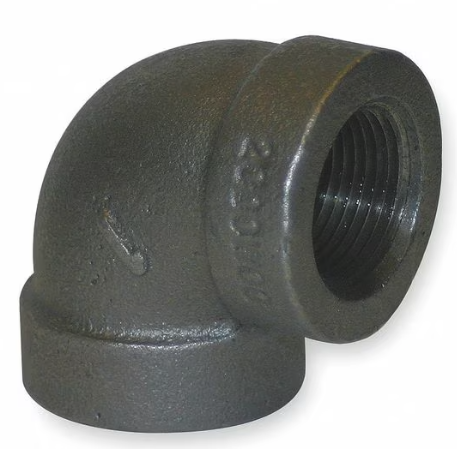
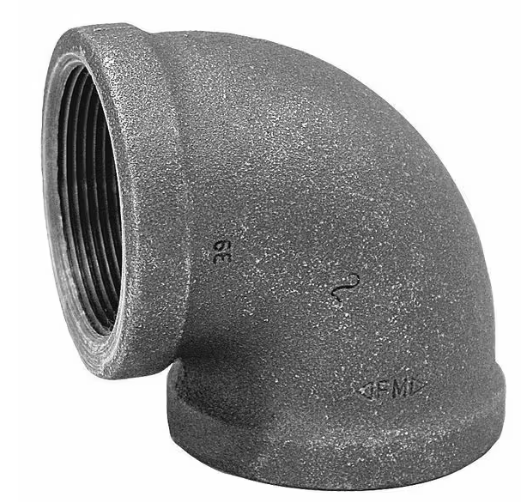
Here is what the fittings typically look like. The heavier, thicker hub is an iron that you can split with two hammers.
The lighter version is a steel, it will not crack, you need to saw a notch or two and peel away the fitting, or nipple inside.
If you plan on splitting fittings with force, gloves, face shield, hat maybe the hard type, long sleeve clothes, pieces can fly.
You can find videos of plumbers splitting fittings. An Instragrammer recently showed a concrete anchor gun being used to split cast fittings!
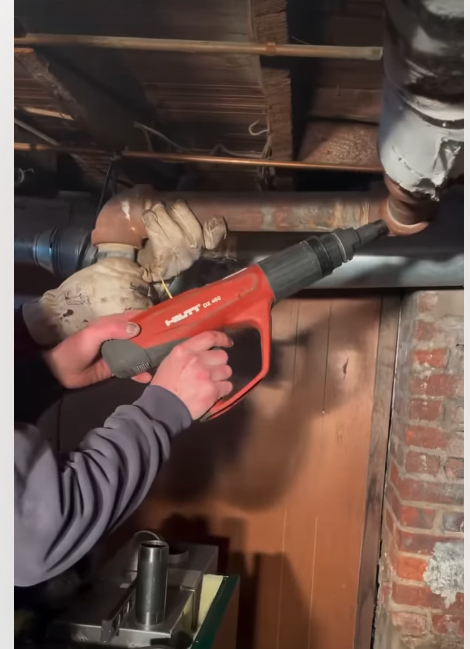
https://www.instagram.com/reels/DGI5R1tRQTG/
 Bob "hot rod" Rohr
trainer for Caleffi NA
Living the hydronic dream1 -
Bob "hot rod" Rohr
trainer for Caleffi NA
Living the hydronic dream1 -
Got it. I did see similar videos. We used to call them Hiti guns. Brand name of course but it's the type of nail gun that uses what we called shots. Basically, like a blank that would be use in a pistol. We used them to drive nails into steel beams on one job we did. Those things are no joke. Thank or the help.
0 -
The fitting used on steel pipe systems are usually malleable iron or cast iron as @hot_rodmentioned. Cast iron fitting are more brittle and can be broken with 2 hammers if you know how. Malleable iron you can't crack with hammers. You can use either type of fitting on hot water or steam heat. Malleable is more common now and some suppliers don't stock both. In the old days CI was more common for heating systems. CI cannot be used on gas.
You may run into some brass fittings or galvanized fittings as well but not as common except for brass valves.
The pipe has always been steel or wrought iron. Wrought iron was used more for underground use as they say it is more rust resistant. You don't see it much anymore. Steel pipe is commonly sold and is what every place stocks either at a supply house or a big box store.
 2
2 -
it seems like a ricochet could be deadly using the desa or remington…
1 -
Exactly Ed. We used to come across very old wrought Iron pipe. It used to take 2-3 times longer to cut out. Mad Dog
0 -
The cast iron pipe that you referenced is most likely wrought iron pipe and "yes" it is compatible with steel pipe. A M Byers , the maker of wrought iron pipe was in business from 1930 until 1969 in Ambridge, Pa, a suburb of Pittsburgh, Pa. I used to see a lot of this type of piping in very old steam and hot water heating systems. It was great for the heating system's return piping since it resisted corrosion much better than steel pipe. You could thread this pipe but why would you since it could not be bought after about 1970. Any time we needed to replace this type of piping we just used sch 80 black pipe on steam systems below the water line and sch 40 above the water line and sch 40 on all hot water systems and cast iron fittings.
0 -
Ductile iron or more accurately ductile cast iron, is what is commonly used for underground piping. It is not brittle like cast iron pipe that is used for sewer and drain work.
Bob "hot rod" Rohr
trainer for Caleffi NA
Living the hydronic dream 1
1 -
Naming is hard in every industry but the heating industry seems to really go out of their way to make things impossible to understand.
A steam boiler boils water (of course)
A hot water boiler doesn't boil water at all!Cast iron fittings are cast (of course)
But so are the malleable iron fittings! (both of these are called black iron)"Black iron pipe" is actually just steel pipe (sometimes painted black! But sometimes with a black oxide coating from manufacturing)
If I'm wrong about any of these (and probably definitely even if I'm not!) there will be other opinions!NJ Steam Homeowner.
See my sight glass boiler videos: https://bit.ly/3sZW1el0 -
Yes, it is confusing more than it needs to be for sure.
Don't know if it is true but I was told the 10' sticks of black pipe (bigbox)come from Canada. The 20' lengths are domestic and have varnish coating not that any of this matters.
From what I know CI and Malleable Iron come from the same metal. Malleable fittings are then heated and held at a specific temp for a certain time to make them malleable. Like annealing steel I guess.
Back in the day when New England was 80% oil heated (and a lot of it was heavy oil) we did a lot of underground oil tanks up to 20,000 gallons. The underground was always black pipe usually 2" and smaller but some larger jobs could be 2 1/2" or 3". Some engineers specified wrought iron instead of steel underground because it was considered more corrosion resistant. You could tell wrought iron from steel because it would have a stripe of red paint on it. It is more difficult to thread.

 2
2


Categories
- All Categories
- 87.8K THE MAIN WALL
- 3.3K A-C, Heat Pumps & Refrigeration
- 60 Biomass
- 430 Carbon Monoxide Awareness
- 133 Chimneys & Flues
- 2.2K Domestic Hot Water
- 6K Gas Heating
- 124 Geothermal
- 170 Indoor-Air Quality
- 3.9K Oil Heating
- 79 Pipe Deterioration
- 1.1K Plumbing
- 6.7K Radiant Heating
- 397 Solar
- 16.1K Strictly Steam
- 3.5K Thermostats and Controls
- 56 Water Quality
- 51 Industry Classes
- 51 Job Opportunities
- 18 Recall Announcements