Welcome! Here are the website rules, as well as some tips for using this forum.
Click here to Find a Contractor in your area.
If our community has helped you, please consider making a contribution to support this website. Thanks!
Sludge covered electrodes and nozzle

Hi, I posted last year on this list when I was troubleshooting my Axeman Anderson hot water boiler. The responses I received were very helpful and informative and gave me enough information to get the boiler working correctly for the upcoming heating season. Thank you to all who responded with suggestions.
I installed new electrodes, a new cat eye, new nozzle and adjusted the electrodes using a Beckett gauge for the proper positioning. I was able to get the ohms reading from 5000+ down to 1000. When everything was finished I had a professional come over and check to make sure it was burning efficiently. It ran all winter without a problem. Now it's summer and time to get it ready for next winter. I started by pulling out the electrodes and nozzle and found that they were covered with a black oily substance. See photos. What would cause this sludge to build up on the nozzle and electrodes?
To me, the non professional, it appears as though the oil isn't burning completely. is it because the electrodes aren't positioned correctly or maybe the nozzle is not atomizing all of the oil?
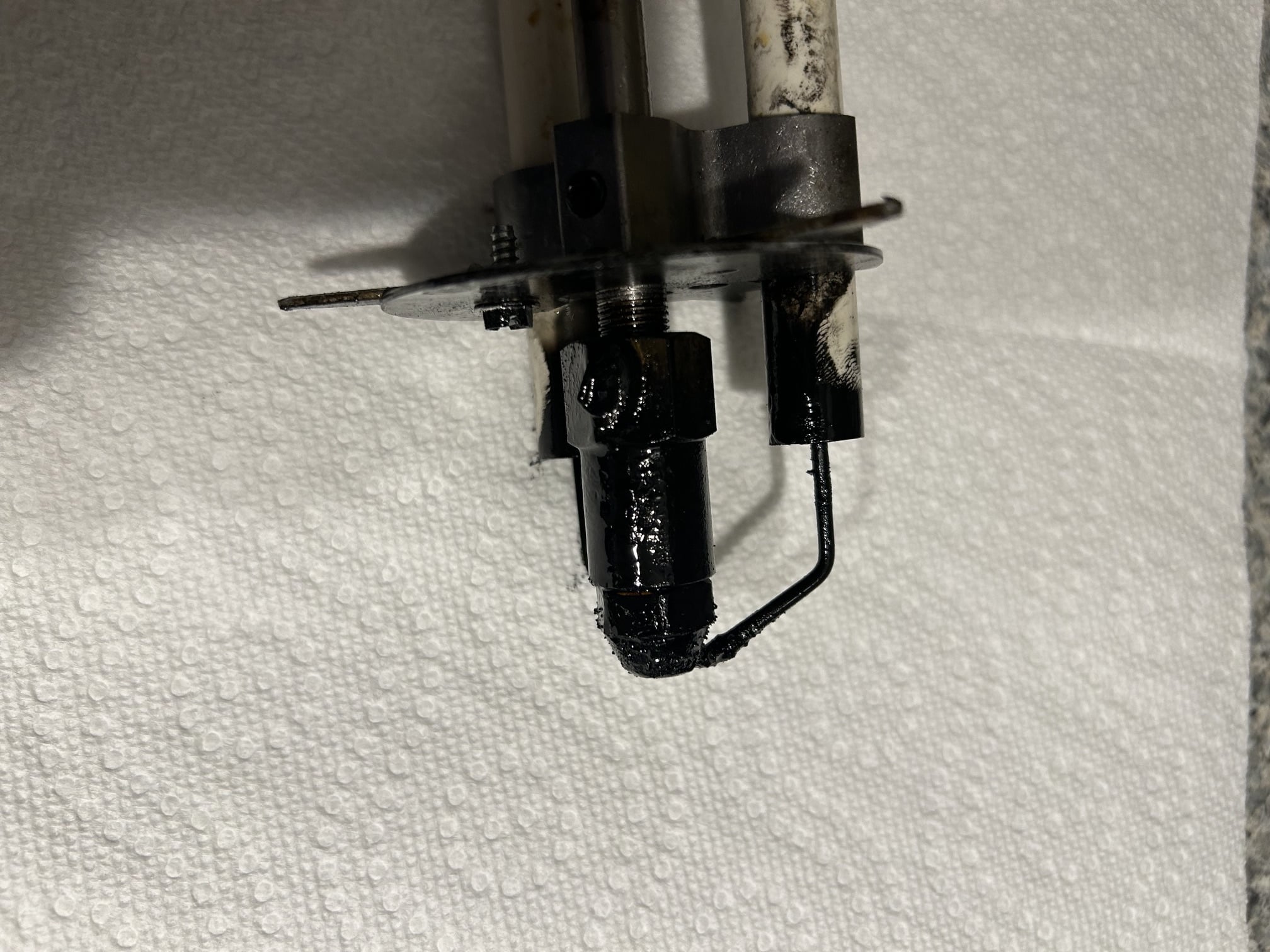
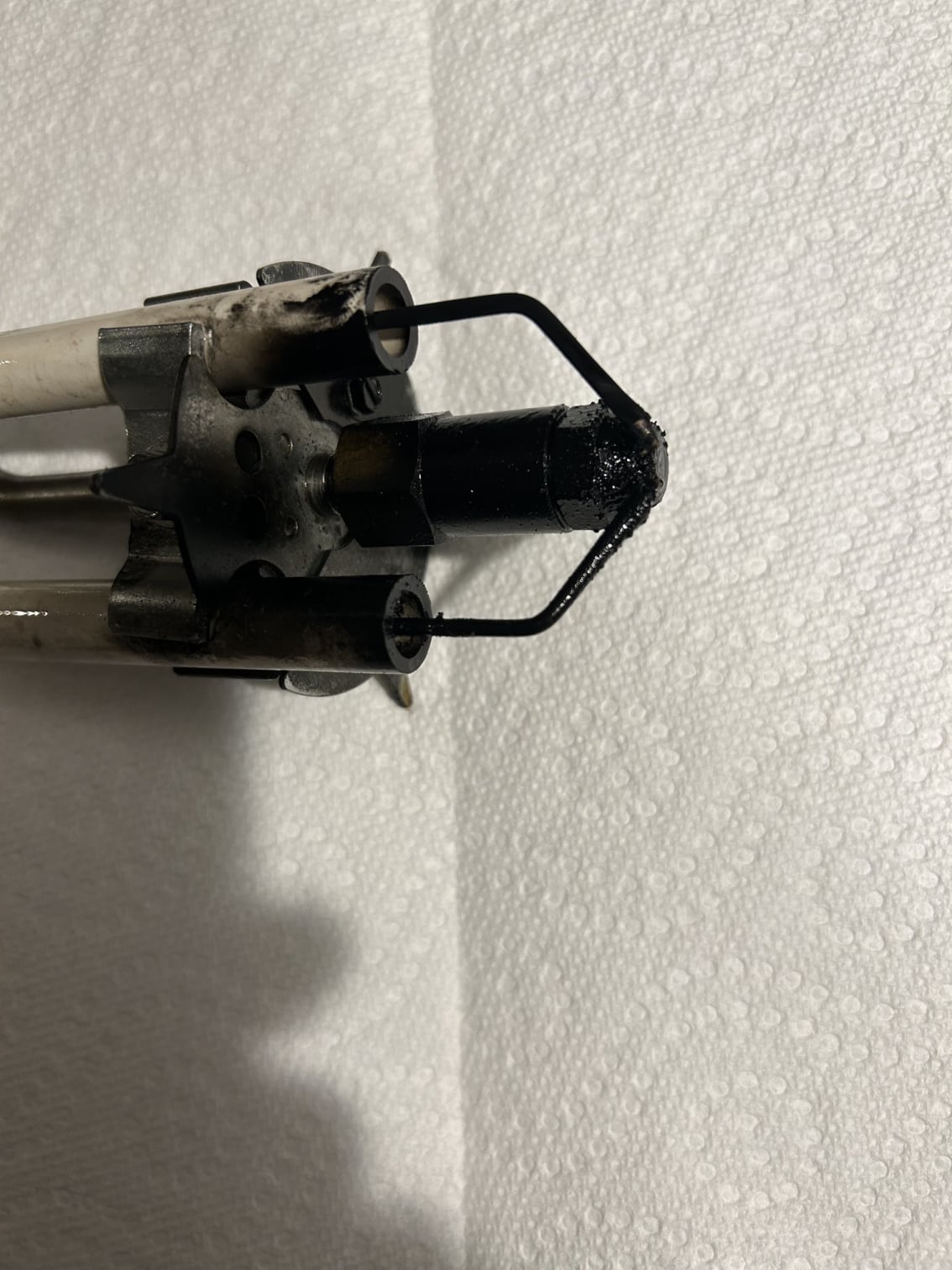
Comments
-
Could be a few things.
Could be improper draft caused by improper set up or depressurization in the combustion zone-things like high efficiency clothes dryers, whole house (attic) fans, dirty burner blower wheel, chimney issues.
Also non pre & post purge, incomplete combustion, partial plugged nozzle, poor/failing pump cut off.
Where should we start.0 -
the last time the parts were changed was a combustion analyzer used?
0 -
Did the "professional" use a digital combustion analyzer last year?
Lots of things could be causing this.
0 -
Draft, way too much air, Z dimension.
Whats the head look like? Put a flashlight down the air tube?
0 -
I really don’t see this amount of black buildup over a year as a serious problem. I have, of course, seen nozzle assemblies that looked as clean as the day I put them into service one year earlier. I have also seen what you have pictured here many times.
What you have pictured is one of the reasons oil burners should be serviced once a year. The technician will replace the nozzle, clean the carbon buildup from the assembly, and polish the electrode insulators so they look new again. Proper adjustment with the Beckett Z Gauge will also help.
Your burner probably does not have an oil valve. An oil valve allows the burner to operate with pre-purge and post-purge cycles, which can help reduce carbon buildup. Those parts can be added if you are interested in having a cleaner nozzle assembly at next year’s tune-up.
A combustion analysis using a modern electronic analyzer should always be the final step when completing the maintenance. I assume you called a professional to check your tune-up with a combustion analyzer. Make sure you record the results of that combustion test.
You need to know the draft over the fire and the draft at the breech (where the vent pipe connects to the boiler or furnace). You should also record the CO₂ and/or O₂ readings in the combustion gases, along with the flue-gas temperature. That temperature should be measured after the appliance’s flue outlet connection but before the barometric draft regulator.
The most important result is the smoke reading. You do not want to have any measurable smoke. The term we use in the trade is “zero to a trace of smoke.” A trace would appear as a spot lighter than a No. 1 smoke reading on the Bacharach Tru-Spot™ smoke scale.
I hope this info helps you with your system.
Edward Young Retired
After you make that expensive repair and you still have the same problem, What will you check next?
0 -
If I had money, I'd bet on a bad cutoff causing oil to drip from the nozzle.
 2
2




Categories
- All Categories
- 87.8K THE MAIN WALL
- 3.3K A-C, Heat Pumps & Refrigeration
- 60 Biomass
- 430 Carbon Monoxide Awareness
- 133 Chimneys & Flues
- 2.2K Domestic Hot Water
- 6K Gas Heating
- 124 Geothermal
- 170 Indoor-Air Quality
- 3.9K Oil Heating
- 79 Pipe Deterioration
- 1.1K Plumbing
- 6.7K Radiant Heating
- 397 Solar
- 16.1K Strictly Steam
- 3.5K Thermostats and Controls
- 56 Water Quality
- 51 Industry Classes
- 51 Job Opportunities
- 18 Recall Announcements