Welcome! Here are the website rules, as well as some tips for using this forum.
Click here to Find a Contractor in your area.
If our community has helped you, please consider making a contribution to support this website. Thanks!
New Boiler Pressure Relief Discharge Post-Mixing Valve Install

Something happened to my original post - I'm trying to recreate it now…
About 3 months ago, we had the domestic water mixing valve swapped out by a plumber in an effort to obtain more consistent hot water in our 2nd floor shower. This was after I had already changed the local Kohler mixing valve in the shower to little or no affect.
The new valve did make a big difference and I consider that issue solved.
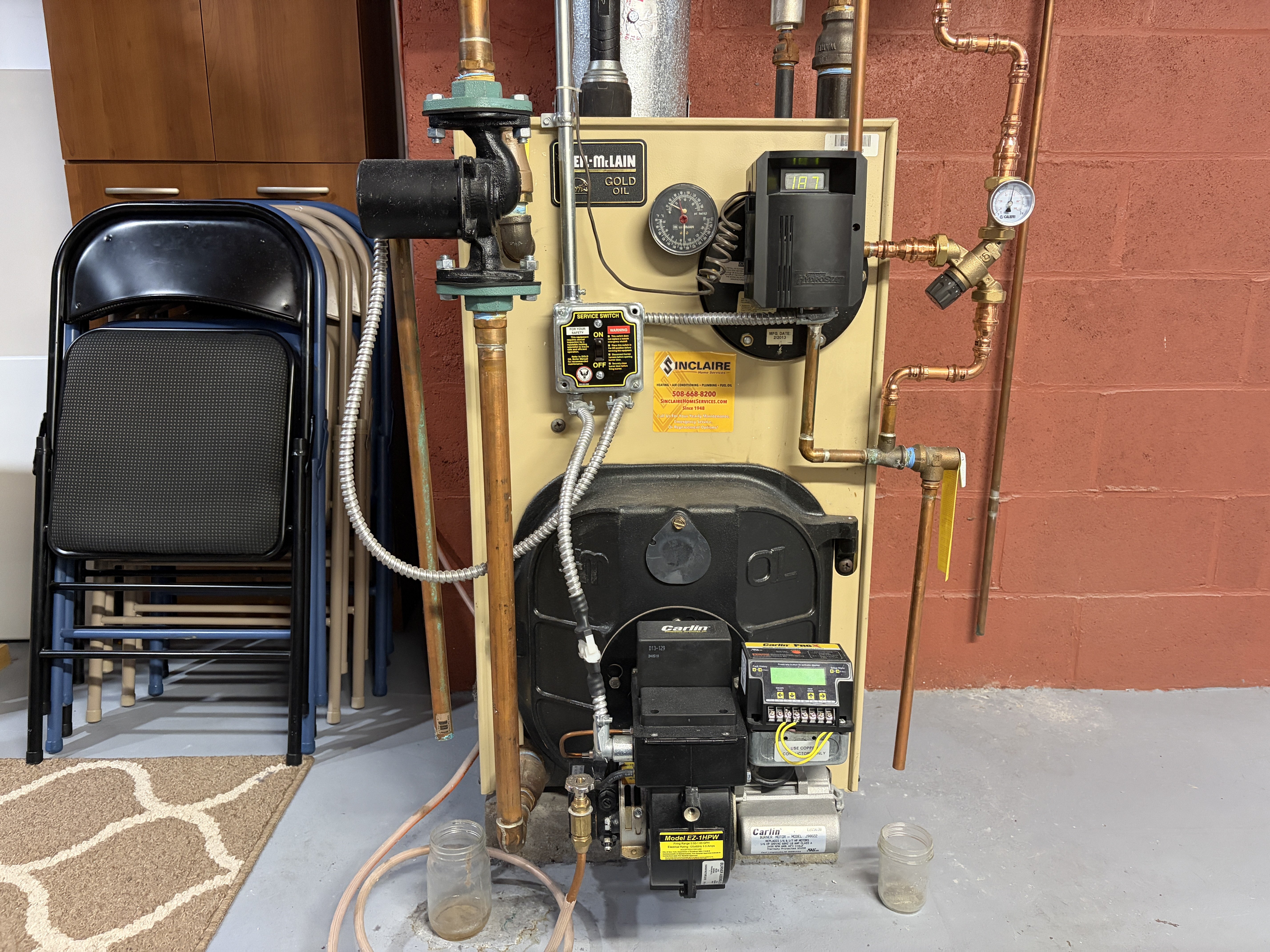
About 6-8 weeks ago, I started noticing water in the left-side mason jar on the floor under the relief valve pipe. This is the first time I've seen water in it in the 5 years I owned the house. When I bought the house in 2021, the mason jars were there, but up until this time, they were bone dry.
Now I'm seeing water in the left-side jar that will fill it roughly every 10-14 days. I don't think it started immediately after the mixing valve swap because I would have connected the two and immediately called the plumber back to look at it. It's definitely some time after that.
I put these facts and pictures through AI which said it is caused by 1) sediment stuck in the automatic relief valve, or 2) A failing expansion tank, or 3) an internal tankless coil leak.
However, I don't trust AI so that's why I'm posting here.
Is this pressure relief issue related to the mixing valve swap, coincidental, or no way to know?
If I call the plumber/heating company back in, what am I expecting them to do?
I'm wary about calling them because they are costly, and they tend to recommend expensive options.
I have a different small(er) business that services the boiler annually that I probably trust more.
I just want it back to the way it was 3 months.
Any advice would be welcome as well as what level of urgency there is in fixing the issue?
Comments
-
I assume it's the boiler relief thats leaking. I see the gauge is at about 30psi. That's the opening pressure of that relief valve. So it looks like the gauge is doing it's job. Could it still be faulty? Yes. but let assume is ok for now. You can drain some pressure off of the boiler, close the make up water valve and see if the pressure goes back up to 30. If it does you'll want to check the expansion tank.
Why was the domestic mixing valve replaced?
Miss Hall's School service mechanic, greenhouse teacher, dog walker and designated driver
 1
1 -
Sorry, I'm not sure what the make up water valve is or where it is.
The mixing valve was replaced because we were having issues with hot water in the 2nd floor shower, even after replacing the Kohler shower mixing valve.
The plumber traced the potential issue to the existing mixing valve which definitely had some corrosion on it and the temperature gradient just by hand feel before and after the valve was not good.
There is a marked improvement in the hot water in the 2nd floor shower, though we do have that mixing valve turned up to 5 (out of 7) which is higher than the recommended setting of 3. That is to overcome what the plumber thought was the ongoing issue of scaling of the coils, affecting heat efficiency. He recommended an indirect water tank to solve the issue permanently, but the mixing valve swap worked so we decided not to invest further unless the problem becomes acute.
0 -
There should be a pressure regulating device somewhere. It's not in the picture you posted. If you step back and post another picture with all of the boiler piping someone will liky point out the feed water valve. Could be up near the expansion tank and will be before the pressure regulating device.
Miss Hall's School service mechanic, greenhouse teacher, dog walker and designated driver
0 -
The feed valve is probably clogged with sediment preventing it from closing completely. If you clean it out there's no way to be sure if the problem is fixed until you're sure the pressure is staying low. I find it easier to replace it than try to clean it out.
0 -
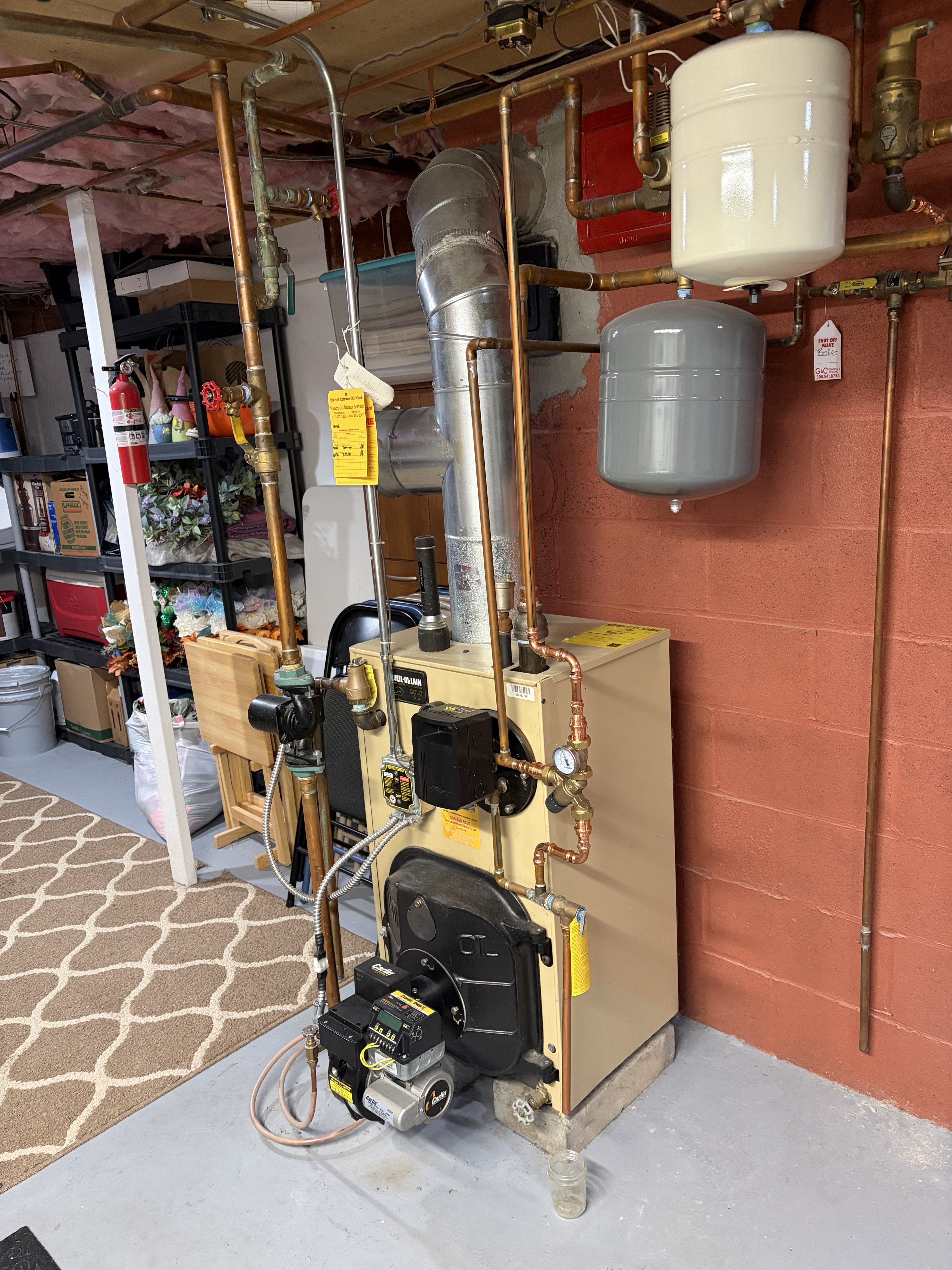
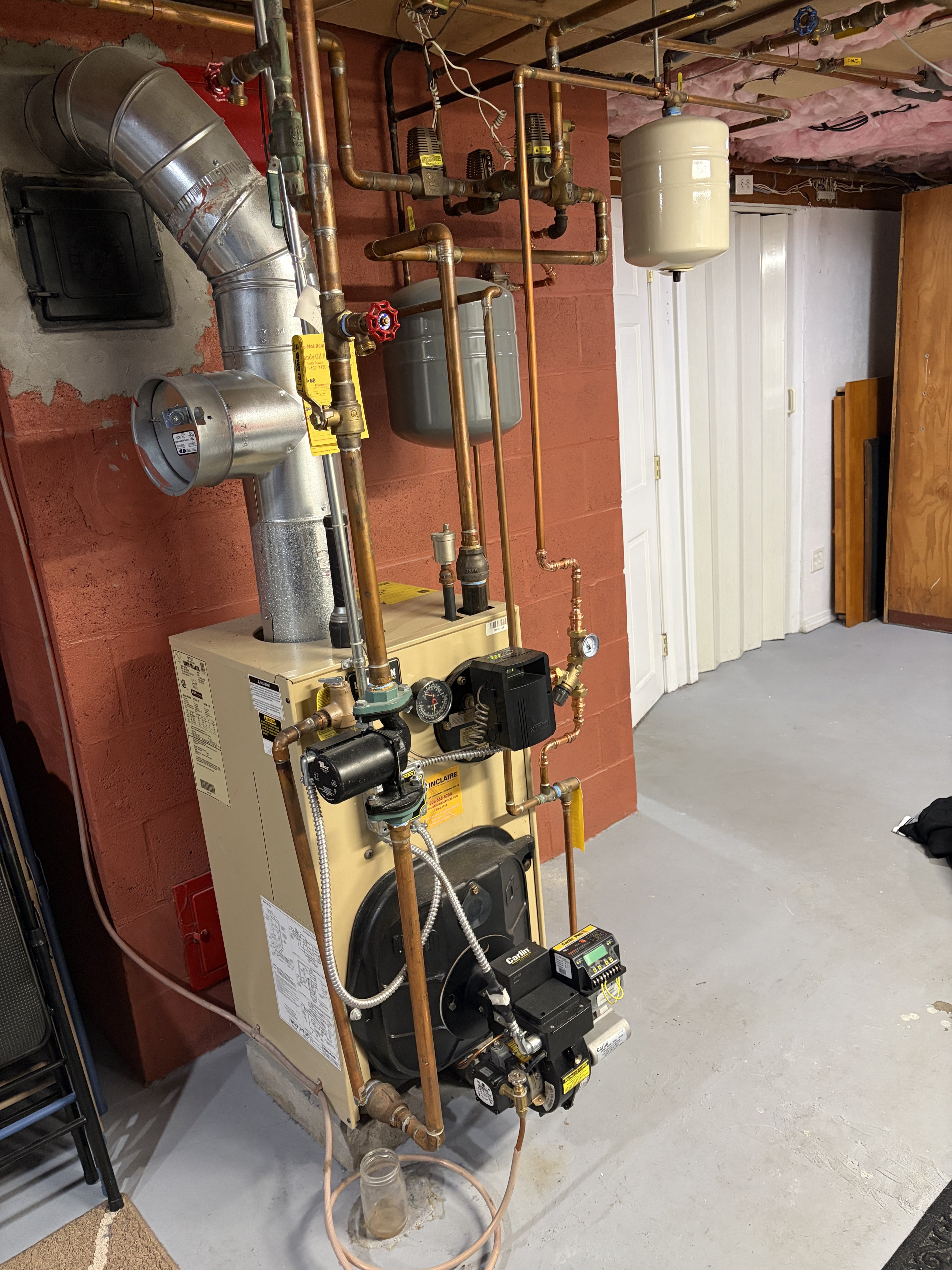
I just realized my original post was incomplete. I copied it in and now it should make more sense. I added a few wider angle shots of the entire system.
0 -
Sometimes a homeowner is not familliar with the terms we use for the different parts of the heating systyem. maybn times a homeower will call this boiler a furnace incorrectly because it is where the fire is. this would be incorrect for the trade because we call a heationg device connected to ductwork to move hot air a furnace .This heating device is connected to radiators and uses water to move the heat (not air) so we call it a boiler.
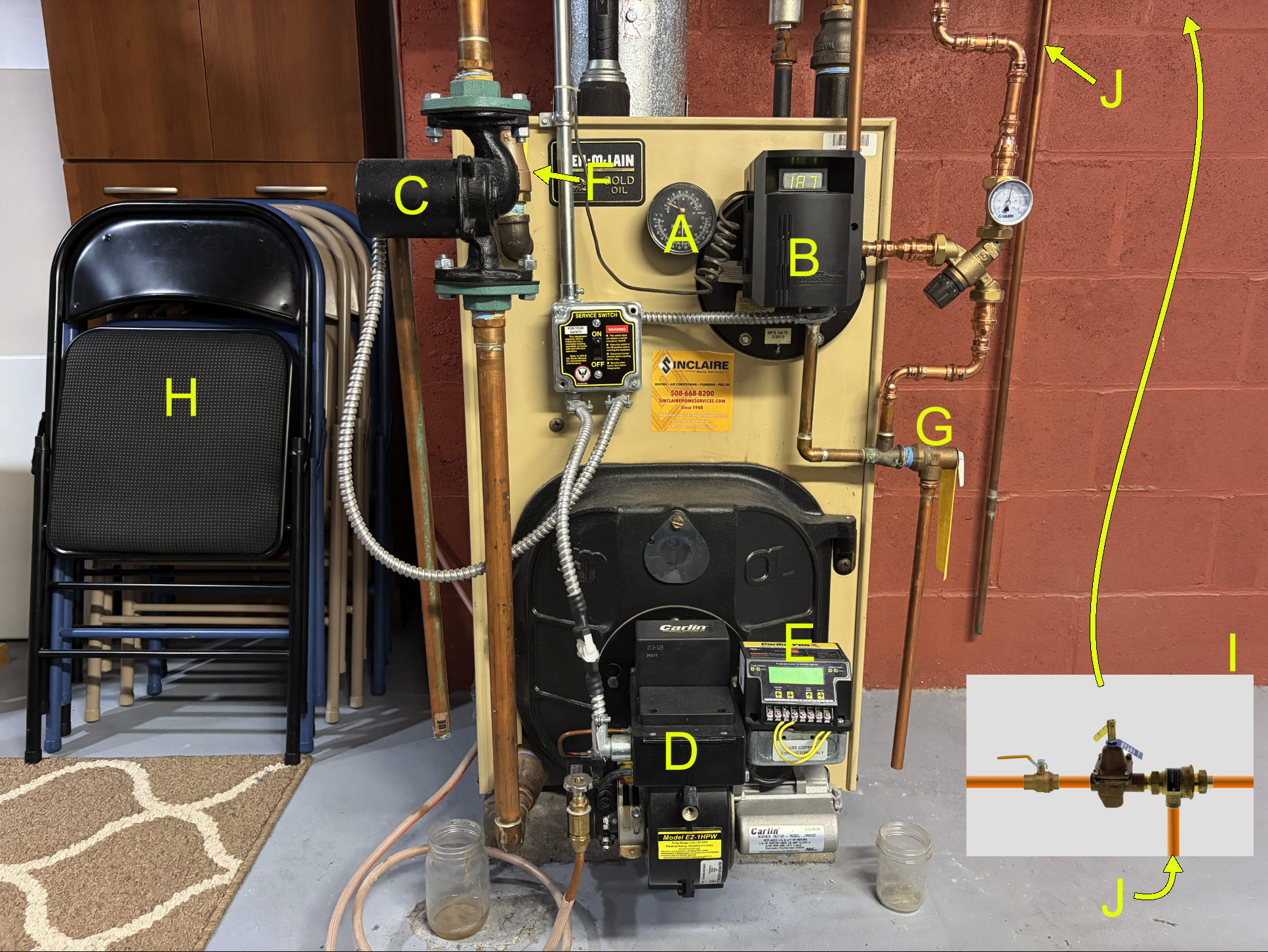
Here are the common names we use for parts of a boiler system.
A is the pressure gauge.
B is the operating control. It includes the high limit, the low limit, and the circulator relay.
C is the circulator. It moves the water through the pipes that connect the boiler to the radiators.
D is the burner. This one is an oil burner, but it could also be a gas burner.
E is the primary control, or safety control. Its function is to turn off the burner if the fuel is not producing a flame. We want the burner to stop supplying fuel to a boiler that has no flame because that would be dangerous.
F is the boiler relief valve. It is hidden by the circulator, but its purpose is to make sure the boiler water pressure does not rise above 30 PSI (pounds per square inch). That would be dangerous as well.
G is another relief valve. This one measures both water pressure and water temperature and will release water if either exceeds the valve's safety limit.
H Those are extra chairs for the poker game on Thursday night and have nothing to do with the boiler system.
I is the makeup water system, which is not shown in this photo. This is how the system is filled with water. It is made up of a series of components. From left to right, there is a manual service valve, an automatic fill valve (also known as a pressure-reducing valve), and finally a backflow preventer. The backflow preventer has a copper vent connection coming out of the bottom that may discharge scalding water, so the vent pipe is directed to a safer location.
J is the discharge vent tube shown in both the photograph and Illustration I. If you follow that pipe upward in the photo, out of the frame, it connects to the makeup water section of the boiler—specifically, the backflow preventer.
Hope this helps!
Edward Young Retired
After you make that expensive repair and you still have the same problem, What will you check next?
1 -
Now that classroom learning is over we will move to the lab and have some hands on training:
Three reasons for the relief valve to discharge
- Defective valve
- Boiler presure is at or above relief valve setpoint (valve is working properly)
- Debris is lodged in the valve seat and not closing 100% (may be easy to fix or may be defective). You need to pop the handle to see if you can clear the debris.
Since you pressure gauge is reading close to 30 PSI, I believe your valve is operating as it is supposed to. That being the case you need to find out why the boiler pressure is going to 30 PSI when a normal boiler operating pressure, like your Weil McLain WTGO, would be 12 to 18 PSI.
There are three reasons your pressure may be going to 30 PSI and the relief valve is discharging.
- The automatic feed valve is defective or set at the wrong pressure. this will allow more water pressure from the household water system to increase the boiler pressure above normal
- The expansion tank is defective or improperly charged with the wrong amount of air pressure. (That is is covered in the class on expansion tanks that you didn't pay for yet)
- The tankless coil has a leak that is allowing household water pressure to leak past the coil into the boiler. that will cause the boiler pressure to increase above the normal operating pressure.
Class dismissed
I hope this helps.
Edward Young Retired
After you make that expensive repair and you still have the same problem, What will you check next?
 1
1 -
Extra credit for additional work:
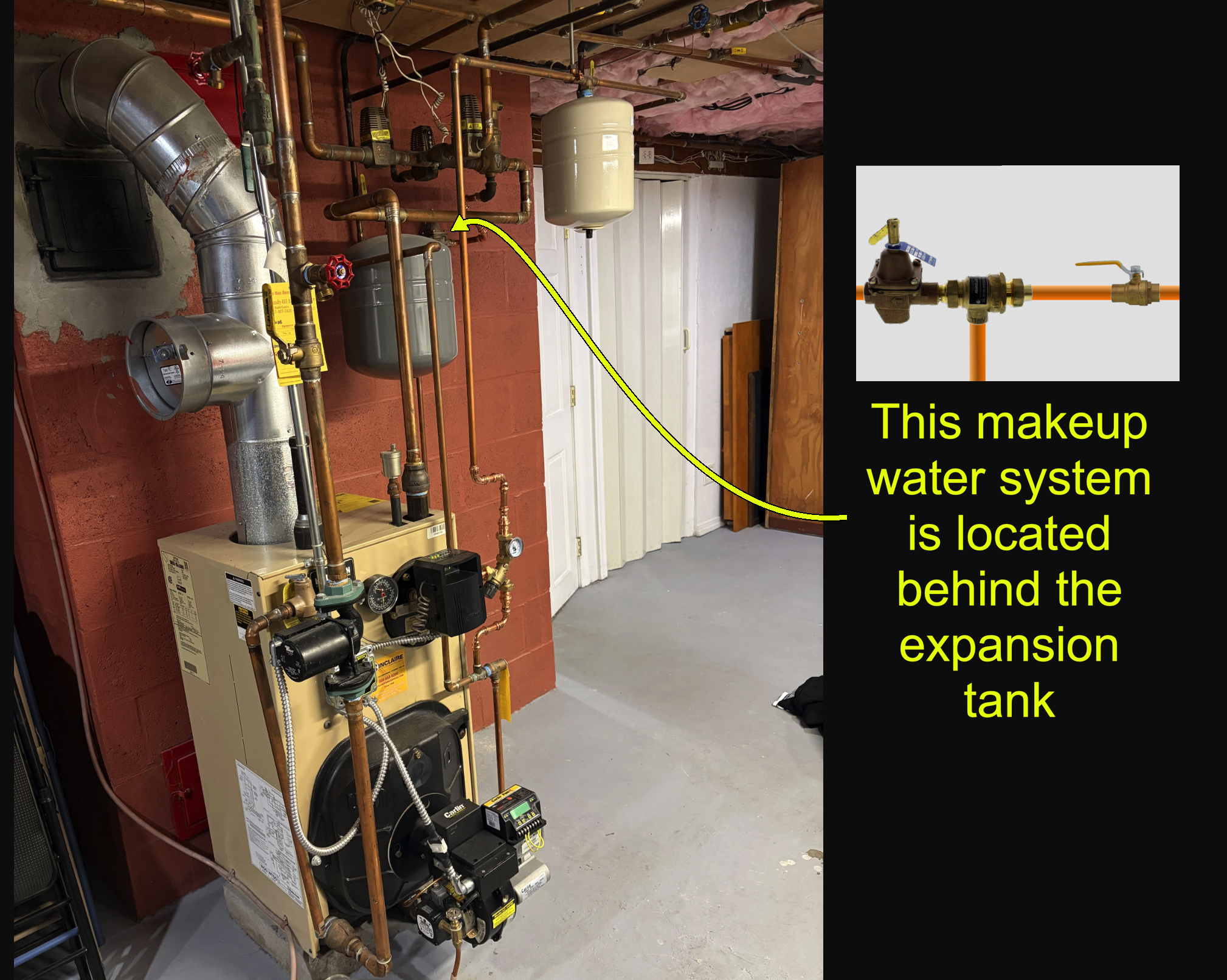
Thanks for the additional photo.
Edward Young Retired
After you make that expensive repair and you still have the same problem, What will you check next?
1 -
Thanks Ed - that is all helpful! I'm guessing a leak in the tankless coil would be a bad outcome(?).
What is the likelihood this is related to the domestic mixing valve swap? Or, is this just coincidental?
I'm asking because I can bring back the plumber who did that work if it's related and they may not charge me for the basic service call (maybe).
What is the urgency of fixing this issue? Can it be addressed within the next month or do I really need to get someone in right away to fix it?
0 -
As others have said there are a few things that can cause over pressure. So someone has to troubleshoot this.
That could be you or your plumber. The plumber has to charge $$$ so the smart thing would be for you to eliminate some of the possibilities to keep the plumbers troubleshooting time down.
Could be"
PRV (pressure regulator) feeding boiler is leaking by
Expansion tank could be bad
Tankless coil leaking into boiler water
Bad pressure gauge or relief valve
As others have mentioned since you gauge reads 30 psi and the relief valve opens at 30 psi that PROBABLY eliminates those items as an issue….note probably.
- Eliminate the boiler prv. Close the valve in the feed water line to the boiler. It's on the back wall with a tag labeled boiler on it. Then drain some water from the boiler slowly to get the pressure from 30psi down to 15psi. Then close the drain. Leave the boiler in normal operation. Check the pressure once in a while. The pressure may go up and down as the boiler heats and cools but should stay in a safe range 10-25psi. If it goes back to 30 and starts dripping that means the feed valve PRV is ok and there is another issue. If it doesn't rise to 30 the PRV IS the issue and it needs to be replaced or cleaned.
- Eliminate the tankless coil. Let the boiler run as normal. Drain down to 15 psi but keep the boiler feed water valve open. I don't see any valves to isolate the tankless coil so thes may need to be installed to eliminate the coil.
- Have them check the expansion tank air side pressure. They have to remove the tank from the system to do this. Probably involves draining the system.
If I had to guess #3 would be most likely followed by #1 and then #2
in that order.
 2
2 -
The first test to see if the auto feed valve is passing is to closed the valve that has the tag "SHUT OFF VALVE Boiler" as suggested by @EBEBRATT-Ed
The second test is to shup off the cold water to the tankless coil and to do that you need to turn off a valve that feeds the hot water coil. as @EBEBRATT-Ed mentioned that valve is not in any of the pictures you have posted but it may be behind one of the expansion tanks as shown in this illustration where the red X is indicating a valve might be located.
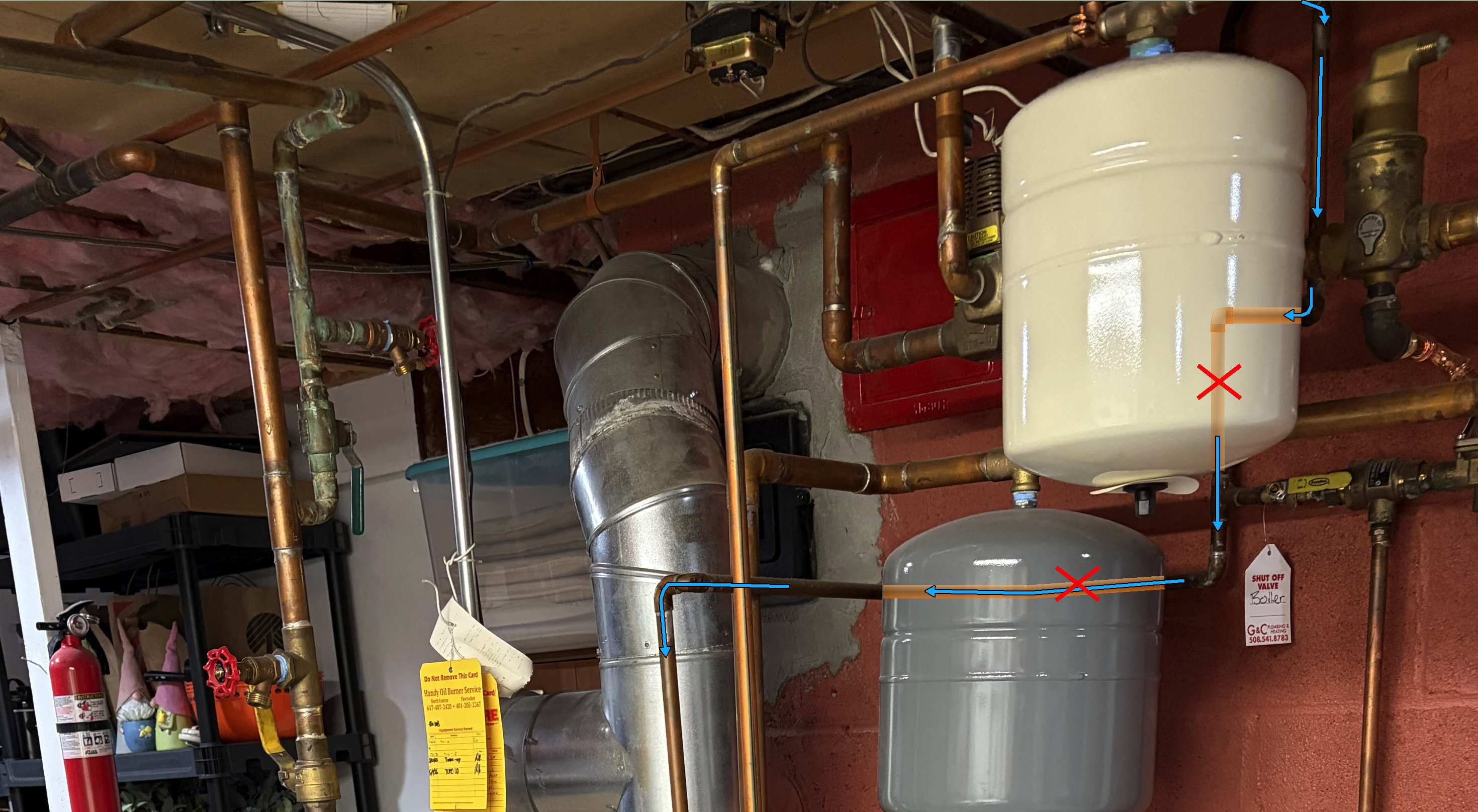
look for a valve that will turn off the cold water inlet indicated by the blue arrows on the cold water pipe to the tankless coil water heater.
Edward Young Retired
After you make that expensive repair and you still have the same problem, What will you check next?
0 -
The tridicator gauge is reading 12/13 psi. You guys are looking at altitude.
And the aquastat is reading 187°, so it doesn't seem pressure related.
@digger5150 , you could try to pop the lever on the relief valve. It's a crap shoot. It might reseat. It might get worse. If you try, put a bucket under the discharge pipe. A relief valve is what we call a "wear part". It has a limited life expectancy. And maybe swap the mason jar for the bucket. If the relief valve ever does blow on pressure (30 psi), a glass jar for the target isn't a good idea.
The tridicator could also be giving a false reading. Its best to have a pro check it.
1 -
On second look your right
0 -
Oh you are 100% right and I even looked twice! That likely eliminates a couple of potential issues.
Miss Hall's School service mechanic, greenhouse teacher, dog walker and designated driver
0 -
I would have, and I made that same mistake reading the gauge. OK, so the normal pressure is 12-13 psi, as one would want it to be. The gauge could be faulty, though that seems unlikely.
I did the manual flush, 3 times for about 2 seconds each time. The first one, it was black as night with a fair bit of sand-like debris. The second time was clear, but still some bits in it. The third time it was clear and no debris.
It is now dripping consistently - to the point of a full mason jar's volume every 2 hours.
My oil boiler servicer is coming tomorrow. I was told on the phone it is either the relief valve, the expansion tank or both…matching what you all have said.
0 -
What you could do is get a 0-30 pressure gauge and a fitting to attach it to the boiler drain valve to check against the boiler gauge.
But since you have the service company coming there is no need.
0 -
I wouldn't think the extrol is bad since we haven't seen evidence of high pressure.
Take a small screwdriver and move the red indicator dial on the tridicator to 15 psi. Tomorrow morning check to see if the pressure dial moved it. If it didn't budge, I'd say it's a bad relief valve only.
When the work is done, make sure to raise all your thermostats and check the heat before they leave.
0 -
A way to slow the drip is to LIGHTLY tap downward on the top of the valve gentle with the handle of a screwdriver. That will improve the seal a bit buy some time before the valve is changed. I had my brother in law do this over the holiday weekend and I changed the valve for him Monday. The fast two or three drips per second slowed to a drip every minute. His gauge was also reading about 15lbs while it dripped indicating no over pressure. Changing the valve fixed it.
 1
1 -
Thanks everyone for all of your input and guidance! In the end, it was both the relief valve and the expansion tank. When the tech first arrived, he thought it was only the relief valve because the expansion tank sounded hollow. But, that turned out to be a false positive.
 1
1 -
I know a lot of "techs" who would've said the same thing. Some would've even thrown in the PRV just because.
1 -
Good - Better - Best choices:
- Good = Fix the most likely problem. the relief valve with no guarantee: $ X.00
- Better = Replace the relief valve and the expansion tank. 60 day guarantee $ YY.00
- Best = Relf Vlv, Exp Tnk, and water feed valve. 1 year guarantee $ZZZ.00.
Why do most people select the middle option?
Edward Young Retired
After you make that expensive repair and you still have the same problem, What will you check next?
0 -
the cost is in getting the tech to the jobsite, so the cost of replacing an old expansion tank long with a failed relief valve, why not.
Bob "hot rod" Rohr
trainer for Caleffi NA
Living the hydronic dream1 -
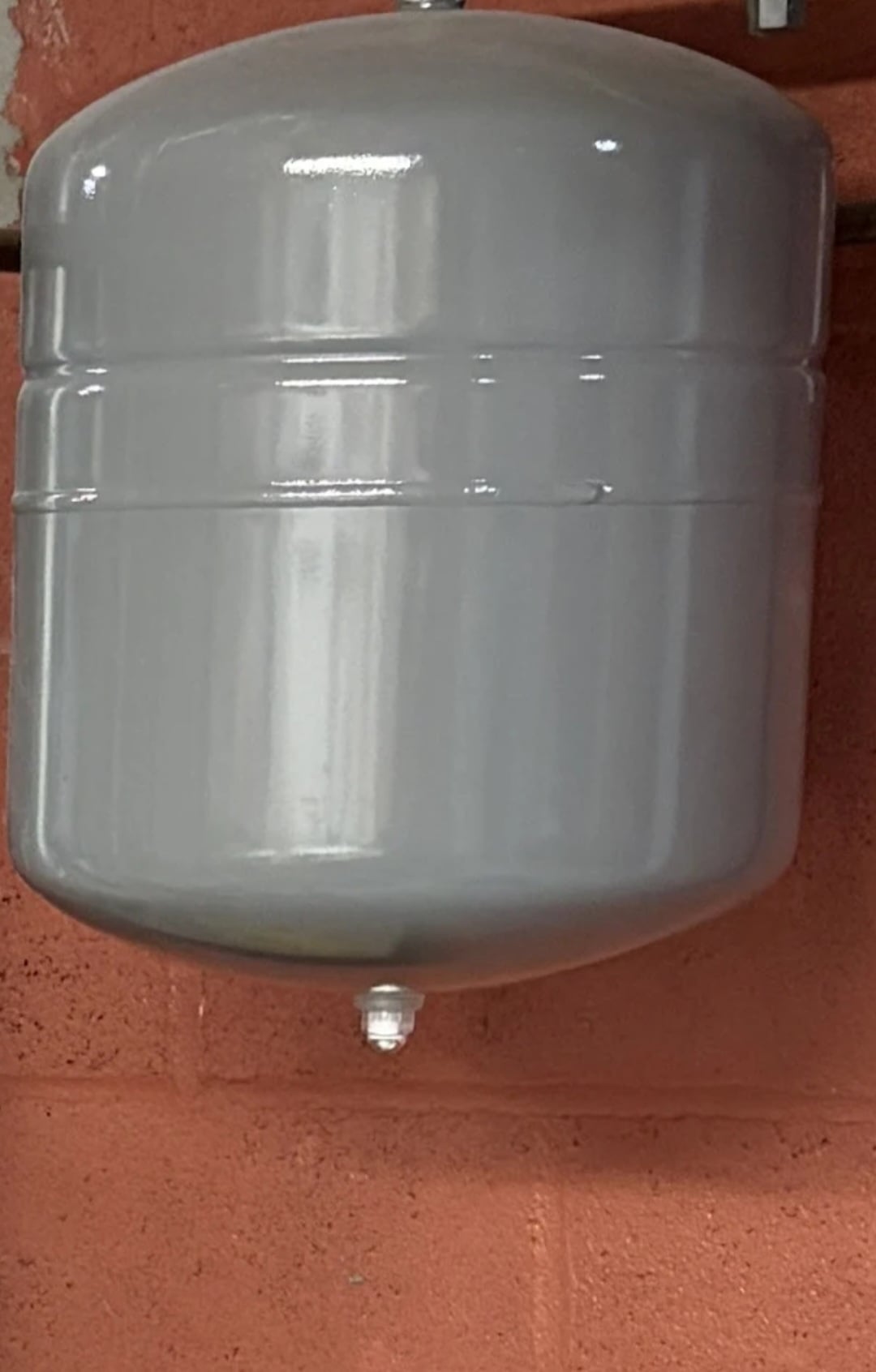
Looks ok to me. If the call came back within a month and the #30 was compromised, I'd waive the diagnostic fee and just charge the part.
I'd actually like to see what a ruptured #30 would do to all that copper its hanging on. @digger5150 , you might want to secure that piping.
0 -
If that cap is white and the tank sounded
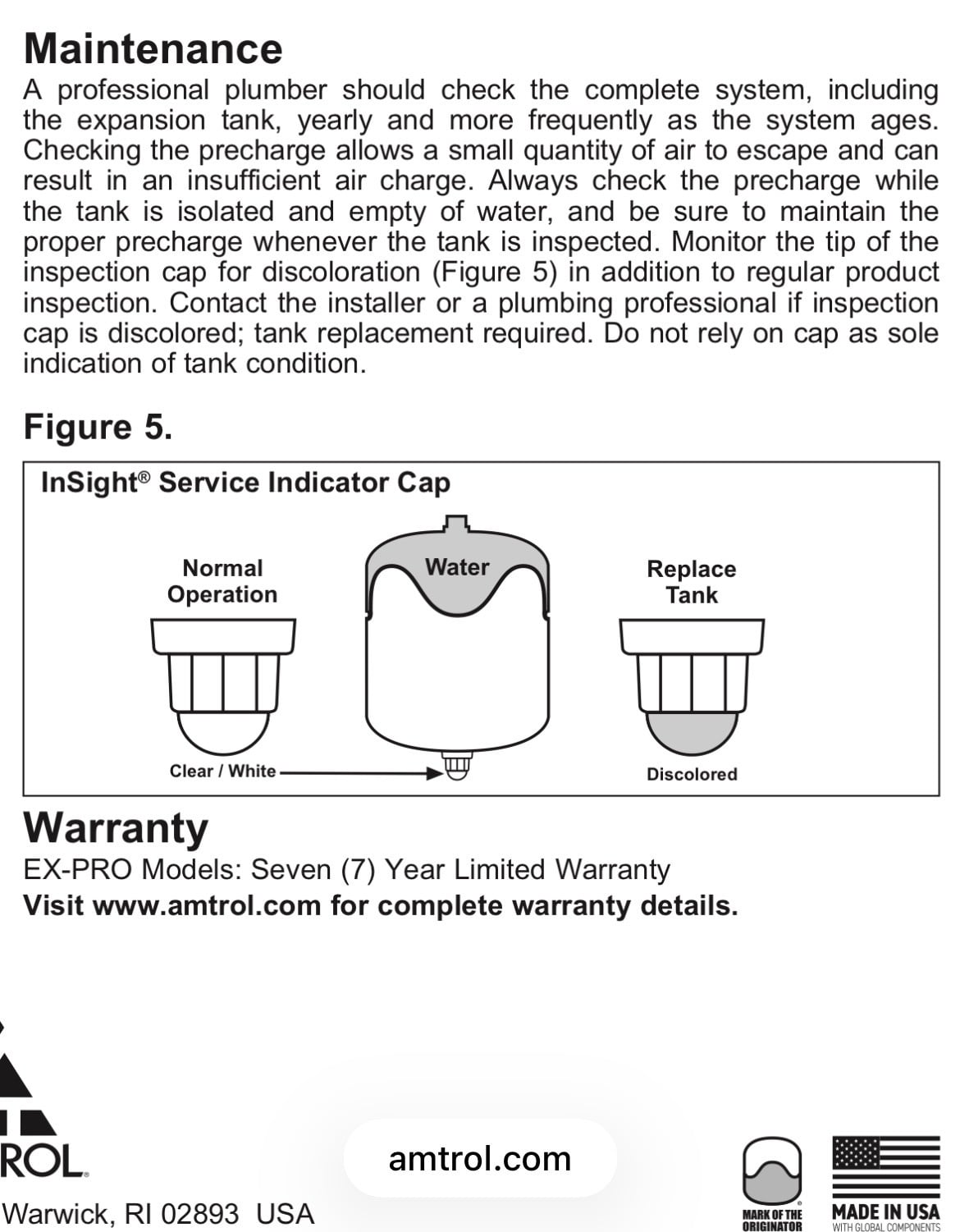
hollow, perhaps it was overcharged on the air side and not taking expansion?
Bob "hot rod" Rohr
trainer for Caleffi NA
Living the hydronic dream0



Categories
- All Categories
- 87.8K THE MAIN WALL
- 3.3K A-C, Heat Pumps & Refrigeration
- 60 Biomass
- 430 Carbon Monoxide Awareness
- 133 Chimneys & Flues
- 2.2K Domestic Hot Water
- 6K Gas Heating
- 124 Geothermal
- 170 Indoor-Air Quality
- 3.9K Oil Heating
- 79 Pipe Deterioration
- 1.1K Plumbing
- 6.7K Radiant Heating
- 397 Solar
- 16.1K Strictly Steam
- 3.5K Thermostats and Controls
- 56 Water Quality
- 51 Industry Classes
- 51 Job Opportunities
- 18 Recall Announcements