Welcome! Here are the website rules, as well as some tips for using this forum.
Click here to Find a Contractor in your area.
If our community has helped you, please consider making a contribution to support this website. Thanks!
A leak underneath by next morning

After winter ended and boiler system is no longer aiming for High Limit temp to satisfy baseboard heating, only the Low Limit is being maintained to preserve our domestic hot water for summer. That's around a 12, 13 degree difference in avg boiler temp btw seasons. The showers and sinks got noticeably colder by first week of June.
An adjustment was just now made to the Mixing Valve in boiler room by a friend of friend who opened it up much more to the Hot side. The temp at the showers and sinks didn't improve much, but the velocity of the water coming out of the shower has increased significantly. Want to understand if the following is an accurate explanation of what happened and what most likely led to leak.
Felt as increased velocity at the shower head. The static pressure remained same as before for the home's plumbing. But the flow rate increased, due to the unrestricted Hot water fully opening up at the mixing valve. And this, resulted in a much greater dynamic pressure (flowing kinetic energy).
A sudden, increased and sustained volume passing through pipes may have introduced extra stress on the shower's components(cartridge/o-rings, valve body casing, shower riser) resulting in this hefty leak, now visible on ceiling in room underneath. Does this all make sense in terms of hydrodynamics?
Comments
-
Um… probably not. First off, the increased flow volume will have resulted in less pressure in the bathroom — since head loss in the piping is almost equal to a constant time the velocity SQUARED. There is a possibility, though, that the change in velocity aggravated an existing water hammer problem cait doesn't sound as though it is higher than it is in the winter. caused by a fast closing valve somewhere. Usually one would hear that, but not always. It seems unlikely that the higher temperature at the fixture would be a problem, since it would seem that it isn't higher than in the winter (by the way, I hope that mixing valve is set for a maximum delivered temperature of 110 F — that's code)
Br. Jamie, osb
Building superintendent/caretaker, 7200 sq. ft. historic house museum with dependencies in New England0 -
Do you have a thermal expansion tank at the hot water source?
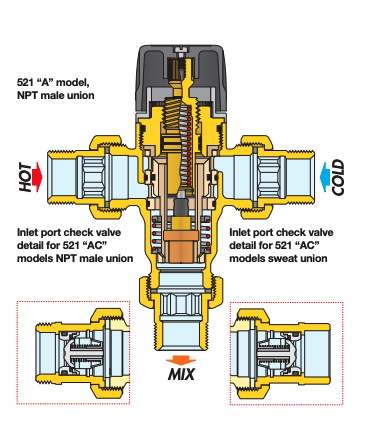
Thermostatic mix valves need occasional deliming to keep the cartridges from seizing or jumping and making uneven temperature adjustments.
Inside the valve as on port closes down the opposite port opens more, so the flow should not change much, see below.
Is this a boiler with a tankless coil?
You want a fast responding mix valve on a tankless coil or tankless water heater.
Also, you need a temperature difference of at least 10°, some valves as much as 25° difference between the mix outlet and hot supply.
So for accurate temperature control the hot water supply should be at least 10° hotter than mix outlet.
Some suggest DHW supply be maintained at or above 140 for legionella protection.
Do your shower valve have pressure or temperature balance valves? More expensive shower valves may be both pressure and temperature balance. Those too need cleaning from time to time
 Bob "hot rod" Rohr
trainer for Caleffi NA
Living the hydronic dream0 -
more flow could be splashing water on some defective caulk or something like that wasn't getting wet before.
i assume this is a hot water boiler with a tankless coil for dhw?
0 -
the converse to @hot_rod 's comments about expensive shower valves is that cheap valves have a stop that limits the travel of the handle and they rely on the temp of the hot water being what it was when the stop was set to control the max temp. if the hot water is cooler then the max temp will be cooler. the stop sets a fixed maximum proportion of hot to cold water.
0 -
@bluemoon71 said: "An adjustment was just now made to the Mixing Valve in boiler room by a friend of friend who opened it up much more to the Hot side. The temp at the showers and sinks didn't improve much, but the velocity of the water coming out of the shower has increased significantly."
I am wondering what type of mixing valve you have. I have serviced thousands of boilers over the last 45 years and have seen this valve called a mixing valve.

These boilers have tankless coils that have a proper mixing valve. The one on the left in the green oval, is an older version that was popular when I started this work many years ago. A better mixing valve is illustrated on the right in the yellow oval.
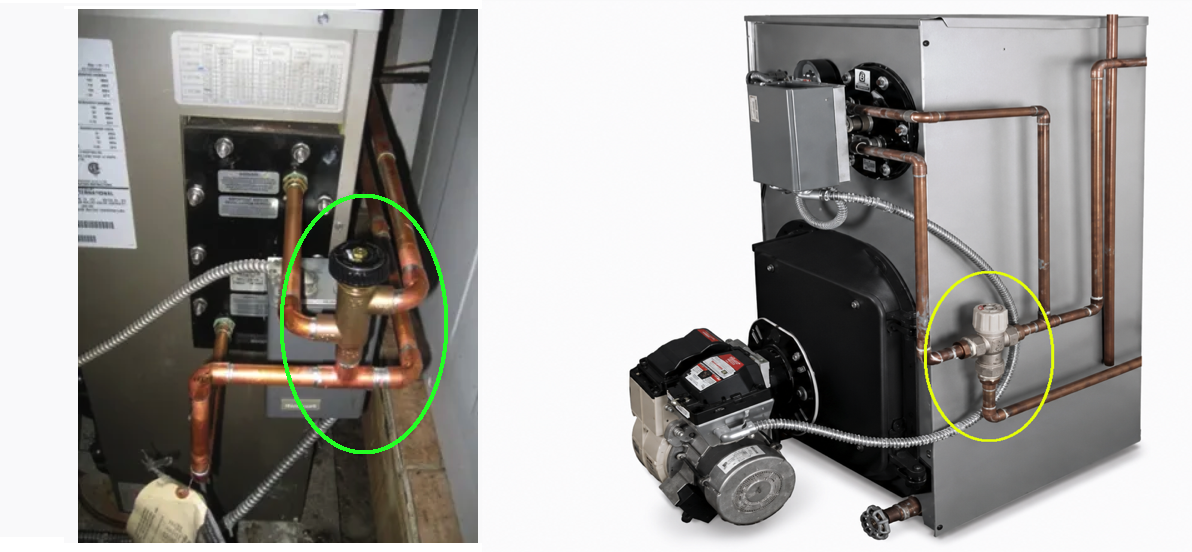
Sometimes a installer may add this an believe it is a mixing valve.
It can mix cold to hot but it is not self adjusting and therefor it is not a true Mixing valve
Edward Young Retired
After you make that expensive repair and you still have the same problem, What will you check next?
 1
1




Categories
- All Categories
- 87.8K THE MAIN WALL
- 3.3K A-C, Heat Pumps & Refrigeration
- 60 Biomass
- 430 Carbon Monoxide Awareness
- 133 Chimneys & Flues
- 2.2K Domestic Hot Water
- 6K Gas Heating
- 124 Geothermal
- 170 Indoor-Air Quality
- 3.9K Oil Heating
- 79 Pipe Deterioration
- 1.1K Plumbing
- 6.7K Radiant Heating
- 397 Solar
- 16.1K Strictly Steam
- 3.5K Thermostats and Controls
- 56 Water Quality
- 51 Industry Classes
- 51 Job Opportunities
- 18 Recall Announcements