Welcome! Here are the website rules, as well as some tips for using this forum.
Click here to Find a Contractor in your area.
If our community has helped you, please consider making a contribution to support this website. Thanks!
The 20 second challenge: What's wrong with the boiler?

In this video, we are inside a boiler room and I give you 20 seconds to look at the boiler and find as many things wrong as you can. I found 4 things. Let me know what you think?
Boiler Lessons


Comments
-
Around here, that boiler would not pass inspection.
0 -
Is 220 voltage allowed for controls?
0 -
Hi @RayWohlfarth , I'm just a water heater guy and know next to nothing about boilers. However, what you said about safety and letting the owner know should you see something unsafe is so important. I couldn't sleep if I didn't alert people to the dangers. For fun, here's a water heater I came across. No, it's not AI! 🤪
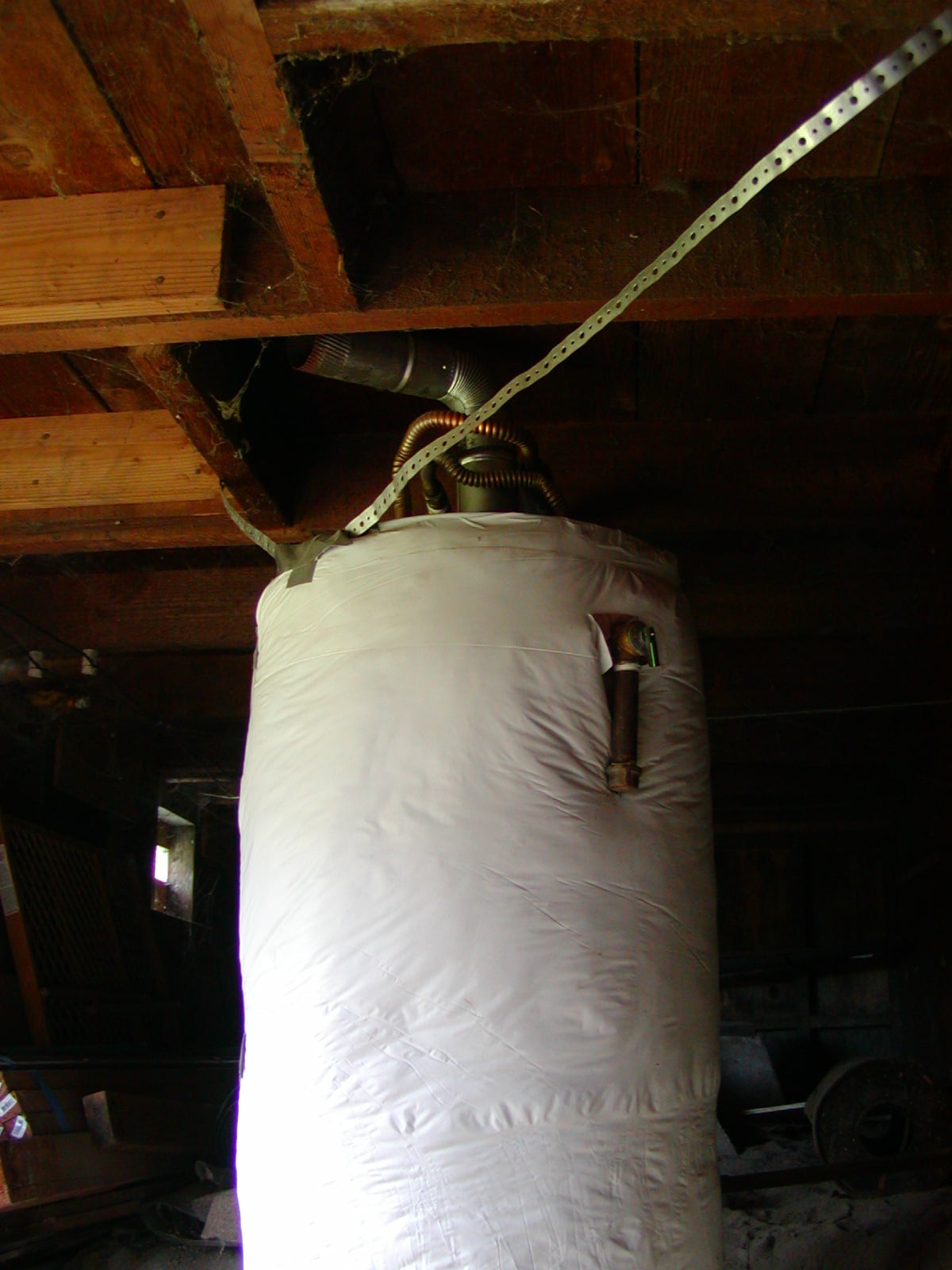
Yours, Larry


 5
5 -
I've been sitting here for literally a minute, trying to think of something funny to say.
But I can't.
0 -
I have come across at least two of these none vented WH.
One even had the plugged T&P relief valve which yours seems to have.
Those insulation wraps are often installed, free of charge, by some governmental agency. They could train their installers to look for some basic safety issues and report them to the agency. Probably free repairs to the HO.
0 -
Funny, scary and sad all at once.
8.33 lbs./gal. x 60 min./hr. x 20°ΔT = 10,000 BTU's/hour
Two btu per sq ft for degree difference for a slab1 -
@Steamhead Same in this area Im wondering if the boiler was never inspected.
@JUGHNE I do not know if 220 volts is allowed. I have never seen it. I always see 24 or 110
@Larry Weingarten That is a scary pic Where did the flu go? Right next to the wood?
@ratio 👍️
Ray Wohlfarth
Boiler Lessons0 -
Hi @RayWohlfarth , I found a way to run the vent properly. Also, gotta say that plumbers tape earthquake strap was a lie. Those never hold in a real earthquake. That owner was not thrilled with the work I needed to do, but I couldn't just let him "think about it" for years.
Yours, Larry
 2
2 -
@Larry Weingarten @RayWohlfarth
So, what do you do with a customer that may not seem interested in correcting very dangerous code violations. Call your lawyer to free you of liability? Do the work for free? Call the installing contractor and tell him to fix his mistakes?
8.33 lbs./gal. x 60 min./hr. x 20°ΔT = 10,000 BTU's/hour
Two btu per sq ft for degree difference for a slab1 -
you do 120v for oil burners all the time. as long as you use low voltage wiring methods (not low energy wiring methods) it doesn't really mater which side of the xfmr you cut the power on, as long as all the switches are rated for 240v. the rules are the same for 120v rms to ground as for 240v rms to ground. you would need a 2 pole disconnect switch.
0 -
also looks like it was converted from an oil burner to a gas power burner
0 -
In these sizes, boilers are sold new with oil or gas burners.
 1
1 -
either way the power burner is why it is line voltage controls. 240v motors make for more balanced loads on the service though it doesn't really matter for a motor that small.
0 -
Hi @Alan (California Radiant) Forbes "So, what do you do with a customer that may not seem interested in
correcting very dangerous code violations. Call your lawyer to free you of liability? Do the work for free? Call the installing contractor and tell him to fix his mistakes?"This is one of those "it depends" places. I always note dangerous conditions on the invoice. If the installer before me caused the problem, I tell the owner to contact the installer. If it's as bad as the photo shows, I tell the owner it's so unsafe, that I'm not leaving until it's safer. I can use the utility excuse too. That is, if the utility saw it, they would shut it down… even if it's your heat in winter. I've seen them do it.
And to @RayWohlfarth 's question, yes, the flue ended inches from the floor joist. It needed work right away!
Yours, Larry
1 -
It is "allowed" or better stated "It was not forbidden". But it is not preferred and here is why:
- Suppose the burner motor is fed with L1 and L2 (240 VAC).
- The operating or limit control opens only L1.
- A fault develops from the load side of the open control to ground.
- Because no complete circuit exists, no fuse or breaker opens.
- The burner motor or ignition transformer may now receive 120 VAC from L2 to ground.
- Some devices, especially motors and transformers, may continue to operate weakly or erratically.
- The burner may continue firing when the safety control believes it has shut off the burner.
This condition was well known and was one reason many standards and manufacturers favored or required grounded control circuits. One of the reasons 120-volt circuits are used to control oil burners and other combustion devices is that all of the limit circuits are placed in the ungrounded leg of the circuit. That way, if a wire somehow becomes shorted to ground between the load (burner motor, gas valve, etc.) and the safety controls, there will be a short circuit and the fuse will blow or the circuit breaker will trip.
You can still operate a 220-volt burner motor or ignition system by using a contactor controlled by a 24-volt or 120-volt control circuit. In that arrangement, the lower-voltage control circuit operates the contactor, allowing the use of less expensive 220-volt or three-phase motors on large commercial burners while retaining the safety advantages of the lower-voltage control system.
Thus, the combustion controls and safety limits are located in a much safer electrical circuit while the high-voltage power is confined to the load side of the contactor.
DANGER OF SINGLE-POLE INTERRUPTION
      ----------------------------------

  L1 -----------------LWCO----HIGH LIMIT----PRIMARY CONTROL-----+
                                                                 |
                                                                 |
                                                             Burner
                                                              Motor
                                                                 |
                                                                 |
  L2 ------------------------------------------------------------+
                (still energized at all times)
Suppose the High Limit Opens:
  L1 --------LWCO----HIGH LIMIT (OPEN)----PRIMARY CONTROL-----X
                                                               |
                                                               |
                                                           Burner
                                                            Motor
                                                               |
                                                               |
  L2 ----------------------------------------------------------+
                (still energized)
Now suppose a fault develops from the load side of the open limit
to ground:Fault to Ground | V L1 --------LWCO----HIGH LIMIT (OPEN)--x--PRIMARY CONTROL----- / | / | / Burner / Motor Fault to Ground | | L2 ----------------------------------------------------------+ 120 VAC from L2 through ground path may operate the motor even with the limit openSAFER ARRANGEMENT 120 VAC CONTROL CIRCUITHot ----LWCO----HIGH LIMIT----PRIMARY CONTROL----Contactor Coil----Neutral
                 ↓ closes


           240 VAC POWER CIRCUIT

    L1 ------------------------------------+
                                            |
                                         Contactor
                                         Contacts
                                            |
                                        Burner Motor
                                            |
    L2 ------------------------------------+
Edward Young Retired
After you make that expensive repair and you still have the same problem, What will you check next?
0 -
that is possible but it is the same realm of likelihood as the contacts of the limit control welding shut. both will happen occasionally. that is where things like water feeders and pressure relief valves come in.
0 -
We always point out Life-Safety issues and shoddy work that could lead to premature failure. All too often, We come across Commercial and institutional boilers that had recent inspections that missed several, glaring safety issues.
We make certain the person accompanying us from the facility acknowledges and understands the safety issue and strongly encourage them to verify independently with another profession if we get "that look." We also video and document the issue so the liability is not on us as the last in.
Just recently we discovered a residential Water Heater with the flue pipe horribly pitched the wrong way. When the Homeowners blew it off after carefully explaining the terrible risk to them for 10 minutes - to no avail - we reported it to the local building department inspector and the gas utility via email. Mad Dog
0 -
Many, many years ago, both Fireye and Honeywell primary controls came with some type of voltage selection where the installer could select the voltage of 120/208/240 volts for the boiler controls. (check out the Honeywell R4126A-1073 control). I saw a few 220/240 control systems but I believe that they were discontinued or even "outlawed" a long time ago. @EdTheHeaterMan went into a great detail about why those voltages should not be used for boiler control systems. I saw 2 or 3 instances where the boilers would not shut down due to a single line and a ground condition allowing 120 volts to keep the system firing when it was supposed to be shut down. Imagine this, a high pressure boiler with an operating pressure between 100 and 300 psig that would not shut down and the only safety for that system was the safety valves that were wide open blowing steam everywhere and you have to go into the boiler room and manually shut down the boiler. I was glad I carried a change of clothes in my truck.
 1
1 -
there is always the possibility for wiring faults to bypass a safety. it is somewhat easier with a 240v ckt made from a 120/240 v ckt. then there is the mr coffee problem where if the thing the safety is supposed to protect against happens the wires to the safety melt and short together.
0 -
I have two boilers in my commercial building, they each have one Low Water Cut Off. They get an insurance inspection yearly, and HVAC vendor maintenance yearly. I will ask about that next time, at the least. Weil-McClain Model 680.
0 -
Looks good as is!!!!
0 -
Unfortunately, in today's world we are actually liable if we see something even if we didn't touch it. Lawyers, litigation and government overreach have realized that it's a big revenue generator.
I'm not downplaying the fact that we should say something' we should, but document everything possible and include a clause "the seen and unseen" in a report. Take pictures, many pictures.
Contact the local authorities if a safety issue or issues are noticed. In some areas a system may be required to be Red Tagged. Mind you, doing this could also bring Lawyers into the equation.
We don't always have it easy. Sometimes we're damned if we do and damned if we don't.
I mention this because it happened to me a long time ago. Fortunately, I got away unscathed sans attorney's fees.
0 -
The actual requirement is not "commercial" where I come from. We follow ASME code and If the boiler is over 400k then the requirements for the manual reset low water cutoff and hi-limit pressurtrol with manual reset are required.
0 -
the type of building also changes safety requirements (size, height, etc. that make it a different class of building). schools and medical facilities also get extra life safety codes.
0


Categories
- All Categories
- 87.8K THE MAIN WALL
- 3.3K A-C, Heat Pumps & Refrigeration
- 60 Biomass
- 430 Carbon Monoxide Awareness
- 133 Chimneys & Flues
- 2.2K Domestic Hot Water
- 6K Gas Heating
- 124 Geothermal
- 170 Indoor-Air Quality
- 3.9K Oil Heating
- 79 Pipe Deterioration
- 1.1K Plumbing
- 6.7K Radiant Heating
- 397 Solar
- 16.1K Strictly Steam
- 3.5K Thermostats and Controls
- 56 Water Quality
- 51 Industry Classes
- 51 Job Opportunities
- 18 Recall Announcements