2nd Heat Exchanger In 2-1/2 Years Same Failure Result - Is It The Water Chemistry?

Problem:
A combiboiler with stainless steel heat exchangers has been running a mixed metal (brass, copper, stainless steel, cast iron) hepex, and other oxygen barrier pex radiant system for 2-1/2 years on municipal water. This is the 2nd heat exchanger failure. The first failure happened at 1-1/2 years. Both failures appear to have the same result.
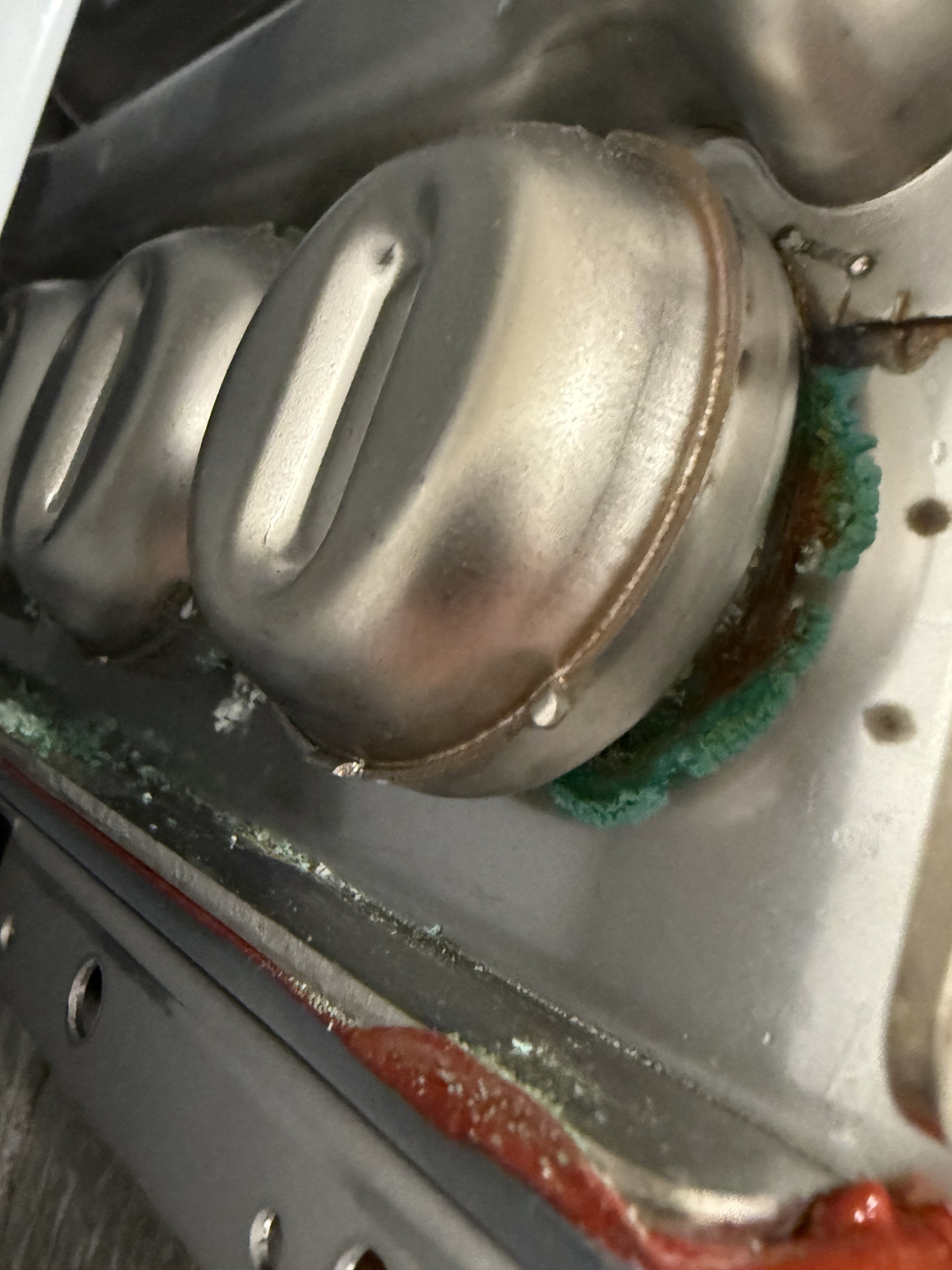
The Primary heat exchanger seems to be the only one failing (leaking with a slight pressure drop…Had to top it up once). This seems to be the same problem that happened to the first failed heat exchanger.
There is green/blue corrosion coming out of the ends of the primary stainless steel heat exchanger which is running the closed loop radiant. The secondary heat exchanger is running the municipal DHW appears to be fine. but it's covered with a material.
The system components at time of install were all new parts:
-Combiboiler with stainless steel heat exchangers
-stainless steel manifold
-brass fittings
-copper pipe
-cast iron grundfos pump
-expansion tank
-Super Vent (air scoop) Cast bronze
Both the Primary closed loop radiant heat exchanger and Secondary heat exchanger for DHW are running on municipal drinking water which is treated to a neutral 7ph-8.5ph and has some chlorine treatment in it by the municipality. The water is very good quality but there still maybe something inside the closed loop causing it to be aggressive to the heat exchanger?
After the first heat exchanger - New to 1-1/2 Years:
The system was flush with municipal water and Fernox F1 was added. The water that was removed from the system has some sediment after sitting a while but according to others in the field it seemed normal.
Sample water was not tested
After the second heat exchanger - 1-1/2 to 2-1/2 Years:
*Sample water was taken and currently has not been tested at a lab.*
I tested an 8.5PH myself. The sample water appears crystal clear with no noticeable sediment. Fernox seems to be doing a great job.
Something must be wrong in the water chemistry?
Where can I get a sample of my water tested in Canada by a lab that specifically deals with hydronic radiant water chemistry experience that will know what is wrong in the water to prevent this once a new 3rd heat exchanger is installed?
Grok AI stats that the water may have an aggressive chemistry.
possible outcomes could be that copper ions are pitting the stainless steal heat exchanger…gathering platelets?…which eventually caused a leak and the oxygen reacted with the water/copper ions making it appear as a green/blue corrosion like residue own the ends of the heat exchanger.
There are many homes in the same subdivision using the same municipal water for drinking some are probably using tankless water heaters and hot watertanks. Local plumbers I have spoken with think the municipal water very clean here and there is not a publicly know issue (at least 2-1/2 of use in my situation). So why do I have this problem? Is it because I am trapping the water in a closed loop?
I am thinking of doing this:
1. Test the Primary closed loop radiant water with a lab that specializes in hydronic radiant water chemistry
2. Flow the system Fernox F3 and then flush with municipal water and empty the system of municipal water
3. Fill the closed loop with DI (demineralized deionized water)
4. Add Fernox F1
4. Remove the current cast iron grundfos adaptive pump and replace it with a new Grundfos stainless steel pump
4b. possibly add Dielectric fittings for for the grundfos stainless steel pump (copper to stainless steel transition)
5. Add a Magana clean/fernox TF1
What would be the best action plan moving forward to install the new heat exchanger and prevent it from getting contaminated with the old problem?
Comments
-
does the system keep pressure if you turn off the makeup water supply?
usually a lot of makeup water is what kills boilers.
what does the ci circulator look like? a lot of makeup water would corrode that too.
it was not running glycol, correct?
a lot of chlorides in the water is hard on stainless steel but I wouldn't expect that to be a problem unless there is also a fair bit of makeup water but i suppose very high chlorides on their own could do it.
1 -
I only topped up the closed loop radiant and shut off the makeup valve directly after. It's been 2 weeks since I noticed it. It's getting worse and the green/blue discoloration on the ends of the heat exchanger are starting to get worse. The PSI of the closed loop has dropped about 1-2 bar since I topped it up. I can tell the closed loop is leaking because I have a bucket under the unit and when the psi drops more a very small amount (1/2 tea spoon) of water appears in the bucket. It has happened multiple times over the last 2 weeks as it slowly loses its PSI.
0 -
Chlorides. Your municipal water people shuld be able to tell you what the chloride concentrations are in your water. And note you are interested in chlorIDE, not chlorINE. That's "ide" not "ine". There is a world of difference from the water chemistry standpoint.
Br. Jamie, osb
Building superintendent/caretaker, 7200 sq. ft. historic house museum with dependencies in New England0 -
maybe buy a ph and chloride test kit. It seems to be water related
I’d imagine there are water testing facilities up there. You need to tell them what the concerns are. Most often potable water is tested for health concerns, not corrosion
If it is high chloride fill it through an Axiom DM cartridge on the boiler side, but high chloride in potable water will still be a problem in the HX
Bob "hot rod" Rohr
trainer for Caleffi NA
Living the hydronic dream0 -
I'm always a bit hesitant when I see boiler water in a closed loop run crystal clear. to me that says the system was taking on makeup water, and lots of it. just an observation. Prior to the failures was a fill valve left open to maintain pressure, or was the valve only ever operated manually?
0 -
A further thought. You don't mention a water softener. Are you using one?
Br. Jamie, osb
Building superintendent/caretaker, 7200 sq. ft. historic house museum with dependencies in New England0 -
or more specifically, did the system maintain pressure with the feed turned off before the boiler started leaking?
0 -
Lab Water Testing:
There is a local water testing facility. What are all of the key items/parameters I should have tested in the water sample?
=======================================================================================
The Municipal fill valve was 100% closed. Since the 2nd heat exchanger was installed (The 2nd heat exchanger was actually an entire new replacement unit). At that time municipal water was added via fill valve and then a dose of Fernox was added via manifold.
The municipal fill valve has been close the entire year.
=======================================================================================
Cloride Lab test from Municipal water report for the 2024 are:
Carbon tetrachloride(Lab Data Transfer) Measurement Name Sampling Point Name Criteria
< 0.0005 mg/L Carbon tetrachloride Test Well#3 <=0.003 MCLChloride(Lab Data Transfer) Measurement Name Sampling Point Name Criteria
2.02 mg/L Chloride Test Well#3 <=250 Secondary StandardVinyl chloride(Lab Data Transfer) Measurement Name Sampling Point Name Criteria
< 0.0010 mg/L Vinyl chloride Test Well#3 <=0.001 MCLParaquat(Lab Data Transfer) Measurement Name Sampling Point Name Criteria
< 0.0050 mg/L Paraquat Test Well#3 <=0.007MAC for Paraquat
ion. Equivalent to
0.01 mg/L for
paraquat as
dichloride=======================================================================================
PH Levels Manual Testing
I have a digital test kit and test strips for PH. The PH is 8.5 in the closed loop at the moment.
Chloride Testing
I do not have a chloride test kit.=======================================================================================
Water Softener
I do not have a water softener. According to municipality the water is considered soft. There are no stains in the sinks or on faucets.0


Categories
- All Categories
- 87.6K THE MAIN WALL
- 3.3K A-C, Heat Pumps & Refrigeration
- 59 Biomass
- 429 Carbon Monoxide Awareness
- 124 Chimneys & Flues
- 2.2K Domestic Hot Water
- 5.9K Gas Heating
- 119 Geothermal
- 168 Indoor-Air Quality
- 3.8K Oil Heating
- 78 Pipe Deterioration
- 1K Plumbing
- 6.6K Radiant Heating
- 394 Solar
- 16K Strictly Steam
- 3.5K Thermostats and Controls
- 56 Water Quality
- 51 Industry Classes
- 50 Job Opportunities
- 18 Recall Announcements