I want to do a new construction project with steam heat…more than anything

I’m not old enough to have piped a house ground up, radiators, soup to nuts. In fact I’m not old. I’m also not young. I’m 40. I’ve altered piping, moved radiators, I’ve made mistakes, and made improvements. I’ve fixed many noisy houses with a quick turn of a screwdriver on that ever misunderstood pressure device, and a hanger or two. Piped a few dozen boilers, just doing what the picture shows in the manual. Never done a whole house and someday I will. Even if it has to be a house I build for myself.
Anyways. For education…have you? Did your dad? Did your grandfather?? If so..were they picky about radiators? Did they keep baking soda and vinegar in the truck because they were sticklers about water quality?
“Grandad wouldn’t install anything but a thatcher!”
“Grandad, was a Dunham vapor man through and through”
I wanna hear the lore
THINK
Comments
-
I'm older than you but not too old. I've piped steam heat in many home extensions, some quite extensive. I'm sure virtually all of the good fitters who frequent this site have done many of these too. Also replaced steam systems in entire houses, added them to attics, basements, etc. The vast majority of residential work is one pipe steam. It was and is the easiest and cheapest way to pipe steam.
Little additions can be challenging. You have to look at a job for a long time, calculate which mains can handle the added load and how to pipe them to attain the proper pitch, balance and capacity. Easier said than done sometimes with all the structural obstructions.
As engineers, we've specified many new and renovated steam systems, mostly medium sized residential, commercial and military/industrial. Our jobs work nicely.
0 -
Its a very long story, Andy, but yes! In short: Purchased an 1899 Country Victorian Farmhouse in 2000. It had a Jack-legged One-Pipe Counterflow Steam system with ordinary cast iron rads, except one scrolled one.
Gutted the home down to the studs. Dug out the basement 2 feet deeper. Installed a One-Pipe Steam Vapor system from scratch with one, Two-Pipe radiator with loop seal (no trap). 2 1/2" Mains. I had been collecting a few ornate radiators from jobs, and junkyard. The rest I picked up from Fran Fahey of A 1 Radiators in Massachusetts (Long Closed) of This Old House Fame.
I went up there with around 4 Large (4k) in cash 💸 thinking I'd have my pick of the litter. I was lucky to leave with 3 Beauties! I took them all to the sandblasters and painted them myself...came out gorgeous.
I did a Double-Drop-Dead-Gorgeous Steam header on a Burnham Independence Gas Boiler which was featured in the Burnham Boiler Calendar around 2002 or so.
I installed an ancient Dole Radiator Co. Pressure guage that still works perfectly...Vaporstat...Puppy runs on 12 ounces.
It was a great experience and the biggest lesson/beating/tuition bill I got was on some unique systems, pickup factors DO matter and you cant play it too close in boiler sizing....and doing one inch thick fiberglass installation on everything will NOT get you out of trouble.
Back then, Noel Murdough (RIP) a regular at The Wall back then and a Steam Savant used to come out on the weekends and drink beer 🍻 and root me on. Dan, Noel and Steamhead were my technical advisors and cheerleaders. Steamhead drove all the way up from Maryland with a grand old Flue radiator for the home in his trunk .
I'd go for it. Once you install one from scratch you will have experience that is rare and invaluable. Here to support you. Mad Dog
es


 4
4 -
Can't forget the modern comforts and Life Safety features: Radiant in basement slab, all bathrooms and mud room, Central AC, Fire Sprinkler System for all 4 levels of home, piped in 2" Main of L Copper with Silver-brazed Joints. Mad Dog
0 -
This. And I miss Noel too.
I did one small house one-pipe project, with help, some 30 years ago. Might still have the article about that, have to look. Since then, several addition projects. Never did get around to doing a Tudor system, which has the fewest moving parts of any steam system - see:
 1
1 -
Funny Matt mentions the pick-up factor.
All these years I thought I was the only one who got burned by the quest for efficiency.
Live and learn they say.
1 -
You'll never REALLY learn anything unless you push the extremes. Mad Dog
 1
1 -
Wow. Thank you Matt, that’s exactly what I was asking. And thank you Ed. What a cool story. I’m unfamiliar with Fran and Noel, but if you have any posts or information on them that resonate with you or want to share, please do! I don’t know why I find steam heating so intriguing but something about it just speaks to me. The people in my local community consider them fussy old systems and try to find reasons to remove them rather than repair them. Its heresy. They condemn the system rather than their misunderstanding of the operation. I’m honored to have the ability and opportunity to seek council with men like you on the topic.
Why don’t we install it today? The owner of the historic home in Ithaca and I spoke a good 20 minutes in and around the topic. He loves it as we do but from a homeowners viewpoint. I’ve pondered and I believe there are a lot of correct answers. I believe it’s socioeconomics. Just as there is more money in the treatment of cancer as opposed to the cure. What I mean is that once it’s in, it’s extremely resilient. Doesn’t do much for the wholesalers who want to sell pumps, valves, tanks, copper, etc etc etc… The Ithaca house has a caretaker who has been there for 40 years and no one has ever done any real maintenance during his tenure. Once a year they had someone come by and say “it’s good.” That’s about it, and behold the damn thing still heats the house. Albeit at a fraction of its potential. Thanks again Let me know your thoughts. 🍺THINK
0 -
and thank you Frank. I’ve never heard of a Tudor system. Or Frederic Tudor for that matter. I have much to learn
THINK
0 -
I recall a thread where a modern steam system was installed using small copper tubing; maybe @Steamhead project?
Edit: Found it on @gerry gill site
and here:0 -
That is wild! Now im gonna be down a rabbit hole researching this insane mini tube system.
0 -
we have circulators and automatic burners now. steam was used because it worked with 19th century technology. there are more economical ways to get the same result now.
 1
1 -
But with unreliable electric service (all these data centers hogging the grid) and wacky weather, the possibility of a freeze-up increases. Steam can survive this- hot-water, maybe not so much.
@AndythePlumber and @4GenPlumber , go for it!
1 -
millivolt steam boilers haven't been made in decades so even with a steam boiler you will need a backup power source of some sort. the circulator in a hot water system doesn't use much power. a small solar battery system could keep either running. the blower in a forced air system would take quite a bit more power. if you don't want to deal with a secondary power source then you could put glycol in a hydronic system to keep it from freezing.
if you want to build one as a hobby you can but it isn't practical do do a complete new residential steam installation as the heating system for a house. even where we have district steam they switched to using a hx and hydronic heat by about the early 60's.
0 -
@mattmia2 are they more economical? Consider.
If you’ve got a steam heating system with an atmospheric burner combusting at ~80% fuel efficiency and the piping connected to it is in good working order. Proper maintenance performed. After that baseline is established. I would expect years of trouble free operation. Even decades of neglect and it will still provide the minimum requirements for the occupants.
***I am not knocking newer hydronic heating systems. I’m a skilled practitioner and operator of modern systems. I deeply understand and appreciate them. I’ve built these systems for single family homes, homes that you COULD put several families in, apartment complexes, student housing complexes, automated car washes and etc…
I’m just asking, what happened to our poor ol buddy steam. It moves on its own. It’s safe, more than reliable, operates at (hopefully) low pressure and as such doesn’t suffer emergency pipe bursts. Almost nothing for controls. If we have an after hours call on a steam boiler it’s almost always electrical or neglect.
What I mean is you can produce a lot of steam through the years at whatever your fuel supplier is charging for the one service call your local hvac sales “company” is bending you over for, to replace an expansion tank. An expansion tank that they installed 2 years ago mind you, and never adjusted the pre charge in. And god only knows what they charged for the first tank. Don’t get me started on what they charge to clean a flame rod. If you consider steam a commodity or a resource, I do, consolidated Edison sure does. Once manufactured, it does what it does on its own….lmk your thoughts and cheers
THINK
0 -
hot water works fairly well if you are close most of the time, even poorly designed hot water will usually somewhat work. steam that isn't installed right will work poorly. steam systems corrode a lot more than hot water systems. you can usually add chemicals to help with that and maintenance also helps with that but a leak free hydronic system corrodes very little. hot water is inherently a bit more efficient because the delta across the heat exchanger is around 30-50 f degrees more in a conventional hot water system. it can be quit a bit more with a mod con and a system designed for low water temps.
maintaining or extending an existing steam system makes sense. installing a new system does not make sense unless it is as a hobby or for historic preservation.
0 -
I dream about doing one. Mine would be a two pipe air vent but every return would drop into a wet return. No traps just a water seal. Rad vents in the basement on the rad returns above the boiler water level.
rads sized for the actual heat loss. Boiler sized for the radiation with minimal PU factor.
But alas at 72 aint happening.
 2
2 -
I first watched this done by Ed Britton of Hudson, NY. I opened my book, The Lost Art of Steam Heating, with the story. I loved watching it happen, and was so happy to share it.
Mad Dog’s house took it to another level. It truly is a college all its own. When you have it in your head, you own it.
Thanks to all of you, and yes, Noel.
Retired and loving it.2 -
A well-designed steam system in a well insulated and laid out building is close enough in fuel costs to a similar home with hot water baseboard, radiators or connectors. I've lived in homes with both systems. If you wanna do it....Do it. There's more to life than counting every penny. Mad Dog
5 -
Ed. We have many original steam systems just as you like em operating in NYC as we speak. Nice and simple. That is why I did a Loop Seal for the one ancient two pipe radiator I have....Traps confuse the H—- outta guys...especially after I pass....Simplicity. Mad Dog
 2
2 -
I suppose gravity hot water system could still be built, requiring no electricity.
No need to drive the transfer medium, water, through another phase change to enjoy radiators and their radiant warmth.
In a typical new well insulated residential home, under 2000 sq ft, (40,000 btu/hr design) Never having lived with steam heat, is it more comfortable, efficient, than a cast radiator at 180 degrees? Or lower?
Bob "hot rod" Rohr
trainer for Caleffi NA
Living the hydronic dream1 -
Our resident guru of DHW btus has a gravity driven radiant wall heating system, runs on solar thermal temperature water.
I imagine it is an incredibly cozy, comfortable home with invisible heat emitters :)
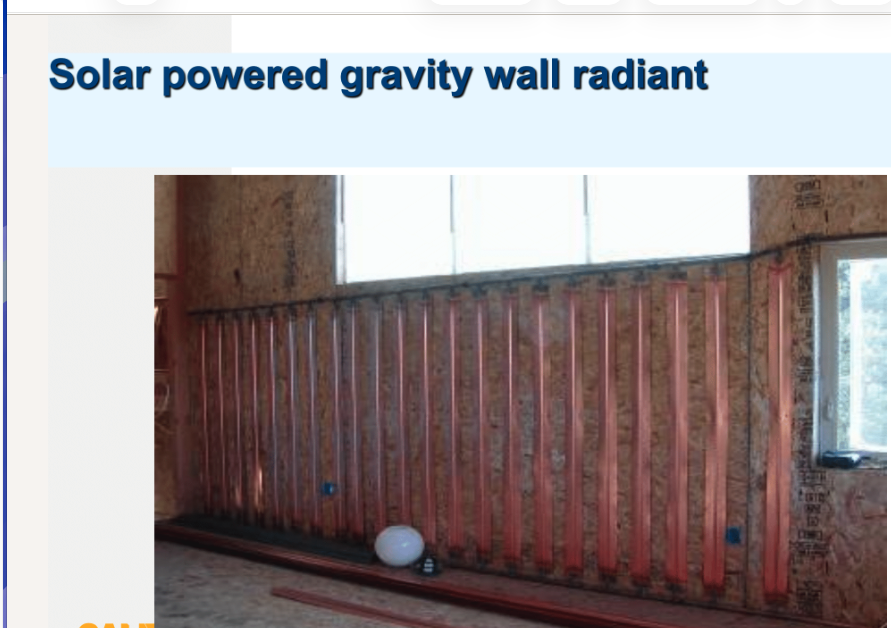
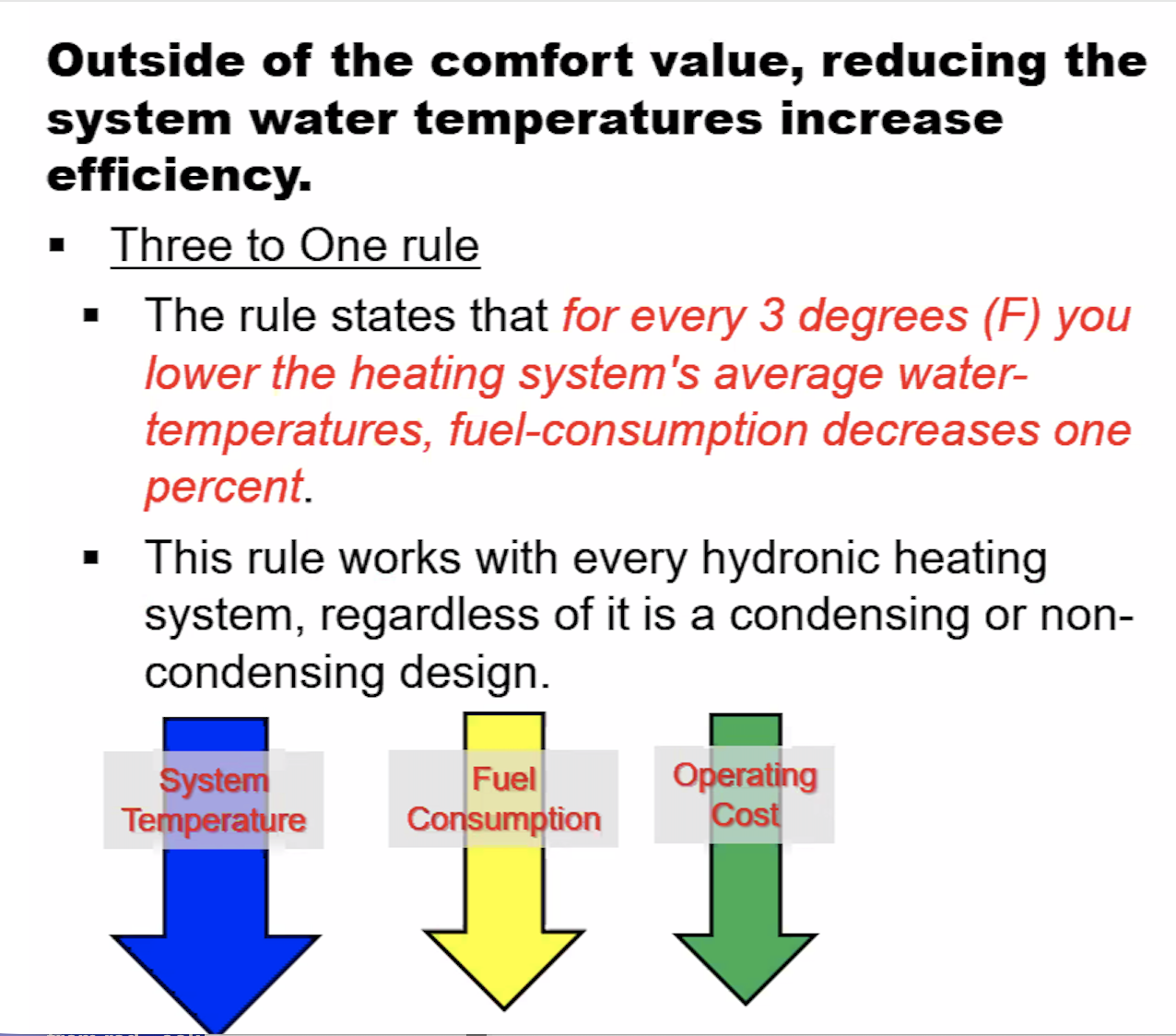
If efficiency is part of the goal, heating the home with water under 120°F has some benefits
 Bob "hot rod" Rohr
trainer for Caleffi NA
Living the hydronic dream2 -
I've extended many systems with predictable results. Not much of a challenge there. But the closest I've come to installing a new system was in an old warehouse-turned-residential building in TriBeCa where we took the basement and ground floor duplex residence (12,000 sq ft) off the building's 2-pipe vapor system and completely repiped it independently as a parallel zone to the single existing boiler. TRVs rather than one big zone valve allowed the split systems to play together nicely and my client's newly partitioned rooms never overheated again. It was massive and all the interior framing made it very difficult to photograph but it was a great learning experience for my whole shop.
Contact John "JohnNY" Cataneo, NYC Master Plumber, Lic 1784
Consulting & Troubleshooting
Heating in NYC or NJ.
Classes3 -
Hi, To follow up on @hot_rod 's post, the house maintains 70 with 80 degree water. I burn about 1/4 cord of wood for supplimental heat per year.
Yours, Larry
0 -
Comfort is getting the right amount of heat to the right place. Not too much, not too little. The reason pumped hot water displaced both steam and gravity hot water is that it does a better job of delivering small amounts of heat. It's more responsive.
Houses built to the latest codes are very tight and well-insulated. They're most comfortable with heat that can be delivered in small increments.
2 -
Zonig is a nice featue also.
And not to forget IAQ indoor air quality has to be addresses in today's modern, tight, well insulated homes.
Air exchange, filtration, humidity control are all apart of the comfort formula.
Bob "hot rod" Rohr
trainer for Caleffi NA
Living the hydronic dream0 -
I just feel that forced or gravity hot water is a much better medium and more manageable. One of the things I love about my gravity hot water system is even just to knock some chill off on a mild but chilly spring day, my boiler can run for an hour and water only reaches 140°-150°and it’s just enough to send heat out to all the rads. Whereas steam, there is no in between, it’s either off or 212° being sent out to every rad.
With how tight new construction is, even with the smaller sized rads, you would still get the full amount of heat which can lead to rooms getting overheated fast. Not as big of an issue in older houses as they aren’t as tight and lose heat faster than a new builds of today. Especially new builds with spray foam insulation with high R values.
I think another issue that keeps steam from being installed in new residential is the fact that there just isn’t the talent anymore that knows how to install it well. Heck, techs struggle with even fixing/managing current systems (thank Goodness for Dan’s books, old timers, the pros here, and the deadmen books).
I’m not going to lie, I’m actually happy I don’t have a steam system, there’s just so much more to them that can go wrong, and more maintenance. I still find hot water and steam heating far superior to forced air. I hate forced air, and get reminded of it any time during winter travels to visit and stay with family or friends. I always be missing my rads and usually freezing in my guest room. 😂Lifelong Michigander
-Willie
0 -
I’m actually happy I don’t have a steam system, there’s just so much more to them that can go wrong, and more maintenance.
I think you meant "there's just so much less to them that can go wrong" but OK 😅
NJ Steam Homeowner.
See my sight glass boiler videos: https://bit.ly/3sZW1el0 -
steam systems don't have to run long enough to heat the whole radiator if they are well balanced and in fact most of the time don't run that long. if they are controlled properly overheating really isn't a problem. the same thing goes for gravity hot water, you have to stop heating it before you can sense the heat or it will overshoot. gravity hot water has more potential to not get the boiler hot enough to evaporate the condensation on a mild day.
both solve the problem quite well if properly configured. gravity hot water was considered superior to steam but it was also more expensive.
2 -
I have one of those! But I replaced the vents with 3/8" tees and tubing to connect all returns to one outlet where I have a check valve, thus creating a natural vacuum steam heating system.
It is so much better this way. More heat is delivered to the radiators; the radiators stay warm 1/2 - 3/4 hr after boiler goes off; during this period, radiators continue to auto-balance as steam favors the coldest rooms (where radiators are condensing faster, lower pressure); heat from boiler keeps getting sucked up to radiators (as measured by the much cooler basement temperature). Highly recommended.
0 -
the radiators stay warm 1/2 - 3/4 hr after boiler goes off
I think all cast iron radiators do this regardless of vacuum 😅
In fact, I have been thinking about this topic of vacuum and the more I think about it the more I think it was just a money grab by Hoffman with never more than imaginary benefits.
The thing that's been bothering me about it is that the vacuum would be equal throughout the system and so any steam wouldn't be drawn to any particular place in the system.
Like why would the steam be drawn to the radiators as opposed to anywhere else? Is the vacuum really deep enough that water in the boiler continues to boil for a period of time? And if it does, does the steam "survive" the path through all those cooling pipes and actually make it to the radiators before condensing?
@pacoit if I may ask, what is the negative gauge pressure of your vacuum at the end of a call for heat and how long does it sustain?
NJ Steam Homeowner.
See my sight glass boiler videos: https://bit.ly/3sZW1el0 -
steam is drawn to the radiator that can condense more steam but that has nothing to do with if it is above or below atmospheric pressure. if it is dissipating more heat it condenses more steam to water that collapses in volume and pulls in more steam because its reduction in volume reduces pressure.
if you hook the vents all together to a vacuum source or check valve you need something like a paul vent on each emitter otherwise whatever you are using to keep steam from exiting the vent system will close when steam from the first radiator gets to it and stop the other radiators from venting.
mechanical vacuum on the returns in a 2 pipe system could have advantages if you're lifting condensate and allows you to use smaller return piping.
0 -
steam is drawn to the radiator that can condense more steam but that has nothing to do with if it is above or below atmospheric pressure. if it is dissipating more heat it condenses more steam to water that collapses in volume and pulls in more steam because its reduction in volume reduces pressure.
The pressure differential travels at about the speed of sound to equalize the pressure (positive or negative) in the system, much much faster than the steam itself can react, so how could the steam be drawn there simply by the condensing?
I think I am picturing more like:
- Steam collapses in radiator (this is constantly happening, I don't mean it happens once and is done)
- Local area of low pressure propagates at the speed of sound, balancing the reduced pressure throughout the system
- The low pressure lowers the boiling point
- The boiler water, at 212-215F continues to boil generating localized higher pressure that just as above propagates quickly throughout the system. This could continue below 212F depending on the amount of vacuum.
But as that heated water (without any new BTUs from any flame) boils, any steam it generates goes toward raising the pressure in the system…this counters the low pressure causing the boiling point to raise back toward 212F. And all the while, every pipe in the system is cooling, and condensing steam, robbing it from ever getting to the radiators (if not completely, at least partially—again very difficult to measure).
I see this whole thing as very very minimal, I'm not sure it would be even possible for us to measure the heat energy transmitted out of the boiler due to vacuum forming after the fire is out.
It's going from a massive amount of energy going into the water to zero when the fire goes out, I'm sorry I just don't buy it.
NJ Steam Homeowner.
See my sight glass boiler videos: https://bit.ly/3sZW1el0 -
i didn't say that vacuum made much of a difference in steam flowing in to an emitter to replace steam that condensed.
where it does make a little bit of a difference that might be worth it is if you're using steam pressure to lift condensate up from basement emitters or to an overhead return(which is common with unit heaters and fan coils and that sort of things in commercial installations.) If you are lifting the condensate 8' you need about 4psi differential between the mains and returns. If you get that by running the boiler at 4psig you need to run it about 10 degrees hotter. if you get that by putting the returns in vacuum you can keep the boiler near 0 psig. it could be worth it in some applications.
0 -
@ethicalpaul I get 5-6"Hg between burns; that is with partially filled radiators, and with half the radiators in the house nearly off (big house). The rads remain hotter and for longer under vacuum than when vented. It's a night and day difference.
@mattmia2 I have no traps in my 2-pipe system; the rads are set to allow only as much steam as they can condense (or less). I use ball valves at the basement return taps as a "mechanic's setting" limiter, leaving the radiator valve setting to the user's preference.
0 -
the way you described it, it sounded like you had a 1 pipe system since you mentioned vents but not using them. vacuum vapor systems were once somewhat common.
0






Categories
- All Categories
- 87.8K THE MAIN WALL
- 3.3K A-C, Heat Pumps & Refrigeration
- 59 Biomass
- 430 Carbon Monoxide Awareness
- 132 Chimneys & Flues
- 2.2K Domestic Hot Water
- 6K Gas Heating
- 124 Geothermal
- 170 Indoor-Air Quality
- 3.8K Oil Heating
- 79 Pipe Deterioration
- 1.1K Plumbing
- 6.7K Radiant Heating
- 396 Solar
- 16.1K Strictly Steam
- 3.5K Thermostats and Controls
- 56 Water Quality
- 51 Industry Classes
- 51 Job Opportunities
- 18 Recall Announcements