Welcome! Here are the website rules, as well as some tips for using this forum.
Click here to Find a Contractor in your area.
If our community has helped you, please consider making a contribution to support this website. Thanks!
Zoning a converted gravity system — Best practices?

I have a large (4500 sq ft) duplex from 1925 with a converted gravity system that is now equipped with a circulator. It is working pretty well, but I am planning to replace the ~70 year old boiler with a mod-con. At the same time, I would like to introduce some zoning, and have a couple of questions.
I would like to put the 1st floor on a different zone(s) than the 2nd and 3rd floor. The 1st floor is generally a few degrees colder than the 2nd and 3rd floors. It would be really nice to be able to control them separately.
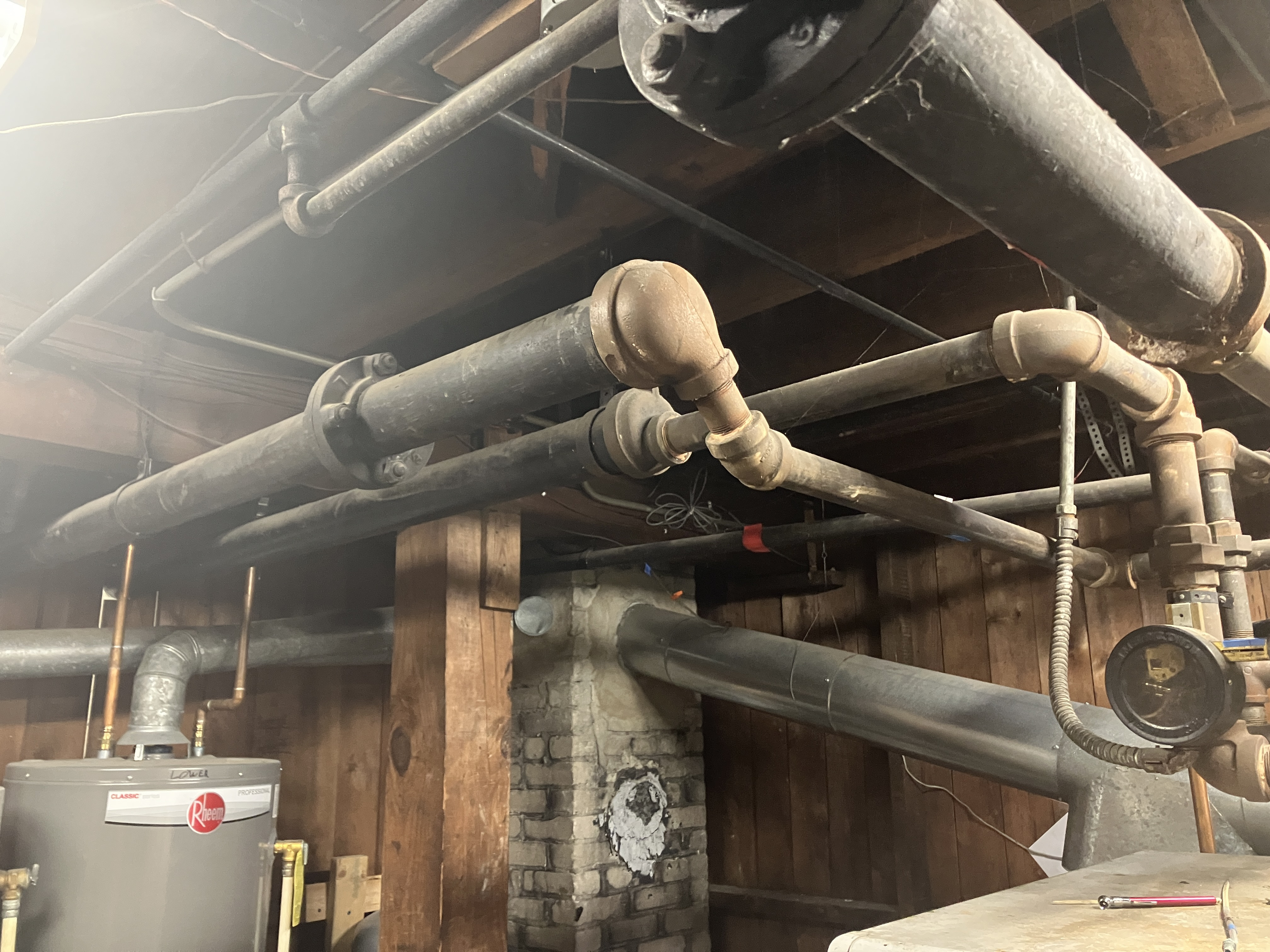
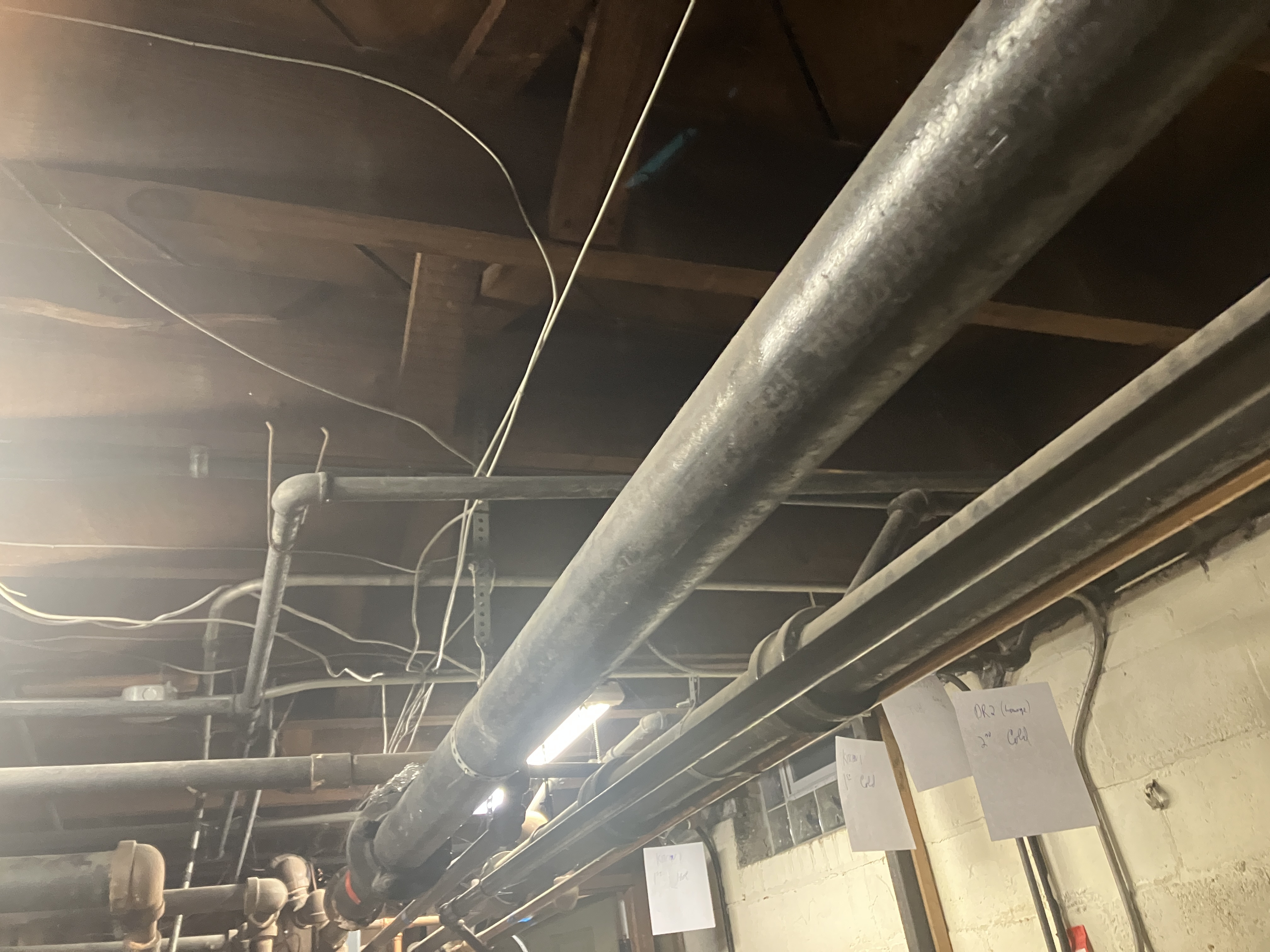
My main question is if it is feasible to “hack off” the supplies/returns to the 1st floor radiators from the giant gravity distribution pipes, cap those off, and build a new distribution system for the 1st floor, while keeping the original 3” gravity pipes for the 2nd/3rd floors? I would hate to think of the labor and trouble it would take to remove those monsters running around the basement. I am hoping they can be repurposed without issue for the mod-con, while feeding only the 2nd/3rd floors.
I actually want to have two separate zones on the 1st floor. One of the rooms (a grand living room with lots of windows) was evidently under-heated as built. It only had two convectors (whereas the rest of the house uses cast-iron radiators). So, somewhere along the way, someone added 28’ of cast-iron baseboard in that room. The baseboard is currently fed from its own “zone” with 3/4” Cu and a dedicated circulator. That room has its own thermostat, which triggers the dedicated circulator. The combination of baseboard and convectors is enough to keep the room warm.
Luckily for me, somewhere along the line, someone also added 1-1/4” steel pipes all the way across the house to feed just 2 radiators on the 1st floor. I plan to use those as the backbone of the distribution system for the rest of the 1st floor. I assume that the installation pro would probably use 1” PEX from the terminus of that 1-1/4” pipe to feed the rest of the radiators on the 1st floor?
I have done hydraulic modeling on the two proposed first-floor circuits (meaning the full Siegenthaler-type analysis). It seems to work out pretty well, with all of the emitters getting between 1 and 3 gpm with reasonable pumps and reasonable flow velocities. (I didn’t bother with the 2nd/3rd floor, since it works okay now.)
The related question is about how the water volume plays into this. I currently have ~200 gallons in the piping and radiators. Much of this will wind up in the 2nd/3rd floor zone. I THINK that the large water volume will have some good effects with a mod-con, by providing a high-mass buffer. Is that correct?
I have also looked into the total heating load and the load of each of the proposed zones. I claim I need a boiler of ~80k BTU/hr to meet design-day demands. Also, I have pretty well convinced myself that the smallest zone (the living room) can easily absorb the minimum output of a mod-con with that total output (assuming a 9:1 or 10:1 turndown ratio) even at 120 deg average water temp. As I understand it, this would help prevent short cycling.
Any comments welcome. My main question is whether it’s feasible to hack the 1st floor rads off of the main distribution system?
Trying to keep Bernie burning!
Comments
-
Our 4800 sq ft condo building, built in 1924, with gravity conversion heating, in the Boston area, also has a design heat loss of around 80,000 BTU/hr (though I quote it as 100,000 BTU/hr for margin), so if you're in a similar climate, your heat loss number is believable.
@EdTheHeaterMan has experience re-piping this type of system, so he may have some thoughts for you.
Yes, the nice thing about these old gravity conversion systems is (1) the high water volume, and (2) the typically massive amount of radiation. The high water volume acts like a buffer tank to prevent short-cycling, and the large EDR lets you heat with low water temps. We could heat this building with sub-120 degree water.
 2
2 -
I’d consider putting TRVs on the radiators and installing a Delta P circulator.
A properly sized mod/con with the ODR curve set correctly would also help to even things out.
Bob Boan
You can choose to do what you want, but you cannot choose the consequences.
 3
3 -
@Bernie _the_Brewer everything you have outlined sounds like it will work. As @jesmed1 mentioned, one of my earliest “new Install” jobs in the late 1970s was to convert a 4 unit building with one massive coal converted to oil boiler so that each apartment owner would pay for their own heat and hot water. I did this with 4 water heaters and three gas boilers. One of the second floor units (the right side) was to use the original gravity hot water piping and boiler (still oil fired) and all the second floor gravity piping was left connected to the second floor radiators. The second floor with the new gas boiler needed only the near boiler piping to be connected to the gravity mains that were isolated from the first floor on the left side of the building, just as you described in your original post. Only the first floor zones needed new 1" copper main piping to connect all the first floor radiators from the old system, much like you plan in your post.
Two differences are that I used different boilers for each zone and I only had one type of radiator for all the zones.
In your case you are zoning off of the same boiler the entire radiator system from the upper floors and your first floor has several different radiator types to contend with.
Since you are using a ModCon for the baseboard zone, you may be able to use the same thermostat to operate both circuits if the baseboard and convectors are heating the same space. You may just need to operate two different pumps with different water temperatures if needed. Outdoor reset may make that temperature difference unnecessary. Only time will tell if you elect to avoid the design with two temperatures.
Sounds like you have done the math necessary to get the project to operate properly. Good luck with your plan. PM me, or post here on The Wall and tag me, if you have any specific queries that I may be able to assist with.
Always glad to help.
Edward Young Retired
After you make that expensive repair and you still have the same problem, What will you check next?
1 -
If you do break it up I would probably pick a boiler that can have several different zone calls with different SWT and reset curves like certain models of lochinvar and viessman. The system with the large volume of water is going to act differently than the system with the CI radiators but modern small piping and the convectors and ci baseboard are going to also act differently.
1 -
Thanks very much for that writeup and sharing your experience, @EdTheHeaterMan ! I appreciate it.
You were correct that, as of now, the convectors and baseboards are on two different distribution systems. My plan was to take the convectors off of the main piping, and plumb them into the 3/4" Cu line that feeds the baseboards. Right now, the 4 baseboards are in series. I thought it might work well to make two groups of 2 baseboards and 1 convector (each), with the 1 convector and 2 baseboards in series. Then put those two groups in parallel. That would give 4 fps on the supply copper pipes, and 2 fps through each of the groups.
Then I would run all 6 of those emitters as one zone, controlled by the thermostat in the room.
I am assuming that I will use a primary/secondary, with each zone being its own secondary loop. Plus probably an indirect DHW tank. But that is obviously subject to what my pro thinks!!
Trying to keep Bernie burning!
0 -
A goal would be to get all the various heat emitters to work not only on one temperature, but the lowest possible temperature. You want to maximize the mod con, so try to operate the system at the lowest possible SWT.
You can still zone the different types, low and high mass emitters, separately.
If absolutely necessary, two temperature zones.
With a mod con, a P/S or hydraulic separator simplifies multiple zones (temperatures) and different pumping requirements.
Bob "hot rod" Rohr
trainer for Caleffi NA
Living the hydronic dream1 -
Agree with @hot_rod on keeping the like radiators on the same part of the system. one idea would be to use the secondary loops in order of temperature. The baseboard can stay in a series as the first loop off of the boiler then the convectors, then finally the upper floors as the last secondary. If you add DHW to the mix then you can use DHW loop directly off of the boiler with the hot water on priority so you only get the highest temperature to the indirect. After the DHW is satisfied, the boiler can go back to the lower reset temperature.
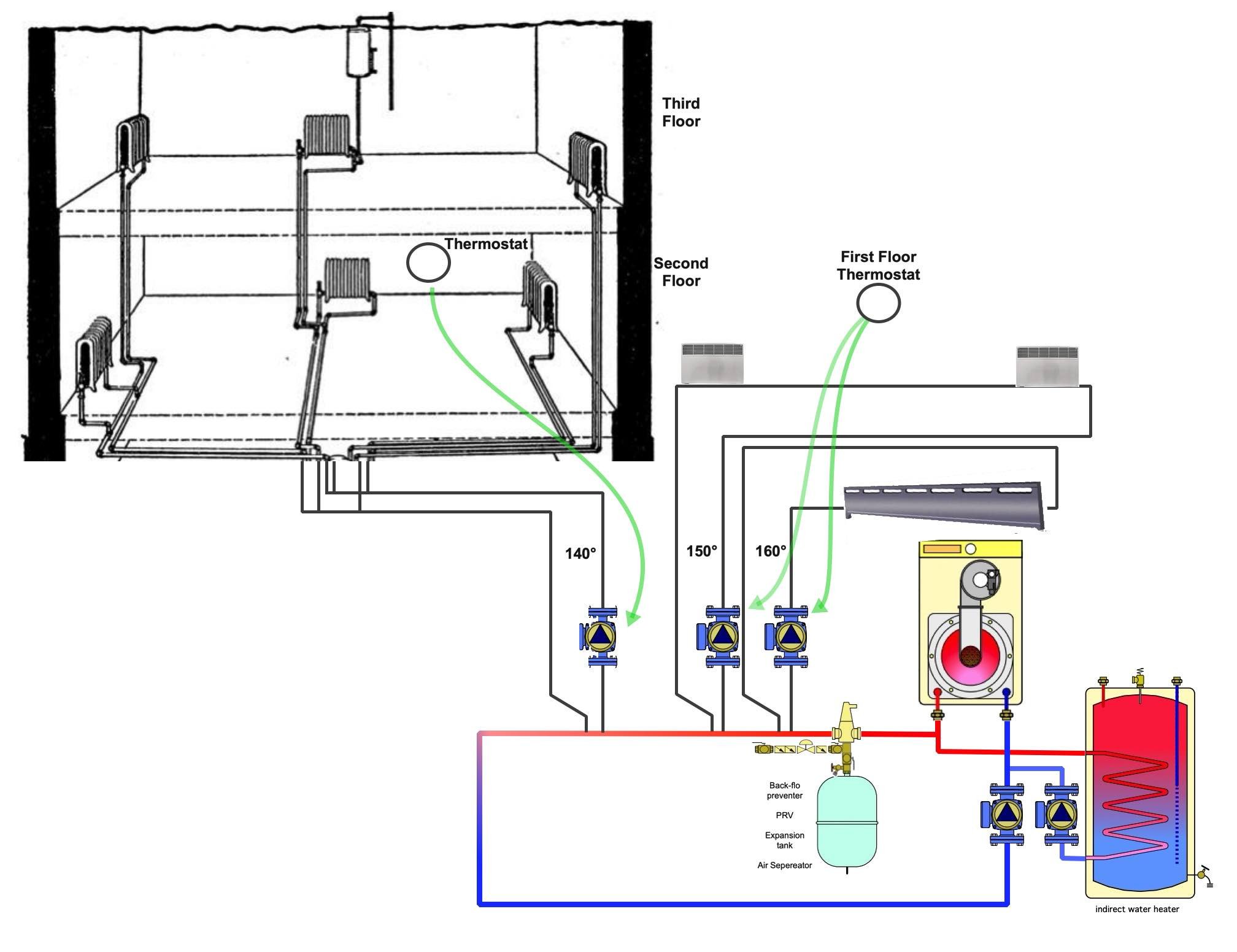
Look at this piping arrangement to see how the return water from the first secondary loop will be mixed with the second secondary loop to yield a lower water temperature as desired without the need for special mixing ore metering valves and controls. the third loop for the second and third floor will get the coldest supply water. When you use the ODR feature inside the boiler, and take some time to tweak the reset curve, you may not need any additional controls to get the water temperatures in the radiators you require for comfort and energy efficiency.
During the colder days both the first and second floor will be circulation more that it is off, as a result of the lower water temperature offered by the ODR feature in the boiler, you may see a temperature range like I have illustrated 160°/150°/140°. When the weather is mild those water temperatures will be much lower as a result of the ODR feature for example: 110°/105°/100°. that will add to the boiler efficiency with return temperatures about 10° to 12° lower than the supply temperatures
These are only examples of what might happen… Your actual results will vary.
Edward Young Retired
After you make that expensive repair and you still have the same problem, What will you check next?
1 -
The series primary has some advantages and disadvantages. It works when a 3 are calling for heat, if only zone 3 calls you get 160° SWT to that last zone. Many boilers can offer multiple temperatures via their control. But obviously only one at a time.
Zones within 10 degrees of one another it is not really worth another mixing station. I'd suggest a 160 and 140. If that?
With radiators you could supply 160 SWT and run a 30- 35 delta. Then you are always condensing. More so as ODR reduces SWT.
These are adjustments you would make as the system operate.
Unless you do an accurate load calc on each room, then determine the lowest SWT for each rooms radiator, it will be a guesstimate.
This is the selling feature of TRVs on radiators. They are proportional non electric solutions. Dial in the temperature you want and it adjust the flow amount. They work very well with delta P circ and ODR, you get constant circulation, flow never stops, right down to ODR enable temperature.
Bob "hot rod" Rohr
trainer for Caleffi NA
Living the hydronic dream 2
2 -
i mean any of the zones can take the temp of the zone that needs the highest temp, it isn't like you'll overheat a radiant floor this way so just a boiler that will produce the highest temp of the zones that are calling seems fine here, no need to have any mixing valves, just a boiler that can do setpoint and reset curve per zone and pick the highest
2 -
I really appreciate the grey matter being expended on this on my behalf. Thank you. I am still abosorbing and noodling.
Trying to keep Bernie burning!
0



Categories
- All Categories
- 87.8K THE MAIN WALL
- 3.3K A-C, Heat Pumps & Refrigeration
- 60 Biomass
- 430 Carbon Monoxide Awareness
- 133 Chimneys & Flues
- 2.2K Domestic Hot Water
- 6K Gas Heating
- 124 Geothermal
- 170 Indoor-Air Quality
- 3.9K Oil Heating
- 79 Pipe Deterioration
- 1.1K Plumbing
- 6.7K Radiant Heating
- 397 Solar
- 16.1K Strictly Steam
- 3.5K Thermostats and Controls
- 56 Water Quality
- 51 Industry Classes
- 51 Job Opportunities
- 18 Recall Announcements