PMJ plc system
If possible would you be willing to refresh my memory on how your plc system is programmed? I tried it a few times but it was a good 14 years ago so maybe me memory is off.
Single pipe 392sqft system with an EG-40 rated for 325sqft and it's silent and balanced at all times.
Comments
-
*12 years sorry.
Single pipe 392sqft system with an EG-40 rated for 325sqft and it's silent and balanced at all times.
0 -
Sure.
Inputs are remote make/break temp sensor on remote radiator feed pipe, analog pressure sensor on boiler header, outdoor temp sensor. Outputs gas valve, single remote solenoid vent.
On call for heat boiler runs continuously until a make on the remote temp sensor AND pressure sensor shows all system vacuum is gone which then starts a timer whose preset is adjusted by the outdoor temperature. That timer is about 2 minutes in moderate weather and 5 minutes + in single digits. So no matter how long it has been since the boiler last ran, it will run until the same approximately a 1/3-1/2 radiator fill is achieved. After that, if a call stays in progress the boiler waits until the remote temp sensor opens again PLUS a set timer of 4 minutes that I haven't changed in years. At that point the boiler will fire again with the stopping point controlled the same as above.The vent opens during the burn as soon as the pressure sensor shows any positive pressure and lets leaked in air out for what is about the last few minutes of the burn depending. Cycling will continue this way as long as the call is still active. Calls get longer and longer as demand increases. Vacuum increases as demand increases.
I can attach charts but in mild weather burns will be 6-7 minutes separated by waits of 20 minutes and calls will be satisfied in a burn or two. As demand increases - say single digits - vacuum and automatic timer adjustments will extend the burns to 12-13 minutes and waits will be18 minutes or so. Burns per hour always close to 2. No two burns/waits are exactly the same.
Recently at single digits outside I looked at a 12 hour chart that showed 22 burns and 4 tstat satisfactions. The tstat was satisfied a total of 66 minutes in 12 hours never for more than 20 minutes and the system was calling for heat all the rest of the time. Radiator condition 1/2 -2/3 full and very constant - tough to tell that they were changing at all. I don't know exactly what the remote temp switch trip point is but guessing about 180F. This is exactly the performance I want where the occupants really have no idea anything is happening.
Hope this is what you were looking for. Happy to share any of it.
For the record I studied the Ecosteam approach along the way and even bought surplus equipment from MarkS.
1926 1000EDR Mouat 2 pipe vapor system,1957 Bryant Boiler 463,000 BTU input, Natural vacuum operation with single solenoid vent, Custom PLC control 1
1 -
I can see how your system would be reasonably applicable, @PMJ , in situations where the radiation is seriously oversized (not so much the boiler), which appears to be your situation. There is also the subjective benefit — which could be quite real — that the radiation will stay in a more or less steady state. This would be particularly true with newer, relatively low mass radiation, I would think, and could be very attractive to many homeowners.
Have you been able to make any measured assessment on the overall thermal efficiency (tank to structure — I'm not interested in boiler efficiency by combustion test)? I am a little concerned, perhaps without reason, by the relatively short boiler run times — but it is likely that I am influenced by my own system, which has a high mass, relatively high water volume commercial boiler which simply takes time to start producing any significantly warm vapuur, never mind any steam.
Br. Jamie, osb
Building superintendent/caretaker, 7200 sq. ft. historic house museum with dependencies in New England0 -
I need time to read and disgest this.
Sadly, I'm sick with a bad cold so I'll need a while. Not ignoring it intentionally.
Single pipe 392sqft system with an EG-40 rated for 325sqft and it's silent and balanced at all times.
0 -
@PMJ yo0u say you have a temperature sensor on a radiator feed pipe, did you ever have or try a temperature sensor on the radiator itself ~1/2 way or so or did I just remember this wrong?
0 -
It has always been on the feed pipe. My description above isn't quite accurate. The fill level isn't always exactly the same. By having it just before the radiator the timer adjustment does vary the fill level. The important thing is that the boiler always does a straight run to the point radiators start filling no matter what. We all know that the time required for that varies a lot depending on off time especially in mild weather and I wanted to eliminate any possibility of lost time for that reheat.
1926 1000EDR Mouat 2 pipe vapor system,1957 Bryant Boiler 463,000 BTU input, Natural vacuum operation with single solenoid vent, Custom PLC control 1
1 -
Not much time today (still working). Obviously no rush on any of it. I will be back later.
1926 1000EDR Mouat 2 pipe vapor system,1957 Bryant Boiler 463,000 BTU input, Natural vacuum operation with single solenoid vent, Custom PLC control0 -
-
Attached is a 12 hour plot from 2-8-26 when the outside temperature was in the low single digits.
There is a lot of information here about how my system works. It takes some getting used to but anyone interested please give it a study and a chance. Sorry about the quality.
Red trace is TTS(time to steam at the remote feed pipe from fire), Blue is total burn time, Green is the time to cool - that is how long it took for the remote heat sensor to open again after the fire went out, the thin black trace is the total burner off time wait.
The red and blue traces start at zero together. Their times end when they go flat at the top. The green and black traces start together when the blue burn ends(first goes flat).
I have circled the 6 times that the call was satisfied and marked a time estimate of how long it was satisfied. The system was calling for heat 88.5% of the time. The longest call satisfaction was about 20 minutes. The heat is the most even when the call % time is high and the satisfied % low.
The time from fire to new steam arriving at my most remote radiator is just over 3.5 minutes except when there was a longer off time wait for a call satisfaction when it is 5-7.5 minutes. The boiler was firing 34.5% of the total time.
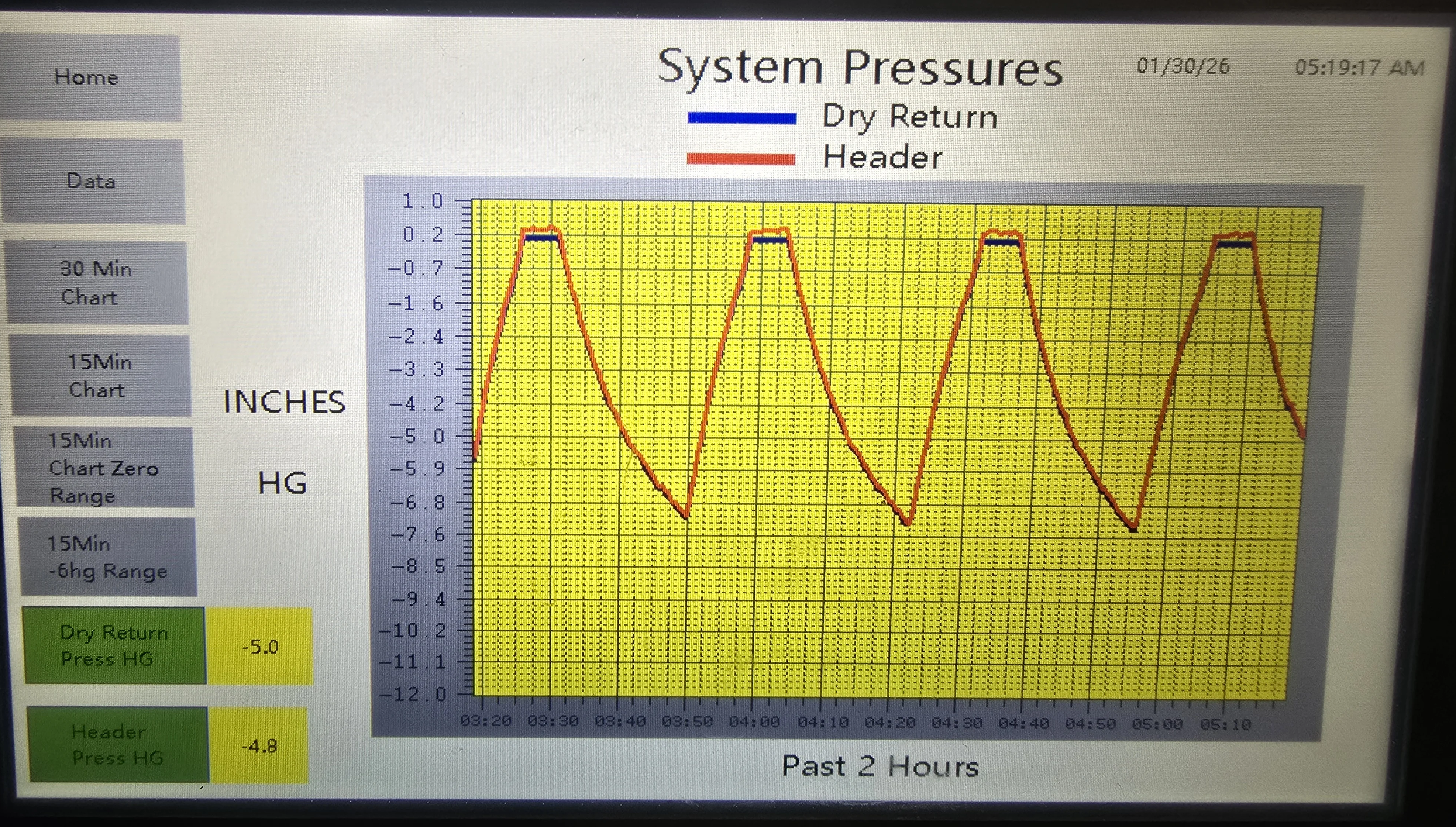
Attached also is a plot of system pressures. Not the same day but just to give the idea. Just want everyone to see that vacuum is still increasing rapidly even after the boiler has been off 17 minutes. There is still a lot of steam in the system at that point. Lower temperature steam yes, but still steam obviously since it is condensing and still dropping the pressure. Peak vacuum will generally occur after 90 minutes to 2 hours if the boiler isn't fired.
More comments to follow.
1926 1000EDR Mouat 2 pipe vapor system,1957 Bryant Boiler 463,000 BTU input, Natural vacuum operation with single solenoid vent, Custom PLC control 1
1 -
@PMJ My present curiosity is the compound pressure transducer used to measure the system pressure. Not finding one in the range I would expect for best performance.
Any custom interfacing to match the pressure transducer's range to the PLC's A to D input range & resolution ?
National - U.S. Gas Boiler 45+ Years Old
Steam 300 SQ. FT. - EDR 347
One Pipe System0 -
I'm using 2 ProSense SPT25-10-V30D. One on the boiler header and one on the dry return. You need to calibrate with gain and offset settings. This is where the PLC platform makes it easy. You need to figure out the equation yourself from 2 points of actual readings to get slope(gain) and offset numbers to put in. This model has a wide range but resolution was good enough for what I needed to see.
photo attached.
1926 1000EDR Mouat 2 pipe vapor system,1957 Bryant Boiler 463,000 BTU input, Natural vacuum operation with single solenoid vent, Custom PLC control 1
1 -
is this the boiler with the jbweld at the top of a section or was that someone else's 1950's bryant?
0 -
Different boiler.
1926 1000EDR Mouat 2 pipe vapor system,1957 Bryant Boiler 463,000 BTU input, Natural vacuum operation with single solenoid vent, Custom PLC control0 -
No. Total focus has been in moderate+ demand conditions. As you might guess my boiler hardly needs to run at all at 40+. Might only fire 2-3 times in 12 hours. Now that I have added outside temp I might play around with things at the really low demand end. I left the run time a little heavy at the low end so at those temps single burn satisfactions and long off times. It turns out a pile of brick and slate in the sun doesn't need much help in those conditions. I might change the slope of the timer adjustment line and shorten burns and the low end more. Nothing is unpleasant though since basically nothing is happening so hasn't been much need to.
1926 1000EDR Mouat 2 pipe vapor system,1957 Bryant Boiler 463,000 BTU input, Natural vacuum operation with single solenoid vent, Custom PLC control0 -
@ChrisJ , Attached is a chart from today when it was 35 degrees. The call was satisfied 12 times or basically once and hour. The waits of around 30 minutes are when the tstat had been satisfied and for about 15 minutes each time. Following these longer satisfied waits the boiler fired and did a full burn of 8 minutes or so followed by normal 17 minute waits with the call still in progress. Notice then that several times the boiler fired for a second time in the same call but that the call was satisfied very early during the second burn. The red burn line will go flat either when steam reaches the remote radiator or the the burn stops because the call was satisfied. If the burn was only 2.5 minutes no new steam had yet reached the radiators. The reason I am pointing this out is that at those times then the calls were satisfied some 20 minutes after the boiler had been off. That is because in a vacuum system a lot of steam is still in the mains when the boiler goes off and still keeps travelling into the radiators. So all that time the temp in the room is still rising slowly even though the boiler had been off the whole time. This is the same phenomenon that everyone accepts as valid logic as a coal fire burns down but don't accept it when the fire goes out suddenly. Actually the two situations are very much the same. And when you consider it happening many times in a single day I think it adds up to more total benefit than one time per day with a coal fire. The plain fact is that a lot of steam that you already produced actually gets delivered to the radiators that never would be without the vacuum.
1926 1000EDR Mouat 2 pipe vapor system,1957 Bryant Boiler 463,000 BTU input, Natural vacuum operation with single solenoid vent, Custom PLC control3 -
For making steam more efficient, this is solid gold.
0 -
Why?
Single pipe 392sqft system with an EG-40 rated for 325sqft and it's silent and balanced at all times.
0 -
Because net steam delivery to the radiators per unit of burn time is higher. Time to steam on every burn is shorter. Air never needs to be pushed out of the way to get steam delivered. Steam never stops flowing from mains into radiators whether the burner is on or off because inside the radiators is always the lowest pressure point in the system. In sum it takes less effort to get the required steam delivered.
1926 1000EDR Mouat 2 pipe vapor system,1957 Bryant Boiler 463,000 BTU input, Natural vacuum operation with single solenoid vent, Custom PLC control1 -
But lightoffs is much greater than on a much lower cycle system?
They claim that's what kills efficiency, no?
Single pipe 392sqft system with an EG-40 rated for 325sqft and it's silent and balanced at all times.
 1
1 -
It doesn't. Time to steam is so much faster in the low pressure that the total is still less even with more cycles. Net steam delivery actually into the radiators per unit burn time. Focus on that.
Everyone seems to get the concept of delivering steam from a dying coal fire that would never be delivered at all without the vacuum. Same thing is happening here on every cycle. Steam already produced actually gets to the radiators that would not without the vacuum - many times a day.
1926 1000EDR Mouat 2 pipe vapor system,1957 Bryant Boiler 463,000 BTU input, Natural vacuum operation with single solenoid vent, Custom PLC control0 -
i am sure there is a thread here with 800 comments that explains this, but you have a 1 pipe system, right?
what keeps the radiator vents from pulling in air when it is under vacuum? do they seal with enough force to not open under a slight vacuum?
other than that you are doing what is difficult to do, making an electric check valve with a very low cracking force. I bet @ChrisJ could make such a check valve. think large area and relatively light valve/ball/flapper so the ounce per in^2 or so pressing on it develops a fair bit of force over that area.
0 -
No. My Mouat system is 2 pipe. Granted one pipe today is a lot harder to do with no vents to use. But the physics are the same in one pipe. Posters here have testified to running one pipe systems with the Hoffman vacuum vents with great success. They weren't believed here either but they said the same things I am saying about the results.
It is actually more important that the cracking pressure be the same than anything else and that probably isn't possible. Vary small differences in resistance to flow would be a problem. That is what made the Hoffman valves so brilliant.
1926 1000EDR Mouat 2 pipe vapor system,1957 Bryant Boiler 463,000 BTU input, Natural vacuum operation with single solenoid vent, Custom PLC control0 -
There's one small joker in the deck… the mass of the boiler and its heat capacity. In the old coal fired — or earlier oil fired boilers, such as Cedric's predecessor — the mass of the boiler was… large. To put it mildly. Modern boilers — even a commercial 80 series Weil-McClain such as Cedric — are a lot smaller and a lot lighter.
Once the fire is shut off in an oil boiler (the situation is more complex in a coal boiler, as the fire does not "shut off" abruptly) the only heat available to evaporate water and create steam — at any pressure — is the heat stored in the mass of the boiler (unless you lower the pressure to a point where heat can flow from the surrounding space into the boiler and thence into vaporizing the water).
The specific heat of iron is about 0.12 BTU/lb.F.. Thus if you have a 500 pound boiler with a mean material temperature of 250 F you can extract about 65,000 BTU from it. About a third of that will be extracted by steaming after the burner shuts off but before the system pressure drops to atmospheric, regardless of the control strategy.
In the case of a system which does not drop into a vacuum, the remaining heat is lost to the surrounding space if the boiler is allowed to continue cooling. A similar amount of heat is required to raise the boiler to the point where it will start to steam from a cold start. Depending on how one defines "efficiency" in a heating system — a very slippery concept — that may be seen as loss and a reduction in efficiency. In a system which is sealed that heat appears in the target space instead.
Br. Jamie, osb
Building superintendent/caretaker, 7200 sq. ft. historic house museum with dependencies in New England0 -
i get about 3000 btu that you can extract. 500 lb, 50 F degrees, .12 BTU/(lb F) = 3000 BTU. I figure under vacuum 200 F is about where it would stop steaming. That is like 3 minutes.
Of course some parts of the boiler will be much hotter than 250 F and some parts cooler.
0 -
Don't get too hung up on that it's just the residual heat in the boiler. Most of the steam that keeps moving to the rads is already in the mains when the boiler goes off. Keeping that moving is the big thing. Open vented air fills the radiators not more steam from the mains. This is where the big difference is. Much more steam actually gets to the radiators, and much of that occurring with the boiler off.
1926 1000EDR Mouat 2 pipe vapor system,1957 Bryant Boiler 463,000 BTU input, Natural vacuum operation with single solenoid vent, Custom PLC control 2
2 -
i don't think there is much heat in that maybe 50 cubic feet of steam in the mains.
there is about 400 btu in 100 gallons of steam.
0 -
It's kind of hard not to get hung up on thermodynamics. The math doesn't lie.
But I'm asking questions because maybe there's a ton the test of us aren't thinking of or understanding. I think we need to consider everything since PMJ has been patient enough to continue sharing info etc.
Single pipe 392sqft system with an EG-40 rated for 325sqft and it's silent and balanced at all times.
1 -
How much heat is in 75 cu. ft. of air (when the vents open and the steam in the boiler and the mains condenses w/o providing heat to the room) for the boiler, piping and radiators vs. 75 cu. ft. of low absolute pressure steam at maybe 180 F? It's like saying you'd rather have an empty gas tank than a small amount of high value fuel in it.
0 -
It's been a thing here for a while that this must only be about boiler residual heat. It is really about never ending flow and all the steam that is already in the mains when the flame goes out. Radiators stay a lot warmer a lot longer because the steam stays flowing that doesn't open vented. I showed flir photos of this a while back. The benefit is cumulative cycle after cycle.
1926 1000EDR Mouat 2 pipe vapor system,1957 Bryant Boiler 463,000 BTU input, Natural vacuum operation with single solenoid vent, Custom PLC control0 -
As a fiend of mine (who runs heavy wreckers) has said many times — there's a lot of ways to add up to 10. They all work… and none of them are wrong.
Br. Jamie, osb
Building superintendent/caretaker, 7200 sq. ft. historic house museum with dependencies in New England0 -
With system pressures like @PMJ documented, the boiler iron and all the water in the boiler has to drop below 200 degrees Fahrenheit before the steam flow stops completely and the steam flow starts at a lower temperature than your typical boilers. So I can see the radiators maintaining a more uniform temperature enhancing comfort. I'd like to see this graph with the boiler water temperature also. Maybe with this cycle rate shown it never truly stops steaming.
 National - U.S. Gas Boiler 45+ Years Old
Steam 300 SQ. FT. - EDR 347
One Pipe System1 -
@ethicalpaul Look ^^^ at how the pressure at the end of the dry return is lower than the pressure at the header. It looks like it is "measurable" doesn't it?
One division on that chart is 0.8/5 = 0.16 in. Hg = 2.2 in. H2O
@PMJ If you have the capability, it would be very interesting to see a radiator temperature overlayed on the above chart.
Also, where is the cursor located in that chart where Header press. = -4.8 in. Hg and Dry Return press. = -5.0 in. Hg.? Obviously steam was still flowing or else there wouldn't be that pressure drop.
0 -
Finally someone is giving this chart some real thought. When new burns start you can see that even 18 minutes after the boiler has been off steam is still condensing and dropping the pressure at a rate not so different than it was when the boiler first went off. So there is still significant steam coming from somewhere. Where is it condensing? Mostly in the radiators. Yes it is increasingly less dense steam and yes the latent heat it is giving up is less, but not that much. Besides, what this really needs to be compared to is if those 18 minutes were spent filling the radiators (and mains) with air instead. The result isn't close.
I'm adding new steam for 12 minutes every 30 minutes and in the living space it is very difficult to tell anything is happening at all because nothing is changing. Radiators are always about the same.
1926 1000EDR Mouat 2 pipe vapor system,1957 Bryant Boiler 463,000 BTU input, Natural vacuum operation with single solenoid vent, Custom PLC control1 -
His is a very large two pipe system that has a lot in it that I’m not familiar with. I can’t remember if he has a crossover trap or what he has between his main and wet return. I was speaking of one pipe when I correctly said that Dimension A is a myth.
His transducers have an accuracy tolerance of +-.5% which across their large range is 0.447 psi
But if you’re willing to admit that Dimension A should be 2” instead of 28” I’ll allow it. I would then say it’s “measurable but insignificant” and not worthy of consideration or concern.
When I’m trying to help people I try to keep things relevant and simple rather than overwhelm them with terms and values that have no effect on their systems or lives.
This grossly inaccurate chart that you have posted from the folks at Peerless whose work I respect and admire, makes professionals and homeowners have to worry about something that isn’t a concern:
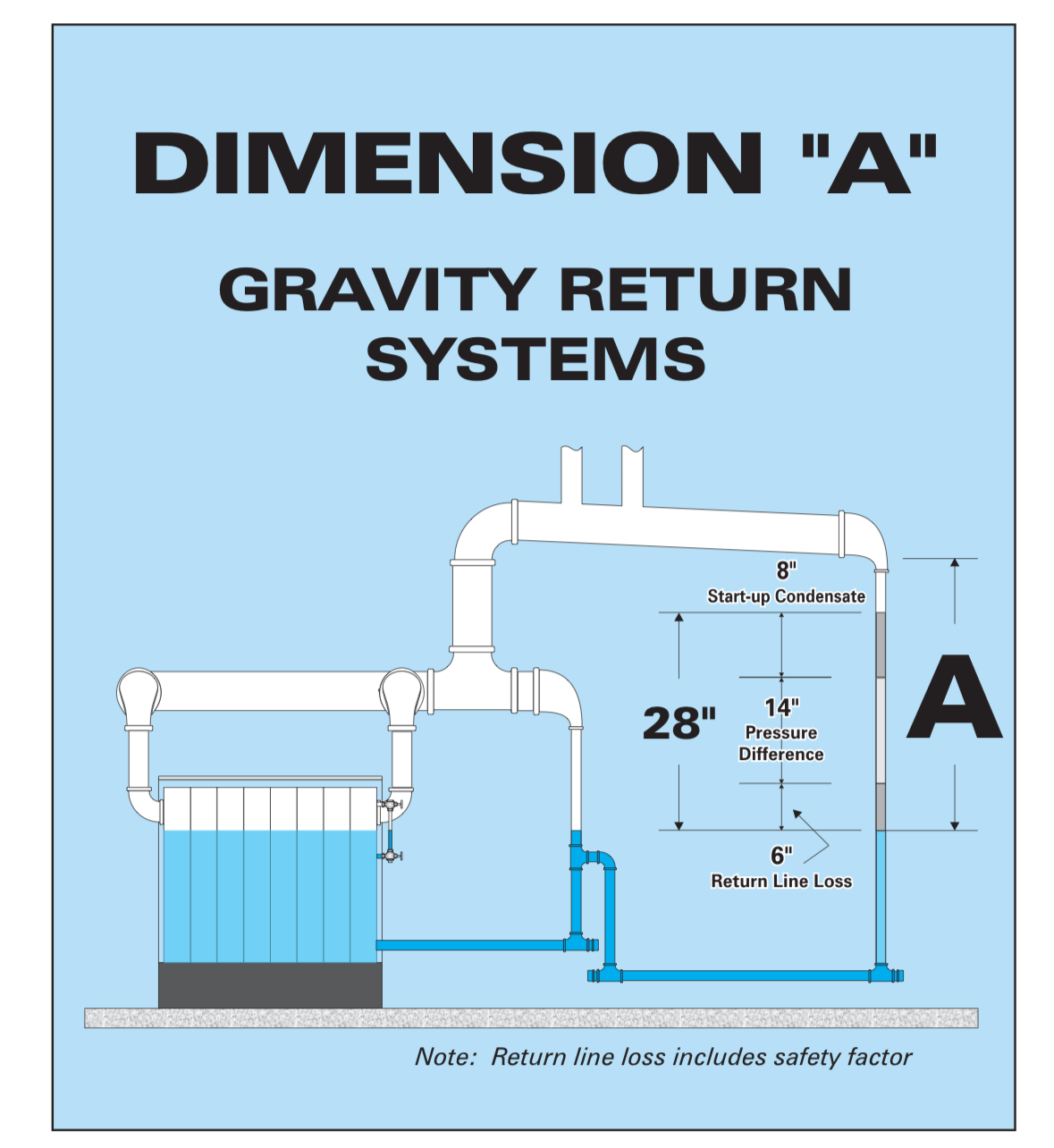
And I don’t care if the guy who drew it is dead, and I don’t use appeals to authority to try to determine the facts.
NJ Steam Homeowner.
See my sight glass boiler videos: https://bit.ly/3sZW1el0 -
Seems to me pretty obvious that if there is flow there is pressure drop so there is an A dimension. It is also clear that it is quite small. My transducers confirm this, though I have never felt the need to increase the resolution to see it more precisely, or even spend lots of time on calibration. The reading is very close to the dial vacuum gage on the header and I did switch the transducers once to see if the difference remained the same which it did. But then I already knew the pressure in the dry return remains lower always just by feeling radiator feed pipes.
But while the subject is up, the more important thing about pressure differences is actually the unmeasurable ones radiator to radiator due to sun, wind etc. which causes different condensation rates on different sides of the house and upstairs vs downstairs. An amazing amount of balancing occurs because of this that again does not if you fill with air. I admit, I would have said the improvement I have seen in balance was not possible until I experienced it myself.
1926 1000EDR Mouat 2 pipe vapor system,1957 Bryant Boiler 463,000 BTU input, Natural vacuum operation with single solenoid vent, Custom PLC control1 -
But you've never tried it on anything smaller than a 1000sqft two pipe system.
Why would anyone assume a single pipe 300sqft system would behave the same?
Single pipe 392sqft system with an EG-40 rated for 325sqft and it's silent and balanced at all times.
0 -
Nothing occurs to me that scale changes the physics, but that doesn't prove there isn't something. I'm open to learning what those are.
1926 1000EDR Mouat 2 pipe vapor system,1957 Bryant Boiler 463,000 BTU input, Natural vacuum operation with single solenoid vent, Custom PLC control0 -
Not to muck up the thread ethicalpaul but the pressure drop in single pipe steam in the main is greater than two pipe steam because of the extra condensate load. You have a teeny boiler at 56MBH steam. Peerless recommends a super generous A dimension of 14 in. in single pipe steam for less than 100MBH. You are neglecting the stack up required for the condensate to get back to the boiler for overcoming the friction effects in the wet return piping as well.
Their chart is a little discombobulated I admit but between the two columns an understanding can be arrived at.
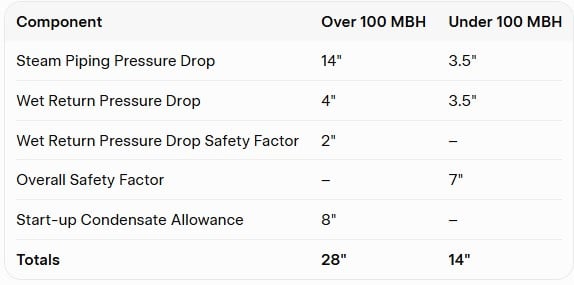
Now back on track for this super interesting thread. Can we maybe see some of those Flir photos of the radiators? 😃
1 -
My curiosity purely from a controls perspective, what brand and model of PLC are you using?
0




Categories
- All Categories
- 87.8K THE MAIN WALL
- 3.3K A-C, Heat Pumps & Refrigeration
- 59 Biomass
- 430 Carbon Monoxide Awareness
- 132 Chimneys & Flues
- 2.2K Domestic Hot Water
- 6K Gas Heating
- 124 Geothermal
- 170 Indoor-Air Quality
- 3.8K Oil Heating
- 79 Pipe Deterioration
- 1.1K Plumbing
- 6.7K Radiant Heating
- 396 Solar
- 16.1K Strictly Steam
- 3.5K Thermostats and Controls
- 56 Water Quality
- 51 Industry Classes
- 51 Job Opportunities
- 18 Recall Announcements