clarification on pressure drop for dyslexia

So when someone says it has a greater pressure drop .. does that mean for ex… From originally 30 PSI for ex to 10 PSI
Or when someone says it has a lower pressure drop… Does that mean from 30 PSI to lets say 28 PSI?
Please help my dyslexia.. lol
Comments
-
Think of it like this:
In a boiler system, when a circulator pump is operating, there is higher pressure at the pump outlet and lower pressure at the inlet. As the water moves through the piping, friction is created, and this friction causes a pressure drop. The longer the piping (and the more fittings and components in the loop), the greater the pressure drop.
In closed-loop hydronic systems, this pressure drop is expressed as pump head, which is how circulator performance is rated.
On a typical small residential hydronic system, a pump head of about 8 feet of head is only around 3.5 psi as seen on a pressure gauge. In a closed system with a static pressure of about 12 psi, the pressure might rise to roughly 15.5 psi at the pump outlet and drop back to 12 psi at the pump inlet while the pump is running, resulting in a 3.5 psi pressure drop.
That pressure difference represents the total pressure drop of the piping system that the circulator must overcome to move the water through the system.
When the pump shuts off, the added differential pressure disappears and the water equalizes throughout the closed loop, causing the system pressure to return to its original static value.
EDIT:
To add more detail, each section of the system has its own pressure drop. For example, the pressure drop through the boiler might be 0.8 psi, a loop of baseboard might be 0.7 psi, another loop or circuit might be 1.2 psi, and the piping and fittings might account for 0.95 psi. An air scoop or air separator might add another 0.1 psi. zone valves and flow check valves each have a pressure drop
When all the individual components are added together, they make up the total system pressure drop. Each component can be evaluated individually, but the circulator must be selected to handle the sum of all these pressure drops at the required flow rate.
I aslo feel your pian, I am a 50 yaer mebmer of the DNA (National Dyslexia Assoc.) I am with yuo man!
Edward Young Retired
After you make that expensive repair and you still have the same problem, What will you check next?
0 -
Now that I think about it, I can see where there might be confusion. That said, the term "pressure drop" in a piping system is always used as being synonymous with "pressure loss" in a piping system… and both are in reference to the change in pressure through the system from one point to another, rather than the pressure at a particular point, when used that way.
Confusingly, one could also use either term to refer to the pressure at a specific point…
Br. Jamie, osb
Building superintendent/caretaker, 7200 sq. ft. historic house museum with dependencies in New England1 -
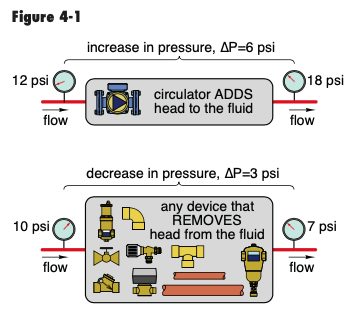
In a closed loop hydronic system Head= the mechanical energy contained in the water, or fluid.
Pressure is a measurement of force within the circuit
The spinning circulator add energy, (head), the piping and components remove that energy. So if you had gauges along the piping path the pressure measured at the circulator gets dissipated, or "used up" as it travels along the circuit.
So pressure changes are evidence that the energy (head) is being added or subtracted.
 Bob "hot rod" Rohr
trainer for Caleffi NA
Living the hydronic dream0



Categories
- All Categories
- 87.8K THE MAIN WALL
- 3.3K A-C, Heat Pumps & Refrigeration
- 59 Biomass
- 430 Carbon Monoxide Awareness
- 132 Chimneys & Flues
- 2.2K Domestic Hot Water
- 6K Gas Heating
- 124 Geothermal
- 170 Indoor-Air Quality
- 3.8K Oil Heating
- 79 Pipe Deterioration
- 1.1K Plumbing
- 6.7K Radiant Heating
- 396 Solar
- 16.1K Strictly Steam
- 3.5K Thermostats and Controls
- 56 Water Quality
- 51 Industry Classes
- 51 Job Opportunities
- 18 Recall Announcements