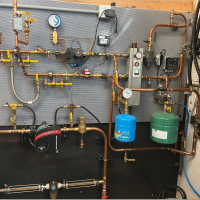
Thermostatic mixing valve and Taco 3 way
Comments
-
too bad the wood boiler cannot run at 180, then all your problems go away
If you can use the supply down to 140
A= 8.33 x v x delta
8.33 x 1750 x 40=583,100 583 000 btu stored.
What is your heat load at design condition? Divide that into the 583k to see how many hours of non fired heat you have in the tank.
Bob "hot rod" Rohr
trainer for Caleffi NA
Living the hydronic dream0 -
Per the designer's calculations, 128,753
I could only put enough wood in to stop it around 180, but with the storage I've found it's nice to get the boiler temp up to 200+. The wood boiler temp, (with cold outdoor temps like we've had recently - single digits dropping into below 0) drops roughly 10 degrees every 3 hours. So If I fire the boiler before I go to bed and it's 210 at 9pm, I'll find it around 170 the next morning, 12 hours later.
I think during the majority of winter I'll need to fire the boiler once every 24 hours. In these especially cold temps I've been firing it twice a day. Total square footage of heated space is roughly 7500sf.
I do appreciate this boiler with the batch burn and storage vs many other boilers where you constantly have to keep them fed.
0 -
8.33x 1750 x 50 delta =728,000 btu would be a 6 hour run at 128k load. But you are feeding the fire also.
So a 12 run would indicate you are below 128k load
The amount of wood and feeding has to do with wood quality and boiler efficiency. Typically 40- 50% efficiency on standard wood burners
Bob "hot rod" Rohr
trainer for Caleffi NA
Living the hydronic dream0 -
When you say a 12 run are you referring to the time the wood boiler is being fired?
This boiler doesn’t run for that long unless I’m continuously feeding it. When I fire the boiler it will burn for about three hours with one big load of wood. It’s a big fire box and takes quite a bit of wood. If wood quality isn’t the best I occasionally feed it with more wood mid burn to make it to the 200+ degrees I’m shooting for.
The designers calculations include heating both garage floors- Approx 1750 sf each level. The lower garage level workshop where the wood boiler is rarely has hot water going through the floors to maintain about 68 degrees, most likely from the rheat coming off the copper pipes and wood boiler itself - even with it being heavily insulated. The majority of the lower level is below grade with 10” concrete walls and 3” of foam on each side (ICF). The upper level garage seems to be heated from the floor below without utilizing the radiant floors. I have that thermostat set to heat to 50 degrees and for the past week it’s maintained about 55-58 without any hot water running through the floors.
So what’s left is approx 4500 of the house - I heavily insulated with spray foam…I do have a lot of north facing windows, though.
anyway - I’ve routinely been seeing 10 degrees of wood boiler temp loss every 3 hours or so, and my wife likes to keep the house warm.
But, I was off earlier about the colder winter temps - I’m up late and did check tonight and at 5pm the boiler was at 210 and at midnight it was at 170 - temps outside are single digits. So considerably more loss than what I advertised earlier in these very cold temps.
Designers calculations might have been figuring heating both garage floors to 70 or something, and not figuring in the heat simply coming off the wood boiler and pipes…
It would appear that I’m not requiring the 128k btu/hr if the boiler only is storing 583k BTUs
0 -
Generally owners look to large buffer tanks or large volume wood burners lik yours to have some non burn time. So my numbers show how many hours you could pull from that 1750 gallons of hot water without needing to have it burning.
Typically owners want to run through the night time without getting up to feed the fire.
So obviously the hotter the tank, and the lower the temperature you can pull down to, the longer the coast or non burn time.
210 boiler- 150 lowest useable temperature 8.33 X 1750 X 60= 874, 650 btus of stored heat
180 boiler- 150 lowest 8.33 X 1750 X 30 437, 325 btus of stored heat
Of course some of that heat escapes through the boiler insulation. If it is inside the heated envelop it is not really "lost" heat. Some is lost up the flue.
So you see the attraction to those high tank temperatures. As long as you can manage them? That seems to be the point of you original post?
Bob "hot rod" Rohr
trainer for Caleffi NA
Living the hydronic dream0 -
yes, definitely. I guess I was a bit confused about your earlier comment that it would be nice to only fire the wood boiler up to 180. If I can temper the heat with this thermostatic valve and actuator, it’s best if I can get the wood boiler up to near max (220). The aquastat allows hot water from wood boiler to be used into wood boiler is below 120. Realistically I figure 10F loss with the 100 plate heat exchanger, and 120 degree water required to run through floors. If wood boiler temp indicates 140 I should get 130 over to the taco I valves.
Usable heat from wood boiler 220-140.
on average seeing 10 degree loss every three hours , so I roughly get through 24 hours before needing to fire it up again.0 -
My though on 180 operating is it would be a way to eliminate the first stage mixing valve the 220 temperature to 170 or wherever you adjust that one.
But if the primary goal is to leverage that 80° delta, then the 220° allows that.
Does the boiler have an ASME pressure vessel stamp by any chance?
Bob "hot rod" Rohr
trainer for Caleffi NA
Living the hydronic dream0 -
I don’t believe so, Sir. I’d have to ask Gary about that.
0

Categories
- All Categories
- 87.8K THE MAIN WALL
- 3.3K A-C, Heat Pumps & Refrigeration
- 59 Biomass
- 430 Carbon Monoxide Awareness
- 133 Chimneys & Flues
- 2.2K Domestic Hot Water
- 6K Gas Heating
- 124 Geothermal
- 170 Indoor-Air Quality
- 3.8K Oil Heating
- 79 Pipe Deterioration
- 1.1K Plumbing
- 6.7K Radiant Heating
- 396 Solar
- 16.1K Strictly Steam
- 3.5K Thermostats and Controls
- 56 Water Quality
- 51 Industry Classes
- 51 Job Opportunities
- 18 Recall Announcements