Repairing dripping hot water radiator valves from 1912 house

I posted earlier about replacing valves but I'm reposting a new topic here since I've decided I'd like to repair them instead and save some money if they are repairable. Someone previously schooled me that the valve stem packing is asbestos and after taking one apart it does look like asbestos. I have a few that are dripping a little and I've tightened the nut to see if that can stop the slight leaks. Actually one radiator with a brand new valve is also leaking a little so I also tightened it. I'll watch them for the next couple days and see if they are still wet.
My questions:
- To fix this leaking temporarily for now, can I loosen this nut and shove some teflon packing over the asbestos packing and tighten it down without draining the boiler?
- One of the valves leaked pretty bad over time, so much that the escutcheon plate is corroded apart and the 2-4" nipple below the valve appears to be rusted and leaking a little. Since it's very cold winter now in MN, can I use some pipe repair epoxy and just plug the leak until spring when I can drain the system and do a proper repair?
Of course, I want to do the repairs correctly but with below zero temps, it would be better if I can temporarily stop the dripping and fix it in the spring. But if I'm causing more damage somehow I'd like to know that.
Comments
-
you can try epoxy but it may not work. more than likely the threads were leaking and caused the deposits. sometimes a piece of rubber tubing and a hose clamp can temporarily stop a leak.
you can shove some string packing in there. teflon will work if that is what you can find but you can still get the graphite impregnated string type too
there were lots of fibers used in packing so it could be asbestos or it could be cotton or a bunch of other natural or synthetic fibers
if the stem is crusty you might have trouble getting it to seal until you clean that off
0 -
I'll take a valve to the pro plumbing supply and see if they have the graphite string. Is it safe to do that repair with the system running and up to pressure or will water rush out? I have some string packing that I thought was made of teflon—it's white.
I'm less concerned about the nuts on the stems leaking, the thing that worries me the most is the 2" galvanized nipple that's just below the floor and the body of the valve. If I could drain the boiler now I'd just replace it. It's quite rusted and leaking some It may have been like that for a long time and I didn't notice it.
0 -
some water will run out when you back off the packing nut. you can probably unscrew it and shove a little piece of string packing in but water will run out, have some rags to catch it, do it on a cold system, and be ready to shove a piece of string packing in and screw the nut back on. it could push the packing out but that isn't very likely,
0 -
You could shut the boiler off and just drain a little to lower the pressure to minimize the leaking while you repack. Then you shouldn't have to bleed much.
0 -
Okay, thanks for the clarification on that. I wasn't sure if unscrewing the stem nut while the boiler was up to pressure was going to make a mess. Draining some of the water out and doing it cold makes sense. I'm going to leave the nuts alone for a couple days and see if tightening made a difference. I've wrapped dry rags around them all. I'll get some of that JB Weld wet pipe repair epoxy and see if that will seal up the 2" nipple temporarily.
When I can drain the system in the spring, would you recommend leaving the existing packing in there and just adding more modern packing string on top of it, or should I clean out the old stuff?
0 -
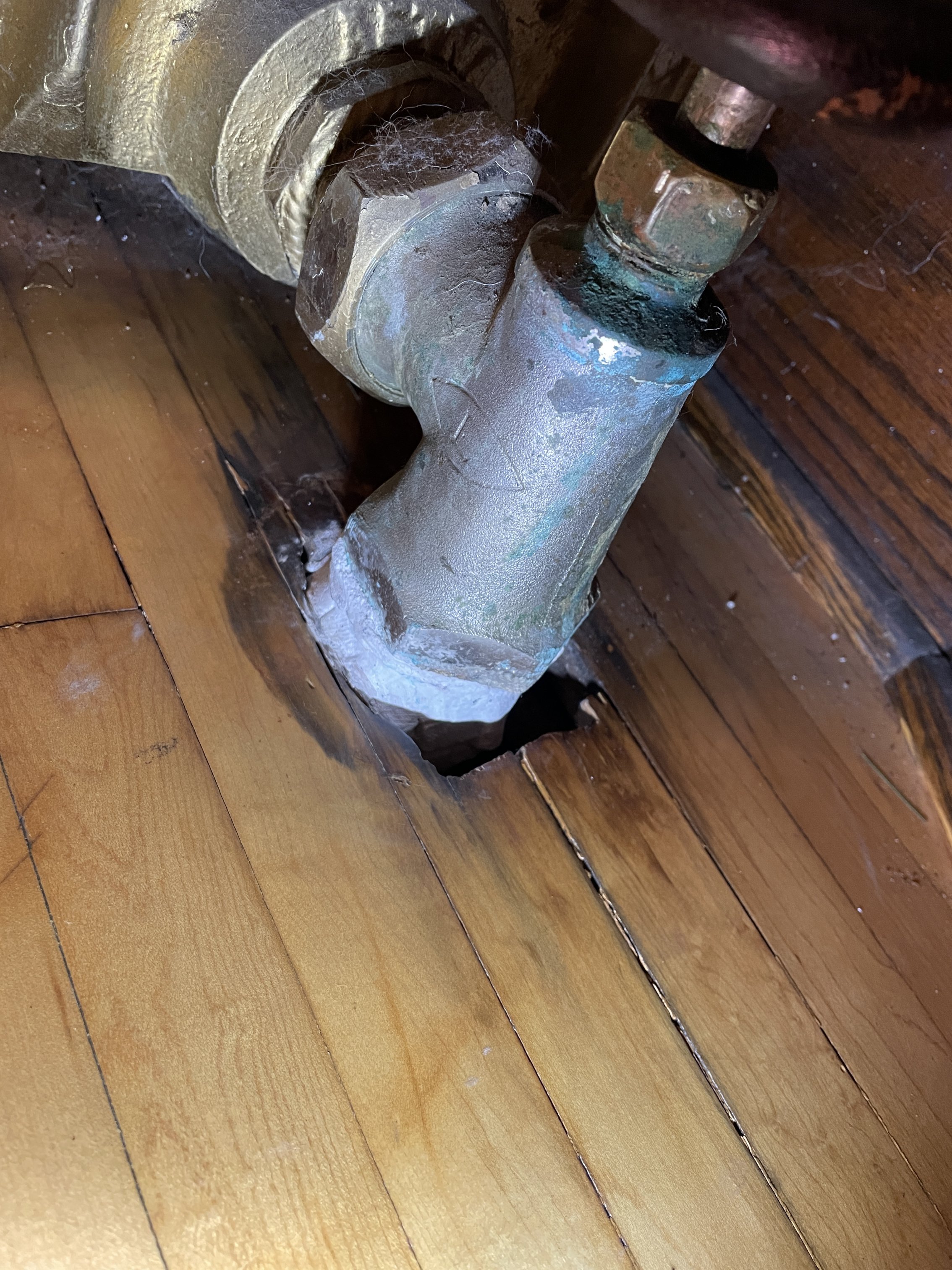
Here's the pic of the corroded nipple that I'm most worried about and the temporary fix. I'm not sure this JB Weld epoxy is going to stick to this rusted metal, but I guess we'll see. If it doesn't hold I may have to call a pro who can fix it fast since I can't be without heat for too long.

 0
0 -
Those riser pipes can be a real tricky repair and best left till warmer weather. It's possible the JB weld will stop the leak it's more likely it will just hide it as it drips down below. Either way it's less likely to continue damaging your floor. In theory the repair is simple but there's a good chance the nipple will break off in the valve and need to be carefully removed without damaging the threads in the valve.
It's good to see there are still some exposed threads on that packing, you might be in luck simply tightening the nut till spring.
Miss Hall's School service mechanic, greenhouse teacher, dog walker and designated driver
 1
1 -
Thanks, I hope it can last till spring. As long as the leak is just a drip and not lowering the water pressure of the boiler, I'm fine with it dripping onto the unfinished basement floor. At this time, I don't see any dripping, but will keep an eye on it.
0 -
That reminds me. I forgot to ask if your system is steam or water. If steam the pressure is very low and repairing the packing much easier. If it's water the pressure will be around 12-15 PSI and the repairs will be more complicated and definitely a warm weather endeavor.
Miss Hall's School service mechanic, greenhouse teacher, dog walker and designated driver
0 -
Be careful if it is indeed ACM (Asbestos Containing Materia)l. You don't need that floating around the house. Please, If you do nothing else spray warm soapy 🧼 water on it to keep it from going airborne. Mad Dog
0 -
It is water and not steam. It's sitting around 10-12psi right now. I hesitate to bring it up to 15 until the repairs to the valves and pipes are fixed.
I'm leaning toward just leaving the packing material and adding some more graphite or teflon rope, but I guess if there is not enough threads to do that, I may have to spray it with soapy water and put on a mask and remove it. I'm not sure it's asbestos so playing it safe is a good idea
0 -
if the nut bottoms out before it stops leaking you have to add more. if there is enough in there to compress more then you might just have to tighten it. teflon is a lot more durable than the various fiber packings, little bits of the fiber packings tend to shred and get pulled out with the stem turning as rell as compressing over time. teflon is more stable but also much harder so you usually need to compress it in stages, add a little, put the nut back on and compress it, add a little more until you have enough that the nut isn't bottoming out
don't crank too hard on them, the packing nut is relatively easy to crack
0 -
Thanks for the extra detail. I'll be careful not to over tighten. Good news is, after tightening the nuts on all the radiators a bit this morning, I see no signs of leaking at the packing nut anymore. Maybe I can just leave them or maybe add some more packing to each of them in the spring.
Since they have been left to leak for long periods of time, I suspect what has happened on a couple of the worse ones ( floor has black staining) the water drips down over the brass valve and does the real damage to the galvanized steel nipple under the valve. The nipple corrosion went unnoticed by me because they are under the floor and the escutchion plate. I can compress the nipple on two of them with my thumb which tells me they need to be replaced soon. Unfortunately one of them is on the second floor and I can't get at the pipes from underneath because the ceiling is finished. If the nipple comes out clean then maybe I can fit a new one without opening the ceiling. The 1st floor one is easier because the basement is unfinished.
 1
1 -
The piping usually is black iron, it is a type of steel but it isn't galvanized. There are various types of nipple extractors/inside pipe wrenches which may or may not get the remnants of the nipple out of the fitting below the floor. if it is just flat plaster below it, cutting in to that and patching it isn't that bad although if it is insulated with aircell inside the ceiling that would complicate it. You could potentially fish a new piece of pex up there.
0 -
I always thought the galvanized steel pipe you can buy at Home Depot is for water and the black pipe is for gas. Are you saying that galvanized steel pipe is the wrong thing to use?
0 -
galvanized is for potable water. black is for gas and steam and hot water heating. because there is little oxygen in a hot water heating system because it is a closed system the steel needs little corrosion protection. it is also supposed to be a somewhat corrosion resistant alloy but water dripping on it will corrode it.
0 -
I was not expecting you to say black pipe should be used for radiator supply lines, but an internet search seems to confirm what you are saying. In the past I replaced a 3' length with galvanized and permanently removed a radiator from the kitchen and capped the lines off with galvanized caps. Do you think I should re-do those with black pipe? I don't want to clog the system if the galvanized pipe can corrode and flake off.
0 -
Galvanized was used for domestic water quite a lot, as it doesn't rust. At first. However, if for some reason it does start to rust, it goes very fast and plugs up. I wouldn't (and don't) use it for anything given the availability of better materials like copper of quality PEZ for domestic. Black iron or copper or oxygen battier PEX for heating.
Br. Jamie, osb
Building superintendent/caretaker, 7200 sq. ft. historic house museum with dependencies in New England1 -
I've replaced most all of the original galvanized water supply pipes with copper—it was highly corroded on the inside.
I don't really want to get into changing it for the radiator supply pipes since it's 1-1/2". It's helpful to know I should be using black gas line pipe for that job, because I would have continued to assume the original stuff from 1912 was galvanized. I'll change out the galvanized pipe and fittings I installed previously with black pipe in the spring when I can drain the boiler and take my time.
0 -
i wouldn't worry about the galvanized you used.
i'm not sure exactly when galvanized pipe became available, i have seen very old domestic water piping that appeared to be black iron pipe.
1 -
I'm wondering if this is related to the leaking or something else. When I had the new boiler installed a few months ago, the technician said to wait 3 weeks and bleed the radiators. I did that, but the water pressure was so low there wasn't enough to push any air/water out of the radiator bleeders. So, I added more water to the boiler to about 12-14psi or so. The meter isn't so accurate that I can get to a specific psi. Anyway, fast forward to noticing some of the valves leaking at the packing nuts and the one nipple that I repaired with JB water weld and the pressure is down to 6-7psi. I've inspected all the radiator valves and piping that is not hidden in a wall and I can't imagine it has leaked much water—we're talking eye dropper dripping. At this time after tightening packing nuts I'm not seeing any dripping. So, what would cause the pressure to decrease so much? Is this normal with a new install that I need to bleed/refill until it's up to normal pressure a couple times? Also, when I refill do I need to do anything other than make sure the system is cold and open the water inlet valve? Do I need to do something to keep water from entering the overflow tank or something else?
0 -
it only has a manual feed, not a pressure reducing valve? if it is a manual valve you need to use it to bring the pressure back up, to about 12psig if you have a 1 or 2 story house, a bit more if it is 3 story.
does it have a microbubble air separator?
fresh water has some air dissolved in it that will come out of solution when heated and the pressure is reduced so either that will find an auto air vent or become a pocket of air somewhere.
when you purge or bleed a system you still leave some pockets of air in places, if you have the air elimination or management set up right those will migrate to the boiler and be vented or deposited in a compression tank so that is probably the air working its way out of the system. if it keeps happening after a few weeks to a month or 2 it may be all of your small leaks adding up.
1 -
It's difficult for me to answer your questions because I know so little about modern boilers. My old boiler was simpler than this one.
Am I correct in assuming "manual feed" means that the water inlet valve for adding water is opened/closed manually? In some systems, is the valve left open and the system automatically adds water when the pressure gets too low? If that is correct, then mine is manual feed.
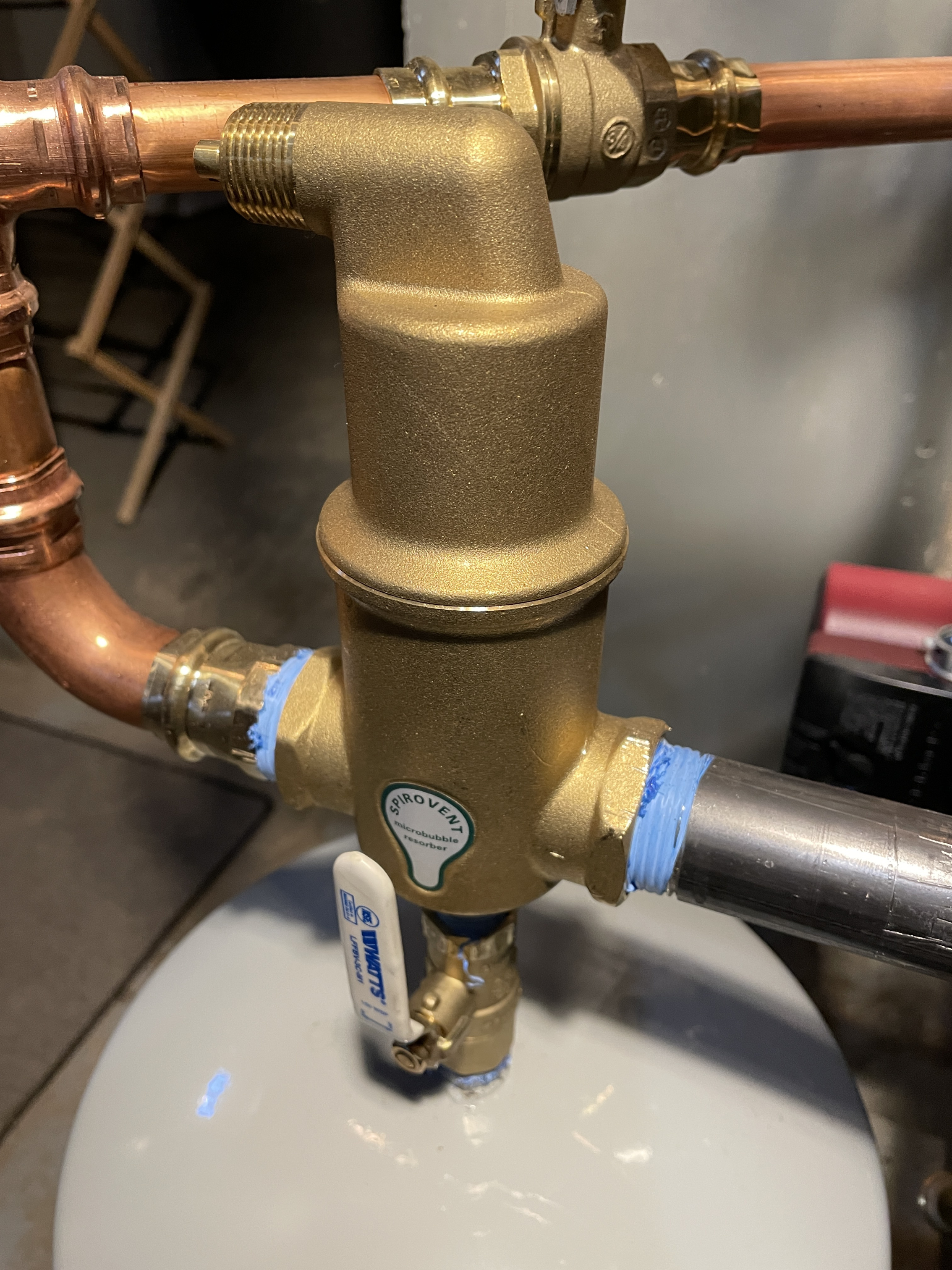
Yes, it has a microbubble air separator—see pic. Is that the thing that removes the air pockets and consequently lowers the water pressure?
Thanks for explaining this, I'm learning a lot about my boiler that I did not know. I added water to 12-14psi cold and now that it's up to full heat it's at 20psi.
 1
1 -
most modern systems have a pressure reducing valve that reduces the domestic water pressure to the cold fill pressure of the boiler. i will leave the debate about weather to leant that on or not for another time.
that is a microbubble air separator. it will remove any air from the system if it is set up correctly and that will reduce the pressure if there isn't an automatic feed of water to replace it.
if there are automatic vents at the top of the system those could pull in air if the pressure is a little low. if the automatic vent an expansion tank isn't before the circulator that could cause the automatic vent to pull in air in some cases.
if topping it up doesn't slow the loss of pressure way down after a few weeks then there might be a bigger issue. you don't want to need to add fresh water very often because a lot of fresh water will corrode the boiler.
0 -
As far as I can tell, there is no pressure reducing valve, and the water supply was turned off by the installers. So, I assume that means this system is designed to need water to be added manually.
I'll keep an eye it and hopefully it will hold pressure now. Why does fresh water corrode the boiler?
0 -
It brings oxygen and minerals with it. The boiler system is a closed system so the oxygen dissolved in the water quickly combines with a little of the iron and isn't available to corrode more iron(some of it gets vented as a gas as well). if you keep adding more water you keep consuming a little of the iron over and over again until the corrosion becomes significant.
1 -
Correct me if I'm wrong but as far as I've seen galvanized pipe is only galvanized on the outside? It's then cut to length removing any galvanizing.
Miss Hall's School service mechanic, greenhouse teacher, dog walker and designated driver
1 -
According to an internet search that's true, it's only coated on the outside. I don't really understand the differences between materials and why black pipe is better than galvanized pipe for a closed boiler system. Also, the internet recommends draining the boiler once per year to flush sediment and reduce corrosion, but wouldn't that also mean you're filling it with fresh water, which apparently is bad for corrosion? Seems a bit contradictory.
0 -
don't use ai for maintenance schedules or pipe specifications.
 2
2 -
galvanized pipe is galvanized on the inside and outside. removing the plating to thread it does introduce some vulnerability to corrosion, but since it is galvanizing it is still protective of that part.
flushing wet returns and flushing the boiler is a good idea every year to couple years but you have to heat it to drive the dissolved air out of the fresh water when you refill it. draining and refiling it once a year is a lot different than adding 20 gallons a month because you have a leak.
1


Categories
- All Categories
- 87.8K THE MAIN WALL
- 3.3K A-C, Heat Pumps & Refrigeration
- 59 Biomass
- 430 Carbon Monoxide Awareness
- 133 Chimneys & Flues
- 2.2K Domestic Hot Water
- 6K Gas Heating
- 124 Geothermal
- 170 Indoor-Air Quality
- 3.8K Oil Heating
- 79 Pipe Deterioration
- 1.1K Plumbing
- 6.7K Radiant Heating
- 396 Solar
- 16.1K Strictly Steam
- 3.5K Thermostats and Controls
- 56 Water Quality
- 51 Industry Classes
- 51 Job Opportunities
- 18 Recall Announcements