taco sentry zone valve

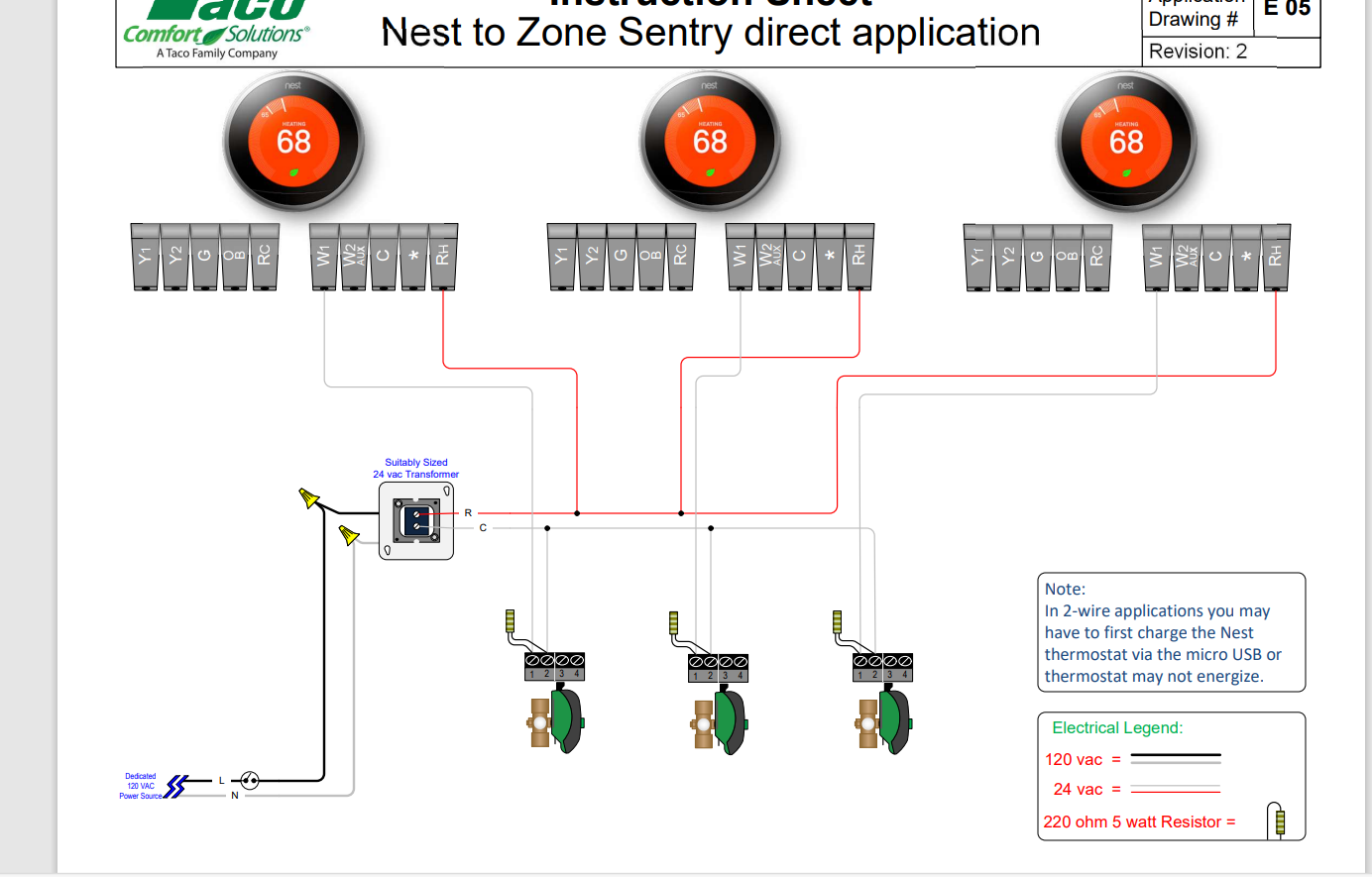
I just installed some taco zone valves. After a call for heat is satisfied, a couple of them would keep cycling open and closed. On one of then I have 6V present on the motor which makes me think this is enough to charge the capacitor in the valve. Theres 0V on the motor when I remove the thermostat from the sub base. The thermostats are battery powered nests with r and w only. Is there something wrong with the thermostat to still have some voltage at the zone valve or is it a weird power thing thats going on.
Comments
-
actually the nests are rechargeable not battery
0 -
the t-stat is trying to power itself by flowing a small current through the zone valve. with a conventional motor driven valve that won't turn the motor but it is enough to charge the cap in the zone sentry valve and open the valve. the other zones will probably do it too when the battery needs to charge in those t-stats.
 1
1 -
An isolation relay may clean up the situation. Adding the 'C' wire to the NEST could be tried also.
National - U.S. Gas Boiler 45+ Years Old
Steam 300 SQ. FT. - EDR 347
One Pipe System0 -
@heatguy34 If you have Nest t-stats, you can add a resistor between the two-power terminals, C-W/Y. Our resistors won't work with Nest t-stats. Nest suggests a 220ohm and up to 5watt resistor with their t-stats. Any questions, you can always call into Taco's Tech Support during normal business hours 8am-5pm EST Mon-Fri 401-942-8000.
0 -
does anyone know why the nest would be able to power itself through the w wire with no c wire? Im guessing it is because w is going right through to common there is just the resistive load of the motor in the way.
@SteveSan I know for the taco switching relay it says that you might have to add a resistor between w and c. So that is for this reason then? also do you have a link from nest or taco where I could look at what they have to say?
0 -
Just put in a relay with a separate transformer. Anything else is a fiddle stick.
0 -
Nest is the worst thermostat to use on hydronic systems for this reason and several others.
Get rid of them and use a non power stealing stat.
Bob Boan
You can choose to do what you want, but you cannot choose the consequences.
 2
2 -
The resistor does a few things;
It provides another current path around the controlled (thermostat switched) load (zone valve motor, relay coil, control board input, etc.). Which is the heating system's call for heat trigger input. The resistor is an added current path to power the NEST.
The parasitic current through the 'W' wire to power the NEST causes an abnormal voltage across the systems call for heat trigger input.
The resistor also lowers the abnormal voltage across the systems trigger input. The abnormal voltage is due to the parasitic current through the heating system's trigger load, so things may behave more normally.
With the 'C' wire connected it minimizes or eliminates the parasitic current through the 'W' wire and the system's trigger load when there is no actual call for heat.
The internal resistance of the heating system's call for heat trigger input may vary wildly from system to system. So with the NEST only using two wires and no resistor, the system's operation may be unpredictable.
Adding a relay, for example, gives a clean on / off command to the heating system. And the relay coil does not care if there is a minimal voltage across it, as long as pull in and dropout voltages are respected.
National - U.S. Gas Boiler 45+ Years Old
Steam 300 SQ. FT. - EDR 347
One Pipe System1



Categories
- All Categories
- 87.8K THE MAIN WALL
- 3.3K A-C, Heat Pumps & Refrigeration
- 59 Biomass
- 430 Carbon Monoxide Awareness
- 133 Chimneys & Flues
- 2.2K Domestic Hot Water
- 6K Gas Heating
- 124 Geothermal
- 170 Indoor-Air Quality
- 3.8K Oil Heating
- 79 Pipe Deterioration
- 1.1K Plumbing
- 6.7K Radiant Heating
- 396 Solar
- 16.1K Strictly Steam
- 3.5K Thermostats and Controls
- 56 Water Quality
- 51 Industry Classes
- 51 Job Opportunities
- 18 Recall Announcements