Set maximum heating boiler interval

2 pipe vapor system, with a 238K BUT boiler. Updated steam traps, main vent to Gorton 2. For the most part, the system is running pretty well. Previous owner replaced a few radiator valve, so I lost the orifice plate for those rads, causing the to over heat. I got really into Home automation lately, and started looking at gas usage by reading gas meter's usage broadcast. For every hour of radiator run time, it uses about 2.4 Therms of gas, which kinda exactly match the rating of my boiler.
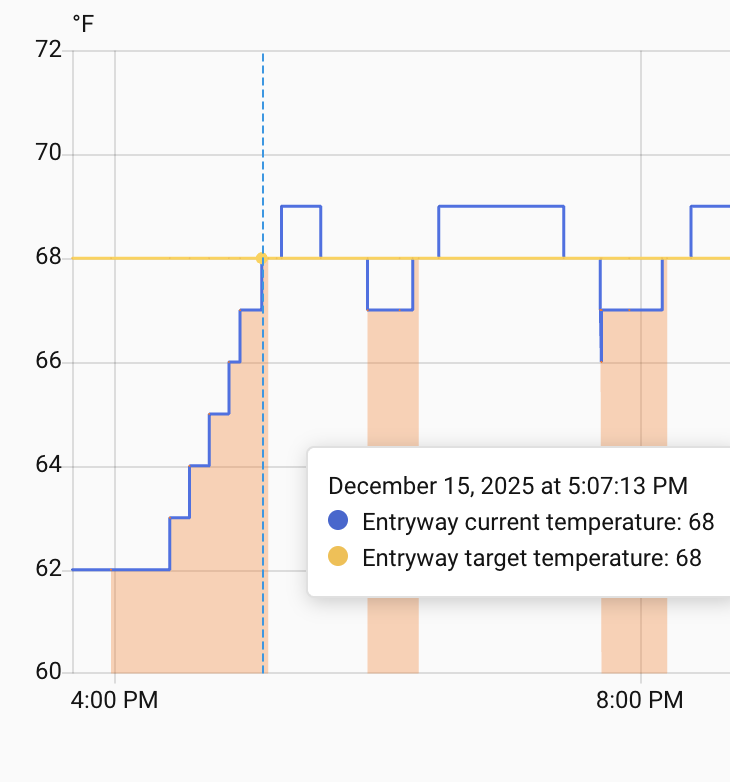
I also started graphing hating time, target temp and current temp. Like the graph here. My nest thermostat has an eco mode of 62, when we are away. As you can see, I came home around 4PM which woke up the heating, it took a little over an hour to heat the house back to 68F. Used around 2.4Th of gas, which all checks out.
Here is my question. I have never witness my system shut off due to it reaching the pressure at the pressuretrol. (I have the stock one at the lowest settting, <2psi) I think It is wasting running unnecessarily long, it takes only 30 or so to get the system to heat up from cold, and it continue to heat. (You can see my current temp overshoot the 68 from the graph) Is there a way to set like a 30 Min max firing interval and let the radiator sit 15 minutes before continuing to heat ? There isn't an easy way to do this in Nest.
Or is there way to set like half firing stage for the boiler once it reach steam temp ? So it is not burning the full 225k at all time ? I have the Weil-Mclain 118-654-501 EG-65 238
Comments
-
As you can see from your graph, it's not really substantially overshooting the temperature (it shows max of 69F when it's set to 68F). The only real savings would come from lowering the average temperature of the room. If you're not doing that, you're just trading off how long it fires vs how frequently it fires, but you wouldn't expect the gas usage to change materially.
0 -
IIf the boiler is shut off, it is not adding any heat to your building. The radiators are cooling off. If you need a certain number of BTUh to keep the building at your desired temperature — you need a certain number of therms of gas. No way around it.
The fact that the boiler isn't shutting off on pressure is good. It is most efficient when it runs continuouslly. If you shut it off arbitrarily before it has a chance to heat the space, then when it turns back on sooner there is the startup time before it can heat the space… you gain nothing.
Br. Jamie, osb
Building superintendent/caretaker, 7200 sq. ft. historic house museum with dependencies in New England0 -
if the thermostat is overshooting that is a thermostat setting. it has an anticipator, either actual or in software, that shuts off the boiler before the temp reaches the setpoint to account for the heat that is still in the system. For a steam system it will be set for the longest cycles but it may be a little too long in your case.
0 -
My logic here is more about how much gas get translate to actual heating. In an hour long cycle, I have to assume the first 30 minutes of burn time is doing the most heating by brining radiator to temp. The 2nd half is just maintaining that temp. Since the radiator isn't getting any hotter, that full 238k BTU isn't really necessary. It seems like my boiler doesn't have a half stage firing mode. I think I can use home assistant to force automat a 10-15 min off time every 30mim.
0 -
the energy that is going in to the system is coming out of the system at the radiators as they condense the steam back in to water. the radiators are not fully heated as the boiler is heating the other parts of the system so the radiator is not giving off as much heat because some of it is cold. some of that energy is consumed in heating the other components of the system. once the system is fully heated the heat moves across the radiator and the amount of heat coming out of the radiator increases.
the heat involved in the pickup of the system isn't excess heat, it is heat that is not yet being emitted by the emitters.
0 -
Ah… no. The clue is in the system pressure. So long as that pressure is constant, the boiler is supplying exactly as much heat as the system is consuming in heating the space (and the components of the system — all of which heat will be radiated into the space at some point).
You are sort of correct in thinking that "the 2nd half is just maintaining that temp" — but that temp has to be maintained to heat the space.
However, it's your system, so give it a try. I think you may find that it won't maintain space temperature at half power…
Br. Jamie, osb
Building superintendent/caretaker, 7200 sq. ft. historic house museum with dependencies in New England0 -
Some day be at the boiler when it comes out of setback. See how long it takes for the steam outlet on the boiler to get too hot to hold. Then start timing and see how long to get steam to the end of the longest main. Then how long for the rads to heat.
0 -
To add to my comment above: do NOT turn off the boiler unless the pressure is rising or the thermostat is satisfied. Just don't.
Br. Jamie, osb
Building superintendent/caretaker, 7200 sq. ft. historic house museum with dependencies in New England0 -
I think I can do that with a few temperature sensor I have lying around.
0 -
the short answer is that the part of the radiator that isn't hot isn't emitting heat so before that part is hot that energy is going to heat the parts of the system, after the radiator is hot that energy is being emitted in to the room.
0


Categories
- All Categories
- 87.8K THE MAIN WALL
- 3.3K A-C, Heat Pumps & Refrigeration
- 59 Biomass
- 430 Carbon Monoxide Awareness
- 133 Chimneys & Flues
- 2.2K Domestic Hot Water
- 6K Gas Heating
- 124 Geothermal
- 170 Indoor-Air Quality
- 3.8K Oil Heating
- 79 Pipe Deterioration
- 1.1K Plumbing
- 6.7K Radiant Heating
- 396 Solar
- 16.1K Strictly Steam
- 3.5K Thermostats and Controls
- 56 Water Quality
- 51 Industry Classes
- 51 Job Opportunities
- 18 Recall Announcements