Welcome! Here are the website rules, as well as some tips for using this forum.
Click here to Find a Contractor in your area.
If our community has helped you, please consider making a contribution to support this website. Thanks!
Recharge diaphragm expansion tank for boiler without disconnecting?

Comments
-
Yes. The tank must be empty of water to precharge it properly.
That said, do you have a pressure gauge on the system? And what does it say? Cold and hot?Br. Jamie, osb
Building superintendent/caretaker, 7200 sq. ft. historic house museum with dependencies in New England0 -
If you think it's not ruptured, then you can try giving it a few pumps with a bicycle pump or whatever you've got while it's still connected. It's a guess but it may work. I've done it successfully plenty of times.Contact John "JohnNY" Cataneo, NYC Master Plumber, Lic 1784
Consulting & Troubleshooting
Heating in NYC or NJ.
Classes0 -
Are you sure your pressure gauge is accurate?
Did you properly purge the system of all air.
Are you sure your feed valve isn't letting water by? Or your tankless coil or indirect (if you have one) doesn't have a leak-allowing street pressure to raise the boiler pressure?There was an error rendering this rich post.
0 -
No tankless coil or indirect. Pretty sure system is purged of all air, it wasn't previously and we had some radiators that didn't work but after re-purging, all radiators work properly. No pressure gauge on the system. The replacement expansion tank is brand new so shouldn't be ruptured.
The pressure of the tank shows 24 psi - I assume that's expected since the tank isn't currently empty of water, and that the empty tank equivalent would be 12 psi, in which case I can increase the psi by 5 to get to 29 psi filled/17 psi empty?0 -
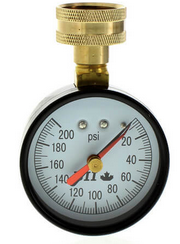
No. You're just guessing at this point. Get a pressure gauge. Watts makes a 0-30 that screws on to a hose bib connection.
Tank pressure needs to be checked with 0 system pressure on it-unless you have a valve like this on it to isolate it:
Set the tank pressure, then refill/repurge until your system pressure gauge shows the same pressure.There was an error rendering this rich post.
0 -
Thanks. What are the symptoms of an expansion tank that is undercharged (ET psi < system pressure) - leaking at the relief valve? Similarly what are the symptoms of an expansion tank that is overchaged (ET psi > system pressure)?0
-
Undercharged, overcharged, system not properly purged, usually all end up at the same result-rising pressure, blows out the relief valve. Which is why you need a good gauge on your system.
There was an error rendering this rich post.
0 -
If your air gauge shows 24 psi, then your system pressure is likely 24 psi as well.
You need a pressure/temperature gause on the boiler. And a nice web stone isolation valve, or at least a boiler drain T'd in between your ball valve and the Ex tank.Serving Northern Maine HVAC & Controls. I burn wood, it smells good!0 -
You should have changed the relief valve as well. Usually when they start dripping, they don't stop. If everything else checks out with the expansion tank and boiler pressure I'm sure thats your problem0
-
number 1 dont read pressure of the tank at all when system is filled. you need to drain all water pressure off boiler. then you can read the tank pressure. you have tons of variables. but no indirect or coil. if you replaced tank before and relief and its still doing it. its simple feed valve is bad. replace it. how do you get your hw? if the tank is old. and low at all on charge. its compromised. don't add air. it obviously went somewhere. oh and most systems are fine between 15 and 18lbs at full temp.0
-
I agree with @Solid_Fuel_Man
If the tank was factory charged to 12 psi and you have 24psi your water feeder is likely the problem. 24 psi in the system will be close to making your relief valve drip when the water heats up.
Check the feeder. And install a drain between the expansion tank and the isolation tank, check the expansion tank pressure when you remove it. Adjust to the pressur e you need0 -
I would like to isolate and drain my #60 Extrol Ex-60 Expansion tank while it remains plumbed into the system. Let's assume that I have all the valves in place to isolate the expansion tank and to provide a path from the tank to a drain bucket. Assuming that the tank is in good condition, here's my question. Will the precharge in the tank drive all the water out of the tank and out the drain? Will the empty tank be like a new tank that I can apply my desired pre-charge to?
0 -
pretty much.
Br. Jamie, osb
Building superintendent/caretaker, 7200 sq. ft. historic house museum with dependencies in New England
 2
2 -
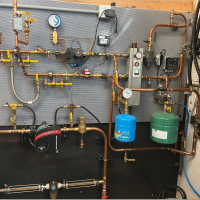
I like the Webstone approach the best. You can isolate the tank, drain off the pressure, then test or replace.
If you are unsure if the diaphragm is blown or not, isolate the tank then depress the Schrader valve. If it spits water, its blown. You should be doing this test at each annual service. An alternative is to shoot the tank with an infrared thermography camera. I have a crummy $400 one that piggybacks to my cell phone and its good enough. You could use an IR thermometer, too.
Yes, you accurately measure the system pressure then charge to that. Of course, if your pressure is 24 psi, the question is why?
Pressure relief valves should be tested ANNUALLY. Most pros will scream bloody murder at me stating the valve will drip and not seal. Fine- replace it. You are there to ensure the safety of the system. A faulty PRV is a huge safety issue. Failing to test it or a TPR on a WH is probably gross negligence by the tech, which could lead to criminal charges if there is a big Ooops! . The public trusts us to inspect, test whatever is required to ensure the equipment is suitable for continued operation. If you don't test, you cannot tell them that. What makes it more important from a liability standpoint is valve Mfrs, such as Watts, now stating inspect annually for leaks, corrosion, damage- test and replace prn but replace the valve about every 3 yrs. So, bring spares, budget the time and be prepared to replace the PRV on EVERY call.

 3
3 -
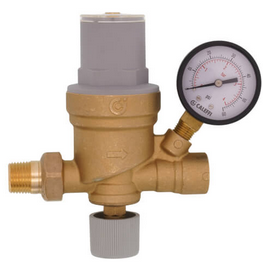
First, on the boiler drain valve, buy a hose bibb pressure gauge and replace the 200 lb gauge with a 30-60 psi gauge and screw it on the boiler drain or on the system bibb and measure the psi of the sys cold. The pressure should be what the boiler cold water pressure feed valve is set to. Should be 12-15 psi. The Ex-tank air charge should be the same as the sys pressure cold. If the cold water pressure regulating feed valve can't be adjusted to 12-15 psi, replace the valve. You may have to drain some water out of the sys to lower the sys pressure. I like Caleffi's PRV valve.
OK, so, the sys pressure on the hose bibb gauge is 12-15 psi, good. How to set the Ex-tank air pressure without removing the tank from the sys. hmmm! I've not done this, but, I have given it much thought. Start with a boiler or the hose bibb gauge that's reading 12-15 psi, the same as the cold water fill valve psi. Add air to the tank and watch the gauge increase in pressure to 28 psi, stop adding air. Drain the water out of the sys until the pressure reaches 12-15 psi ( the fill valve pressure). Repeat the process. When adding air doesn't change the gauge reading higher, stop adding air. That means that the air charge on the tank bladder has pushed all the water out of the tank and adding more air won't change the sys pressure. Again, drain the water out of the sys until the gauge read the fill valve psi. Final step, take a tire pressure gauge and let air out of the Ex-tank until the pressure on the tire gauge is the same as the cold water regulating boiler fill valve psi,
A dripping boiler pressure relief valve (PRV) that's dripping when the boiler's cold means a faulty pressure relief valve or over pressurized sys (above the valves rating, 30 psi). A PRV valve that leaking when the boiler is up to temperature means a lack of space for the heated expanded water to move into, which is what an Ex-tank provides. Usually a water logged Ex-tank that's lost it's air charge or a ruptured diaphragm.
https://www.supplyhouse.com/Caleffi-553642A-1-2-NPT-AutoFill-Boiler-Feed-Valve-w-Pressure-Gauge
https://www.supplyhouse.com/Boshart-PG25-WTG200MP-Water-Test-Gauge-3-4-Hose-Connection-threaded
 0
0 -
There is an answer to your question here: near the end of the video.
Edward Young Retired
After you make that expensive repair and you still have the same problem, What will you check next?
0 -
Ed Young, you're a good looking guy.
0 -
If you don't have a Webstone valve on the tank, there is another easy way:
Get a 5-gallon bucket and a short hose. Shut off the fill valve to the boiler.
Attach the hose to the boiler drain and put the other end in the bucket. Open the boiler drain and the bucket will start filling. Keep the hose end in the bucket under water. If the bucket fills up and water is still draining, close the drain, dump the bucket and repeat the procedure.
When the water stops filling the bucket, keep the hose end under water. This will keep air from getting back into the system. The system pressure should be zero at this point. Now check the tank pressure and adjust if needed. If you have to add a lot of air to the tank, you might need to dump the bucket again.
When finished, close the boiler drain, dump the bucket, remove the hose and repressurize the system.
0





Categories
- All Categories
- 87.8K THE MAIN WALL
- 3.3K A-C, Heat Pumps & Refrigeration
- 60 Biomass
- 430 Carbon Monoxide Awareness
- 133 Chimneys & Flues
- 2.2K Domestic Hot Water
- 6K Gas Heating
- 124 Geothermal
- 170 Indoor-Air Quality
- 3.9K Oil Heating
- 79 Pipe Deterioration
- 1.1K Plumbing
- 6.7K Radiant Heating
- 397 Solar
- 16.1K Strictly Steam
- 3.5K Thermostats and Controls
- 56 Water Quality
- 51 Industry Classes
- 51 Job Opportunities
- 18 Recall Announcements