Existing SIM system never worked well

Hi all! Got a question on existing snow melt.
Glycol loop off main building heat from atmospheric 1.2mbtu boiler.
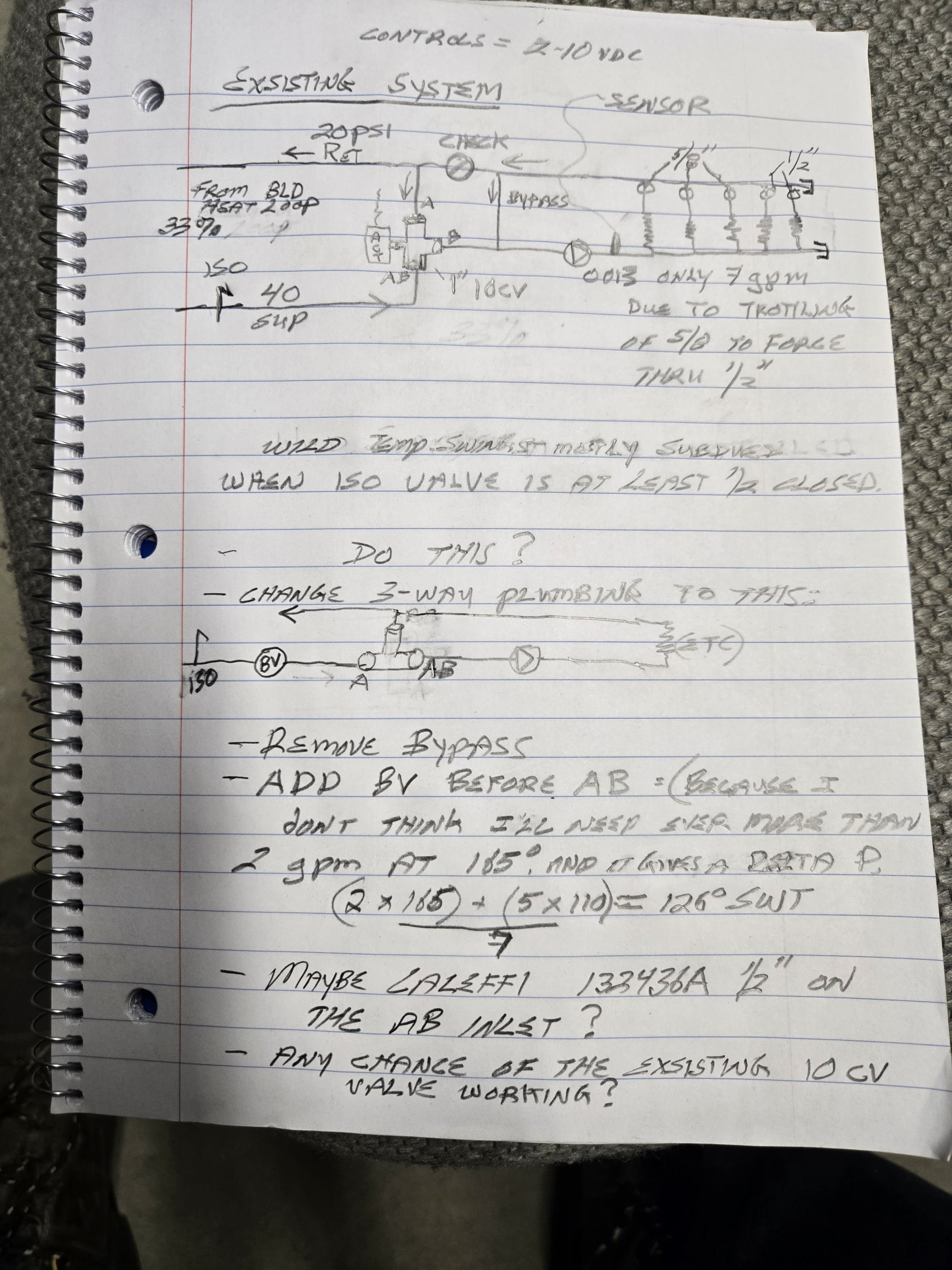
The mixing diverting valve sees approx 40 psi on the supply side and 20 psi on the return. This piping has numerous AHUs also piped in the same branch from supply to return.
Little to no reset on fluid temp. On the photo of my notes, …any chance it can work better if I change it? Am I barking up the wrong tree? (Owner wants it to function better and I think it's mostly from early 2000s altho a GC recently added the ½" loops….no one knows how long. I did step off where I think it runs under a sidewalk and if it's 2 runs up and back they would be at least 300 feet each, so each loop is at least 300ft) Those loops had 25' pieces added on to them in the exposed basement with crimp fittings which I've changed to expansion fittings, and they had wirsbo return manifolds on both sides so I changed the supply side manifold.
Any help would be great! First one I've worked on!
Comments
-
how many square feet of snowmelt? Is it all 1/2 tube?
Bob "hot rod" Rohr
trainer for Caleffi NA
Living the hydronic dream0 -
if you can get some fluid to flow a thermal camera will tell you where the tubes are.
1 -
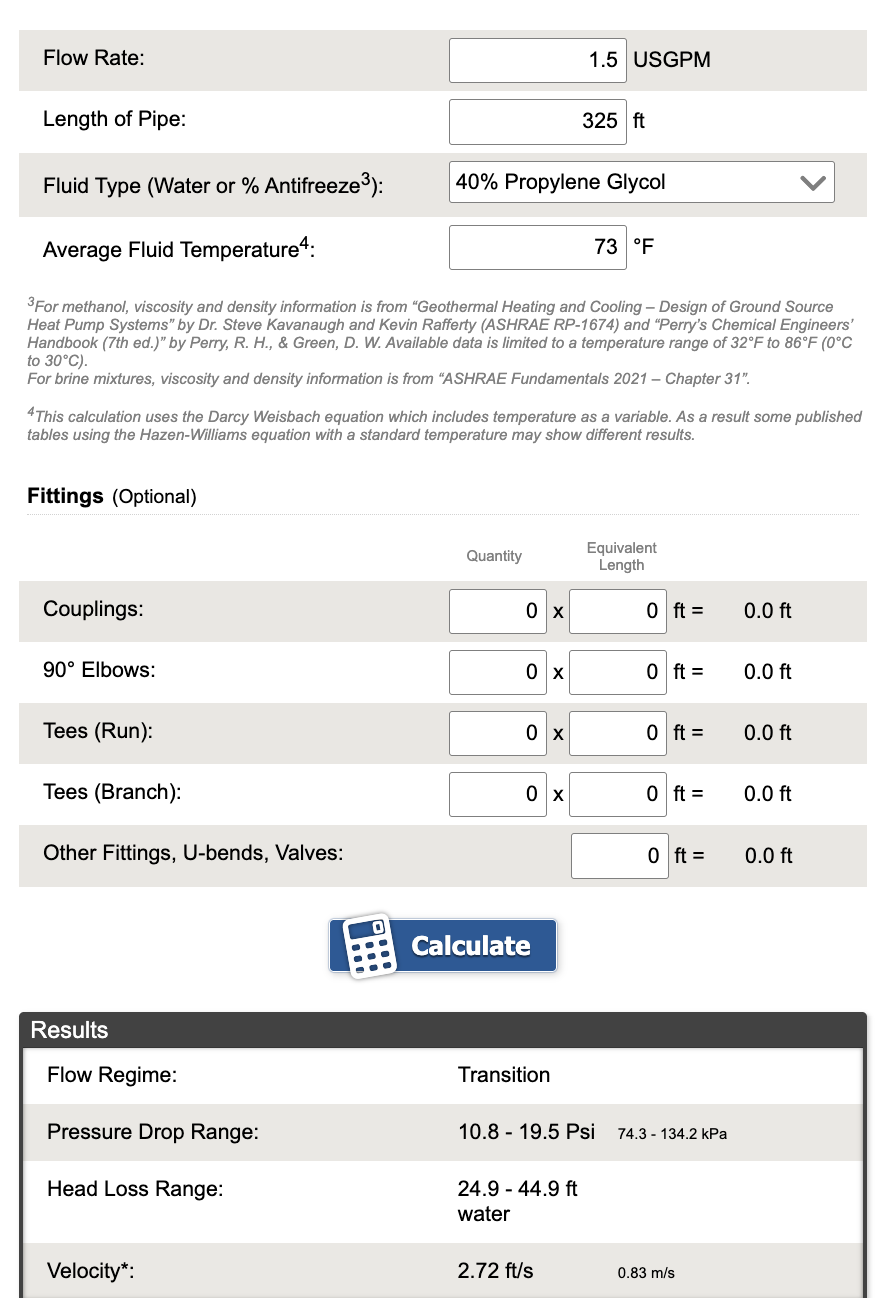
A 325' loop of 1/2 pex with 40% PG, 1.5 gpm looks like this,
a long loop like that will need some serious circulator power.
If everything is piped adequately, purged well, either not enough boiler power, not enough tube and diameter to deliver needed btus, and or not enough circulator power.
 Bob "hot rod" Rohr
trainer for Caleffi NA
Living the hydronic dream0 -
I don't know the answer to that. There's 5 loops total and the 3 ⅝ loops are likely much shorter and flow very well. I can get flow thru the 2) ½" runs but not 1.5 gpm each. It's mid 50s temps now and 1 of the ½" loops gets warmish after a few minutes with 130⁰ SWT. The other ½" loop barely changes temp but does flow a bit into a bucket when I tried that.
Are you showing the circ would need to make 25-45 fthd? Ouch!
Can you comment on the piping and possible piping change, and the 20psi differential on the 3way?
0 -
tube size and spacing, required flow rate, SWT are all determined by how much heat (btu/hr) you are trying to deliver to the area
Without some sort of starting point it will be a trial and error exercise. You may not get what you need or want, if there wasn’t any planning or calculations done.
1/2” Pex can work in a sidewalk application, but those lengths are working against you
If you collect some data, you can determine how many btus are actually being delivered. 100 btus/ sq ft is a starting point. It comes down to how much and how quickly do you want the snow to disappear
Bob "hot rod" Rohr
trainer for Caleffi NA
Living the hydronic dream0 -
Sometimes contractors skip on insulation, this generally means between 40% to 60% of your output goes to heating the dirt instead of melting the snow. Check what you have under the slab. If there is no insulation or they used bubble wrap, pretty much a lost cause with long runs of 1/2" pipe.
0 -
Thanks for the input so far from you guys…
Well no one on-site knows really anything about the install. Im hoping to get piping input as well from you guys because the SWT temp swings so wildly. Is the idea of the 3way piping change , deleting the separate bypass and utilizing a BV a good idea?
The BV would be to limit the flow into A port , and the pressure drop would help to balance the pressures on each side of the 3way, and give better performance of the mixed fluid temp to keep the 3way from hunting rapidly.
Is the 20 psi differencial from supply to return typically going to cause metering issues with a 3way?
0 -
changing the mix valve assembly will not help much if any. Especially if you are short on tubing, and or ability to provide the needed btu.
The delta changes a lot on SIM. Obviously very wide on first start, closes as the slab warms. Maybe end up around a 30 delta at equilibrium
Does the sidewalk have any concrete steps? That is a really tough application as you have so much exposed concrete, top, face and two ends often.
The pressure differential is a result of the system resistance and the circ providing it
Early in my career I did a driveway SIM in 1/2 tube. My Grundfos rep bailed me out as much as he could with a massive vertical shaft “jet pump” You could hear it running outside the garage where it was located😳
If you have adequate btus you can pump you way out of poor performance system, to a point. With SIM being an intermittent load, going over the recommended velocity may be one small improvement to try
The first question still…how many sq feet total and how much horsepower do you have to throw at it?
Bob "hot rod" Rohr
trainer for Caleffi NA
Living the hydronic dream0 -
that pressure differential adds up considering the 1/2" I would bet those are at least 300' loops like you have said. someone got on google and saw the 1/2" tubing 300' loops rule of thumb. personally my next question would be, "did they also find the 12" on center spacing rule of thumb" because that will also hurt you pretty bad in your quest to get the SIM working well.
0 -
It's a 0013 at 25.5 fthd with the ⅝" loops throttled to ¼ turn open each and the ½s wide open. So right at 7gpm about. The ⅝ tubing gets hot within a couple minutes of running .
By memory I'd say 800 sqft of brick for the 3) ⅝ loops. And 600 sqft of concrete sidewalk for the 2) ½ inchers.
They're mostly ok with how it melts, except for the ½ but that's employee not customer…so they don't care too much about that, altho I do. (I forgot to say I changed from the original 008 to the now 0013 at high speed.)
When I pointed out the wildly swinging SWT they wanted that fixed. That's why I was looking at changing the setup. I thought if I changed the supply port to use the characterizing disc it should help control that but the 10 CV at that flow rate is likely too big anyhow. I forget the math but somewhere around 4cv.
Commercial setup with carryout, can run nonstop below 34⁰.
There are no steps…..and I like the jetpump story! I might need one on the ½"!
0 -
I think you may need to do the fine tuning under a load condition.
I would keep the 5/8 zones wide open, split the 1/2 loops off and give them their own pump, sized to move as much flow as you are comfortable with.
Minimize the glycol %, 40% should be adequate in most places. Cold glycol really hits the circulator performance.
Are the bricks set in a sand bed? That is another hit on the heat transfer if so. Over a slab with maybe some grout sand is a better transfer installation
Remember it is the connected load that will dictate the boilers operating condition, not the other way around.
The system will be in a transient condition up until the supply and return temperatures stabilize. At that point the system is taking all the boiler can provide. At that point you want to notice delta t.
Pumping flows change as glycol warms, so trying to get a good number on that takes time for the fluid to warm and thin out.
Bob "hot rod" Rohr
trainer for Caleffi NA
Living the hydronic dream1 -
I agree splitting the 2 zones makes the most sense. you will get better performance for both, and then the 1/2 loops wont be dragging down the 5/8 zone.
0


Categories
- All Categories
- 87.9K THE MAIN WALL
- 3.3K A-C, Heat Pumps & Refrigeration
- 60 Biomass
- 430 Carbon Monoxide Awareness
- 134 Chimneys & Flues
- 2.2K Domestic Hot Water
- 6K Gas Heating
- 124 Geothermal
- 170 Indoor-Air Quality
- 3.9K Oil Heating
- 80 Pipe Deterioration
- 1.1K Plumbing
- 6.7K Radiant Heating
- 397 Solar
- 16.1K Strictly Steam
- 3.5K Thermostats and Controls
- 56 Water Quality
- 51 Industry Classes
- 51 Job Opportunities
- 18 Recall Announcements