EK1 Near Limit Aquastat

Had my 12 yo Energy Kinetics storage tank lower seam give up the ghost yesterday and plumbed in a typical AO Smith 100 as a replacement.
All connections are essentially as they were with the prior EK tank with minor differences for nipple placement and tank height etc.
I wired the tank to bypass the heating elements and run heating calls off that lower thermostat.
It seems to me like the boiler is running nearer the high limit during a domestic heating cycle now before the heating call extinguishes.
I assume there might be two causes... 1. Dip tube. 2. Lower tstat placement.
Any thoughts from @Roger or other EK gurus?
Comments
-
Use the upper thermostat.
0 -
Wouldn't that make it even worse?
In my mind the long dip tube is just pumping water that just left the PHE right down near the tank drain where it gets sucked back up into the PHE. That just gets hotter and hotter without ever really stratifying in the tank. Seems like it would take even longer for the upper stat to reach the setpoint than the lower one which is closer to where the tube is dumping hot water.
0 -
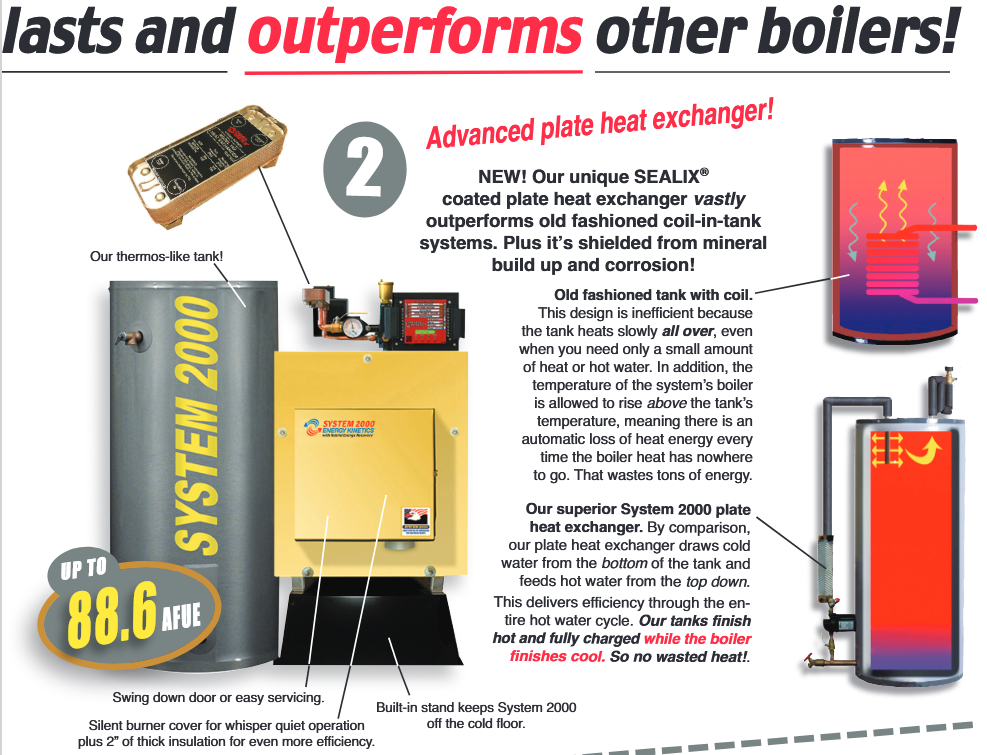
If the boiler is running at a high temperature during a DHW call / recovery I would think the overall heat transfer efficiently is not as good as the former tank. Maybe the dip tube need to be shorter like in the picture. Was the dip tube length of the new tank matched to the old tank ?
 National - U.S. Gas Boiler 45+ Years Old
Steam 300 SQ. FT. - EDR 347
One Pipe System0 -
Yes, disregard. I was looking at the EK piping and pictured in my head your tank without a dip tube.
If its approaching high limit, there's poor heat transfer. Can you check in and out temperatures on both sides of the plate HX? Do you have the manual to see how to back flush the HX?
0 -
The new tank may have heat a trapper nipples on the cold side, reducing the flowrate.
Bob "hot rod" Rohr
trainer for Caleffi NA
Living the hydronic dream1 -
It does have blue plastic pieces in both upper nipples that decrease the ID a fair bit. I'm not sure if they are molded straight in as part of the dip tube though. The tiny black heat trap flapper surely isn't reducing flow rate, I can basically blow on it and it opens.
0 -
Thank you all for your posts.
@NEMatt , I suspect that once you modify the dip tube as Energy Kinetics instructs, you will be restored to proper operation. Right now I believe the hot water is going to the bottom of the tank, and the cold water is pulling from the bottom of the tank, so it’s essentially bypassing, which makes it look like poor heat transfer.
I don’t have the diagram on my phone, but if needed, please contact our tech support team on Monday if you need further instructions on converting the electric tank.It is possible that there is some other restriction, but piping the tank properly is the first step.
Best,
Roger
President
Energy Kinetics, Inc. 1
1 -
Thanks for chiming in.
I'll be modding the dip tube tomorrow and that'll hopefully get it squared away.
I plumbed it almost exactly like the original tank, the only exception being one additional 90 on the 3/4" pipe and the smaller ID moulded plastic in the tank nipples. I back flushed the PHE for good measure so I doubt it's a restriction.
0 -
You’re welcome, @NEMatt - it sounded like you were on to the right solution before I commented.
From Rob’s post, just to clarify, It’s no problem, I enjoy contributing, but I’m out of the office today and appreciate his help!
Roger
President
Energy Kinetics, Inc.0





Categories
- All Categories
- 87.8K THE MAIN WALL
- 3.3K A-C, Heat Pumps & Refrigeration
- 59 Biomass
- 430 Carbon Monoxide Awareness
- 133 Chimneys & Flues
- 2.2K Domestic Hot Water
- 6K Gas Heating
- 124 Geothermal
- 170 Indoor-Air Quality
- 3.8K Oil Heating
- 79 Pipe Deterioration
- 1.1K Plumbing
- 6.7K Radiant Heating
- 396 Solar
- 16.1K Strictly Steam
- 3.5K Thermostats and Controls
- 56 Water Quality
- 51 Industry Classes
- 51 Job Opportunities
- 18 Recall Announcements