Hydronic Snow Melt System in Toronto Questions

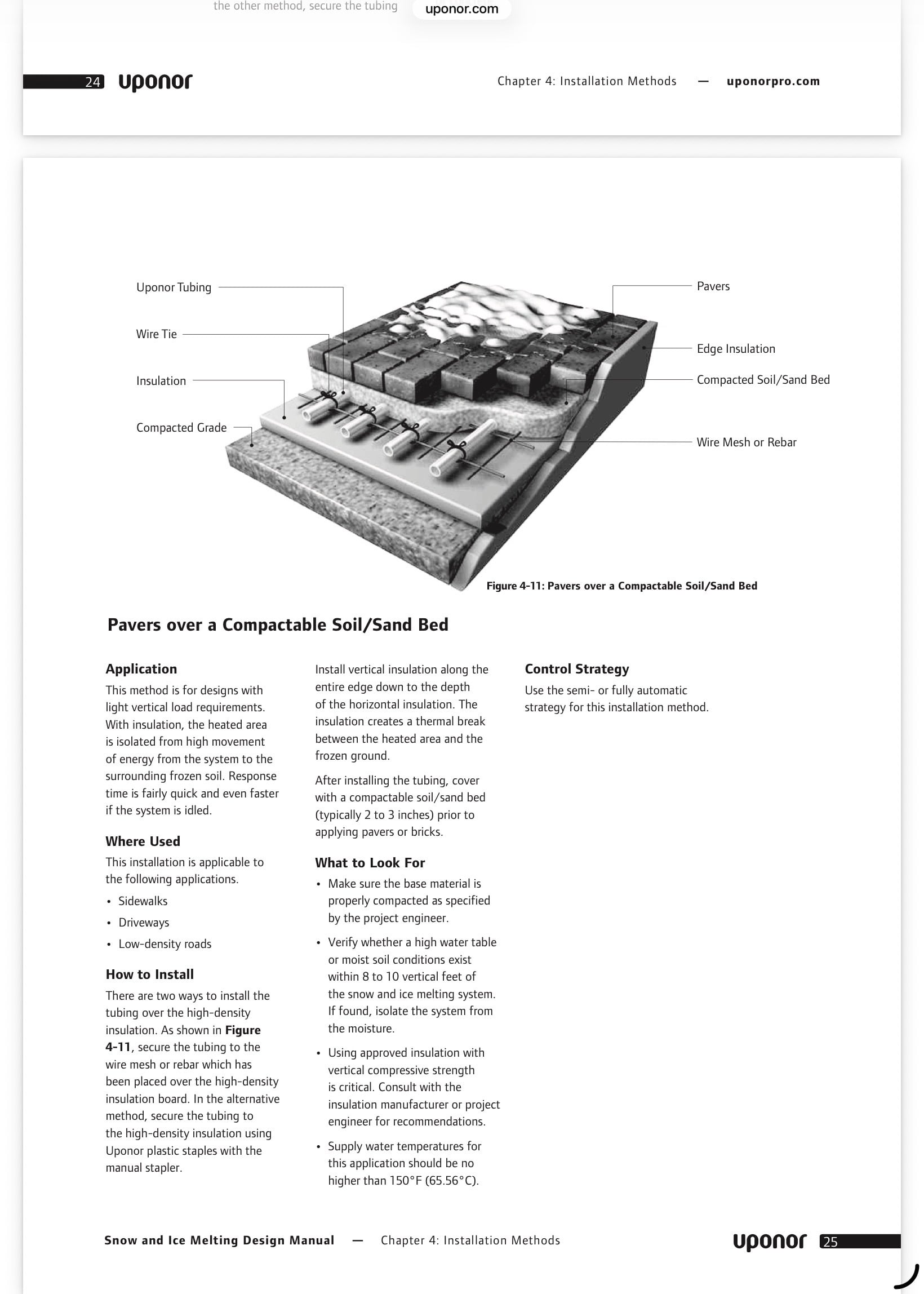
Hello- my dad hired different contractors (to save money) to do a hydronic snowmelt system for his 2 garage driveway and would like paver stones as the surfacing material. The different contractors seem to be giving conflicting information so I'd like the opinion of this forum to know what's actually correct. Which is the correct way to install hydronic snowmelt piping with paver stones?
Option 1 (from bottom to top):
-1.5" insulated foam board
-pex tubes (1/2")
-embedded in concrete, with an extra 1.5" on top to "protect" the tubes
-1.5" of bedding sand for pavers (compacted down to 1")
-3" unilock pavers
My Concern: 1.5"+1"+3" = 5" from the surface of the paver stones to the hydronic tubes? Isn't that too thick to melt anything? I think I see online you want to keep pipe-paver surface to 2.5" for efficient heating?
Option 2 (from bottom to top):
-1.5" insulated foam board
-pex tubes (1/2")
-embedded in HPB, with an extra 1.5" on top compacted to 1"
-3" unilock pavers
My Concern: The pipe-paver surface here is 4" which is better but the contractor says this is a bad option because the HPB stones are sharp and will break the tubes? But I see online from various resources you can embed in bedding sand and it may even be preferred?
Would appreciate any insight into this issue!
Comments
-
have they performed a SIM design? What class system, how many btu/ sq ft, etc.
Generally 3/4” tube is used to move enough btus
It is not too hard to do a design yourself, then all contractors bid on the same, correct design.
Bob "hot rod" Rohr
trainer for Caleffi NA
Living the hydronic dream 1
1 -
Hm, nothing that they shared with me. Do the depth measurements seem right to you? Thanks again
0 -
The guide I attached should answer all the design questions and consideration?
Stamped concrete is another option, less installation work. And the tube would be placed about two inches below the surface. So probably a faster responding system. Unless you plan on ideling$$ the slab?
 Bob "hot rod" Rohr
trainer for Caleffi NA
Living the hydronic dream1 -
Thanks, Bob. Yea it’s gotta be pavers to match the rest of the front yard. Your diagram does indicate sand bedding which is what i see everywhere but this contractor is obsessed with embedding in concrete and then pavers on top- which i think is fine. the issue i have is his desire to put an extra 1.5” concrete between top of the piping and below the pavers—this i don’t see recommended anywhere. he says it’ll protect the tubes from vehicular dmg on the driveway..
0 -
Concrete is R0.1/inch, it won't do much here. Try to minimize the amount of sand as well as it will hold water that needs to be melted each time the system runs. Usually, instead of pavers, stamped concrete is the better option.
Also think about where your snow melt will go. There are a couple of heated driveway setups around me that are very effective in turning a bit of easy to shovel snow into ice that needs to be chipped away.
0 -
Thank you!
0 -
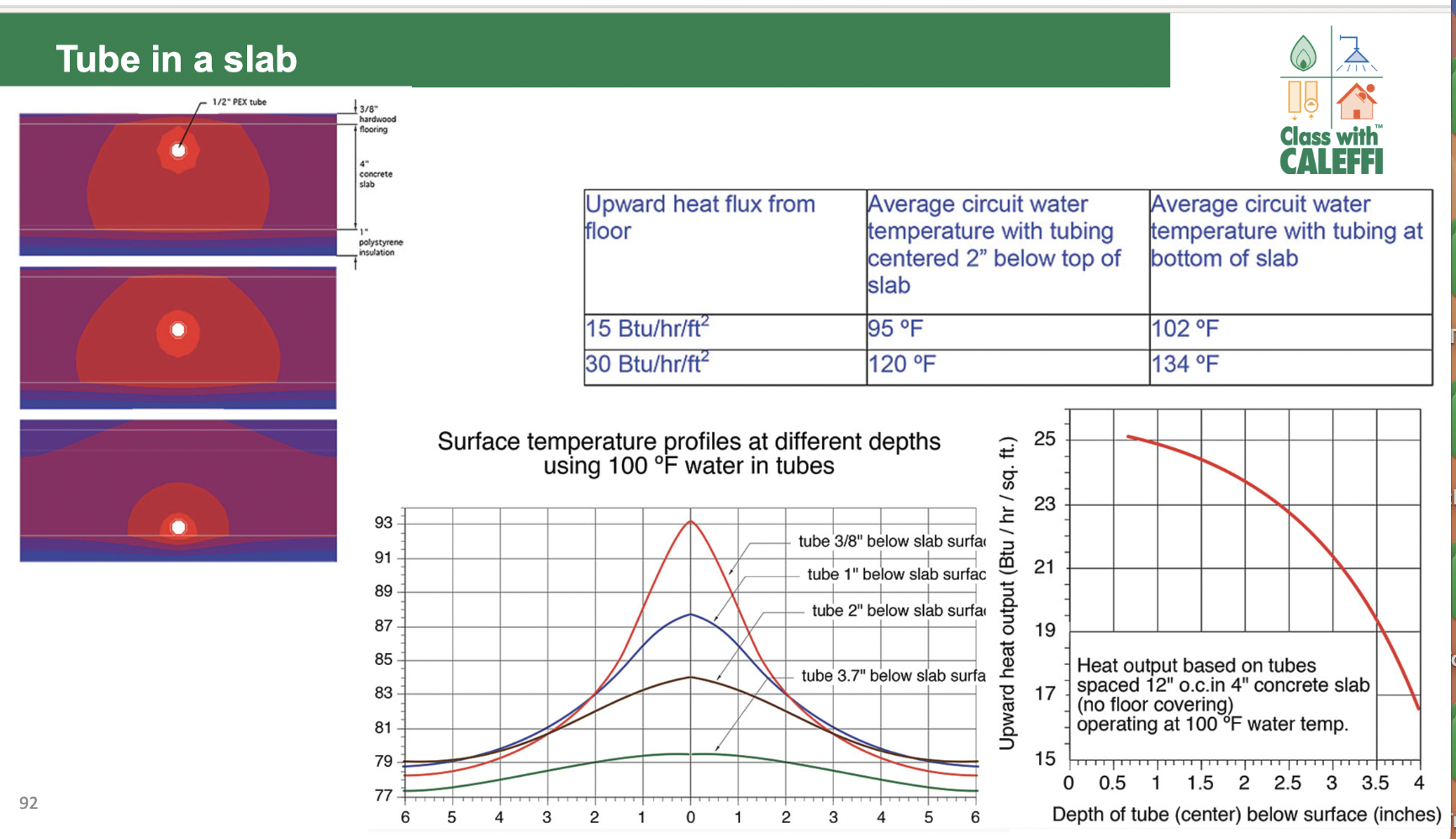
yes the farther down the tube in the assembly, the lower the output. Perhaps it can be accommodated with higher supply temperature. I can dig out some info on that tomorrow.
I would ask for an actual design. Most all the tube manufacturers will do a design with a software program.
Basically it comes down to the amount of snow and how quickly you want it to melt and be ice free. That is why there are different performance classes for SIM design.
You have one chance to get it right. Unless they have very short loops, I don’t see 1/2 Pex being a good choice.
Bob "hot rod" Rohr
trainer for Caleffi NA
Living the hydronic dream1 -
-
At my fathers old carwash, the Monorail carwash systems company uses the design where the heavy black polyethylene tubing is imbedded in stone mix concrete and tie wrapped to the reinforcing mesh.
Sand mix concrete is better as long as it is properly installed where the sand mix concrete is vibrated in place to properly settle to fill any void and eliminate air bubbles, level out and as a result it is easier to screed.
You can buy concrete that is colored that would match your existing colors.
Car washes operate their floor heating systems from October 1st to May 1st 24 hours a day as a rule with 100 percent 160-170 degree heated automobile antifreeze to keep the slab and aprons free of ice.
I would look at a colored concrete sand mix that will match the surroundings rather than using pavers for this as a gravel sand mix concrete will be much less likely to perforate the tubing as a crushed stone mix concrete would.
Properly installed the continuous slab would be screeded and a crown created in the center to allow the melt water to fall away from the center of the driveway to thew edges where it can be channeled away as long as it has somewhere to drain to.
You have to keep in mind that a continuously warm slab will more quickly respond to snow and ice melting needs too.
0 -
This was modeled for a 4" slab, 12" on center. Snowmelt should be 8-9" with 5/8 min, better yet 3/4 tube.
The lower the tube in the slab the higher the downward loss and slower the response on start up.
The sand and paver would need to be added to this model also.
Sand is not a great conductor of heat, pavers are, they are denser than concrete as they are formed under pressure.
I would look at the SIM design manuals from Uponor, Rehau, Viega, atc. They should all be online. Get up to speed on a proper design before you start the project or get bids.
Use a regular concrete mix, the stone (aggregate) is what gives comcrete its strength. A sand mix would not be ideal for a driveway.
Usually concrete is mixed with a 5/8- 3/4 aggregate over the tube, so with 3/4 you usually see 2-2.25" of concrete required over the tube.
Holding the tube up into the pour is easier said than done. Without "chairs every 18" the mesh or rebar will droop down during the pour.
 Bob "hot rod" Rohr
trainer for Caleffi NA
Living the hydronic dream 2
2 -
You guys have all been so helpful. Thank you!
0 -
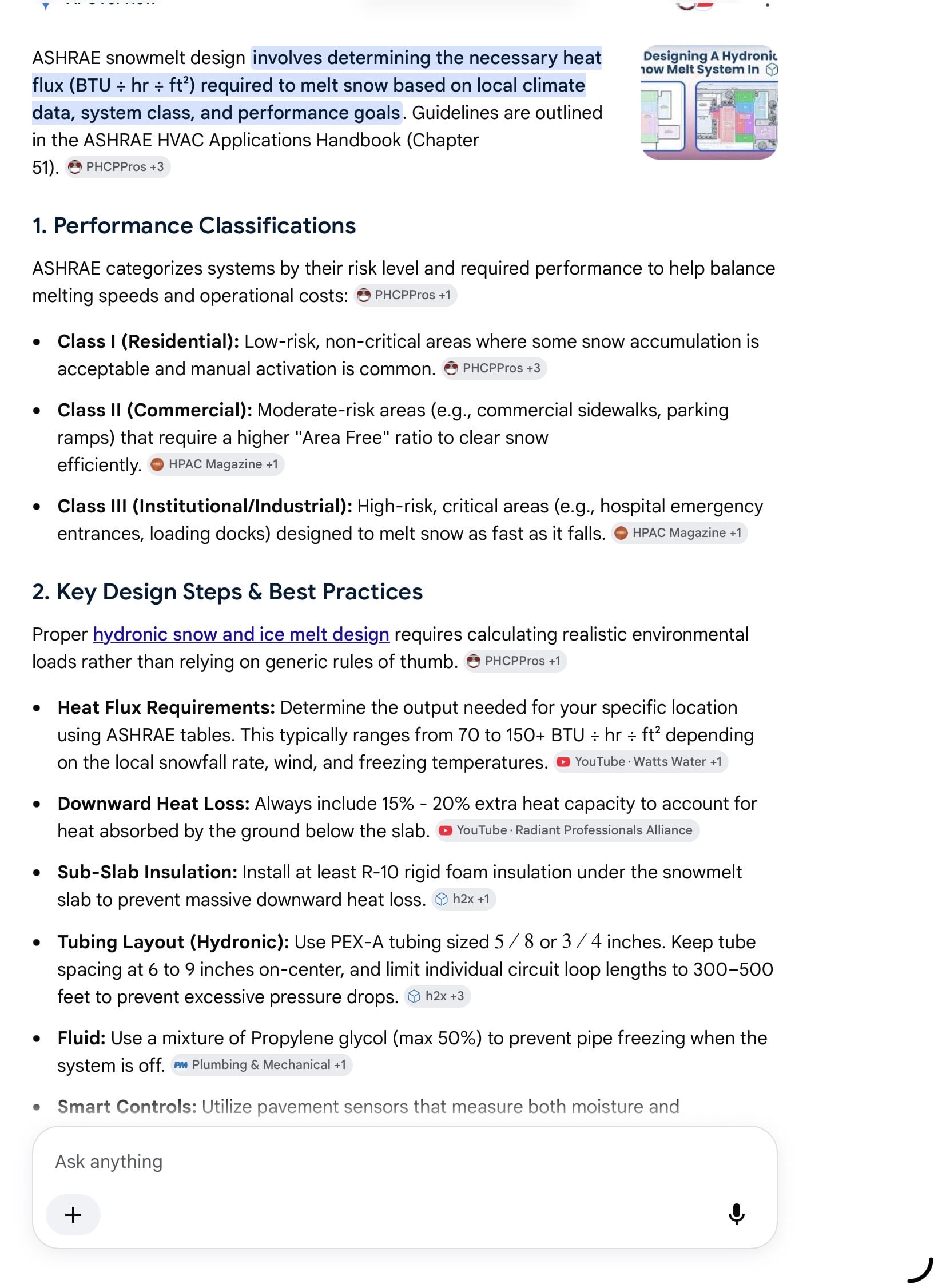
The ASHRAE Class 1, 2, 3 system was abandoned a while back and replaced with a more complicated system using Free Area Ratio (Ar) and Frequency Distribution data points. This new PPI document helps to explain it: PPI Recommendation J - Hydronic Snow & Ice Melting System Performance Level Selections
Unfortunately, the ASHRAE tables don't include Canada. I used to live and work in the GTA, and it was common to size residential SIM systems for 150 Btu/hr-ft2 output, but it depends on exposure to wind, natural drainage/slope, and other factors.
This PPI presentation contains graphics and pictures of installation types, as well as detailed design steps and control options. Presentation - Snow Ice Melt Design Installation
1






Categories
- All Categories
- 87.8K THE MAIN WALL
- 3.3K A-C, Heat Pumps & Refrigeration
- 59 Biomass
- 430 Carbon Monoxide Awareness
- 133 Chimneys & Flues
- 2.2K Domestic Hot Water
- 6K Gas Heating
- 124 Geothermal
- 170 Indoor-Air Quality
- 3.8K Oil Heating
- 79 Pipe Deterioration
- 1.1K Plumbing
- 6.7K Radiant Heating
- 396 Solar
- 16.1K Strictly Steam
- 3.5K Thermostats and Controls
- 56 Water Quality
- 51 Industry Classes
- 51 Job Opportunities
- 18 Recall Announcements