Sizing hydronic boiler replacement, how much overhead capacity for an indirect tank?

My W-M CGi 4E series 2 boiler with 76k output btu is leaking and needs replacement. Thing is, radiation has been added since it was installed, a 30 gal indirect tank and a 13k btu blower to heat the basement. I calculate my main baseboard radiation plus kitchen radiant (3 zones) is about 67k (112 ft of baseboard or radiant equivalent). The only time the house has been cold was last winter when we had weather in the teens for weeks here in NJ. It still wasn't hardship, mid-low 60s. My Wisconsin born wife said her childhood home was much colder!
When I installed the tank my local supplier sold me a priority control since it's a one pump system, which was a disaster, the house would get cold when the tank was slowly recovering! I solved that by ditching the relay and replacing the standard Honeywell zone valve with a 1" full port White Rogers valve which recovers the tank in a flash. Plus the basement heat rises so it's supplementing the upstairs radiation rather than simply being lost.
So I have 80k of radiation without the tank. Some sources advise allocating 50k for the indirect, others say don't bother, since it's very intermittent load.
The question is: should I just get an 88k CGi 5, or up my output to a 117k CGi-6? Do I lose any efficiency to speak of with shorter cycling? Other downsides?
Comments
-
the part you are missing here is a heat loss calculation for the house to tell you if that 80k of radiation is enough.
Unless you are showering or washing clothes in hot water all day long I wouldn't worry about adding extra for the DHW load. If you say have 4 people showing in a row or nearly simultaneously and you are running out of hot water I would solve that with a bigger dhw tank rather than making the boiler bigger.
I would worry about if you need to add more radiation to cover the heat loss of the house or if you have it micro zoned such that the boiler is spending all its time on pre purge and post purge instead of heating or something like that.
If the boiler is gas a mod con could modulate down to deal with smaller zones better, provide water matched to the radiant zone swt if that is the only zone calling and you pick the right boiler model, and would deal better with being a bit oversized to cover the dhw load if you wanted to do that.
 1
1 -
if the radiation is just little bit too small you could run and odr control on a ci boiler that brings the swt up to 200f or so on the design days and brings it down to maybe 150f on the mild days.
0 -
I seriously doubt the house is under radiated. You don't need to add anything for an indirect.
A hot water boiler has an extra. 15% built into its rating for piping and pick up.
0 -
what is the design day temperature for that area?
Not being able to warm the home above 60 when outdoor is in the teens doesn’t sound right? Did the boiler run non stop during that period ?
A load calc would be the first step
Second step is tighten and seal the home to lower the load
Third confirm the radiation can cover the load
A mod con would handle a zoned system better than a fixed output boiler
Bob "hot rod" Rohr
trainer for Caleffi NA
Living the hydronic dream 2
2 -
I doubt it too. I think years of history is better than a heat loss analysis! I probably should have measured the in-out water temps during that cold spell to see if it was the boiler or radiation that was the bottleneck.
So your opinion is the 88k is fine?
FWIW, I'm really reluctant to get into mod-con for the maintenance cost eating into any energy savings, the installation being beyond my skills and equipment, and the fact the venting/air supply would be hard to do in the basement location. As is, the current pipe is going through the 1st floor rim joist and doing a completely half **** journey up an external terra cotta flue before cutting back inside the building into the old chimneys for the cast iron coal stoves. No doubt this is illegal even though half a century old, and I'm contacting a contractor to install a double wall stainless vent pipe. That's a whole nother can of worms, like does it have to go to the roofline as long as it's a certain distance from any windows? The contractor should know, but I like to double check these guys, I've seen them wrong enough times.
 1
1 -
I wish I paid more attention to my boiler during that cold spell, but I had a far bigger crisis going on with the failing steam boiler in my rental building! New boiler there now, lord that was traumatic, no one could fix that 12 year old boiler.
Google says my design day temp is 15F. There's not a lot that can be done in this old uninsulated brick "tenement". The windows are Certainteed ca 2000, I tried to buy good quality replacements for the previous replacements. Did I? IDK. And like I said above, I'm reluctant to go the mod-com route.
To be honest, I'm probably overthinking this because it's just not been a real problem. But no time like replacement time to put everything on the table, right? Last time was in the middle of December and there was nothing to do but get Moe Larry and Curly in to replace the boiler ASAP! I also knew far less about heating back then. Even so, they screwed up the venting and I had exhaust coming out the WH hood! That was when I ditched the tank heater for the indirect.
0 -
We can't form an opinion on if the boiler size is ok without knowing why the system was failing. It could be that whoever installed the baseboard just put it wherever they felt like and didn't do any math. It is also possible that it could be uneven such that it was turning off the t-stat before the rest of the house was warm. The manual j will give you the answer.
1 -
I just tallied up my total gas charges for the last 12 months. It appears to me there is no way the efficiency savings can ever come close to the added service costs of a mod-con, never mind the initial purchase and installation costs. I'd save like 10%, or $150/year. Is there something I'm not getting?
84.55
156.56
225.33
334.47
286.97
202.22
71.91
27.66
27.65
26.35
31.30
41.45
$1516.42 total for year
0 -
operating cost probably isn't the main factor. there are pros and cons of both conventional and mod con boilers. a mod con can save you having to repair or replace a failing chimney or other vent. a mod con can modulate to match the current load so it runs long cycles with more even heating. in many cases a mod con can feed a low temp or high mas system directly or with simple primary secondary piping simplifying the near boiler piping and controls. a mod con can accommodate smaller zines without short cycling. a mod con can accommodate some oversizing for the dhw load without short cycling. a mod con usually takes up a lot less space. the cons are that a mod con usually doesn't last as long and requires more complicated maintenance. a quality mod con applied correctly and maintained somewhat could still last 30+ years.
0 -
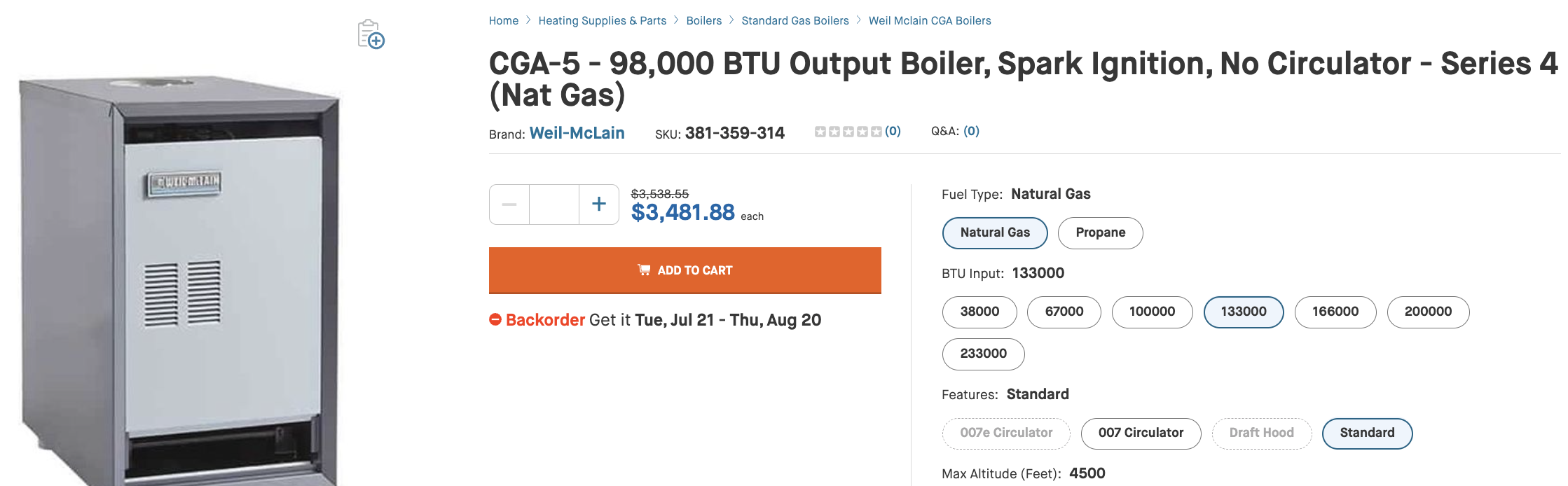
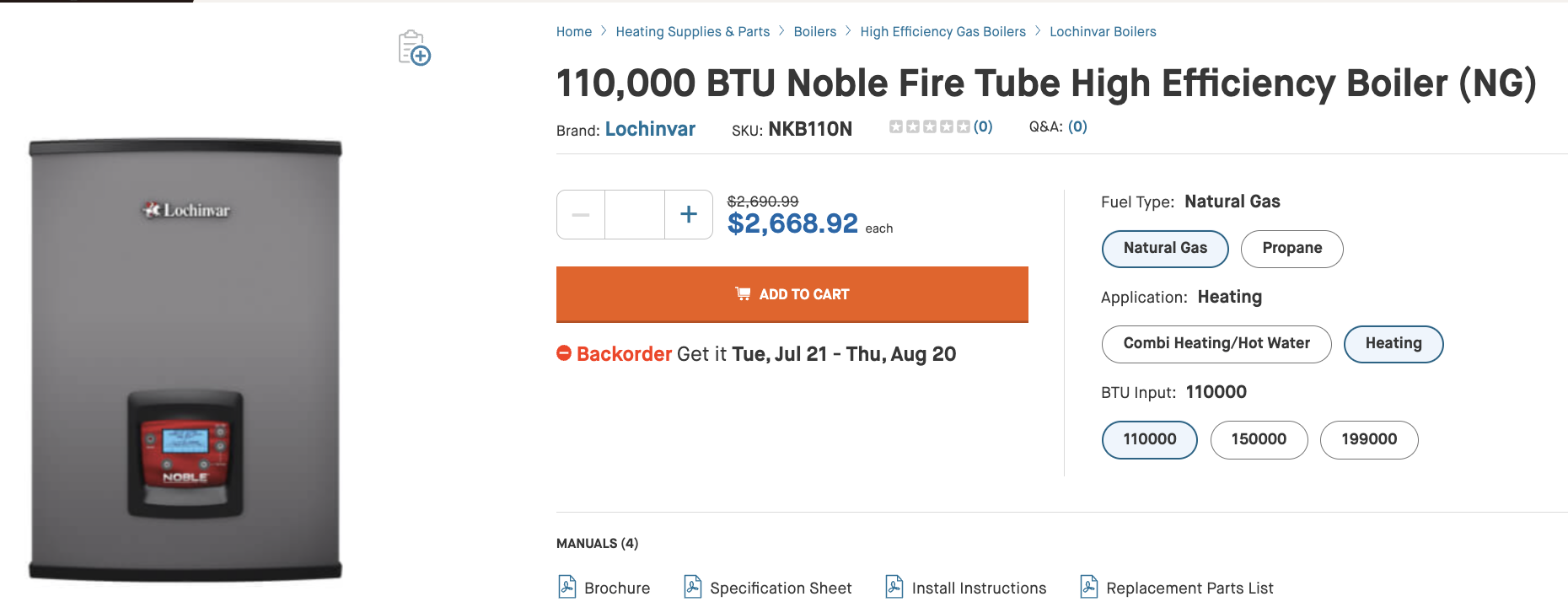
Similar output CI vs mod con $$
The Nobel is the price point Lochinvar, still plenty of control features compared to a Weil CI.
The $800 savings with the Nobel should offset any price difference?
 Bob "hot rod" Rohr
trainer for Caleffi NA
Living the hydronic dream0 -
Thanks, but as I understand it, a mod-con needs to have it's combustion tuned on installation, among other more complex aspects of an install, while the CGi I would have no problem installing myself. I'd expect that installation labor to be quite a few times more costly than that $800 savings, plus the cost of pro service yearly. All true?
0 -
any gas appliance should get a combustion analysis when it is installed. it being off tends to be less problematic with a natural draft appliance.
1 -
Never seen a pro analyze a DHW tank, and I guarantee the stooges who installed the outgoing CGi didn't. Honestly, when I was struggling with the bad steam boiler throwing CO and soot I had to yell and scream to get them to analyze it. One prominent member here ghosted me when I asked. ¯\_(ツ)_/¯
0 -
Well, you were never on one of our jobs. We analyzed everything.
0 -
you size a boiler to the largest load. In some cases that is the DHW load. So if DHW is a concern, identify that load also.
Combi or tankless work on the concept of heating water 77 degrees at a constant flow. If you have or want that type of DHW production you need around 80k to generate 2 gpm continuouslyThe math is fairly simple
500 x flow x delta. 500 x 2gpm x 77 degree rise =77,000 btu
With an indirect, some boilers have a time function to prevent the DHW from locking out the heat for long periods. Generally 15-20 minutes recovers a DHW load. Rarely do you drag the entire tank down to 50 degree water temperature. If you are in the shower and hot water drops below 103f, you probably shut ‘er down and get out.
Bob "hot rod" Rohr
trainer for Caleffi NA
Living the hydronic dream0 -
Price point between the 2 different style boilers is not the only difference to consider. Is your boiler room cubic footage big enough to support the combustion according to code? It's another aspect to consider when comparing the mod/con to the cast iron. You might have to install a fan in a can or similar device to bring outside air in with the cast iron. Most if not all the boiler rooms I work in Boston do not meet the code for combustion air. With a mod/con the combustion air is part of the install.
0 -
The intake is a real issue, but on another property with a 200k btu steam boiler I added louvers to a basement window for air intake.
Well, fortunately I managed to save the boiler by extracting the remains of the corroded PRV nipple, so it's off the table for now. I had thought it had breached the CI itself there was such a mess of corrosion and water, but the 'cut inside the pipe and bang it to collapse' technique worked! I'd only previously used it on old radiators to change spuds. The hub was mostly intact. I know better than to neglect a leaking PRV, I just was rarely in that boiler room and busy.
0




Categories
- All Categories
- 87.8K THE MAIN WALL
- 3.3K A-C, Heat Pumps & Refrigeration
- 59 Biomass
- 430 Carbon Monoxide Awareness
- 133 Chimneys & Flues
- 2.2K Domestic Hot Water
- 6K Gas Heating
- 124 Geothermal
- 170 Indoor-Air Quality
- 3.8K Oil Heating
- 79 Pipe Deterioration
- 1.1K Plumbing
- 6.7K Radiant Heating
- 396 Solar
- 16.1K Strictly Steam
- 3.5K Thermostats and Controls
- 56 Water Quality
- 51 Industry Classes
- 51 Job Opportunities
- 18 Recall Announcements