Basic question for new-build hydronic heating

A few years ago, I got a lot of good input from people here on my hydronic heating system for my shop. The tubing is in the slab and after three years, I’m very happy with it. It is now time to design a system for the new house on the property, which is a different animal. I used LoopCAD to design the system for my shop and will be using the latest version for the house’s system. Construction will start in a couple months and it will be 2600 sq ft, with a 9-foot basement under 1000 sq ft and a 4-foot crawl space under the remainder. I’ve done a lot of searching on this forum and the internet in general and I’m having difficulty finding relevant information that is less than ten years old. Since I’m sure technology has improved since then, I need some help with basic design. Starting with the most basic, is there an installation method that is preferred for new construction, i.e. in-floor vs. under-floor? Once I know that, I will come back with more specific questions.
Additional info: Central ohio, propane heat, plan to use a combi-boiler for heating and DHW. The main floor will have LVF throughout with area rugs here and there over the LVF. Tile in the bathrooms. The basement and crawl space will be primarily used for storage so they don’t necessarily need to be as warm as the rest of the house in winter.
While I want to have an efficient system, I don’t want to add details that are technically helpful but have a 15+ year payback period. A local Warmboard contractor wants $ for the installation, so that’s not gonna happen. I’ll probably do the installation myself (possibly with a helper).
Thanks in advance.
Comments
-
The basement will have tube, I like to do 6" on center for fast response and lowest possible SWT. Insulation below. Someone, someday may want to finish that space, tube is inexpensive
For the framed floors either plates from below, plates or a pre-manufactured dry system on top.
Or a 1-1/2" thin slab on the framed floor. Double the bottom plate your walls if you go with a thin slab. It depends on floor covering. If you plan on any nail down hardwood, thin slabs add some challenges. Tile, floating hardwood, carpet works on thin slabs.
Slower response, a bit more thermal mass to even floor temperatures
Radiant walls or ceilings.
Pros and cons to all the methods.
If you are doing the work yourself lay foam or concrete insulation blankets in the crawl to make it more pleasant to work down there.
The LoopCAD will indicate the tube spacing, generally 8" and lengths as well as SWT. Or if you have high load ares that need supplemental.
Panel radiators are another option. Really no need for radiant floors in bedrooms, typically carpeted, mostly covered by furniture.
My next build will be a blend of panel rads and radiant floors in tile areas like bath and kitchen.
What is your AC plan?
Bob "hot rod" Rohr
trainer for Caleffi NA
Living the hydronic dream0 -
Thanks for the quick response! Lots of good info there.
It sounds like no single approach is hands-down the best one, which is good to hear. I'm leaning toward the thin slab approach for the living area. We won't be using hardwood flooring anywhere and just the thought of installing all that tubing overhead from the basement/crawl space makes my shoulders and back hurt.
We're going to put a concrete floor in the crawl space also and will have rigid R-10 under both it and the basement floor, as well as around the perimeter.
We plan to use a central AC unit, mainly because I'm not aware of a good alternative. I familiar with mini-splits, but I'm not quite convinced they're as awesome as some people on the web make them out to be.
0 -
Ecowarm is a good alternative to Warmboard. It has a thinner aluminum skin which translates to warmer water temperatures, but it’s quite a bit less expensive to buy. And it’s still plywood and not particleboard like some of the others. However, with any preformed board product, you’re stuck with their spacing. I like tight tube spacing at exterior walls and then wider spacing as you move inside and you can’t do that with a board product.
An alternative is something like Gypcrete. It used to be $3/[], but it’s probably more now. Great sound insulation as an extra! And freedom to space you’re tubing any way you wantYes, radiators are an option, but I sure like warm floors.
8.33 lbs./gal. x 60 min./hr. x 20°ΔT = 10,000 BTU's/hour
Two btu per sq ft for degree difference for a slab0 -
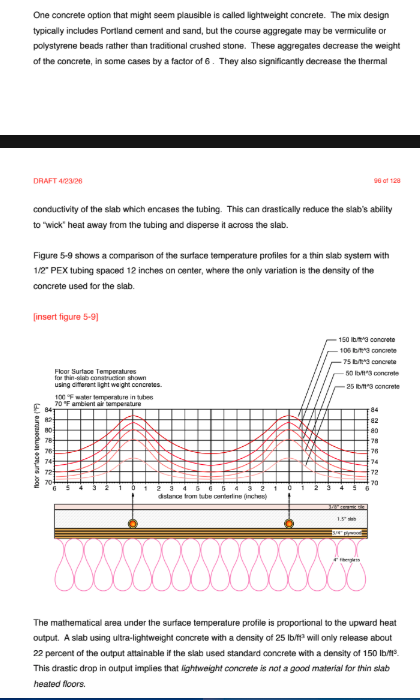
I would stay away from lightweight mixes, those with plastic beads or lightweight aggregate.
Gyp pours are not good for tile applications and the gyp comes apart if it sees any moisture. Even with a sealer. It's original intent was sound and fire barrier for hotels.
This mix works well down to 1-1/2" pours, the Youker Mix
1 cubic yard 3000 psi
517 lbs portland
1639 lbs concrete sand
1485 lbs #1A 1/4" crushed (pea gravel)
4 oz air entrainment agent
15 oz Hycol water reducing agent
1.5 lb fiber mesh
51 oz superplasticizer
20 gallon water
Send this list to the batch yard you are considering
You can wheelbarrow this or a small concrete pumper, 2" hose even
PVC control strips in the interior door ways. Break the area into small mosaics with these control strips. PVC drywall trim works well for this
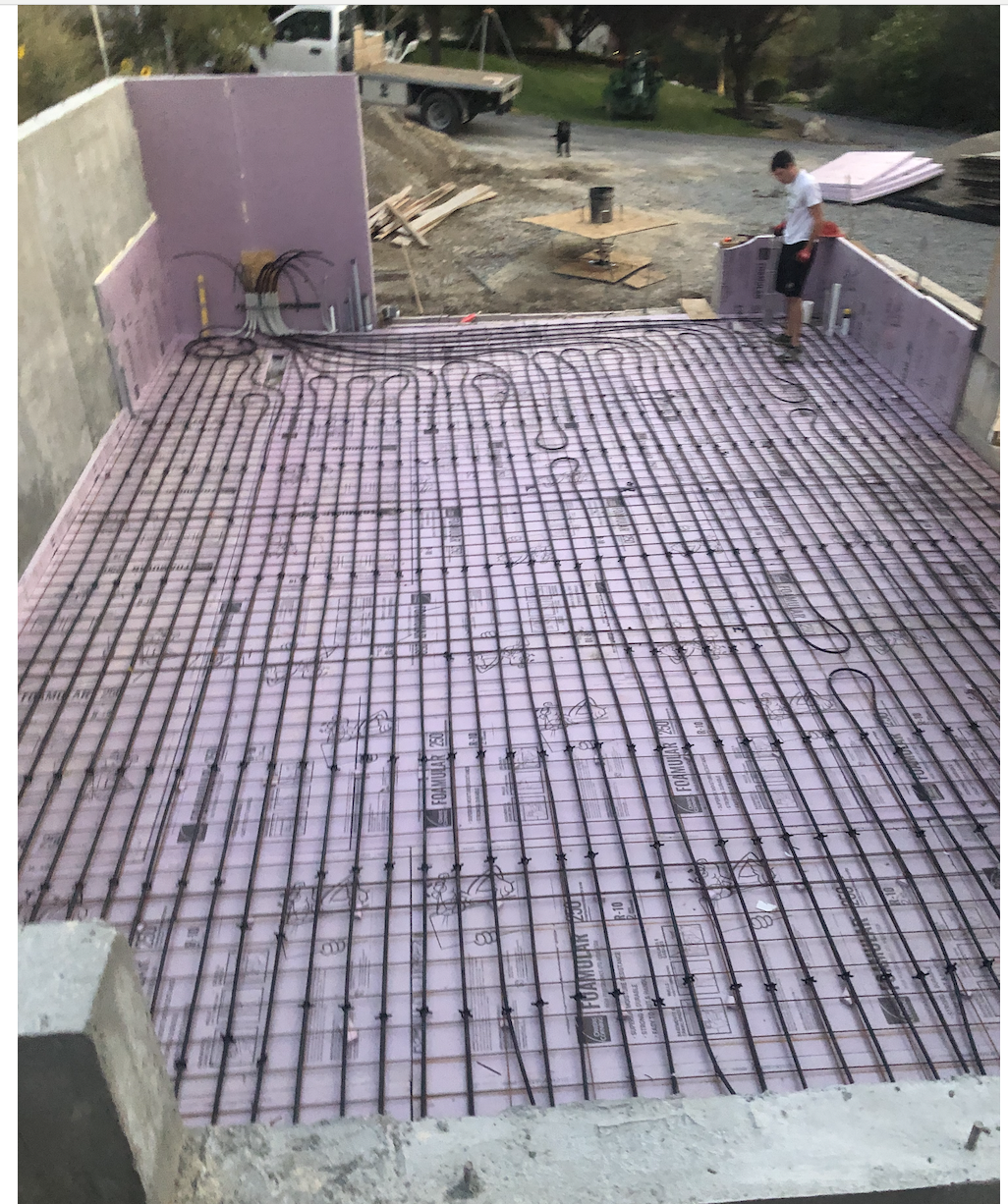
Poly film over floor sheathing as a bond breaker. Tape the seams
Duck tube below wall plates, mark plates where they can be safely drilled for plumbing and electrical work.
Mineral oil or WD 40 on any sleepers for hardwood nailing.
3/8" pex tube
Plan on some of the fine "road map" cracks even with all precautions.
Also pay attention to joist sizing, no bounce in the floor! there are a lot of I joist options these days.
Put a one size larger plate down 1st. Frame wall on top of that. This gives you a screed board everywhere.
A drone is a good option for getting pics before the pour. Pex unwinder from shop stool :)
Our next Idronics issue, Avoiding Common Mistakes, this graph regarding light weight mixes
 Bob "hot rod" Rohr
trainer for Caleffi NA
Living the hydronic dream 1
1 -
Even more good info! I will definitely use the idea of upsizing the bottom plate to use as a screed board. I already have some questions on the Youker mix after talking with a local concrete supplier but I will start a separate thread for that to make it easier for someone to find in the future (and not make this one a catch-all for my questions). I hadn't thought of the barstool unwinder. I made mine out of an old hub bearing off my pickup and some square steel tubing I had laying around. Not pretty but functional.
Thanks again.
0 -
don't spread out your questions in different threads too much, having the background of the project is frequently helpful in answering the question in ways you didn't anticipate.
i wonder if you could make acceptable lightweight concrete with vermiculite or perlite instead of the sand but still using portland cement. i think the lime/plaster in place of the cement is what makes the gypcrete too fragile.
0 -
I poured my home, 1983, with 1-1/2” using a formula I learned at a RPA event. Years before I learned of Harveys formula.
Basically a pea gravel mix, plasticizers, and 3 time the fiber mix that typically goes in yard of standard mix.
It got a wood glue down parquet floor, it held up well through 3 owners
Im sure there are various blends that would accomplish the same. If your local yard knows the goal, let them suggest a mix
The graph above shows why lightweight mixes are not ideal for radiant slabs. The aggregate has a lot to do with the strength and durability of of the slab. You sacrifice some of that with lightweight mixes, plus the transfer penalty. Size the floor framing to accommodate a standard mix in my suggestion.
Bob "hot rod" Rohr
trainer for Caleffi NA
Living the hydronic dream1 -
If your house is being built to modern standards it is going to have a much lower heating load than older houses of the same size.
One implication of that is the responsiveness of the heating system becomes more important. In a tight house the solar gain is a much bigger portion of the total heating load, so the heating load can increase quickly when the sun goes down or goes behind a cloud — or it can increase quickly when the sun comes up or the sky clears. How quickly your heating system can respond will be determined by how quickly your surfaces can change temperature, and that's determined by how much heat capacity they have. The trend today is toward systems like WarmBoard* which have low heat capacity and can warm up and cool down quickly.
The reason concrete has been popular is that it has good conductivity, which leads to a nice even heat. The way it's typically used, though, it has a lot of heat capacity. An ideal floor is going to have high conductivity with low heat capacity.
The output of a heated floor is entirely determined by the surface temperature. One of the things that happens in a low-load house is that the surface temperature necessary to heat the house is so low it's not very noticeable. In a well-sealed house you don't get the cold floors you get in a leaky house, the floor temperature is usually withing a couple degrees of the air temperature.
It's worth doing a thorough heating load calculation and then figuring out what floor temperatures that will result in on both the coldest days, but also an average winter day. What often happens is that if you do large amounts of floor heating the surface temperature on an average winter day is only a couple of degrees above room temperature. If what you want is toasty toes, it makes sense to limit the area to places where you are likely to be barefoot, like baths, and run them at a higher temperature.
My personal preference is to size the baths so their floors can heat the entire floor on an average day, then use additional emitters to even out temperature and meet the design load. You want some combination of 2-stage thermostats, zoning and thermostatic radiator valves to do that.
*(not endorsing this brand, just using as an example.)
0


Categories
- All Categories
- 87.8K THE MAIN WALL
- 3.3K A-C, Heat Pumps & Refrigeration
- 60 Biomass
- 430 Carbon Monoxide Awareness
- 133 Chimneys & Flues
- 2.2K Domestic Hot Water
- 6K Gas Heating
- 124 Geothermal
- 170 Indoor-Air Quality
- 3.9K Oil Heating
- 79 Pipe Deterioration
- 1.1K Plumbing
- 6.7K Radiant Heating
- 397 Solar
- 16.1K Strictly Steam
- 3.5K Thermostats and Controls
- 56 Water Quality
- 51 Industry Classes
- 51 Job Opportunities
- 18 Recall Announcements