Thoughts on series piped panel radiators with diverter valves

Hi,
I am retrofitting my small 400 sq ft apartment with wall mounted panel radiators. Currently I have oversized cast iron radiators but they are mounted terribly and take up too much space.
The plan right now is to put in a loop of 4x radiators. The current piping is in series, into the first one, then on to the next one etc.
I see these companies offer "H" valves for the panel mounting and have solutions for using the TRV built in for series piping by using the diverter type hookup.
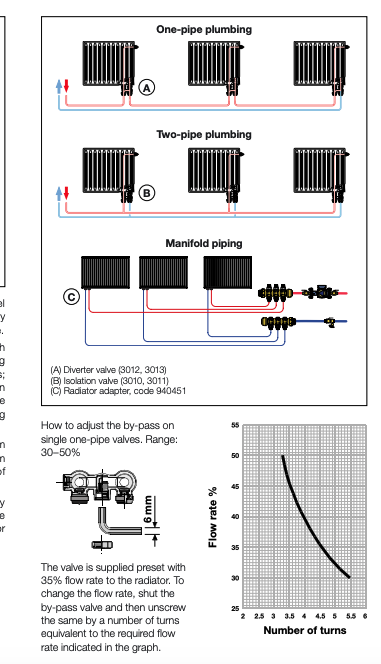
The Caleffi 3012 cut sheet calls out:
The diverter style offers an adjustable by-pass to send 30% to 50% of flow toward the radiator, factory-set for 35%. In addition, the diverter style contains a unique thermal break device in the return side (right leg) to prevent undesirable flow to the radiator due to thermo-syphoning when the thermostatic valve is closed, no call for heat.
Im trying to wrap my head around this. Does this mean if it is set to 30% bypass if the TRV is full open 30% goes to the radiator and 70% bypasses. If the TRV is closed down all the way 100% flow to the next radiator?
Anyone use these before?
Would love insight.
Thanks
Brian
Paxton Controls Corp
Comments
-
The three ways to pipe panel radiators … Daisy loop , diverter valves and tees and the home run .
The Daisy loop is a series system , good for a couple of radiators … You use the radiators diverters ..BTU input is as good as the supply pipes used .. Four radiators I wouldn't … 1/2" pipe gives you 28K ?
Divertor valves and tees or the Home run would be a better choice …
There was an error rendering this rich post.
0 -
In series you get temperature drop, so take that into account when sizing the end of the line radiator. Generally 3 radiators in series, but it depends on the size/ btu load.
With a fixed speed circulator, As I see it when one radiator turns off flow, the pressure drop from that radiator is gone. But additional flow is pushed through the H bypass so pressure drop goes up. It may be a wash.
A delta P circ, depending on which P mode, constant pressure for example, may behave differently. Let me think it through so more in regards to the pump type.
Bob "hot rod" Rohr
trainer for Caleffi NA
Living the hydronic dream0 -
Used in a one pipe application, those H valves could be considered an adjustable mono-flo/ diverter tee. I suppose.
 Bob "hot rod" Rohr
trainer for Caleffi NA
Living the hydronic dream 1
1 -
A 400-square-foot apartment is likely getting heat from a larger boiler that serves the rest of the building. I’m guessing that cast iron radiators are typical throughout the other apartments. How each apartment receives heat from the main system will determine the best way to reconnect your new radiators.
Is this a condo, or is it a rental property where a management company (or individual) owns the entire building? That may also determine what you are allowed to do when connecting to a common heating source.
Assuming you have the proper permission, how does your apartment receive heat from the central boiler?
- Individual supply and return piping to each radiator, with those pipes hidden from view. This was most common from the 1940s through the 1960s.
- A single supply and a single return from the main boiler system to your apartment, with each radiator branching off that supply and return (like Diagram B in @hot_rod ’s diagram above). This might be what you have, based on your statement: “The current piping is in series, into the first one, then on to the next one, etc.”
- A true series loop: a single supply goes to the first radiator, then from its return to the second radiator, then from the second to the next, and so on until it reaches the single return the the main boiler system. This is generally a poor design because the water loses significant temperature at each step. The last radiator in the loop would receive very little heat. This type of layout is better suited for copper tube with aluminum fin baseboard systems. This scenario sounds like what you described, but as mentioned, it’s unlikely to work properly with cast iron radiators.
Depending on the pressure drop between the supply and the return from the main boiler system that feeds your apartment, you may need to add a small circulator pump to your new radiator system zone.
Edward Young Retired
After you make that expensive repair and you still have the same problem, What will you check next?
0 -
how is this system controlled? is this apartment a separate zone? if it is grouped as part of another zone, mixing panel radiators and ci radiators on the same zone is not likely to work out well because of the much greater mass of the cast iron radiators that need a longer cycle time than the low mass panel radiators.
 1
1

Categories
- All Categories
- 87.8K THE MAIN WALL
- 3.3K A-C, Heat Pumps & Refrigeration
- 59 Biomass
- 430 Carbon Monoxide Awareness
- 132 Chimneys & Flues
- 2.2K Domestic Hot Water
- 6K Gas Heating
- 124 Geothermal
- 170 Indoor-Air Quality
- 3.8K Oil Heating
- 79 Pipe Deterioration
- 1.1K Plumbing
- 6.7K Radiant Heating
- 396 Solar
- 16.1K Strictly Steam
- 3.5K Thermostats and Controls
- 56 Water Quality
- 51 Industry Classes
- 51 Job Opportunities
- 18 Recall Announcements