Aquastat settings and summer water level

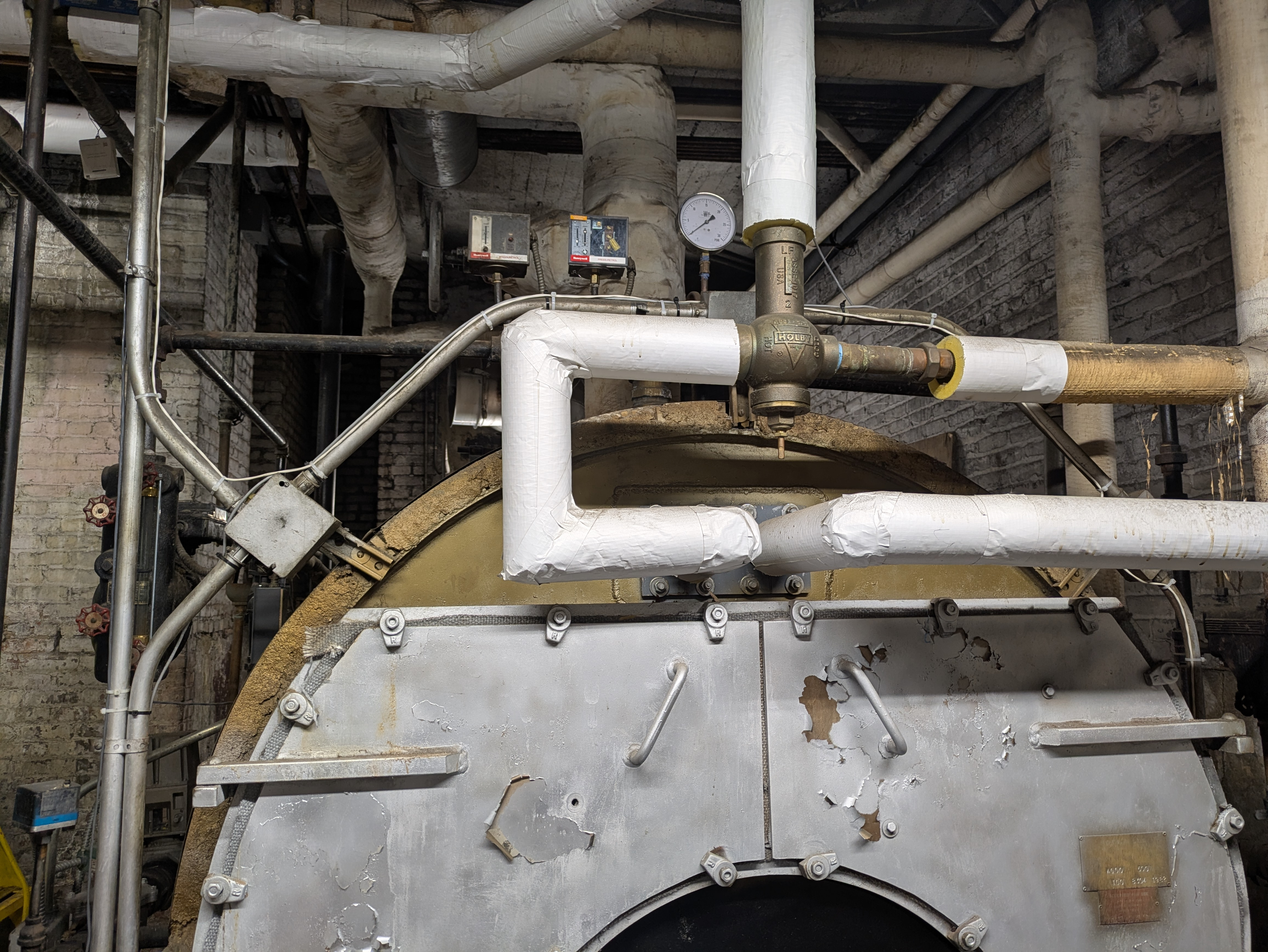
Hi we have a 100 hp boiler (see pic)
which provides steam heating and domestic hot water through a built in coil and mixing valve. My questions are as follows 1) what should the temp settings be during the heating season and non heating season? 2) should the boiler water level be raised above the coil level in the non heating system. What are the tradeoffs for alternatives.
Thanks
Comments
-
I believe raising the water level to fully cover the tankless coil would provide a benefit.
After a closer examination of the photo of your boiler, I definitely recommend raising the water level to ensure the entire tankless coil is submerged.
The solid line indicates the appropriate water level for winter operation, when steam is required to heat the building. In some cases, this level may cover less than 50% of the coil responsible for producing your domestic hot water. that is fine when the water temperqtuer in the boiler is 215° and there is steam covering the top of the tankless coil.
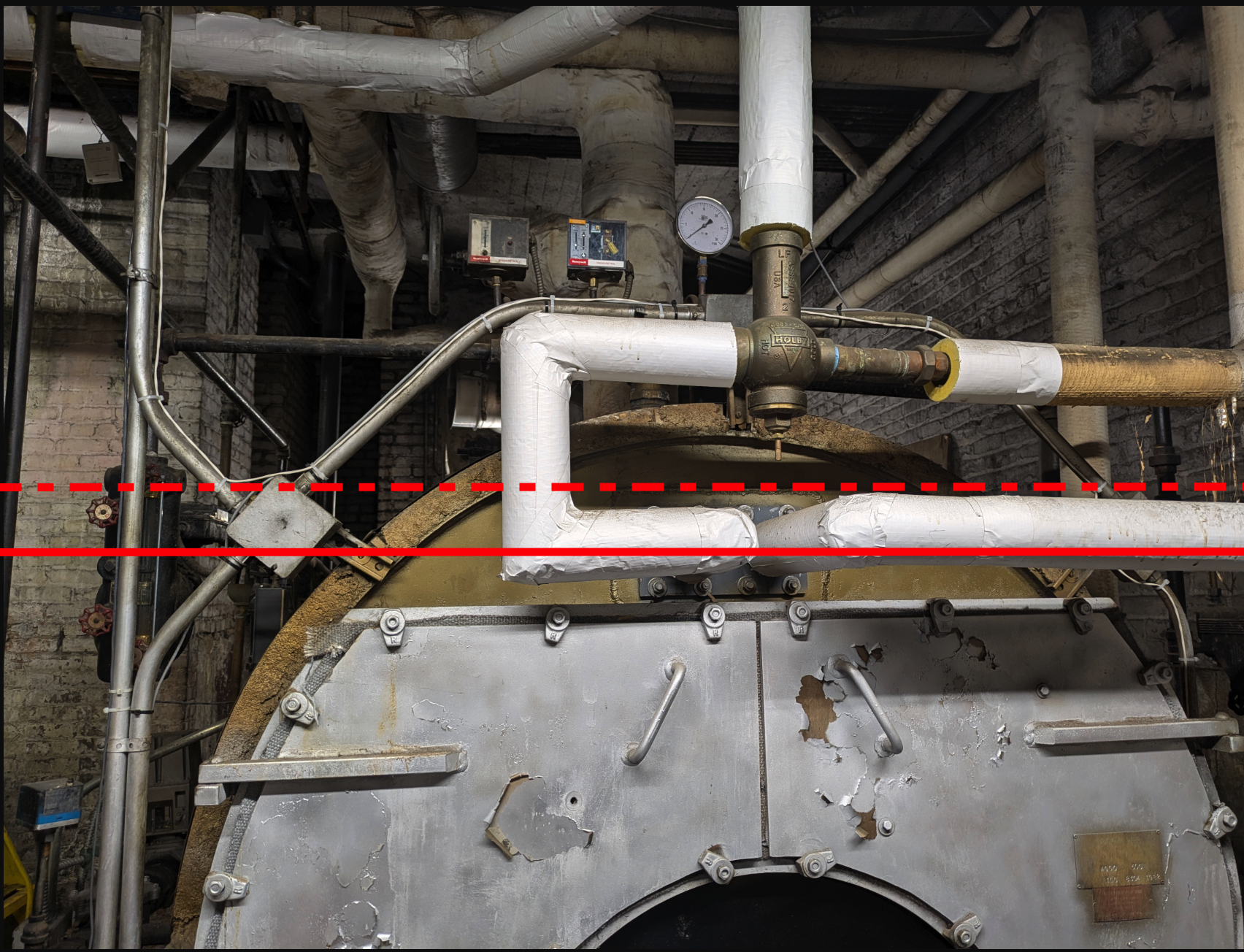
By raising the water level to the dashed line in the summer when there is no steam, the entire coil becomes submerged. This increases the surface area in contact with the hot boiler water, resulting in significantly more efficient heat transfer.
That would put the water level at the top of the gauge glass or slightly above the gauge glass. You don't want to put water into the steam mains, so leave a small amount of room at the top of the boiler for air and expansion.
I do not see the water temperature controls (aquastat) in this photo. I would typically recommend setting the high limit to 180°F and the operating control to 160°F (if there are two separate controls).
If these settings do not provide sufficient domestic hot water for the building during peak demand, you can increase the operating control to 170°F or up to a maximum of 180°F. I would not recommend exceeding 180°F on the operating control. The high limit should be set approximately 10°F higher than the operating control (if you have two water temperature controls).
Edward Young Retired
After you make that expensive repair and you still have the same problem, What will you check next?
0 -
You make a good suggestion about raising the water level during the non heating season. The aquastat only shuts off the burner when it reaches the set temp then relights when it drops 10-15 degrees (the number has rubbed off but I think it's either 10 or 15).. With the recent warm weather in NYC I set it to 160 and noticed the DHW temp is in the 120-125 range which is good. I will set the aquastat to 160 and see how it goes.
I assume you are suggesting to make the aquastat to 180 in the heating season? Early in the year(and prior years) I was set to 195 and noticed the boiler was on for a shorter period during a call for heat (vs 180). I guess that's the tradeoff between 195 vs 180.
0 -
@Wvega123 said: “I assume you are suggesting to set the aquastat to 180° in the heating season?”
That is not what I suggested. If anything, I recommend the lower temperature, provided there is no problem supplying sufficient hot water.
The first question to answer is: How many water temperature controls (aquastats) does your boiler have — one or two?
If you have only one, that is the operating control. It maintains the boiler water temperature used to produce domestic hot water (DHW). If you can supply enough hot water at 150°F without complaints, then set the boiler to 150°F year-round. There is no reason to keep a large boiler at a much higher temperature than necessary. Doing so only increases off-cycle losses and raises your operating cost.
If you have two controls, the higher temperature is set on the high-limit control. If you do not have a second control, there is no need to set a higher temperature at all.
When it comes to domestic hot water, the lower the boiler temperature, the lower your operating cost — as long as you maintain adequate hot water delivery. You do need to ensure that water sitting stagnant in the system (especially overnight) eventually reaches at least 140°F to help control Legionella bacteria. I believe 160°F boiler water will allow the water passing through the tankless coil to reach that 140°F threshold without difficulty.
So, I suggest starting at 160°F. Monitor tenant feedback. If there are no complaints about insufficient hot water, then 160°F can be your year-round setting.
If you receive complaints from more than 5% of the tenants, increase the temperature in 5°F increments (to 165°F, then 170°F, etc.) until complaints drop below 5%.
A building with zero complaints usually means you’re not working hard enough to control operating costs… and you’ll never satisfy Old Mrs. Kravitz in 3B anyway!
Edward Young Retired
After you make that expensive repair and you still have the same problem, What will you check next?
0 -
We only have one aquastat so it is the operating aquastat. I was told the higher temp setting was to prevent shocking the boiler during the winter. I guess that isn't so. We use circulating pumps to keep the DHW moving.
Thanks for the insight
0 -
Its a steel boiler. You can't shock it.
 1
1 -
@HVACNUT said: "Its a steel boiler. You can't shock it".
And I will only add this: "with room temperature return water from radiators"
If you for some reason dry fire it and then apply cold water to it while it is still red hot, then watch out, you can mess up a really nice boiler room that way! That is why you test your LWCO devices to make sure that they operate properly. NO WATER = NO FLAME
Edward Young Retired
After you make that expensive repair and you still have the same problem, What will you check next?
0

Categories
- All Categories
- 87.8K THE MAIN WALL
- 3.3K A-C, Heat Pumps & Refrigeration
- 59 Biomass
- 430 Carbon Monoxide Awareness
- 133 Chimneys & Flues
- 2.2K Domestic Hot Water
- 6K Gas Heating
- 124 Geothermal
- 170 Indoor-Air Quality
- 3.8K Oil Heating
- 79 Pipe Deterioration
- 1.1K Plumbing
- 6.7K Radiant Heating
- 396 Solar
- 16.1K Strictly Steam
- 3.5K Thermostats and Controls
- 56 Water Quality
- 51 Industry Classes
- 51 Job Opportunities
- 18 Recall Announcements