Ohms and draft

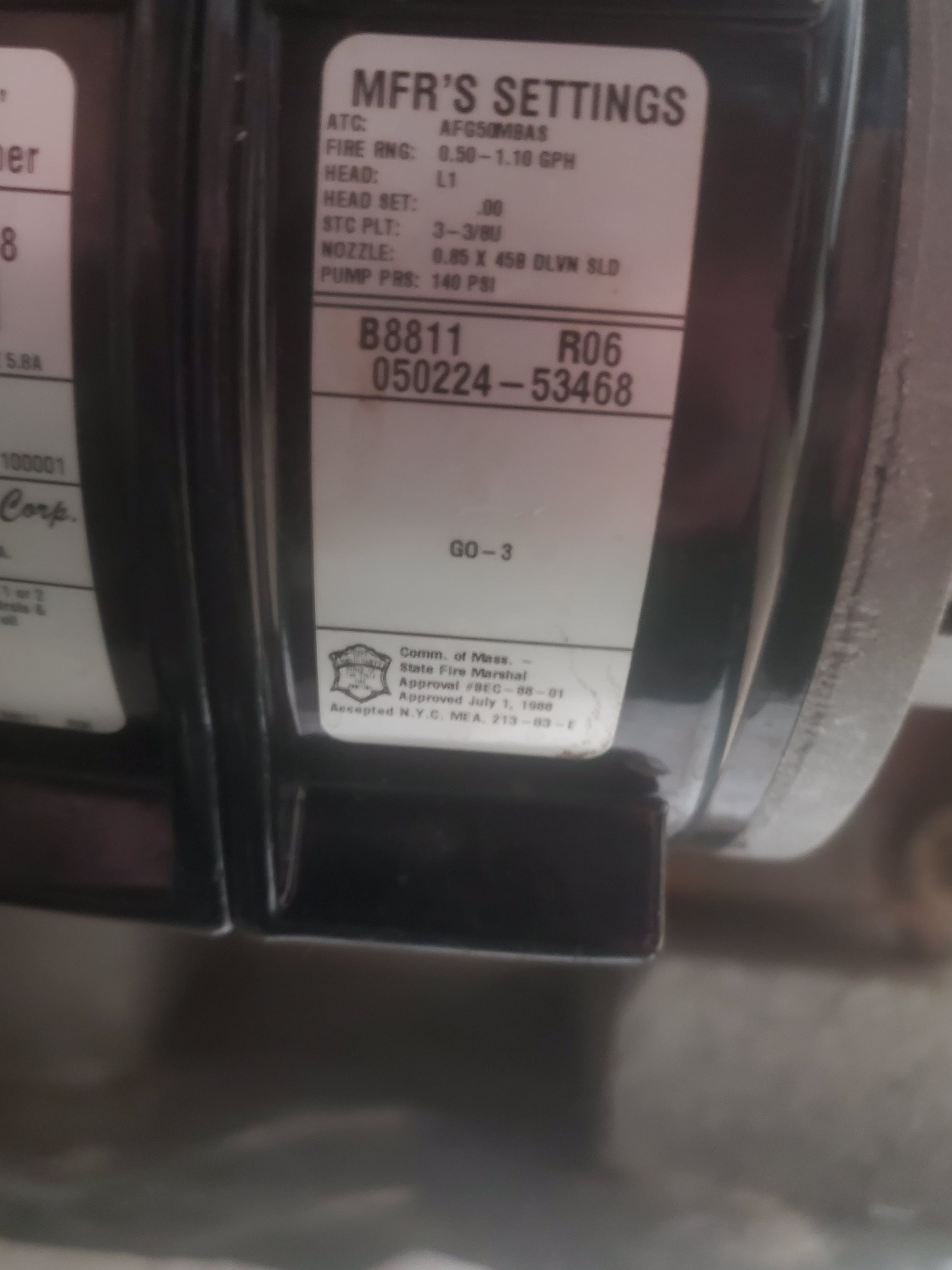
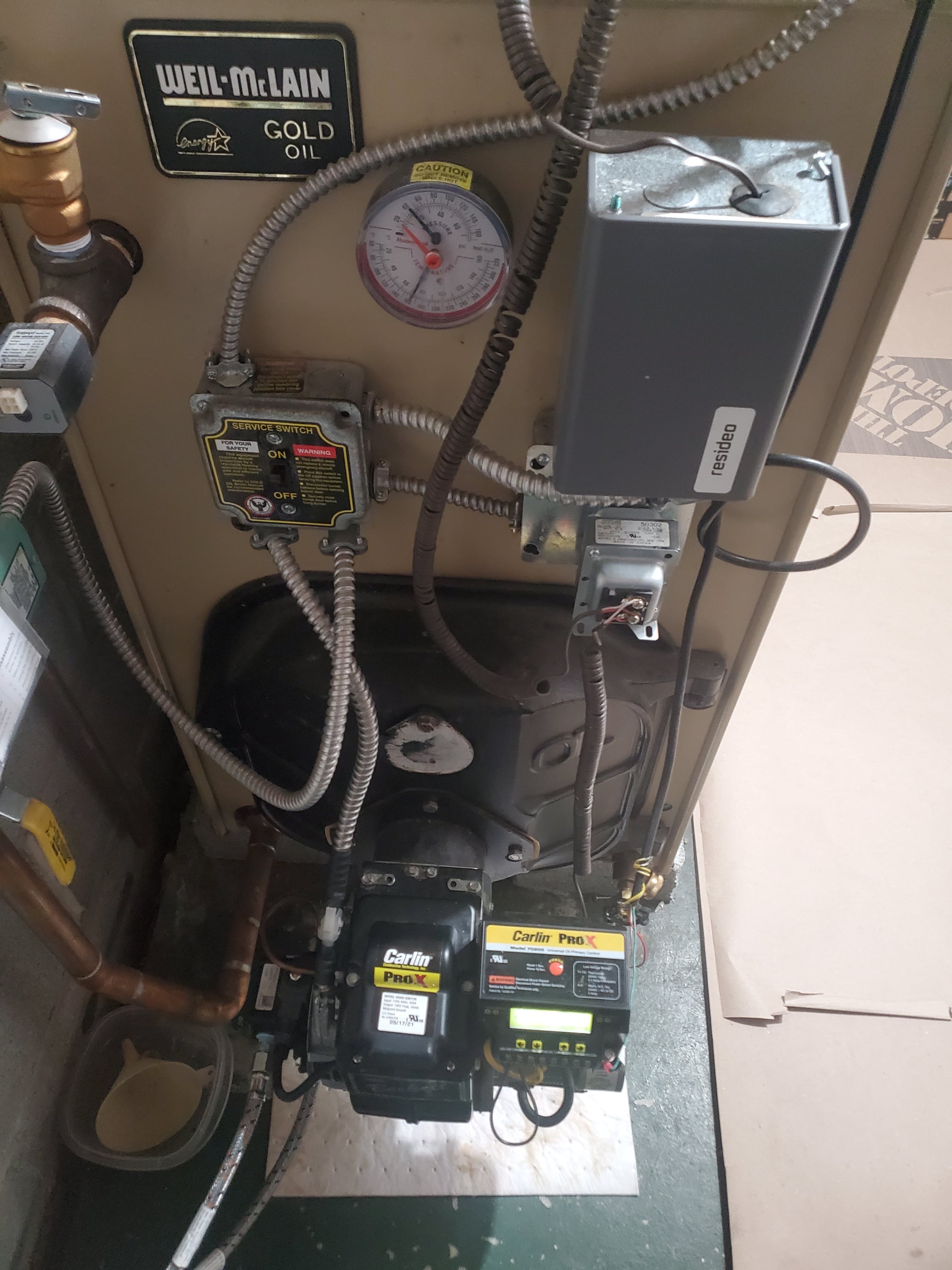
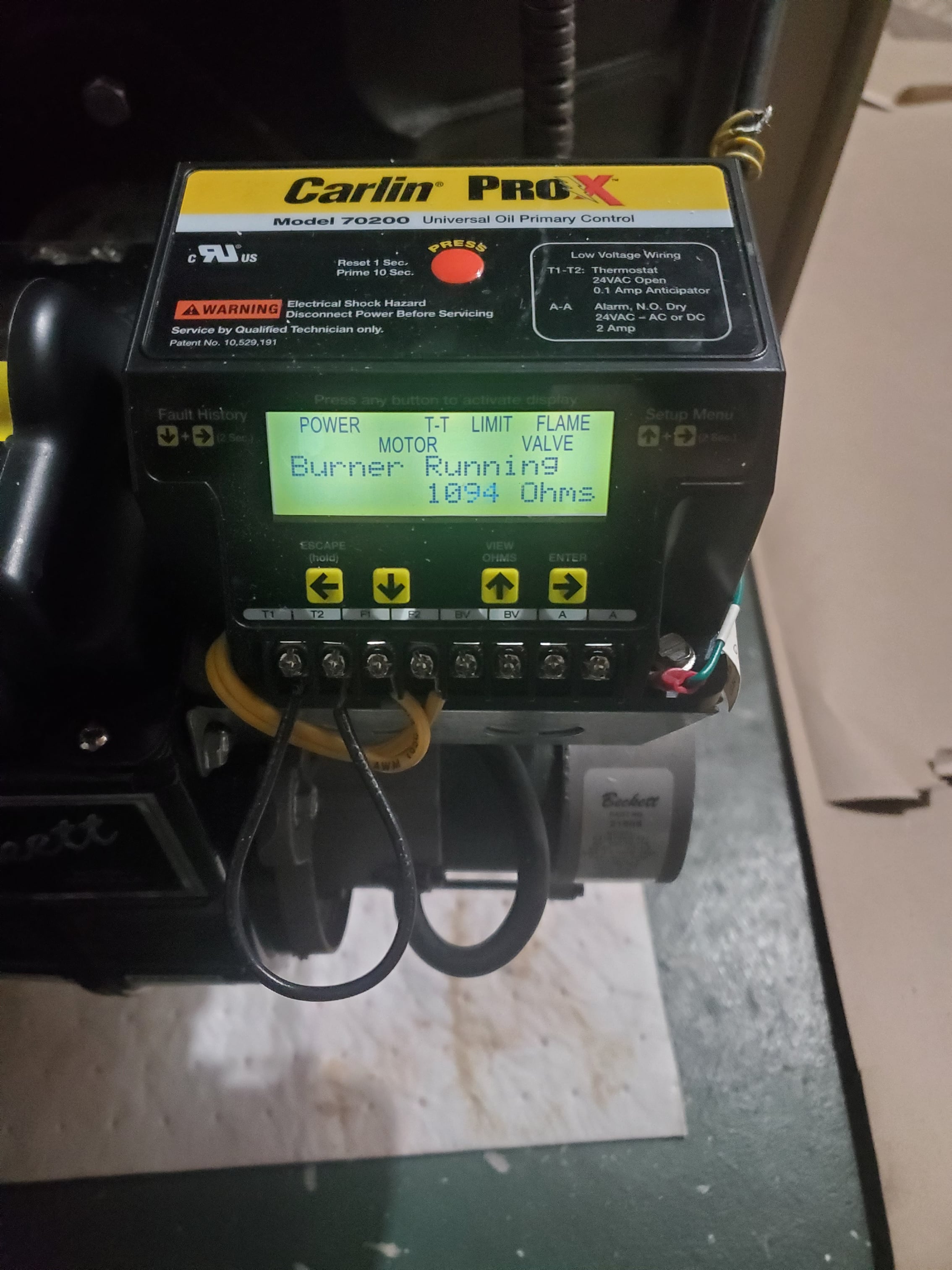
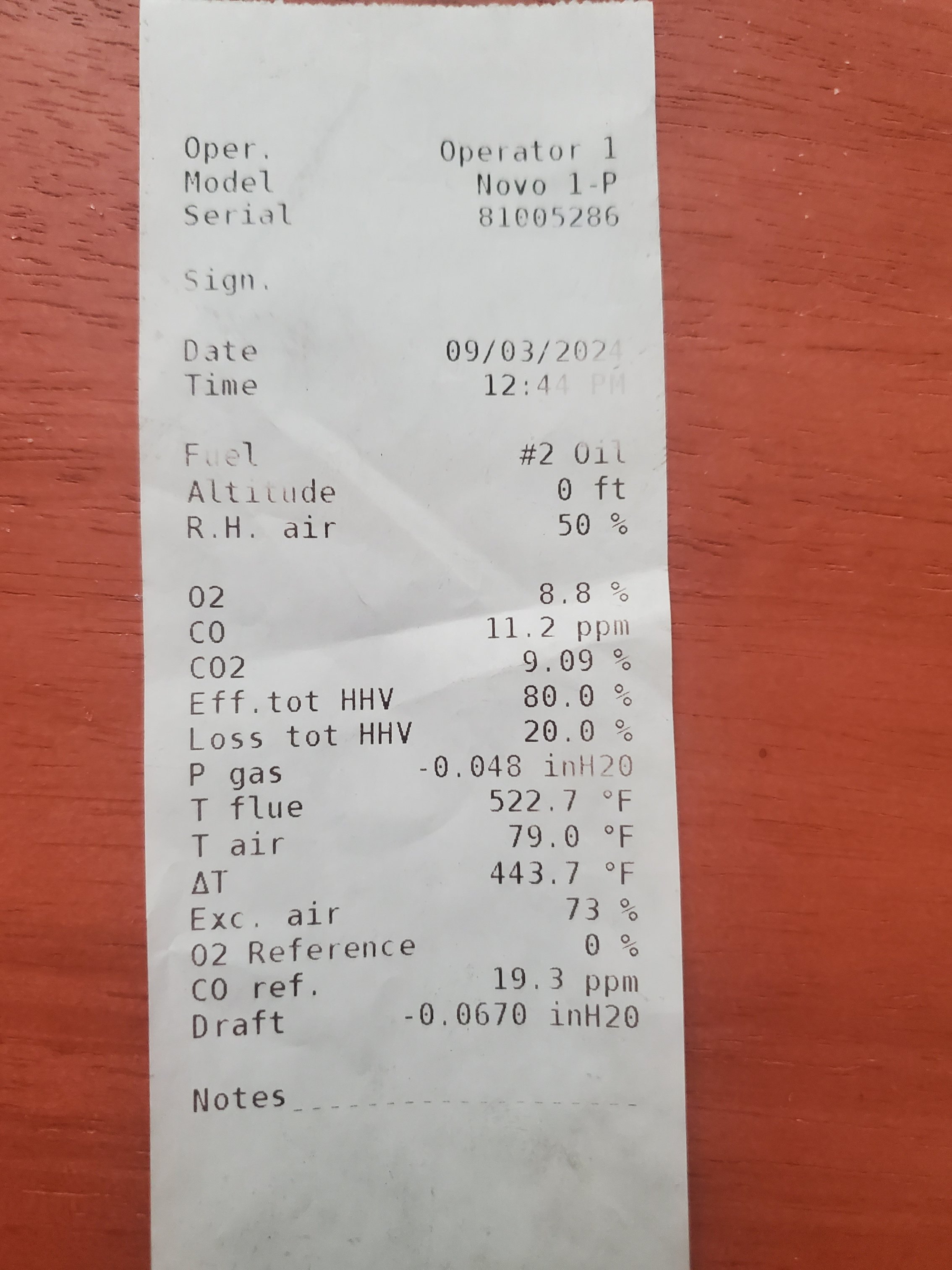
I have a 20 year old WM3 boiler that has had regular servicing. Two years ago a stainless steel liner was installed. Burner ran fine.This past November the burner was serviced. Cleaning took place and the tech replaced the .85 nozzel w a .75 because that was all he had with him. The pump had been replaced 6 months prior but tech left it set at 100psi instead of setting to 140 as per the label on burner. There is no baffel installed in burner as suggested by Becket for smaller nozzel. Ohms varied between 590 and 650. The following is the result of service. Two weeks ago burner start "missing". Low thunder sound off and on. Soot appeared at joints in flu pipe. Different tech. Discovered burner coupling may have been slipping and replaced.Increased pump pressure to 140 and ran tests. He could not get draft to .02 without damper weights reversed and it always partially open. Ohms are now at 1000. There are two zones for heat and one for indirect. Burner seems to run fine but during the day burner satisfies call for heat in a minute or two w outside temp at 45. So my questions are why increase in ohms and draft and is something still not right? Thank you.
Comments
-
Ohms and draft are not something that has a direct cause-and-effect relationship in most cases.
The ohms measured by that control are a measurement of the amount of light that is passing over the cadmium sulfide sensor (Cad Cell) inside the burner housing. That “Cad Cell” changes resistance based on the amount of visible light that the lens is exposed to.
That reading can be changed indirectly by the amount of combustion air that is introduced to the flame, which can change the brightness of the flame. Indirectly, draft can change the ohms, but in theory the draft is supposed to remain constant over the fire, and therefore it should have little or no effect on the ohms.
If there is a flame color change that results from chimney draft changes, then your draft control adjustment may need to be addressed in order to stabilize the draft over the fire.
Your query: "So my questions are why increase in ohms and draft and is something still not right?"
There are adjustments that can change the readings, as you have already noticed. The fact that you now have a 0.75 nozzle at 140 PSI with that most recent combustion test, compared to a 0.85 nozzle at 100 PSI, tells me that your air-to-fuel mixture must have been changed in order to result in a zero smoke spot test.
The draft may be more than you need at the breach (the back exhaust connection). A draft of about -0.03 at the breech with about -0.01 over the fire would be ideal. The reading of -0.067 at the breach does seem high, and after all attempts to get a lower draft at with the existing barometric control, perhaps a second barometric draft control is one way to reduce that draft over the fire.
You see, the more draft you have pulling the very hot byproducts of combustion through the heater, the less time there is to absorb the heat from those exhaust gases. That results in a lower operating efficiency.
Edward Young Retired
After you make that expensive repair and you still have the same problem, What will you check next?
0 -
If your original nozzle was 0.85@140lbs and now you're running a 0.75@100lbs, you're being downsized by 25%. I would think your cad cell resistance readings would be higher with the smaller nozzle and pump pressure everything else being equal.
Your resistance (ohms) change with the visible brightness (air settings) and volume of the flame. If ohms was a reliable way of setting the burner, then the flame would be adjusted to ohms, not combustion gas readings. What your tech needs to do is to measure combustion and provide those numbers to you.
You can have a damper partially open all the time if there is actually a draft inside the flue. Is there?
0 -
Thank you for the comments. My original psi was 100 w .85 nozzel. Pressure was increased to 140psi w .75 nozzel. If I hold a lighter to damper opening the flame is drawn toward flue.
0 -
Tell them to come back out, and set it up the way it was before they 'fixed' it. That's poor combustion, underfired.

 2
2 -
Oh, that's different. Your original post says the tech replaced the 0.85 with a 0.75 and that the 140lb pump was replaced and left set at 100lb instead of being adjusted to 140lbs…
If you're still getting a significant draft with your damper open, you need two dampers. It's not that common but I've seen some flues draw so much they needed a second barometric damper.
0 -
This confirms that draft is present; however, observing flame movement or smoke does not quantify the draft level. Accurate draft measurement for proper combustion requires a manometer that has a resolution to 0.001 " WC. (inches water column)
Actually, this is not exactly accurate, Mike. A 0.85 GPH nozzle at 100 PSI delivers 0.85 GPH. A 0.75 GPH nozzle at 140 PSI delivers approximately 0.89 GPH. This means the firing rate is actually slightly higher than the original firing rate before the service was completed. Here is the math:

0.75×(√1.4)≈0.75×1.183=0.887≈0.89 GPH
To go a step further, if the boiler is oversized for the building, someone may have performed extensive testing to achieve the current combustion numbers in an attempt to reduce fuel usage. Returning the boiler to the original factory specifications could make that efficiency adjustment ineffective.
I would need to know more about this job before recommending your proposed resolution.
Edward Young Retired
After you make that expensive repair and you still have the same problem, What will you check next?
0 -
I would go with the smaller nozzle. You say the boiler comes up to temp quickly so you may e overfired for the load. Also a smaller nozzle will lower your stack temp which will increase efficiency.
Your Co2 is on the low side
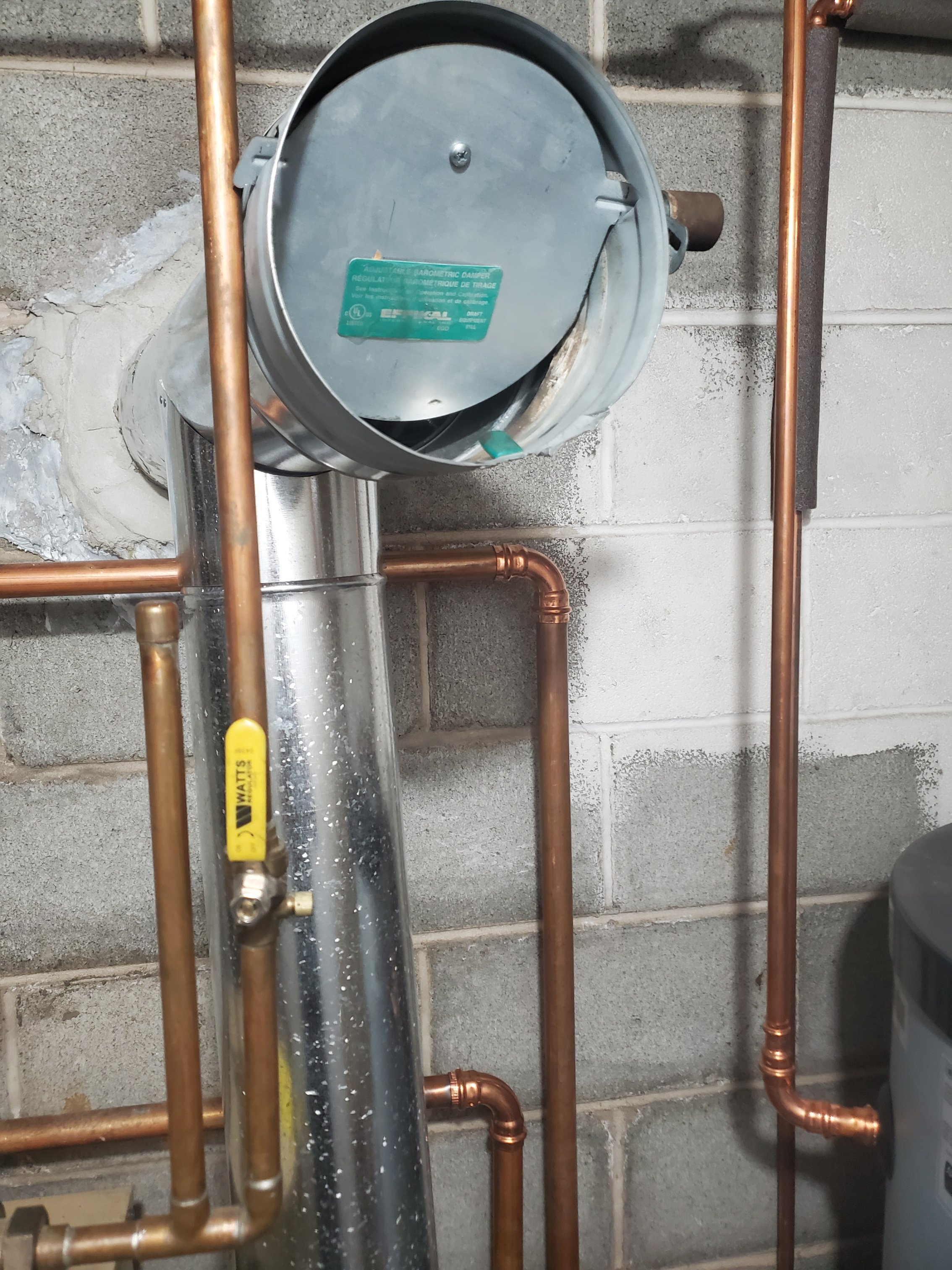
You barometric damper is not installed correctly.
 2
2 -
This is terrible combustion! No wonder ohms are high! Call the company back up and request a senior service technician to correct this. That barometric damper is not installed correctly, that's the first thing to fix. I would use the .75 nozzle at 140 PSI pump pressure. The draft over fire should be set for -.01- .02". Then you should be able to measure -03"-04" in the stack, if the boiler is clean. The tech should be able to obtain a true zero smoke in the range of 5-6% O2 and 11-12% C02. Ohms should be around 300-600. At 8.8% O2 you are running the risk of ignition problems from too lean of an air/fuel mixture. And ohms are always higher with a lean burn.

 2
2 -
An .85 45°B @ 140 psi is what should be used with the L1 head and that boiler. Down firing with the LFB isn't even an option. Oxygen is high, CO2 is low. Too much excess air.
 1
1 -
It seems I created confusion with my original post. The tune up results were from 9/25. Prior to that ohms were high and tech replaced cad cell. Nozzel was .85 and pump pressure was 100 psi. Tech replaced nozzel w .75 and left psi at 100. Now ohms were 590 - 650. The draft was -0.06. After the recent service for which I have no slip, the tech left nozzel at .75 but increased psi to 140. He said he looked at sevice records for past years and saw the draft was always around -0.06 and he adjusted damper to -0.02. I checked the ohms after he left and what had been in 590 - 650 range was now in the 1000 range. Before I call him back, I would appreciate suggestions to question him about the recent service without seeming flippant. Also, the comment was made that damper is incorrectly installed. I would appreciate more information how it should be installed. Thanks for everyone's help.
0 -
Again, forget about the ohms right now. Have the correct nozzle installed. Correct draft set (-.02 over fire. -.04 breach). 0 smoke and combustion test for better results than what you showed earlier.
 1
1 -
@Miata asked: " Also, the comment was made that damper is incorrectly installed. I would appreciate more information how it should be installed."
This is on page 2 of the barometric draft control instruction sheet.
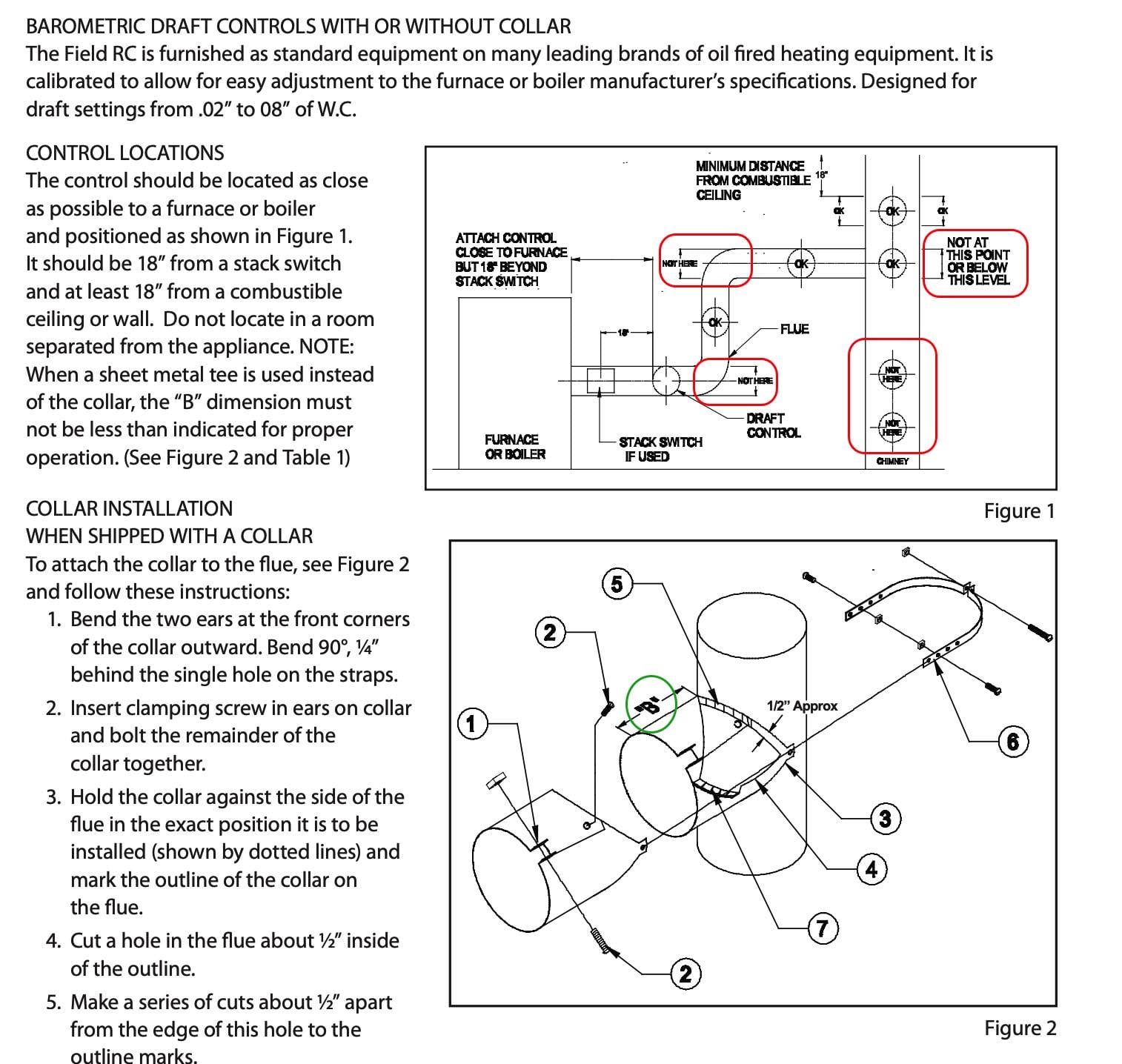
See the incorrect locations I circled in Red? I believe you have the incorrect location at the upper right of Figure 1. Although I have heard from several experts in the industry that have done some field testing. That location is not all that bad. The other three are the problem. The way your Barometric Draft Control is installed is probably fine.
If you want the barometric draft control moved to be inline with the vent connector pipe, make sure that Dimension B in the green circle on Figure 2 is of adequate size for a 7" draft control. The standard sheet metal Tee fitting for dimension B is only about 2 inches. You need at least 3.5" for the Effikal damper you have. Dimension B is measured at the smallest point on the arc of the branch of the Tee.
Point of interest: Before Effikal was acquired by Field Controls, that particular damper you have was the most accurate available. Don’t let anyone replace it with something else.
Edward Young Retired
After you make that expensive repair and you still have the same problem, What will you check next?
0 -
73% Excess Air?? Something isn't correct. I know how to calculate nozzle/pressure relationships. Original post "…tech replaced the .85 nozzel w a .75 because that was all he had with him. The pump had been replaced 6 months prior but tech left it set at 100psi instead of setting to 140 as per the label on burner…"
That is what I commented on, and it said to me the burner was originally firing at .85 @ 140 and was left at .75 @100 psi.
I see the OP made a different comment later. Still has 73% excess air. I also doubt the air temperature was 80° in the basement.1 -
I agree @HydronicMike "I see the OP made a different comment later. Still has 73% excess air. I also doubt the air temperature was 80° in the basement." it was only 79°
Edward Young Retired
After you make that expensive repair and you still have the same problem, What will you check next?
0 -
Actually, there is a version of the WM GO-3 that can accept a lower firing rate. The proper way to do this is to use a 0.65 × 60°B nozzle with the same burner and L1 head. You can even purchase that boiler with the label that reads WGO-3R, which has the 112 MBH input information. However, it would be perfectly acceptable to make that same adjustment on a GO-3 (without the “R”), since everything on that boiler is identical except for the label.
Agree that it is still set up incorrectly.
Edward Young Retired
After you make that expensive repair and you still have the same problem, What will you check next?
0 -
I appreciate all the excellent suggestions. My current problem is how to approach my oil company. All of you have worked in the field or are currently, and I am sure have had that "certain" customer. Because I have a Carlin pro I can easily checked ohms on a regular basis. I mention this because I may be viewed by the techs as that homeowner. I have had a service contract with my oil company for a least 5 years. When I call they respond immediately and a tech arrives within a few hours. They have replaced almost everything on my burner at no charge. So how to share my new "knowledge" with many suggestions to the tech? Thanks
1 -
try this approach:
If you want to get a technician out to your home without creating the impression of an emergency, you might simply tell the service company that "you occasionally hear a noise and are not sure whether it indicates a problem". Intermittent noises do occur from time to time, and explaining that you are unsure whether it is a concern keeps the call from being treated as an emergency that requires immediate attention. This can be helpful from a dispatcher’s perspective when scheduling service calls.
In larger companies with dozens of employees and a fleet of service trucks, calls are typically prioritized based on urgency, location, and workload. I’ve worked in companies with more than sixty employees where dispatching required careful prioritization. I have also been the one-person operation where the schedule was determined by practical considerations—like urgency, location, workload, and making it home in time for dinner so the Marvelous Mrs. Young could feed both me and the kids.
Once the technician is standing in front of the boiler, you can mention that "you occasionally hear a slight rumbling noise, although it may not be happening at that moment," and ask if they would "check the combustion settings while they are there." It is generally best not to bring up technical details such as ohm measurements that may not be relevant to the issue, as that can sometimes distract from the main concern.
You might also mention that the previous technician (if it was not the same person who serviced it last time) "adjusted the pump pressure and that, according to Weil-McLain’s specifications, the burner can operate with a 0.65 × 60°B nozzle at 150 PSI". Since the burner currently has a 0.75 nozzle installed, you could ask whether that change might occasionally contribute to the rumbling noise you have noticed. The technician may even have a 0.65 × 60°B nozzle on the truck and could consider replacing the current nozzle to see if that resolves the issue.
Another recommended option is a 0.85 × 45° nozzle at 140 PSI, although based on your previous experience you feel that may be more firing rate than your home really requires.
Edward Young Retired
After you make that expensive repair and you still have the same problem, What will you check next?
1 -
Ed, excellent suggestion. Thank you and all the others for all their help.
0 -
Weil McLain are a tight boiler . You always have to down fire them from the posted label or you will get a positive pressure above the fire . Called back pressure.
I feel for your next tech :)
There was an error rendering this rich post.
 2
2 -
Never had this problem. You get back pressure because the heat exchanger isn't properly & completely clean, or a venting issue. Downfiring almost always leads to poorer combustion/efficiency.
I haven't installed a pin boiler in at least 30 years. Worse to properly maintain.2 -
Yes, the early WM Gold 3 and 4 section boilers were extremely tight. You couldn't slip a 2 mm wide soot sword between the sections without it getting stuck. And the passages past the pins needed a soft brush. A stiff brush would get stuck. By the 21st century, they breathed much better.
1

Categories
- All Categories
- 87.6K THE MAIN WALL
- 3.3K A-C, Heat Pumps & Refrigeration
- 59 Biomass
- 430 Carbon Monoxide Awareness
- 124 Chimneys & Flues
- 2.2K Domestic Hot Water
- 5.9K Gas Heating
- 119 Geothermal
- 168 Indoor-Air Quality
- 3.8K Oil Heating
- 78 Pipe Deterioration
- 1K Plumbing
- 6.6K Radiant Heating
- 394 Solar
- 16K Strictly Steam
- 3.5K Thermostats and Controls
- 56 Water Quality
- 51 Industry Classes
- 51 Job Opportunities
- 18 Recall Announcements