leak in pex tubing in concrete slab

Currently building a new house which we layed pex tubing runs in the concrete slab that got poured right before winter hit late this past fall. It seemed to hold pressure through the pour and also for a couple weeks after. Currently all the framing is done, and ive gotten back to checking the manifold to see if its holding pressure. Put in around 40 psi of air pressure and that dropped within a week. Ive found the smallest leak off the manifold but havent had the chance to fix that yet. Im worried the framers ran a nail too far through the concrete slab and hit a tube. Not sure where to start with this issue. Located in south dakota.
Comments
-
fix the discovered leak and air it up to 80 psi. It will drop as the air from the compressor cools down. But if it drops to zero, time to start looking.
Any framing that was anchored down is the first places to look. Check the gauge with spray soap also, if it ever had moisture in it maybe it froze?
It is repairable once you find it. Is the slab the final finish? Or are you going over it with tile or wood?
Bob "hot rod" Rohr
trainer for Caleffi NA
Living the hydronic dream
 2
2 -
I found the leak with soapy water right by the pressure gauge, but it seemed to be very slow. I'll fix that soon. Nothing has been in it yet. Plan to lay vinyl flooring as we progress, so I'm not sure how to find the leak in the floor without getting a broiler going.
0 -
The higher the air pressure the easier to hear or see them leak with soapy water, around nails, etc. 100 psi is acceptable in pex tube.
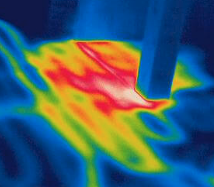
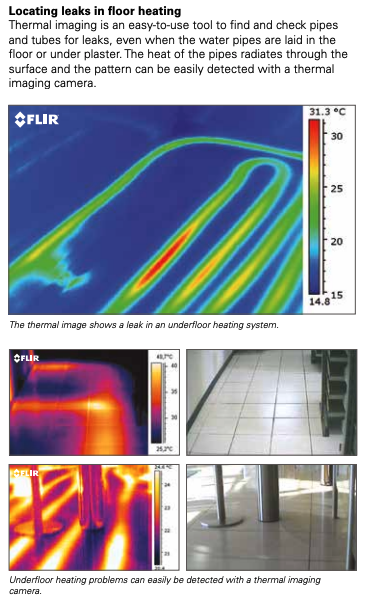
By far the easiest is with an infrared camera, but you need to connect the tube to a boiler or other heat source.
Possibly on a cold day, warm air from the compressor may show on the camera, worth a try.
Do you have manifolds attached to the loops with individual shut offs?
If so you can do a loop by loop air test.
Did you take pics of the loop layout or have a drawing? That helps narrow down the area to investigate.
Maybe it was just the leak at the gauge, start there.
 Bob "hot rod" Rohr
trainer for Caleffi NA
Living the hydronic dream
 3
3 -
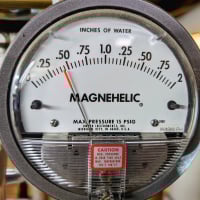
Don't overlook the possibility that sometimes the gauges themselves can leak.
0 -
@hot_rod did you, or anyone ever think to try testing radiant tubing with nitrogen like AC lines, at a much lower psi, of course. Then one could easily calculate pressure drop or rise, based on line temperature (decay test) to determine if there is an actual lea
Just wondering.0 -
I've used Leakbusters a few times. They have a bunch of different tricks they use.
With air pressure they have a headset and a heavy flat steel mic that they slide across the slab. That was successful on one indoor greenhouse slab job.
On another, a snowmelt, he used a fill tube with a venturi and orifice like pressure washers use. So it sucked air in as it pushed water into the various loops. He was able to detect the noise better with the water/air blend and the listening device.
For indoor use he has some gas that could be injected and he would use a sniffer.
In both cases he marked a few spots on the slabs with a piece of masking tape and sure enough the leaks were within inches of his marks!
Bob "hot rod" Rohr
trainer for Caleffi NA
Living the hydronic dream 3
3 -
you don't need a boiler. I have a removed 50 gallon water heater ( condo mandated @10 years) that I will temp in to test and tune up my system while I wait for a heat pump.
Find a freebie like that, and temp it in with what-have-you. Get it found ASAP so it does not toss a wrench into your progress. I suppose you heat it and then look at the nails that coincide with it first? 100PSI air will not send up some bubbles?
0 -
Isolate each loop and pressure test. Use a moisture probe if its a larger leak or a ground penetrating radar. Rocks and rebar can puncture the tubing as the concrete cures.
0 -
watching
0 -
air is much cheaper then N2.
0 -
If you have any source of hot water, even a electric water heater and a hose, putting hot water into a loop at a time would show the leak very quickly with an IR camera.
 Bob "hot rod" Rohr
trainer for Caleffi NA
Living the hydronic dream0 -
In my experience I'd say 99% of the time the leak is at a manifold connection. Just spray it with bubble solution along with any union connection to the manifold, valves and end plugs that may be on the manifold to check for a leak. Even a very slow leak at the manifold will drop the pressure over 24 hours. Fix or tighten that leak before worrying about something under a slab. For leaks under a slab or pavers I've used American Leak Detection with their Helium and sniffer to identify a leak site for a circuit that would not hold pressure. In one instance I used a Big Ear (amplified ground phone) to locate six leak sites using compressed air for a frozen floor slab on a repo residence that left water without antifreeze in the system.
 2
2 -
What is the reason to use nitrogen instead of air. Air is 78% nitrogen. Or is it just not wanting oxygen and/or trace gases in the system, which can be purged out?
0 -
Helium as @Geosman mentioned is the go to gas for leak detection in piping. If you want to go to the trouble of hauling a welding gas cylinder.
Start simple check gauges and connectins, try high pressure air. Then heated water or helium.
Bob "hot rod" Rohr
trainer for Caleffi NA
Living the hydronic dream0 -
I used a ultra sonic leak detector to narrow down a air pressured leak under concrete before.
1 -
Had that with mine when I started testing my install. I ended up sealing my setup with epoxy - no more leak! Held 80 PSI well over a day.
1 -
The house that I did this at 3 years ago called me this morning 14 hours after I posted this comment.
0 -
No one has mentioned freezing, but is there a chance that the test water in the tubing froze over the winter?
PEX can withstand freezing water, as long as it has room to expand evenly along its length - but that doesn't apply to PEX under pressure embedded in concrete. I hope this is not freeze damage.
0 -
not another leak I hope!
0 -
The main reason is moisture.
It's used for brazing etc to shield the inside of the tubing from Oxygen.
Single pipe 392sqft system with an EG-40 rated for 325sqft and it's silent and balanced at all times.
 1
1 -
Chris, interesting. I am slightly familiar with welding, but clueless on the intricacies of brazing. I thought brazing is high temperature soldering rather than welding, since the base metal is not melted in brazing and a flux is used for both. Although a flux is used in some welding applications.
0 -
The shield gas in welding I believe does very much the same thing in brazing. If O2 gets to the copper it turns black and nasty stuff flakes off. As long as all of the air is purged out, it stays nice and clean.
Some brazing uses flux, most refrigeration stuff doesn't, it uses phosphor in the brazing rod that somehow acts as a flux. Usually called Sil-Phos.
It basically is very high temperature soldering, basically glowing hot.
Single pipe 392sqft system with an EG-40 rated for 325sqft and it's silent and balanced at all times.
0



Categories
- All Categories
- 87.6K THE MAIN WALL
- 3.3K A-C, Heat Pumps & Refrigeration
- 59 Biomass
- 429 Carbon Monoxide Awareness
- 124 Chimneys & Flues
- 2.2K Domestic Hot Water
- 5.9K Gas Heating
- 119 Geothermal
- 168 Indoor-Air Quality
- 3.8K Oil Heating
- 78 Pipe Deterioration
- 1K Plumbing
- 6.6K Radiant Heating
- 394 Solar
- 16K Strictly Steam
- 3.5K Thermostats and Controls
- 56 Water Quality
- 51 Industry Classes
- 50 Job Opportunities
- 18 Recall Announcements