Ashton Valve Co. history

I recently bought two old steam gauges at a flea market. The first one was a circa 1913 Ashcroft/Gurney 0-30 psi gauge that I tested and then installed on our hot water boiler's expansion tank because (1) it was bigger and more legible than the existing gauge, and (2) I liked adding a vintage touch to our 1924 building. I had never heard of the Gurney Heating Co, so I did some research and posted some Gurney boiler/radiator history here in a different thread.
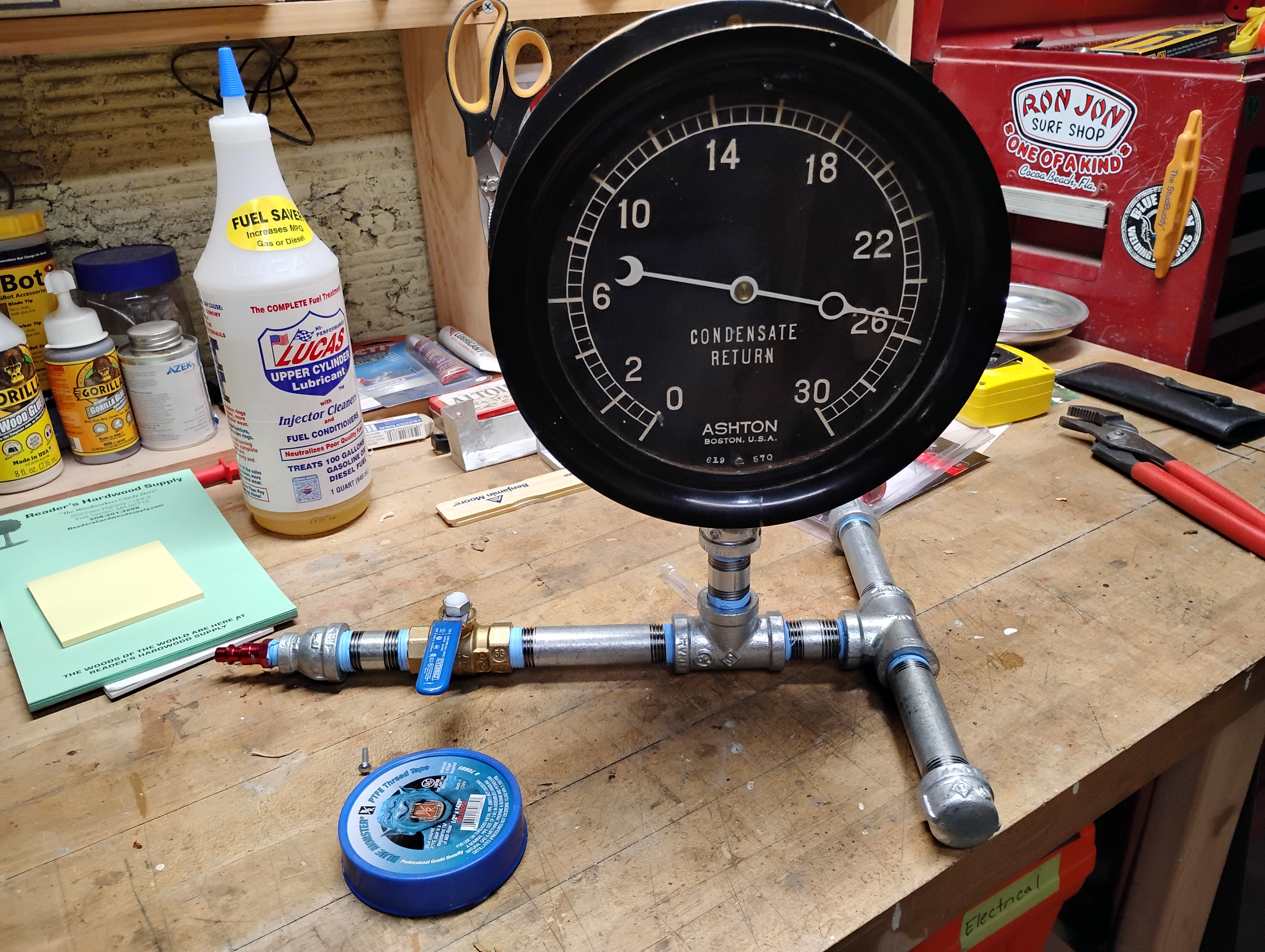
Today I checked out the second gauge, a larger 8-inch Ashton gauge with a "Boston" mark on its dil. (I live in a Boston suburb, so there is a lot of old stuff floating around that was made in the area). Here is the Ashton gauge on a small test rig I made to check its accuracy against my air compressor's gauge. The Ashton gauge still works smoothly and agrees with my compressor gauge.
I had not heard of the Ashton company either, so did a little research. The company was started by an English immigrant to Boston named Henry Ashton, who invented and patented a new type of steam safety valve, and the Ashton Valve Company was born in 1872. Here is one of Ashton's present-day descendants writing about Henry Ashton and his company.
The above writeup by Rick Ashton cites several major steam boiler explosions that illustrate the danger of steam boilers at that time. Rick says one boiler explosion at a lumber mill in 1894 resulted from a steam pressure that was probably over 500 psi (!). The explosion severly damaged the mill and killed 4 people. The boiler flew through the roof and landed 1200 feet away.
Henry Ashton's invention was a locking "pop" steam relief valve. The locking feature meant that the boiler operator could not try to get more power from his steam locomotive/engine/whatever by adjusting the relief valve to get more steam pressure. Apparently this was a common cause of boiler explosions. The locking feature meant only certain people (not the boiler operator!) could adjust the relief pressure setting, reducing the chance of an explosion. Details of the locking "pop" valve can be seen in schematics here:
One of the early Ashton Valve Co. buildings still exists at 161 First Street in Cambridge, Ma, near MIT. I used to live in Cambridge not far from there, but had never heard about Ashton. Cambridge and Boston are full of old factory buildings like this.
As a mechanical engineer, I love finding tools and mechanical devices that were made around here 100 or so years ago and that tell a story about American ingenuity and industry (even though Ashton was an English immigrant!). Massachusetts, Connecticut and New York were chock-full of factories that built tools and equipment of all kinds in the late 1800's and early-to-mid 1900's. Probably one of the most common "artifacts" around here is the Walworth pipe wrench, from Walworth Manufacturing in Boston. Every plumber who retires around here leaves behind his old Walworth wrenches, and you can find one or more Walworth in practically every old garage, tool box, and flea market within 100 miles.
But back to steam, it seems we owe Henry Ashton for making steam boilers safer with his locking relief valve. Tip o' the hat, Henry. And thanks for the gauge.
Comments
-
Someone used to post on here about Ashton I think. might have been Rick it was a few years ago.
1 -
I'll be darned. Here's Rick Ashton's old thread.
0 -
I could meet someone today and if they walked by me tomorrow, I may not recognize them. But with names its a different story. I can remember the name of customers from 50 years ago. Always been that way.
0

Categories
- All Categories
- 87.6K THE MAIN WALL
- 3.3K A-C, Heat Pumps & Refrigeration
- 59 Biomass
- 429 Carbon Monoxide Awareness
- 124 Chimneys & Flues
- 2.2K Domestic Hot Water
- 5.9K Gas Heating
- 119 Geothermal
- 168 Indoor-Air Quality
- 3.8K Oil Heating
- 78 Pipe Deterioration
- 1K Plumbing
- 6.6K Radiant Heating
- 394 Solar
- 15.9K Strictly Steam
- 3.5K Thermostats and Controls
- 56 Water Quality
- 50 Industry Classes
- 50 Job Opportunities
- 18 Recall Announcements