Welcome! Here are the website rules, as well as some tips for using this forum.
Click here to Find a Contractor in your area.
If our community has helped you, please consider making a contribution to support this website. Thanks!
Rube Goldberg indirect for Air to Water heat pump

I have been working on getting the most out of an indirect on an A2WHP (best is get a HPWH, but I already own the bits).
Using a plate HX, this sits on my primary loop which is in constant circ with ODR. The charge pump is driven by the 3 way valve control signal from the A2WHP when it goes into DHW mode (same signal also disables all space heat).
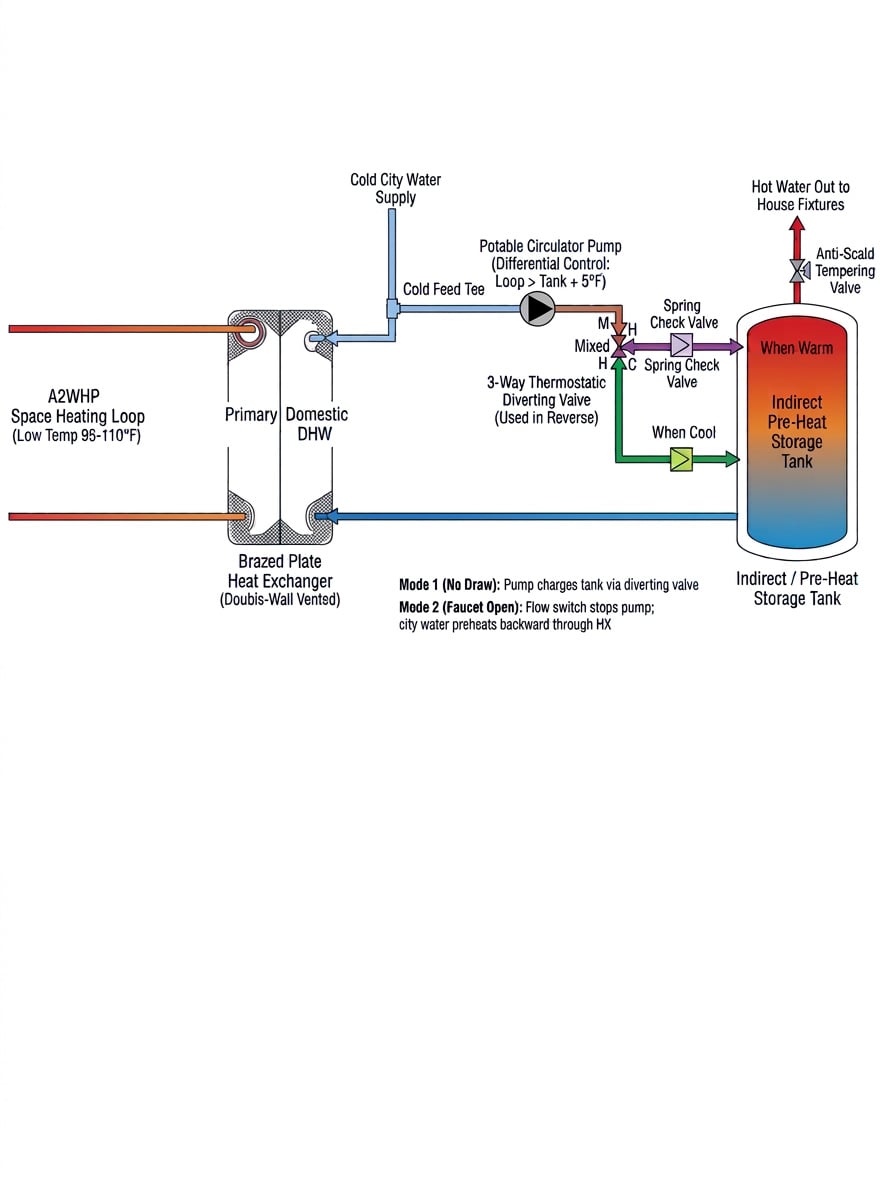
This setup accomplishes a couple of things. Any cold water draw is flows backward through the HX and is pre-heated to space heat temp. Since this uses low temperature space heat, the COP is much higher. It also back-flushes the heat exchanger.
The challenge I had with a simple HX/pump setup is it charge pump flow rate was always a compromise. Flow rate too high, outlet temp would be too low and it would actually cool the top of the tank off (A2WHP output at high temp is much less than a modcon). If too low, then the unit would have to run at higher temp for long time to re-heat the tank (bad for COP).
In this setup, when there is a DWH recharge cycle, the charge pump runs into the mix port of a thermostatic mix valve. If the water temp is low, the mix valve diverts to the bottom of the tank which avoids breaking stratification. Once the bottom of the tank warms up and the outlet temp increases, the valve switches over and heats up the top of the tank. This way, the pump can run at max flow to get the most out of the supplied heat.
It only needs a couple of additional easy to get parts and works much better.

Comments
-
Interesting
On cold water draw, what prevents flow from going through circ path and avoiding prewarming of through heat exchanger. I'm assuming some cold flow will go through both paths.
….oh I see the fine print now. Flow switch to stop circulator. But does it close off that circ return path?
When your water heater calls for heat, what temp fluid does the awhp send to HEx?
Just a bit complex 😅
0 -
for your own system it makes sense. might be a hard $$ sell for a customer.
Bob "hot rod" Rohr
trainer for Caleffi NA
Living the hydronic dream0 -
@bjohnhy The cracking pressure of the flow checks after the mix is enough to prevent flow in that direction. Even if there is a bit of flow under high draws, the mix valve toggles to the cold path, so no matter what, the water goes into the bottom of the tank.
Fluid temp needs to be about 7F above water tank target. I use a 125F targe so heat pump supply just a bit over 130F water. With this setup, it only needs to do this for very short period of time essentially near the end of the cycle which significantly reduces recovery time and improves COP.
@hot_rod A regular indirect won't work well with an A2WHP. It will make DHW, but recovery will just be too slow in colder climate. You can use a high area indirect but those are $$$ as they tend to be commercial units.
The BOM cost on this setup is about 1/3 of an equivalent indirect. Since I use a regular resistance tank, I can use the elements to boost recovery or re-charge the tank at night time when electricity is cheap without loosing house heat. This is important when temperatures drop bellow 10F here.
1 -
clever use of the fphx. A plate HX is about 5 times more efficient than an indirect. Two moving and turbulent flows are the key
Bob "hot rod" Rohr
trainer for Caleffi NA
Living the hydronic dream0 -
The thing about a flat plate heat exchanger is you have to match the flow between both sides.
I'm still trying to wrap my head around this design, but I'm going to offer a competing design where the cold water comes into a tee that splits between the bottom of the tank and the cold side of the heat exchanger. The circulator always runs the water through the heat exchanger, so the volume through the heat exchanger is constant regardless of the demand for hot water.
The regular thermostat in the tank controls the circulator, and a zone valve on the hot side of the heat exchanger.
If you want to get fancy, put a zone valve on the outlet of the circulator so you can switch whether the heated water goes into the top or bottom of the tank. Use the regular thermostats in the tank, but use both of them. If the upper one is calling then heated water goes into the top of the tank, if the lower one is calling then the heated water goes into the bottom of the tank.
0 -
The thing about a flat plate heat exchanger is you have to match the flow between both sides.
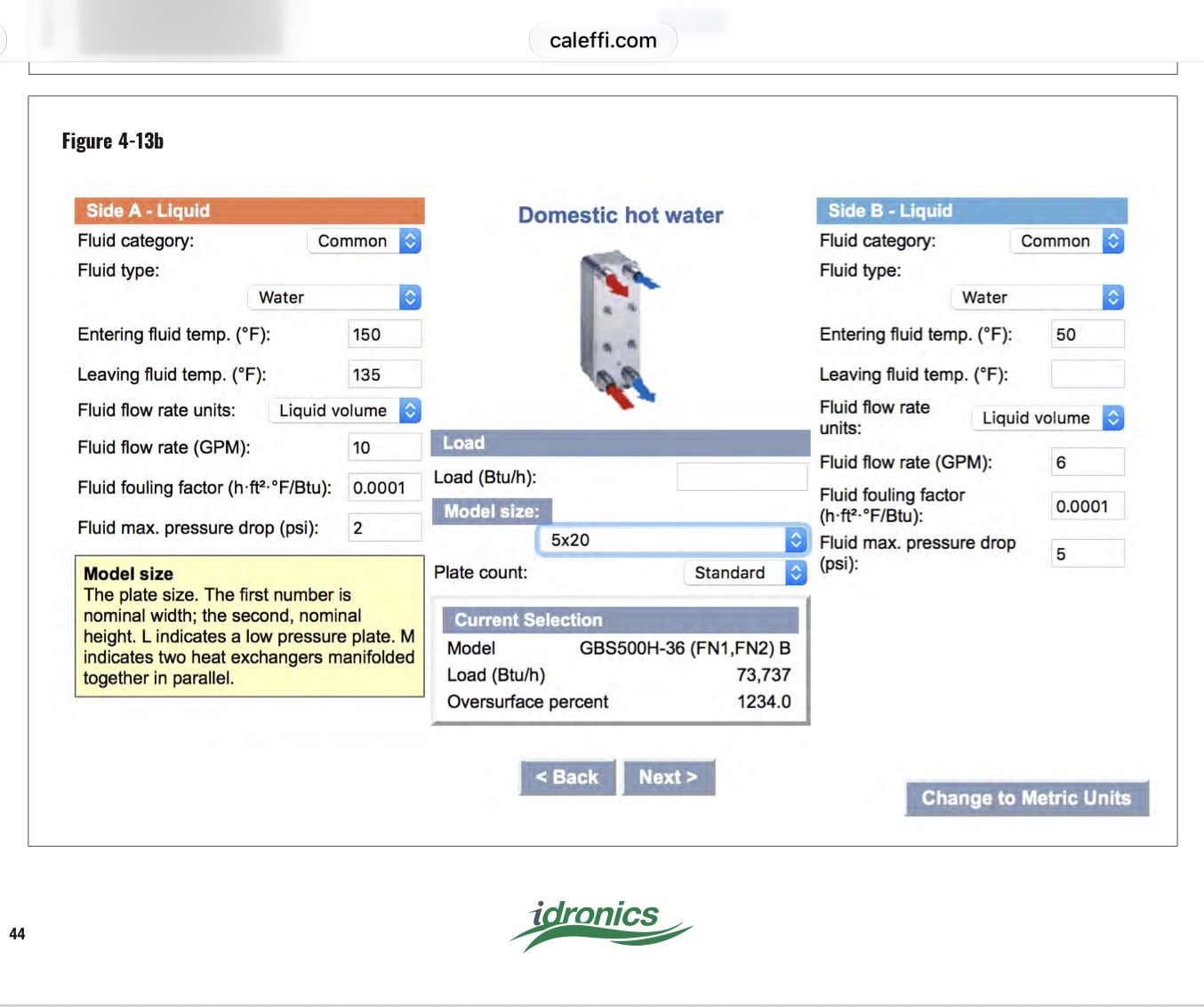
I’m not sure I follow the flows have to match, do you mean A&B side of the HX?Here is a typical DHW plate application, 10 gpm on the boiler side, 6 on the DHW side
Sizes HX just like you size a circulator, to the job you need it to do.
 Bob "hot rod" Rohr
trainer for Caleffi NA
Living the hydronic dream0 -
@DCContrarian I went through a bunch of options and they all end up being too expensive or complicated to implement.
The nice part about this config is that it just works and there is no penalty for over-pumping the charge pump. About the only adjustment is setting the mix valve for the crossover point which just needs to be about 10F bellow tank target.
That pre-heat from space heat loop actually makes the biggest difference as DHW cycle is now much shorter.
0 -
I should have clarified that I was talking about using a heat exchanger with a heat pump, you want to match the flows on both sides because you want to match the temperature deltas on the two sides, because you want the hot side to get as cold as possible and the cold side to get as hot as possible. And that can only happen when both sides have the same flow.
I can't find it right now but Taco makes a packaged heat exchanger that is a flat plate with two variable speed circulators, plus control logic to match the flow across the two sides.
0 -
Taco x block. It has its limitations. I like Kaos custom setup over it.
I wonder how important the reverse "flush" flow for cold water draw is. How much it helps with keeping hex clean? It does decrease the transfer efficiency a tad with lack of counter current flow. If I were to do something like that I would probably keep the cold flow and DHW circulation flow in the same direction (both counter current to the AWHP).
0

Categories
- All Categories
- 87.9K THE MAIN WALL
- 3.3K A-C, Heat Pumps & Refrigeration
- 60 Biomass
- 430 Carbon Monoxide Awareness
- 136 Chimneys & Flues
- 2.2K Domestic Hot Water
- 6K Gas Heating
- 124 Geothermal
- 170 Indoor-Air Quality
- 3.9K Oil Heating
- 80 Pipe Deterioration
- 1.1K Plumbing
- 6.7K Radiant Heating
- 397 Solar
- 16.2K Strictly Steam
- 3.5K Thermostats and Controls
- 56 Water Quality
- 52 Industry Classes
- 51 Job Opportunities
- 18 Recall Announcements