Welcome! Here are the website rules, as well as some tips for using this forum.
Click here to Find a Contractor in your area.
If our community has helped you, please consider making a contribution to support this website. Thanks!
Identifying tubing that shouldn't be used for heating

I want to become better at identifying the types of tubing that have been used in the past for heating and are no longer acceptable. I was looking around on this website and a few others but I was unable to find a page that lists all the different tubing and shows pictures or describes them so I can identify them.
I've seen a few of them in the past on jobs. The orange Entran tubing, regular plumbing non-barrier PEX and the gray polybutylene tubing. From what I read there was a red polybutylene tubing that had an O2 barrier and some of the different Entran tubing was supposed to be better than others. Is there any risks for homeowners using systems with these types of tubing besides oxygen ingress? Are there any other brands of tubing that homeowners should be careful with? I'm sure guys like @hot_rod and @Larry Weingarten will be knowledgeable on this topic, I appreciate any help anyone can provide me.
Comments
-
doesn't polybutylene kind of have problems with bursting under elevated temps?
then there are gong to be systems that are ok in place but are no longer flexible enough to put a new fitting on or just plain have obsolete fittings.
0 -
tubing used for hydronics needs to have an oxygen barrier
So the common choices are Pex, PERT, Pex Al Pex, PP, and Watts Onix
I think Infloor made PB Polybutylene that had an oxygen barrier, a shiny red tube as I remember.
There was some of the orange Entran that had an oxygen barrier, the E-3 and all the black colored Onix has an aluminum o2 barrier
There were several versions of Heatway Entran, the first Entran,, then Entran 2, the problematic version, Entran 3 I think an Entran3D, then Entran O-nix which became the current black Onix
EVOH is the layer that provides the oxygen barrier, or the aluminum layer in PAP
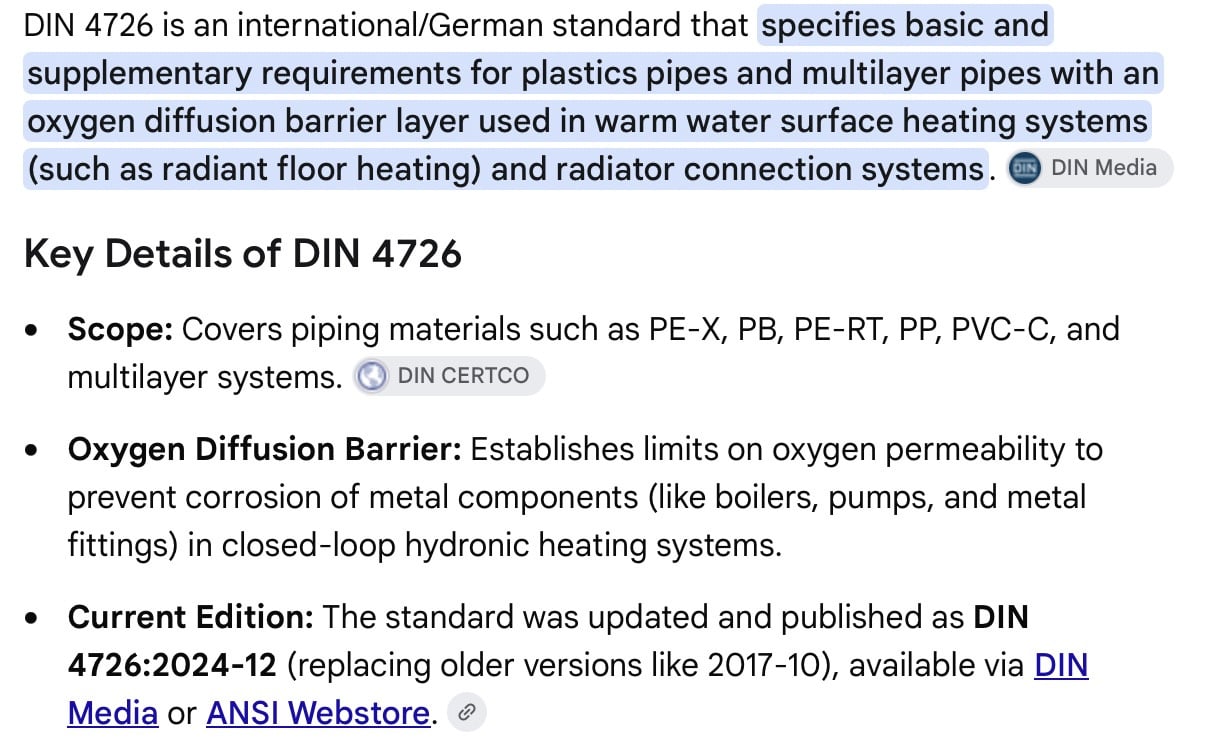
Heating tubing with barrier usually is stamped with the DIN 4726 approval
Some suggest on low temperature, below 120f, non barrier Pex can be used if an oxygen inhibitor is used and maintained.
You may still come across the RadiantRoll, a version of the small diameter black , non barrier, EPDM SolaRoll
There were some car wash packages that used PP, basic black poly “well pipe”
And I recall one DIYer that used garden hose coupled together on his home🤓
For liability and peace of mind I would suggest using a barrier tube for hydronic work.
The PPI, Plastic Pipe Institute website has lot of info on all plastic and composite tube, probably a listing of current manufacturers
Bob "hot rod" Rohr
trainer for Caleffi NA
Living the hydronic dream0 -
Thanks @hot_rod. I'll have to check out the PPI website, that sounds like a great resource to familiarize myself with the older types of tubing that I haven't seen in person that is no longer acceptable to use.
I didn't realize there was so many different versions of the Entran tubing.
One more question I have, is it possible to damage the EVOH oxygen barrier during installation or storage of the tubing? I worked on one boiler that had fin tube baseboards connected with shark bite O2 barrier pex and the boiler water looked like water from a poorly maintained steam boiler, rusty mud. The circulator and expansion tank rusted out. I suspected non barrier tubing being used but I didn't see any. The boiler had a functional microbubble air seperator too.
0 -
Most all mfg print on the tubing if its barrier or not.
I realize that Watts and Heatway state the aluminum inside the Onix tubing was O2 resistant. Unfortunately, it is not. IMO not even close.
Quite frankly I would rather have non barrier pex than Onix.
The issue w/ O2 ingress is not something a Spirovent or a Discal can separate out. Its dissolved O2 that is the issue.
Poly Butylene is still out there in service in some heating systems. I see it from time to time here in NH. It was never a strength issue in closed heating systems… other than the O2 issue (yes that's a big problem). Inch to inch it actually has better strength than Pex.
0 -
maybe pb is chlorine and heat so potable water in an attic in arizona is a problem but not in a heating system?
i suppose that also pb in a heating system would be inside the building envelope but in climates that barely freeze potable water tubing can be in an attic.
the system with the rusty water could have had a leak. constantly adding makeup water will bring in oxygen. or even just a waterlogged expansion tank so it kept burping out the relief valve as the system heated.
0 -
I have maybe 2000' of red O2 PB in my house. Most in concrete, some in walls and under floor on AL extruded plates. Since 1997, coming to 30 years.
I had been running at `120 until I got things tamed down. Now at 100 to 110 or so.
Never a tube problem, just the manifolds from "Infloor". Some leakers and pumps that needed manual starting each season. Two of the three 4 way mixing valves still working.
I did have a CI boiler with black pipe PS piping. Copper to remote manifolds.
Changed the CI for ModCon some years ago and CI and blk piping showed no corrosion.
Installed 2 PEX manifolds and needed a special "shark bite" type coupling fitting to go from the 1/2" PB to PEX.
0 -
There was a time when the EVOH was the outer layer and some did get scratches with slab installs. It would also squeak on whatever it touched.
I think all the brands have added an additional layer over the EVOH now, both to protect the barrier and add additional UV protection
I have seen some of the Onix systems pin hole expansion tanks, destroy ferrous pump bodies in a few years time.
Then earlier Heatway system running 20 plus years without any corrosion issues. I don’t have an answer for that.
Same with the SolaRoll, some destroyed ferrous metals and plugged the tube within years, and there are some still running fine almost 30 years later?
It is known that the higher the fluid temperature the higher the o2 ingress. The fin tube, 180 SWT jobs we did with early rubber were a disaster.
Someone gave me a few rolls of pex that had been under a job trailer for 6 months, it was extremely brittle. UV is as much an issue as O2 ingress.
I would store left over pex in the cardboard box!
Pex, pert are wonderful materials, but they have some limitations.
I have not seen a system piped with only copper and steel pipe have o2 corrosion issues.
People that flush and refill hydronic systems often may experience o2 related issues however.Bob "hot rod" Rohr
trainer for Caleffi NA
Living the hydronic dream0



Categories
- All Categories
- 87.9K THE MAIN WALL
- 3.3K A-C, Heat Pumps & Refrigeration
- 60 Biomass
- 430 Carbon Monoxide Awareness
- 134 Chimneys & Flues
- 2.2K Domestic Hot Water
- 6K Gas Heating
- 124 Geothermal
- 170 Indoor-Air Quality
- 3.9K Oil Heating
- 80 Pipe Deterioration
- 1.1K Plumbing
- 6.7K Radiant Heating
- 397 Solar
- 16.2K Strictly Steam
- 3.5K Thermostats and Controls
- 56 Water Quality
- 51 Industry Classes
- 52 Job Opportunities
- 18 Recall Announcements