Welcome! Here are the website rules, as well as some tips for using this forum.
Click here to Find a Contractor in your area.
If our community has helped you, please consider making a contribution to support this website. Thanks!
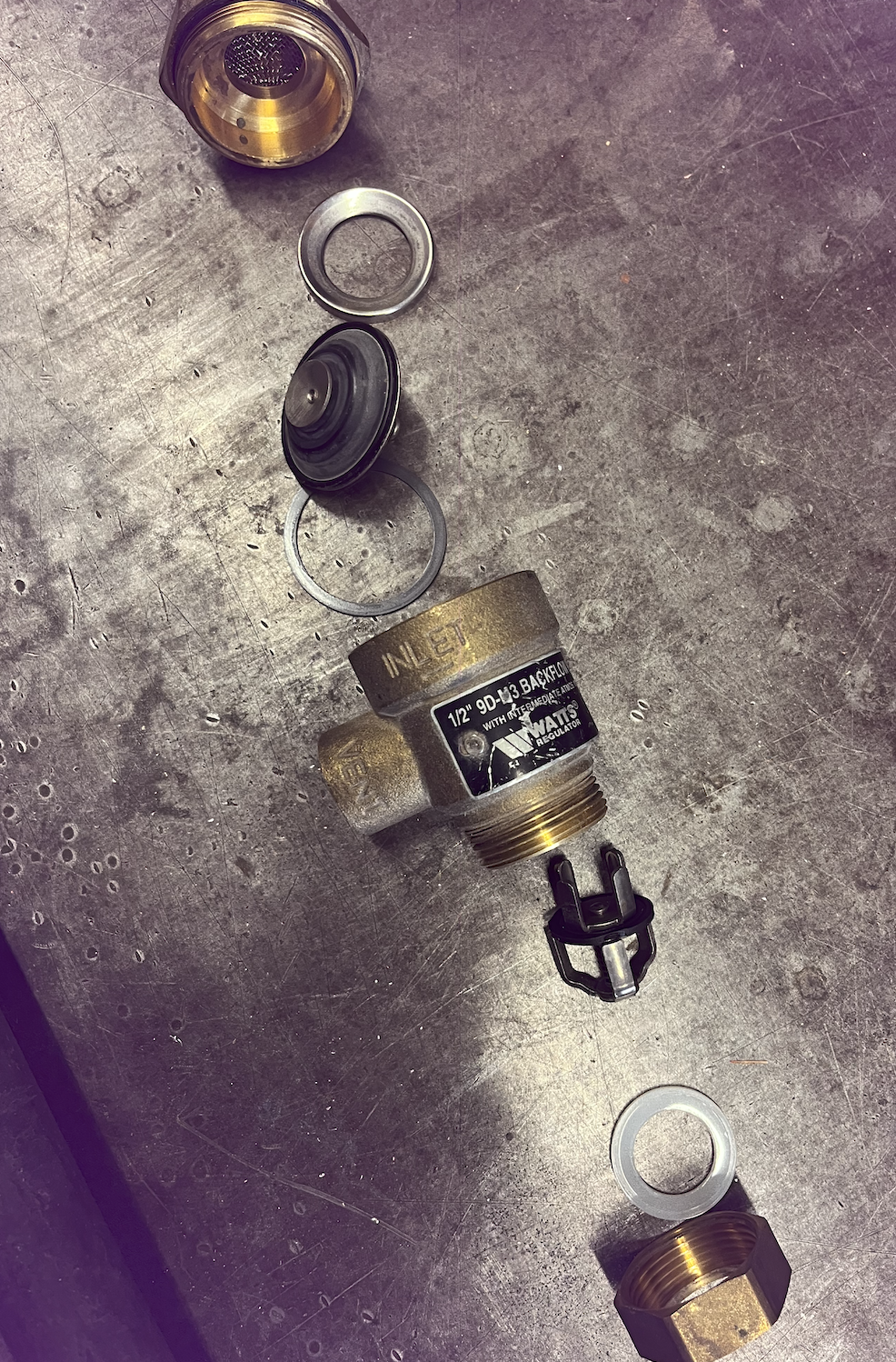
Watts 9DM3 back flow preventer/new model number LFD9

I was wondering how easy it is to clean the Watts 9DM3 back flow preventer?
I have softened well water, my Watts back flow preventer is mounted on a long nipple 1/2" black iron pipe after the ball valve and before the Watts fast fill valve on the pump module.
I wanted to fill the steel compression tank with water as it appears low on water after I installed the new Bell & Gossett NRF-25 circulator.
I opened the ATF 12 to vent the excess air out of the steel compression tank then I opened the ball valve to add water back and the fast fill valve but nothing happened other than air coming out of the steel compression tank.
I have not had to add water back to my coal stokers system for at least 5 years before this.
There was no leakage coming from the back flow preventer nor was there any pressure build up on the boiler pressure gauge.
I can buy a new back flow preventer and just swap them out I guess using the old unions if the long dimensions for the valve length are the same.
I found a great deal of dirt and rust in the isolation valves when I removed the old circulator and I cleaned that out and I also sanded the flanges smooth as they were very rough with 10 years of seasonal use for heating only.
Investing in a dirt/magnet separator should be on the list when the plumber comes on Wednesday; The only issue is where to locate it as the boiler will probably have to be drained to sweat in a dirt/magnet separator on the return loop to the sump.
That would allow for the installation of a Drain O-Tank valve and reducing bushing at the front of the steel compression tank after the plug is removed.
I should probably buy 2 cans of Fernox to have on hand before the work starts then I can charge the boiler through the boiler drain on the pump module Tee that is used to vent air from the system.
Thanks much,
Leon
Comments
-
If it has a fill valve and BFD, the fill valve is more prone to sticking shut.
There is a strainer on the inlet of the BFD, maybe the fill valve also.
BFD easy to disassemble and clean, keep track of the order of parts.
 Bob "hot rod" Rohr
trainer for Caleffi NA
Living the hydronic dream0 -
Thank you Bob, I will think about this some more as the bfp and the fast flow valve are 11 years old now.
Respectfully,
Leon
0 -
Comes a point where rubber components inside give up the ghost. Consider it a consumable and replace 3 critical components.
BFD, fill, and safety relief valve.
Bob "hot rod" Rohr
trainer for Caleffi NA
Living the hydronic dream0 -
Hello and good morning to you Bob,
I agree with you that they should be replaced. I will have them replace all three components and add the Drain-O-Tank valve and to the front tapping of the steel compression tank based on the 11 years of use and drain the boiler a bit to allow the replacement of these parts .
I have one Bell & Gossett circuit setter for the boiler bypass loop already
With my screwed up system having an NRF 25 set at speed one in the pump module pushing 12 gallons per minute feeding one inch pipe meeting a Tee then being reduced to 3/4" to make two loops should I have them install one Bell and Gossett circuit setter on just one loop or 2 circuit setters sweat into the existing copper for both loops?
The short loop is 100 feet +- with 3/4" fin tube in several lengths in the entry way and the bathroom and the long loop is at least 125 feet of 3/4" fin tube baseboard.
So here I am for parts:
- 1 One inch to 3/4" reducer bushing for the front tapping of the 15 gallon Bell & Gossett steel compression tank
2. 1 3/4" Drain-O-Tank valve
3. 1 3/4" NPT Watts Series M2 LF9D back flow preventer
4. 1 3/4" NPT Watts feed water pressure regulator.
As there is a ball valve ahead of the back flow preventer do I really need the feed water pressure regulator anymore when a second ball valve would serve the same purpose as I do not have a bladder expansion tank?
———————————————————————————————————————————————————
5. 1 30 PSIG Watts pressure relief valve
6. 1 potable hot water expansion tank piped into the cold side of the hot water domestic coil.
7. 1 wall hung support bracket for potable hot water expansion tank.
8. 3 cans? of Fernox boiler treatment-54 gallons+- of water volume
The return lines to the boiler sump have ball valves and drain cocks for bleeding air bubbles. I suppose that I could simply throttle one of the ball valves and leave the boiler bypass open when I start the coal stoker.
The old Bell and Gossett NRF 25 circulator could have been going bad for a long very time and I did not know it.
What remains is the 1/2" copper pipe needed for the potable hot water expansion tank, fittings for the domestic coil connections being sweat pipe 1/2" unions for the domestic hot water coil-dielectric pipe nipple fittings for the domestic hot water coil connections-we have to make sure the potable hot water expansion tank is plumbed into the cold side of the coil which has the longer flat copper pipe.
The folks at Keystoker told me to be sure to have the potable hot water tank piped into the cold side of the coil and in so doing assure that any pressure buildup goes back to the water heater to prevent the piping from blowing apart. They told me to use a pencil to determine the length for which tapping is the cold side where the longer side is the cold side.
______________________________________________________________________________________
My system as best as I can tell
225+- feet of 3/4" fin tube baseboard
34 gallons of water in the keystoker kaa-4-1 coal stoker boiler.
The 15 gallon steel compression tank will be half full approximately 7.5 gallons
_______________________________________________________________________________________
Due to space limitations where the coal stoker is placed it is parallel to an exterior wall.
The pump module is mounted at a right angle to the boiler flue pointing to the wall.
After the circulator the one inch copper reaches near the exterior wall and then there is a one inch copper sweat/sweat elbow that is connected to a short 1 inch copper pipe that reaches a 1 inch sweat/sweat tee that has two one inch to 3/4" sweat reducers sweat to the vertical 3/4" copper lines feeding the 2 baseboard loops, one travels up to the ceiling reaching the long baseboard loop and the other travels to near the floor.
The more I think about this the screwier my piping looks because it was supposed to be one continuous loop from the laundry room to the first and second bedrooms then to the living room loop that has 3 sections of baseboard and then travels to the dining room and then the 15 foot length of baseboard in the kitchen that then turns right into the entryway then turns left across the front doorway and then to the third bedroom that was turned into a storage room and the room for the water softener there are three 15 foot lengths of baseboard and then travels under the floor to the bathroom loop that has 2 short lengths that return to the laundry room and back to the boiler sump in one loop.
One of the old circulator loops was used to heat the bathroom and the other circulator was used to heat the longer heating loop.
They used one of the old Bell & Gossett circulators for to balance the temperature between the old hand fed wood and coal boiler and the original AVCO Lycoming oil boiler.
I will talk to the plumber about this on Wednesday before we begin the repairs.
This poorly insulated converted one room schoolhouse is always very cold when the wind kicks up even with the shelterbelt of trees.
The heating plumbing leaves a lot to be desired but I am hopeful that we can fix it to work well.
Thank you in advance for your help Bob,
Leon
0 -
Unless you know exactly what gpm the various zones or loops need, the circuit setters will be a trial and error setting procedure, 3/4 Fin tube can run anywhere from 1- 4 gpm, depending on how much btu output you need.
My feeling is people that zone with pumps have know idea how many gpm is actually flowing.
Although new ECM with gpm readout gets you an idea.
But don't bet the farm on those "calculated" gpm readouts. I've seen them read 80% errors.
A balance valve with a readout is the way to know actual flow. Although the B&G Circuit Setters require a very $$ meter to read them.
Bob "hot rod" Rohr
trainer for Caleffi NA
Living the hydronic dream0 -
Hello and good morning to you Bob,
Thank you very much for your valuable advice. I will shut the bypass off and see how it goes after I fire up the boiler on Wednesday.
Respectfully,
Leon
0 -
Leon, about your question on the feed water regulator: I’d definitely keep it, don’t swap it for a ball valve. Your well pump probably pushes 40 to 60 psi, and your relief valve is 30 psi. Without the regulator, every time you open that valve to add water you can push the system right past the relief setting. The regulator holds the fill at around 12 to 15 psi, so you can top off without watching the gauge the whole time.
Also, careful with shutting the bypass off completely. On a coal stoker, that bypass is usually there to keep cold return water out of the boiler while it’s warming up. Too-cold returns can make the boiler sweat on the inside, and that rusts it out. I’d leave it partly open on startup and close it down gradually once the return lines are warm to the touch.
0 -
Hello and good evening AlexE,
I think a great deal of my boilers per performance have been because the NRF-25 circulator was going bad due to its age and I did not catch it soon enough.
The new NRF-25 seems to be pushing water a great deal more and you can hear the new NRF-25 spinning where I could not hear the old circulator spinning and I just let it go without a second thought so that is on me.
I will leave the boiler bypass alone and fully open as I have the stoker timer running for 2 minutes for 6 periods every 30 minutes as I have a totally exposed chimney that is a tile lined 8 by 12 block chimney 16 feet tall so I am saddled with a short chimney with poor draft.
(Using the standard recommended hold fire times used by keystoker always ends in out fires and unburned coal in my 4 gallon ash bucket).
By creating 6 hold fire times 2 minutes long during the 30 minutes, I maintain a good coal fire and I have been using much less coal; and in the process we are making a much finer ash when the coal does not have a lot of rock in it-The State of Pennsylvania allows up to 13% rock by weight in every ton of Anthracite coal sold.
Once we get the plumbing straightened out on Wednesday I will be firing up the coal stoker to make heat in the house again.
My 11 year old domestic coil gasket is leaking and I have to replace it with the new one I bought today on Wednesday when the plumber is here.
SO its off to the plumbing supply store tomorrow for 2 bottles of Fernox, a 30 PSIG relief valve, a new back flow preventer, a new pressure regulator, Drain-O-tank valve and a 1 inch to 3/4" reducing bushing.
0 -
I am waiting on the plumber, all my garden hose is shot, I hope he has a hose on the truck to drain the boiler down. I forgot to buy the Drain-O-Tank valve yesterday, if he does not have one on the truck I will run to town to pick one up. My plumbing supply wholesaler does not carry Fernox; I will have to see if Lowe's still has it.
0 -
Well, we did not have to drain the boiler as the pressure relief valve and the fast fill flow regulator are fine as well. The supply house has never heard of Fernox aerosol boiler treatment.
He traced the problem to the L8124L triple aquastat as failed. He replaced it with an L7224U digital triple aquastat. The box for the L7224U looked like it had been through a heavy rain and then dried off. It works that is all I care about.
He replaced the back flow preventer reusing the original union from the first back flow preventer after seeing what the poppet valve looked like. So, after almost $943.00 we have heat.
I will be going back to the plumbing wholesaler tomorrow with the fast fill valve and the pressure relief valve and have them credit my debit card for the purchase as a refund, then to the bank to verify the refunds were credited to my account.
0 -
10/29/2026
My 29, October 2026 update for my coal fired stoker boiler heating system,
I have a warm home and warm floors, The thermostat is set at 68 degrees Fahrenheit, the NRF 25 circulator is pushing 12 gallons per minute, the Bell & Gossett circuit setter is wide open and not diverting water back to the boiler sump.
The Dwyer Mark II Manometer is reading .01 Hg. with light north winds. The water pressure in the kaa-4-1 boiler is reading 11 PSIG. The water temperature is 150 Degrees Fahrenheit. I have used very little coal since yesterday, I have a lot of rock in the rice anthracite coal again.
The only problem is rock in the Blashack Anthracite Rice Coal. The State of Pennsylvania allows for up to 13% rock in the Anthracite coal that you buy. If they bothered to push the mined and reclaimed anthracite coal through the magnetic separation process a second time there would be much less rock in the coal I buy.
I hope that the rock free Sub Bituminous Stoker Coal from Wyoming is going to be brought east if and when the Union Pacific/Norfolk Southern merger is approved.
0

Categories
- All Categories
- 87.9K THE MAIN WALL
- 3.3K A-C, Heat Pumps & Refrigeration
- 60 Biomass
- 430 Carbon Monoxide Awareness
- 135 Chimneys & Flues
- 2.2K Domestic Hot Water
- 6K Gas Heating
- 124 Geothermal
- 170 Indoor-Air Quality
- 3.9K Oil Heating
- 80 Pipe Deterioration
- 1.1K Plumbing
- 6.7K Radiant Heating
- 397 Solar
- 16.2K Strictly Steam
- 3.5K Thermostats and Controls
- 56 Water Quality
- 51 Industry Classes
- 51 Job Opportunities
- 18 Recall Announcements