Welcome! Here are the website rules, as well as some tips for using this forum.
Click here to Find a Contractor in your area.
If our community has helped you, please consider making a contribution to support this website. Thanks!
Boiler ran 2 years with expansion tank valved off: cleanup plan?

Hoping to get some advice on what to do after finding a problem with how my boiler was installed.
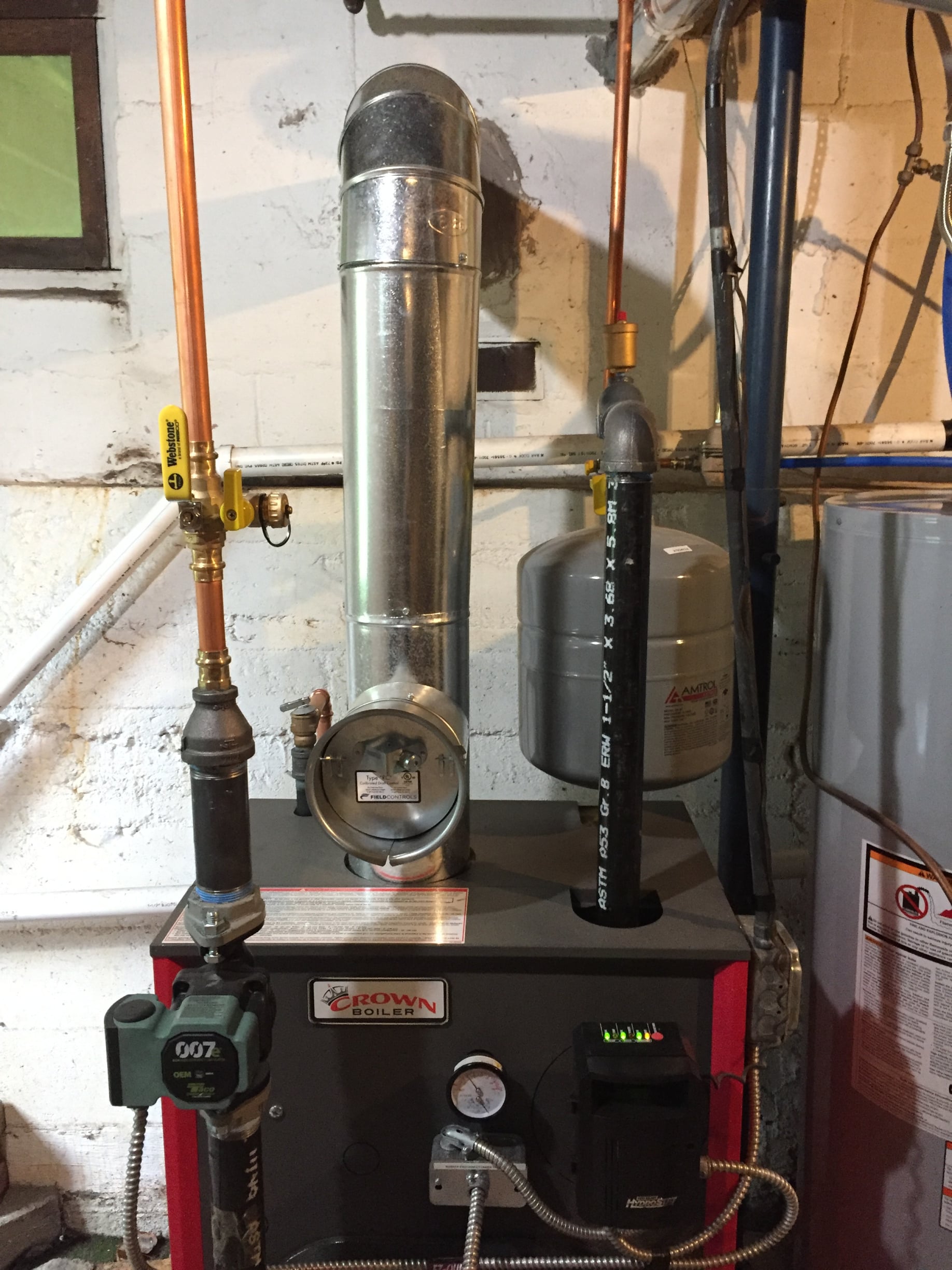
Crown TW3 cast iron oil boiler (TWB100ZOLT4SSU0), put in October 2024 by the previous owner, one zone of fin tube baseboard. The baseboard and piping are older, no idea how old. Domestic hot water is a separate water heater. Water is from a private well. I'm in Ulster County NY.
I bought the house spring 2025. Since I've been here the relief valve discharge pipe has dripped on and off, and I didn't think much of it at first. The boiler ran with a 140°F low limit for the first two seasons and was shut off in the summer.
This October I turned off the low limit so it only fires on a call for heat. Pretty much immediately I started hearing gurgling whenever the heat came on. When I went down to look, the gauge was reading 0 psi. I also noticed the ball valve on the line to the expansion tank was closed. I'm pretty sure it's been closed since the install.
I turned the system off and had a tech look at it. The feed valve was stuck, he jiggled it and it started feeding again. When he bled the system the water that came out was basically black. He also opened the expansion tank valve. Since then, pressure has been holding 12 to 15 psi cold to hot, nothing out of the relief valve, no gurgling.
If I understand it right, with the tank valved off there was nowhere for the water to go when it heated up, so pressure spiked every cycle, the relief valve dumped, and then on cooldown the feeder made up with fresh well water. Two seasons of that would explain the black water. I'm guessing the feeder finally seized up and that plus the deeper cooldowns without the low limit is why it got to 0 psi.
What I'm thinking of having done:
- new relief valve
- new feed valve (or at least rebuild it and clean the strainer), and make sure the backflow preventer is actually working
- run a cleaner through it (Fernox F3 or something like it), flush, then add a corrosion inhibitor (F1 or similar)
- put a magnetic dirt separator on the return
Am I missing anything? Anything here that's overkill?
Comments
-
I think what you mentioned is a good plan. While you at it just to be sure I would remove the expansion tank and check the pressure in the air side. It should be 12-15 psi with no water pressure on the bladder.
because expansion tanks can fail. I would install a valve to isolate the expansion tank (which you may already have) with a tee and drain valve between the isolation valve and the tank
1 -
0


Categories
- All Categories
- 87.8K THE MAIN WALL
- 3.3K A-C, Heat Pumps & Refrigeration
- 60 Biomass
- 430 Carbon Monoxide Awareness
- 133 Chimneys & Flues
- 2.2K Domestic Hot Water
- 6K Gas Heating
- 124 Geothermal
- 170 Indoor-Air Quality
- 3.9K Oil Heating
- 79 Pipe Deterioration
- 1.1K Plumbing
- 6.7K Radiant Heating
- 396 Solar
- 16.1K Strictly Steam
- 3.5K Thermostats and Controls
- 56 Water Quality
- 51 Industry Classes
- 51 Job Opportunities
- 18 Recall Announcements