Welcome! Here are the website rules, as well as some tips for using this forum.
Click here to Find a Contractor in your area.
If our community has helped you, please consider making a contribution to support this website. Thanks!
Help Altering System with mixed Radiant and Baseboard

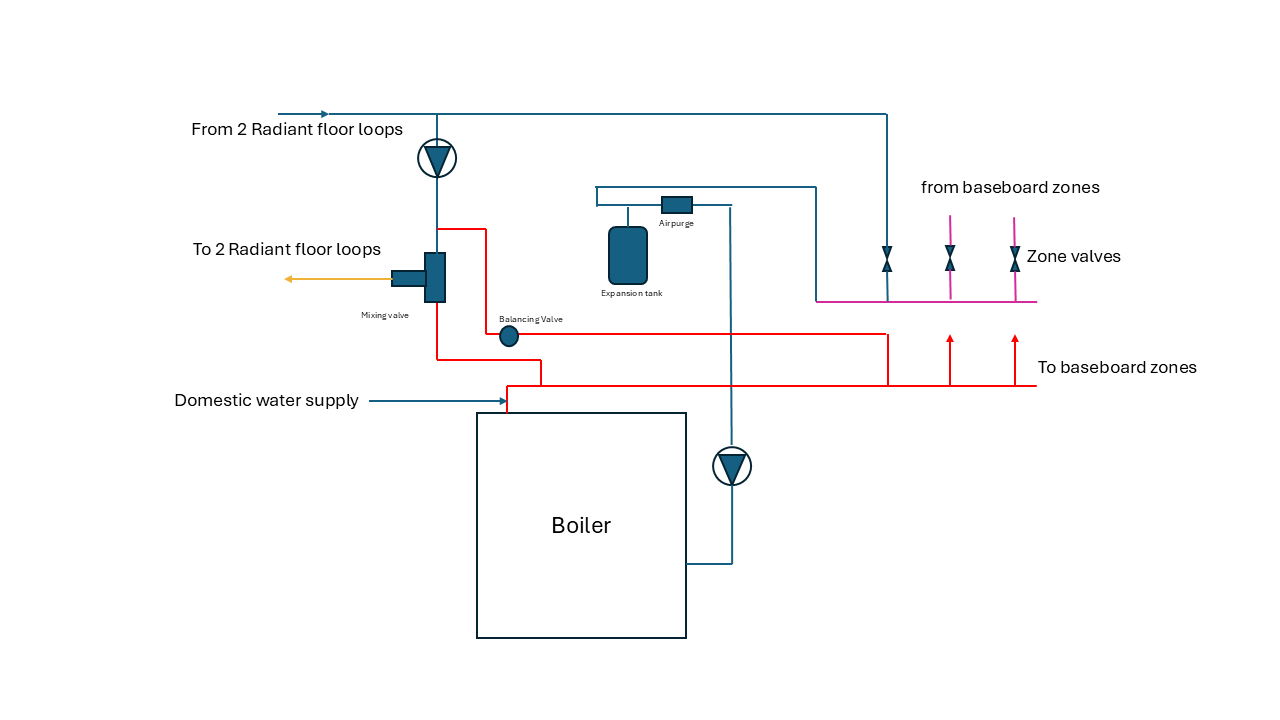
I moved into a house with a incorrectly plumbed hydronic system, It is a 2000 SqFt home and it has a non-condensing Crown AWI128 cast iron boiler running LP. The basement is in-slab radiant heat and the upstairs is baseboard. At some point the radiant heat was disabled because the water in the loop was running too hot. This also dumped a lot of cold water into the boiler on start-up. Flue and damper were replaced at some point from the condensation. A sketch of the layout is shown in the first image and it looks like a supply and return manifold system with the main circulation pump, taco 0014-f1 medium head medium flow, on the boiler return. There is a second circulation pump that pumps into the cold port of the mixing valve, which doesn’t make sense to me. The two pumps in the system try to force water through the 3-way mixing valve. When the other two baseboard zone valves are closed, the main pump is dead headed except for the path through the 3-way valve. In this scenario, the main circulation pump wins out at the mixing valve and forces unfixed boiler supply water through the radiant loop. The expansion tank is on the return before the pump, and whoever plumbed it made the return manifold higher in elevation than the supply and put the expansion tank at the high point with an air bleeder there. There are no circulation pumps on the baseboard loops.
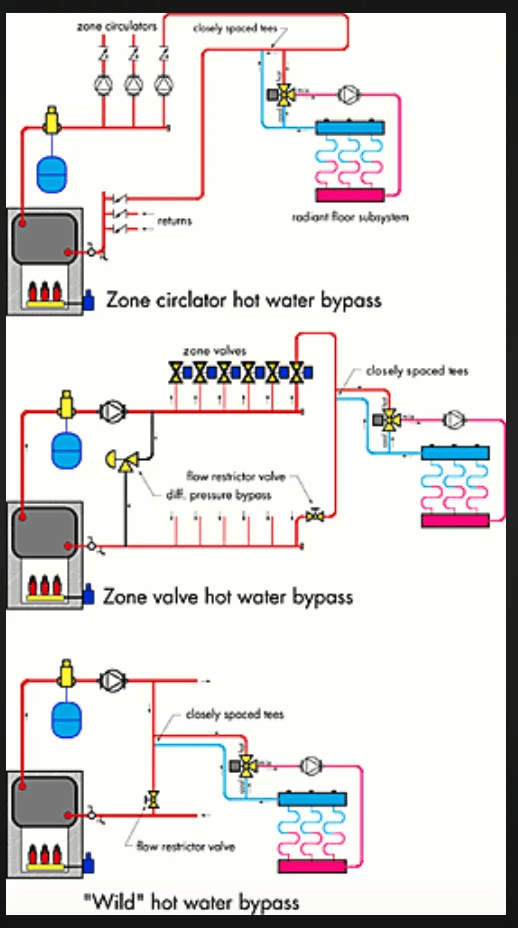
I would guess the radiant heat was originally set up with a 4 way mixing valve based on the physical piping layout. I am wondering if the middle solution in the second image "zone valve hot water bypass would work? Do I need the differential bypass valve? Would people suggest adding a 3-way anti-condensation valve between the main manifolds, or just one on the return of the radiant heat loops?
Current system
considering piping the radiant loop following the middle layout "zone valve hot water bypass"
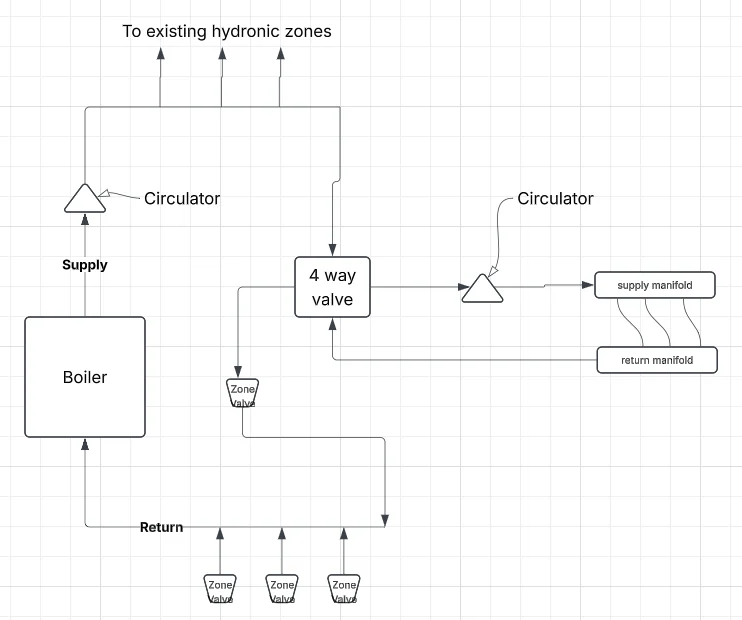
or I could use a 4-way mixing valve, somewhat like what is piped in this diagram but my circulator is on the boiler return.
Comments
-
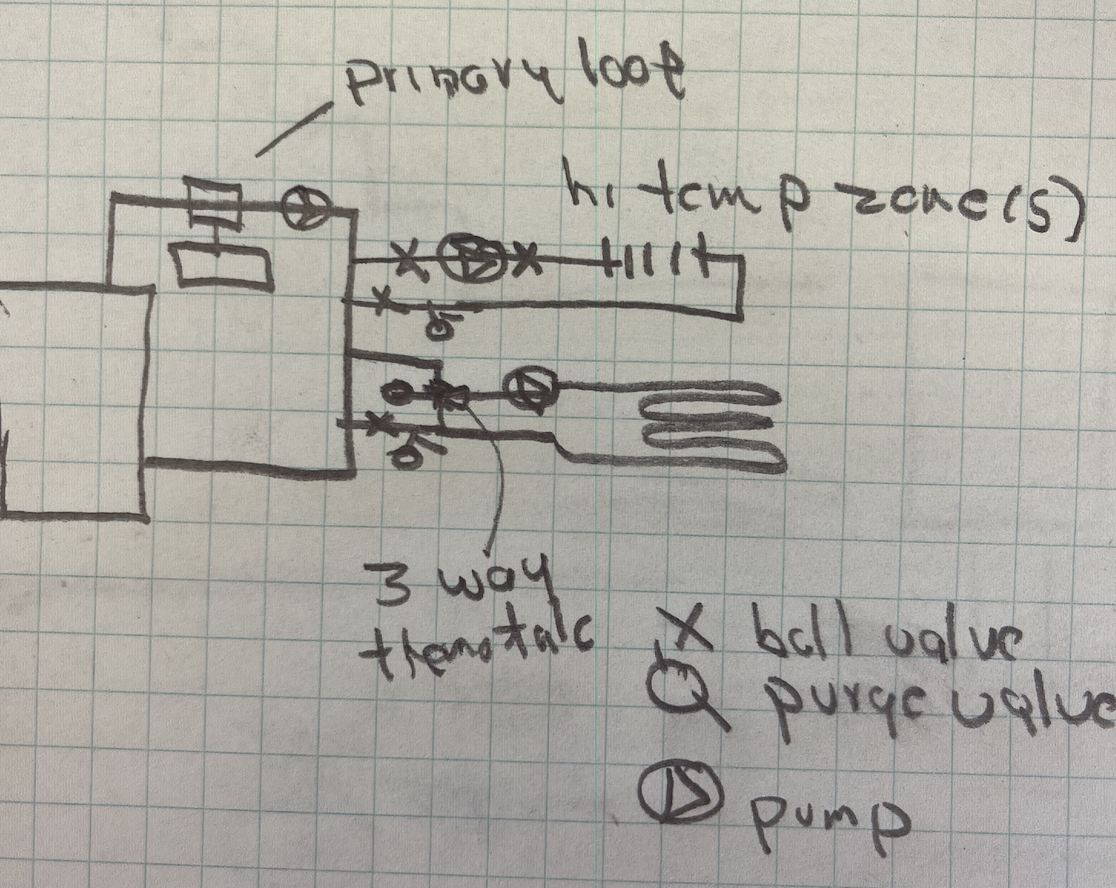
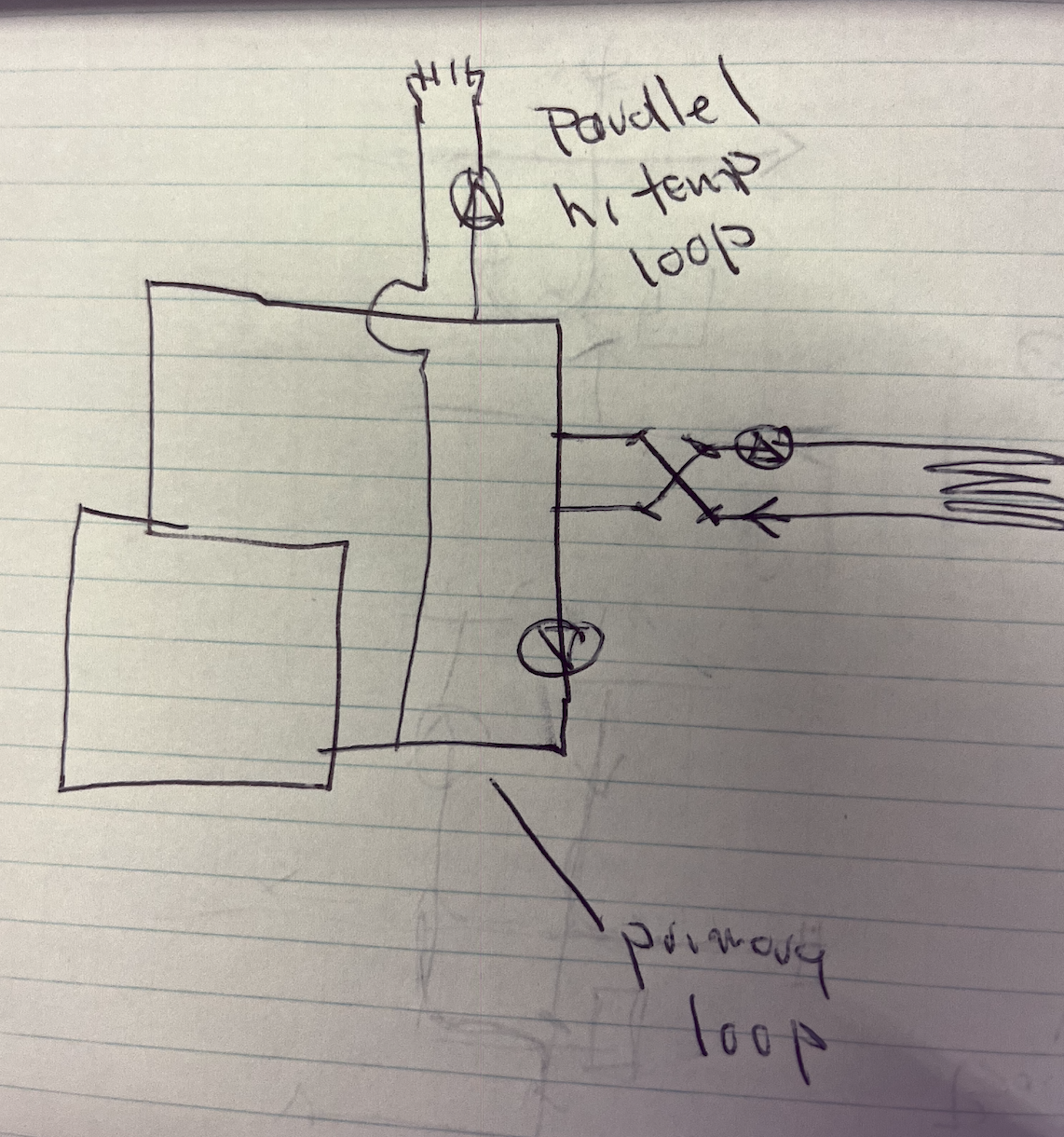
If the low temperature radiant is 20% or less of the total load, which in a basement it probably is, then you don't need boiler return protection. A simple dual temperature system could look like this
A boiler primary loop.
Hi temp loop
Lo temp loop with 3 way thermostatic.
If the basement is one zone, you could use a manual 3 way and build a proportioal mix system.
This would be most efficient as both hi ad lo temperature modulate based on outdoor temperature
 Bob "hot rod" Rohr
trainer for Caleffi NA
Living the hydronic dream0 -
I would guess the radiant is close to half the load. It is about equal square feet on the two floors and half the basement is above ground (walk out basement). There are two radiant zones but I don’t know how they are distributed. There are two baseboard zones upstairs. Right now the system is a direct pumping scheme, not primary secondary. Are you suggesting to re pipe the entire system? It’s original boiler and piping from 2003.
0 -
What components do you have to work with? Do you have a 4way valve you want to use? Or are you stating from scratch with a repipe?
You want a high and low temperature supply, and boiler protection?
The 3 piping examples for for adding a small radiant zone to a high temperature system. None of them have boiler return protection.
You have about 90,000 btu available from that boiler so if you could narrow down that basement load to make a way to ballpark the zone requirement? For example the basement 2000 sq ft at 10 btu/ ft is only a 20,000 load. I think you could cover that without adding a protection device.
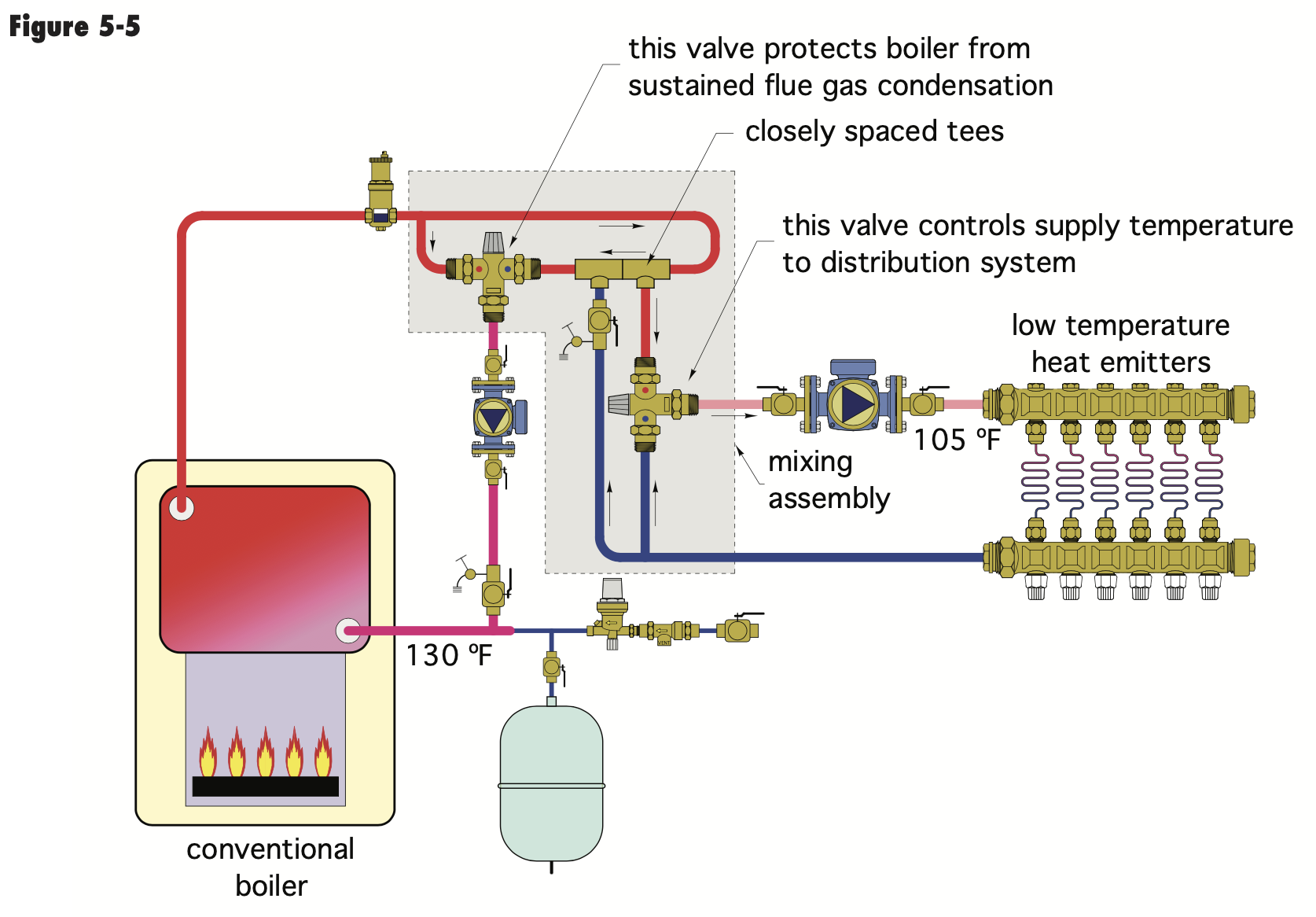
Here are two options with two thermostatic valves Fig 5-5, just add another set of close tees for the high temperature zone, above the tees shown
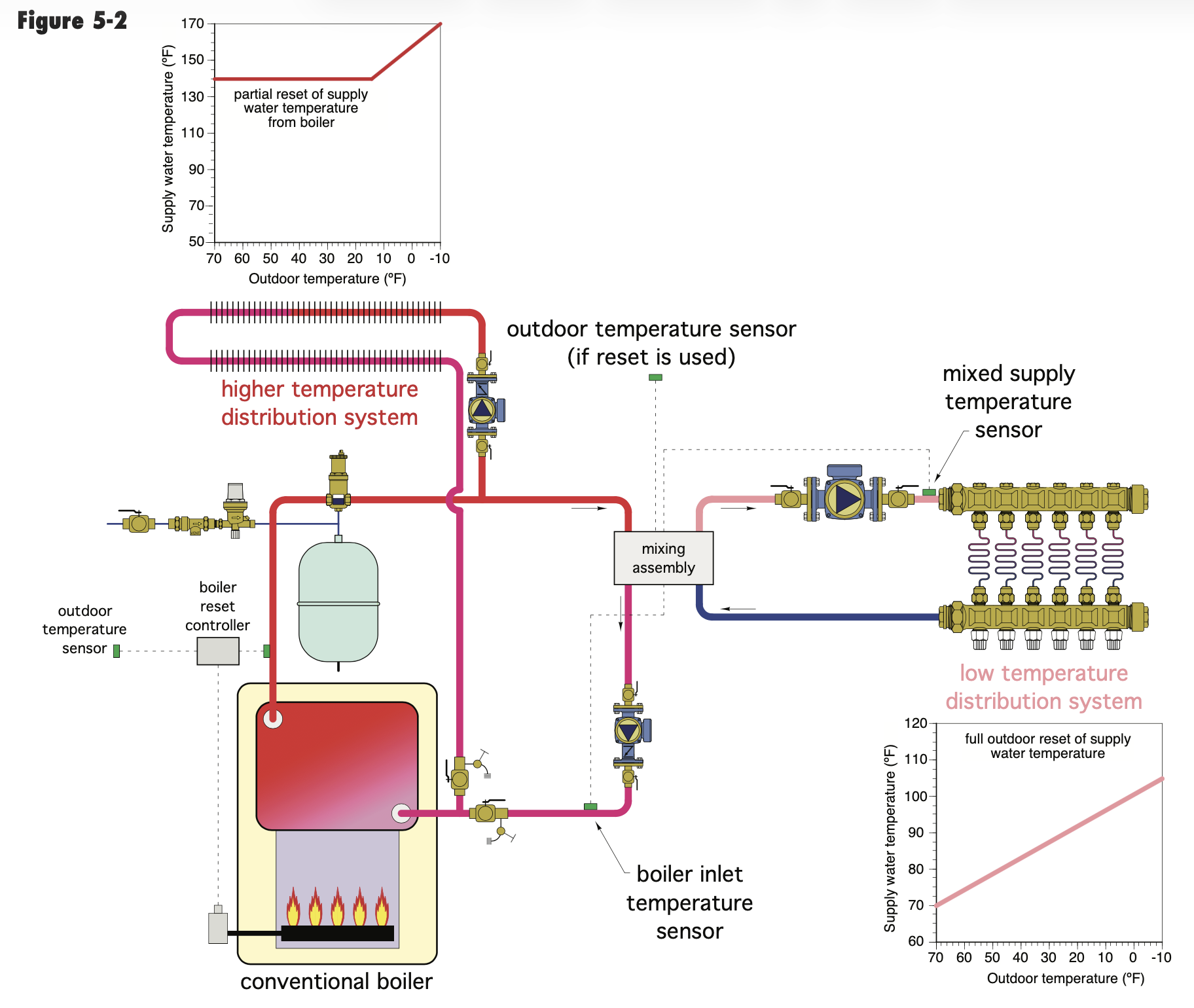
In Fig 5-2
A 4 way could be the mixing assembly giving you boiler return protection and mix for the radiant based on ODR. It requires a 4 way valve, actuator and control, maybe 1000 bucks worth of hardware. The boiler inlet temperature sensor protects the boiler when the radiant runs.
Plus if you have ODR control already on that Crown?, a small reset , 140- 170 maybe, on the boiler then the high temperature load is also ODR controlled.
Two outdoor sensors. It covers all the bases. ODR adds comfort and some efficiency gain.
 Bob "hot rod" Rohr
trainer for Caleffi NA
Living the hydronic dream0 -
Thanks Hot Rod for the response. No I do not have a 4 way mixing valve, it simply seemed like one route to go about fixing the issue. I am trying to avoid doing a full repipe based on the boiler age and the added cost and time to do the job. Boiler is from 2003 original to the house and the house is in colorado at 8000 ft and 50% of the basement walls are standard exterior construction (walkout basement). I think the peak demand could be up to 45 btu/sqft given the age and location of the house, with the basement being 1000 sqft. Roughly a 35,000-45,000 BTU maximum heat demand. I have no idea what the loop spacing is in the cement slab or if the slab is insulated underneath.
No the boiler doesn't have ODR currently. My understanding is that there are minimal efficiency gains to have with a condensing boiler that cannot modulate it's combustion rate and it would cause a lot of short cycling. But the temp swings from running the baseboards on temperate days are a bit unpleasant and it would be nice to address that.
Your figure 5-5 was similar to what I was imagining before hearing that a 4-way valve could perhaps be a better solution. I am curious why the setup in figure 5-2 does not use closely spaced tees for baseboard loop, and instead ties the loop return into the boiler return. Would you only suggest a 4-way mixing valve in the 5-2 setup, which has a primary loop for the boiler? Do you not suggest using it in the layout that I posted in my third image? Thanks
0 -
45 btu/ sq ft would be an extremely high load for a basement, even with walkout. A radiant floor can get you 27 maybe 30 btu/ sq ft without getting too hot to stand on. I'd guess in the 20's somewhere.
Regardless, a piping fix would be the same.
Fig 5.2 is sort of unique in that it has ODR on the boiler that covers the high temperature load, and with the correct mixing assembly ODR on the low temperature. The high temperature load is allowing the boiler temperature directly to the load without blending that you would get with it attached to close tees.
The boiler is within the primary loop, which allows that mix assembly on close tees. you oily have a primary secondary system if thjere are closely spaced teees, somewhere. Although a hydraulic separator is also a P/S device, in a box.
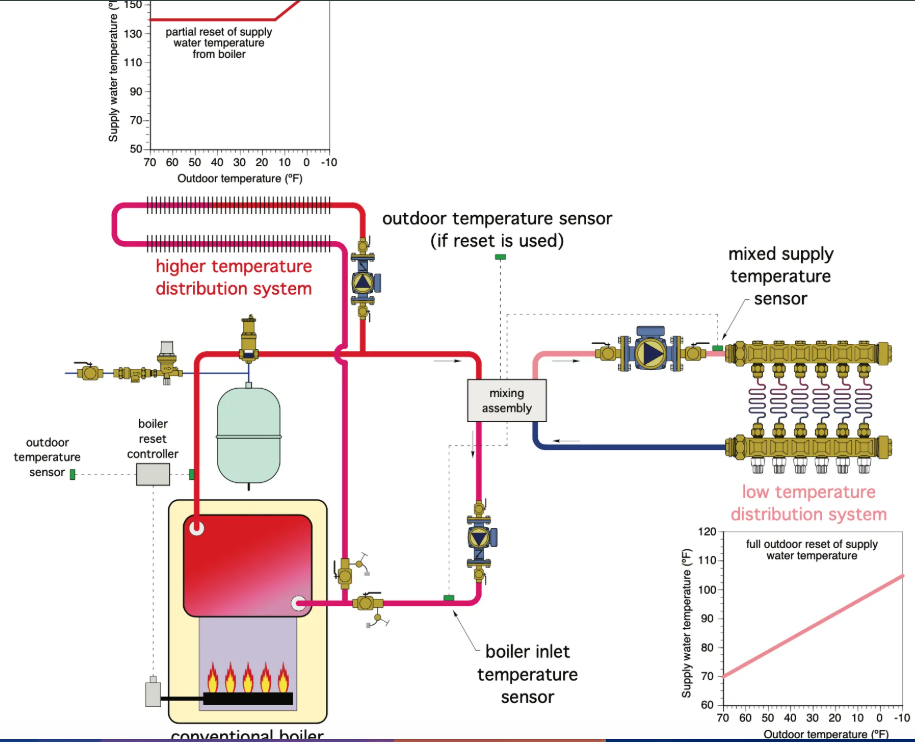
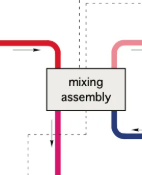
The mix assembly would be connected via close tees the is what is in this boxed area. It doesn't show a specific device, could be a motorized valve, or and injection pump. Or a mix assembly on the radiant manifold itself.
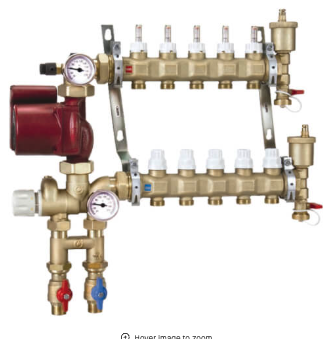
Below is an example of a manifold with the mix assembly built into it. There are versions with motorized mix valves also. This one has a thermostatic mix. But it sound like you have the manifold already, so chose a mix device to use at the boiler piping.
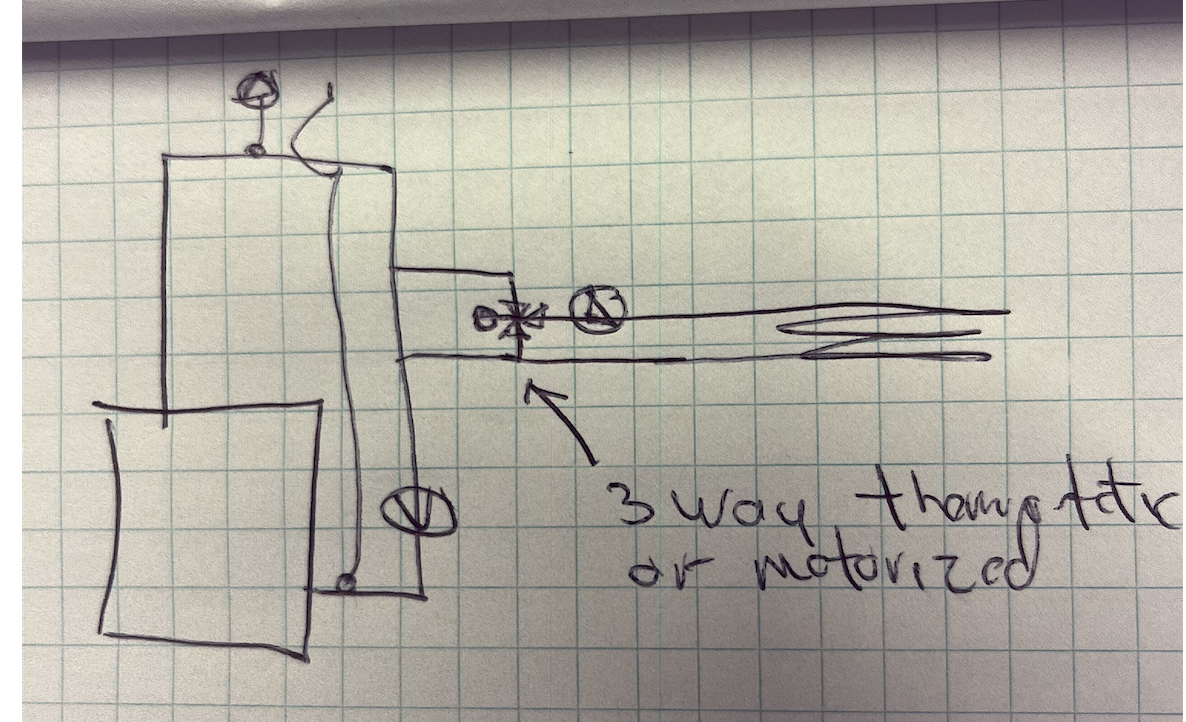
Here is 5.2 with a 4 way or 3 way.
Least expensive would be a 3 way thermostatic, but it would not allow ODR on the radiant, it is a fixed temperature device. Still connected vis close tees.
I was trying to build a fix around parts I though you had.
So do you want good, better, best option :) The more adjustability and features the higher the $$.
The systems with ODR save some operating cost, but also provide long runs, less cycling as the supply is always trying to match the heat loss of the spaces. A hydronic cruise control of sorts.
 Bob "hot rod" Rohr
trainer for Caleffi NA
Living the hydronic dream0 -
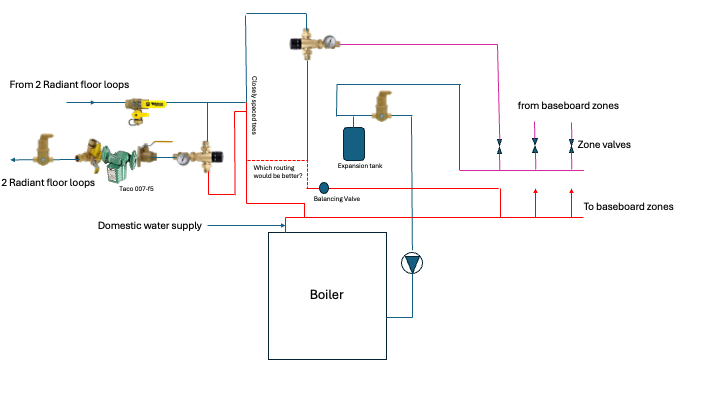
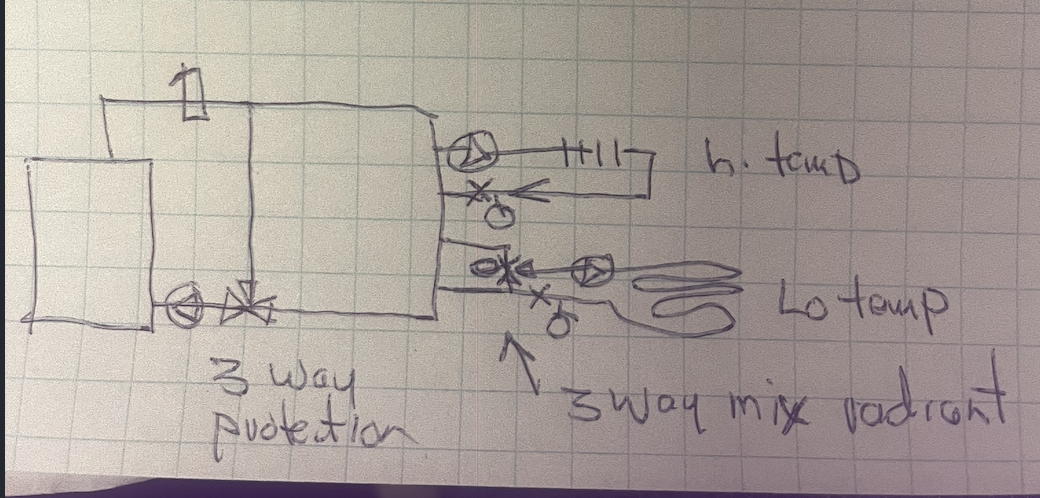
Hi Hot rod, I was planning to alter the system in the following way and wanted to get your thoughts on this layout and if you think it will work. The bypass from the boiler supply to return that forms the primary loop would be 3/4" pipe.
I was also wondering if I should install check valves on the 3-way mixing valves, primarily the one for the radiant loop. I ask because of what you said in this post. After reading your thoughts about check valves on recirculation loops with a pump, I was reading this post and I thought maybe the problem in that system was cold water from the radiant return was backflowing through the mixing valve. I can't understand how else the hot supply to the radiant mixing valve would drop from 178F to 100F, there is no thermal load in that short section of pipe what else would cause that huge delta T. Made me worried that I need check valves on my 3-way mixing valve.
Do you think the Taco 007-F5 is correctly sized pump?, maybe that is an impossible question. There are two loops that service 1000 sqft in a concrete slab basement. I have no idea how long the pex run is of each loop. Is the only way to know is run the pump and see if the delta T of each loop can get to 10-20 degrees after equilibrating. Thank you for the help.
 0
-
I'm not following why the baseboard returns are going in to a second mix valve?
You have a high temperature circuit, and a low temperature. I don't think you need return protection with just a basement radiant zone.
You have a 105 output boiler, possibly less than a 60k load up and down.? Maybe 18- 20,000 for the basement. So just a boiler temperature loop and the mix down radiant with one mix valve.
Bob "hot rod" Rohr
trainer for Caleffi NA
Living the hydronic dream0 -
Thanks for the reply and the help hot_rod, that's awesome! Baseboards do not go to the second mixing valve. Output from the second mixing valve mixes with returns from baseboards.
The second mixing valve is boiler return protection only for the radiant heat bypass. I was concerned about start up cycling of the slab. (I'm in colorado, lots of warm days with cold nights) Concrete floor is a huge thermal mass, and trying to bring up the temp of the slab from 55 to 75 F could have extended periods of cold water returning to the boiler. I read elsewhere that if the radiant zones are about 10% of boiler heat output or less than I don't need return protection. Boiler is 91k Btu at sea level, I'm at 8000 ft, so derated to about 80k btu. I think conservative estimates of the basement radiant load is 20k btu, considering half the walls are above ground exterior. That is 25% of boiler output, but it is a high mass boiler. This is why I ask you, you're the expert.
Removing the boiler protection reduces the layout to the zone valve hot water bypass in the second image of my first post. That layout also makes sense to me, but you originally said that is for a small load, this seems larger than a small load. 60K up and down is probably close to actual needs, probably goes higher a couple times a year when it's -20F outside.
Would you instal a mixing vavle with check valves for the radiant zone? Is that only for domestic water loops from demand on the loop dropping the pressure? Thanks for the help hot_rod.
0 -
How often do you drop the slab to 55°? If you warm it in the fall and maintain 75 or so, you just have that big lift one time
2200 sq ft= 27 yards of concrete, at 4" thick is around 110,000 lbs of concrete
110,000 x .21 X 20°= 462,000 btu required. So if you have the tube and pump capacity to add 25,000 btu/hr. It will take 18- 1/2 hours to raise that slab 20 degrees. So yes you would want to protect that boiler from cold return.
Here is one option with a return mix valve, protects both hi and low temperature condition.
And a second mix , 3 way thermostatic for the radiant.
Does the boiler run on outdoor reset? If so and if the basement is one zone, you could use a manual 3 way mix and it tracks with the boiler reset temperature.
 Bob "hot rod" Rohr
trainer for Caleffi NA
Living the hydronic dream0
Categories
- All Categories
- 87.9K THE MAIN WALL
- 3.3K A-C, Heat Pumps & Refrigeration
- 60 Biomass
- 430 Carbon Monoxide Awareness
- 134 Chimneys & Flues
- 2.2K Domestic Hot Water
- 6K Gas Heating
- 124 Geothermal
- 170 Indoor-Air Quality
- 3.9K Oil Heating
- 80 Pipe Deterioration
- 1.1K Plumbing
- 6.7K Radiant Heating
- 397 Solar
- 16.1K Strictly Steam
- 3.5K Thermostats and Controls
- 56 Water Quality
- 51 Industry Classes
- 51 Job Opportunities
- 18 Recall Announcements