Noritz NRCB199DV: E54/E57 again. domestic expansion tank was on the hydronic loop for years.

Photos are from last year, BEFORE the repairs described below. I know
that's not ideal. I'm back at the unit Wednesday and will post current
photos and pressure readings then. Posting now because I'd rather know
what to look for before I'm standing there.
SYSTEM
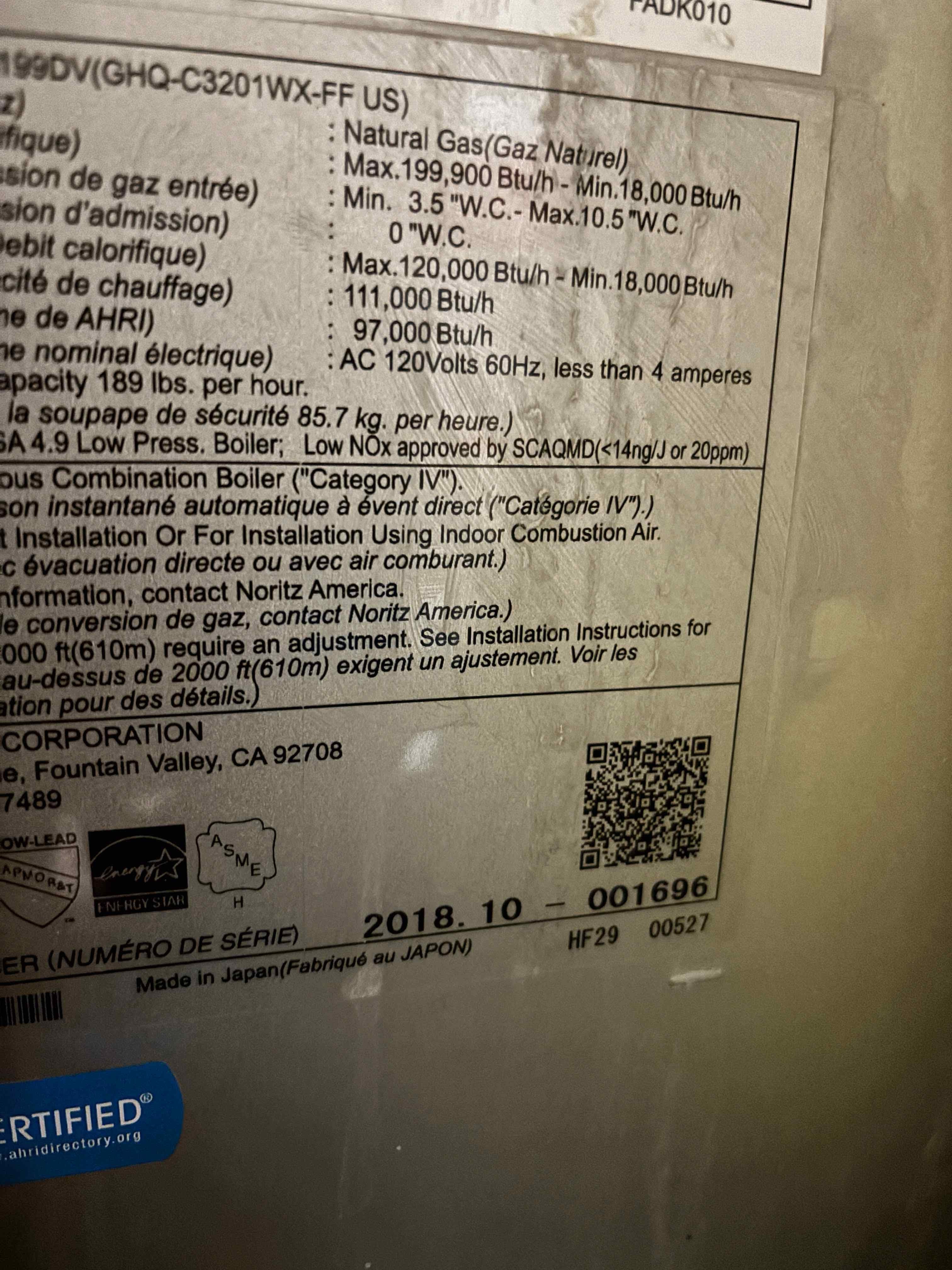
- Noritz NRCB199DV, manufactured Oct 2018. Space heating only - the DHW
ports are capped, domestic hot water comes from a separate gas tank. - Rating plate: heating capacity 120,000 Btu/h.
- Supply setpoint 160-165F.
- Four zones on an Argo panel - zone valves, one circulator, plus the
boiler's own internal pump.- Basement baseboard
- 1st floor baseboard
- Owner's suite baseboard
- 2nd floor apartment, forced hot air through a 12x15 water-to-air
coil in an attic furnace
- Boiler is in the basement. The attic coil is above the 2nd floor -
call it three levels of rise. - Mix of old iron/galvanized and copper. Municipal water.
- No record of the heating side ever being flushed, cleaned or treated.
No real maintenance for many years.
THE FAULT
Intermittent shutdowns on Error 54 (low heating water pressure) and
Error 57 (auto feeder open more than 600 seconds). Power cycling resets
the timer and it runs fine for a while, then does it again.
WHAT WAS FOUND AND DONE LAST YEAR
A plumber replaced the expansion tank and the boiler's internal
auto-feeder inlet valve. Two things from that job that I only recently
understood:
- The old feeder valve's internal black rubber filter screen had
completely collapsed, squeezed down and turned INSIDE OUT. - The invoice reads, word for word:
"Replace expansion tank that's for domestic water with proper
hydronic expansion tank #30. And proper pressure gauge. Pressure was
low so turned up fill valve/prv to 15 psi. Boiler running at 20.
That is correct to pressure."
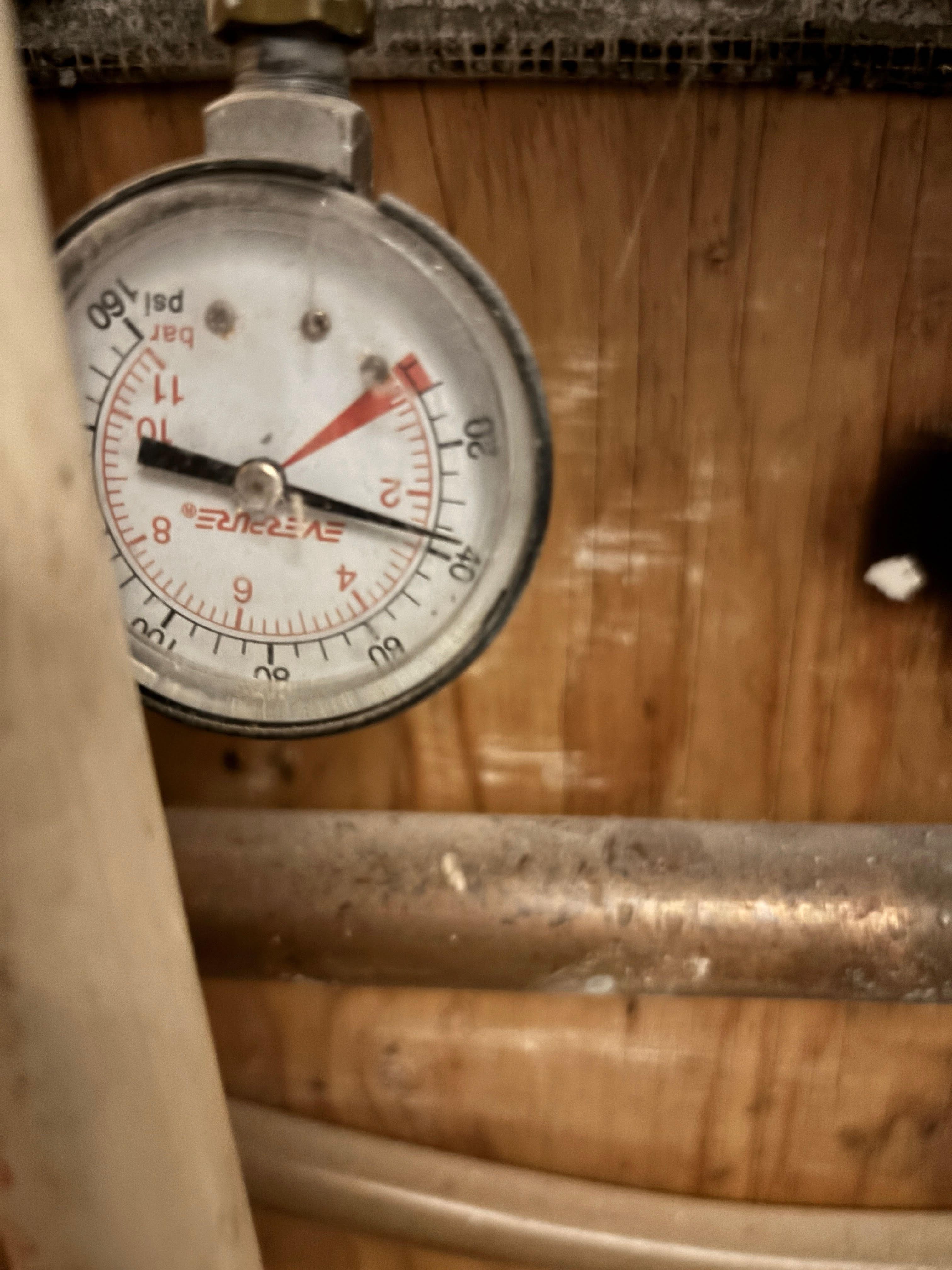
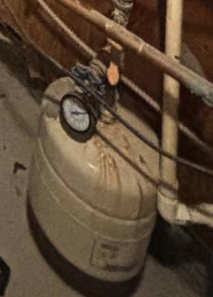
So a DOMESTIC water expansion tank had been sitting on my hydronic loop,
along with a domestic 0-160 psi gauge (photo 4). Both were replaced with
an Amtrol #30 and a new gauge. Nothing on the invoice about setting the
tank pre-charge. The relief valve was not touched.
Less than a year later the E57 timeouts are back.
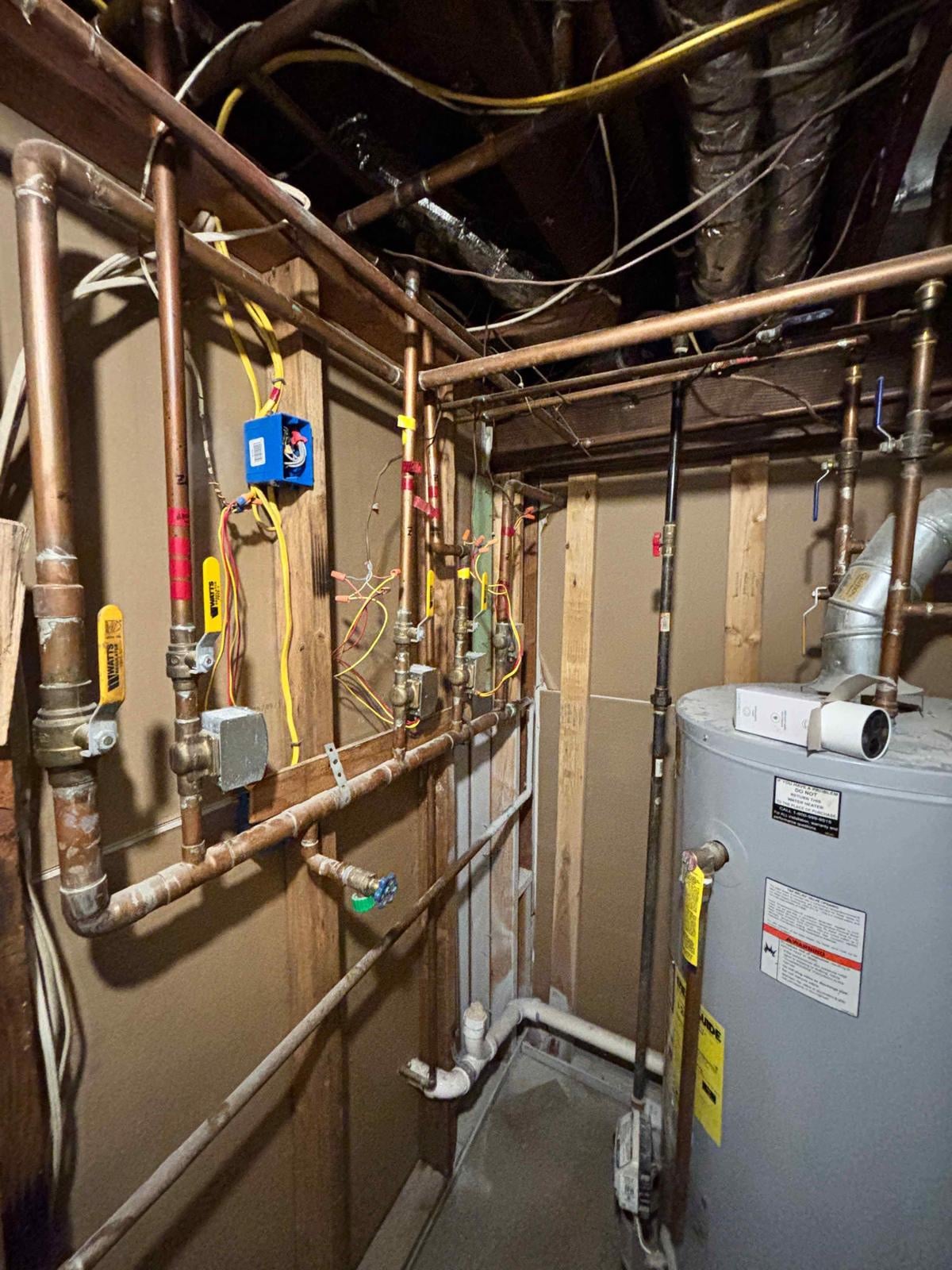
The expansion tank sits on the floor in the corner, several feet below
the boiler (photo 1, bottom centre). The new one went into the same
spot, just larger.
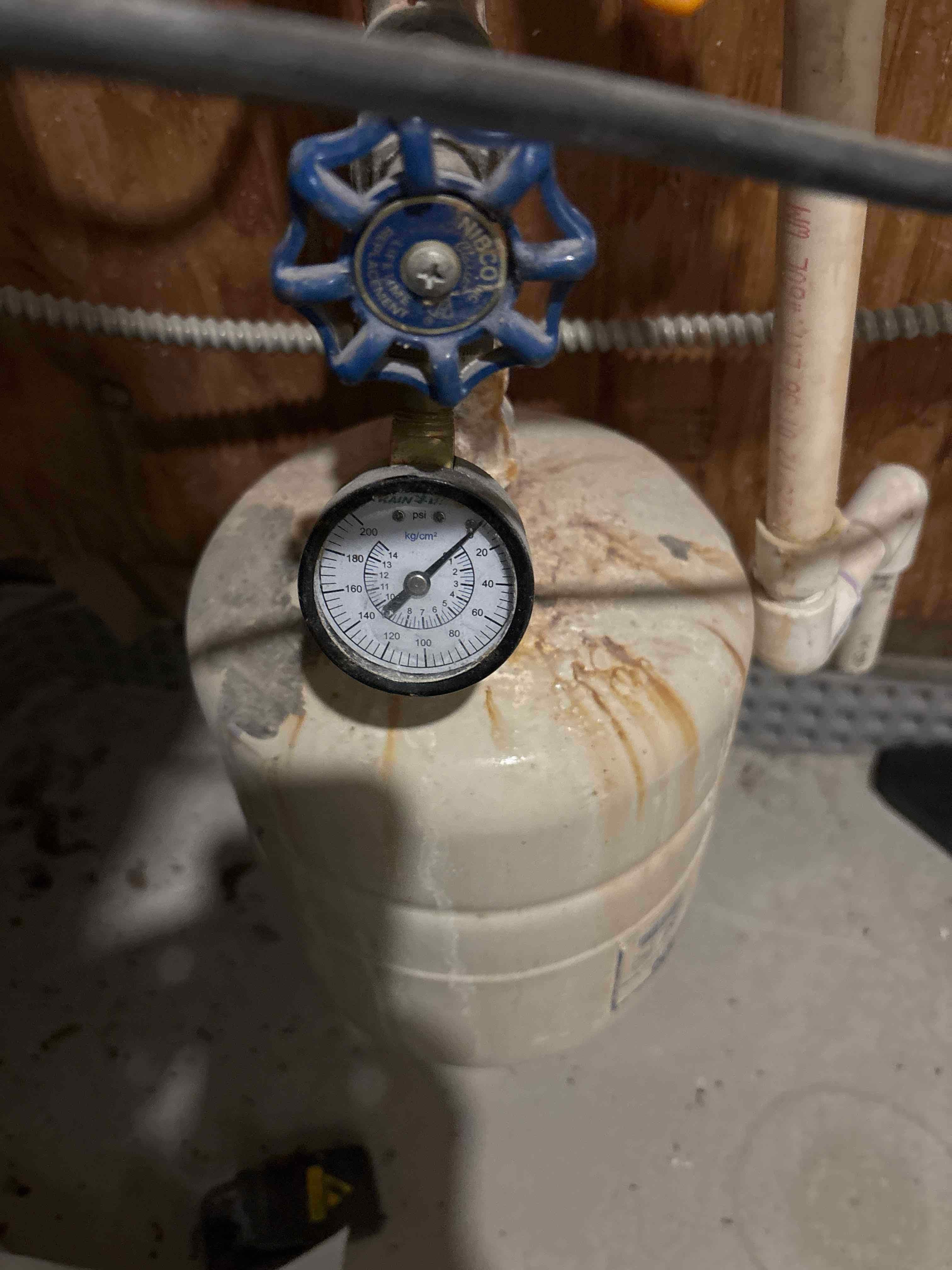
NO VISIBLE LEAK
Nothing wet, no puddles, no staining on the floor. The only thing I can
see is rust-brown streaking running down the side of the OLD tank in
photo 3.
PHOTOS
- Near-boiler piping. Argo panel on the left, old expansion tank on the
floor at bottom centre.
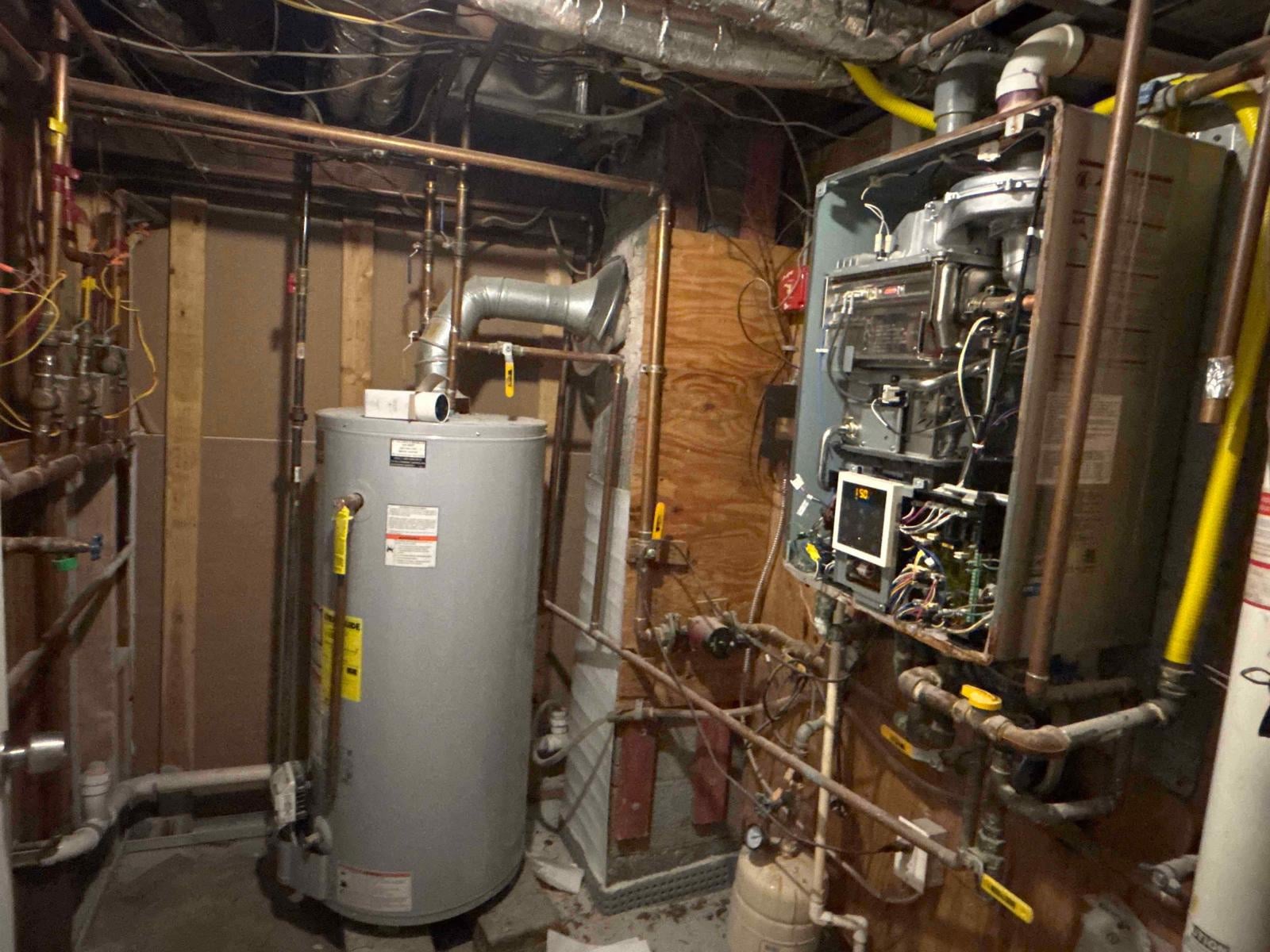
2. Same wall with the boiler's front cover off - taken by the plumber
during that visit.
3. The OLD expansion tank, the domestic one. Note the rust staining
running down the shell.
4. The OLD pressure gauge. Everpure, 0-160 psi.
5. Zone valve manifold, on the wall opposite the boiler.
6. Rating plate.
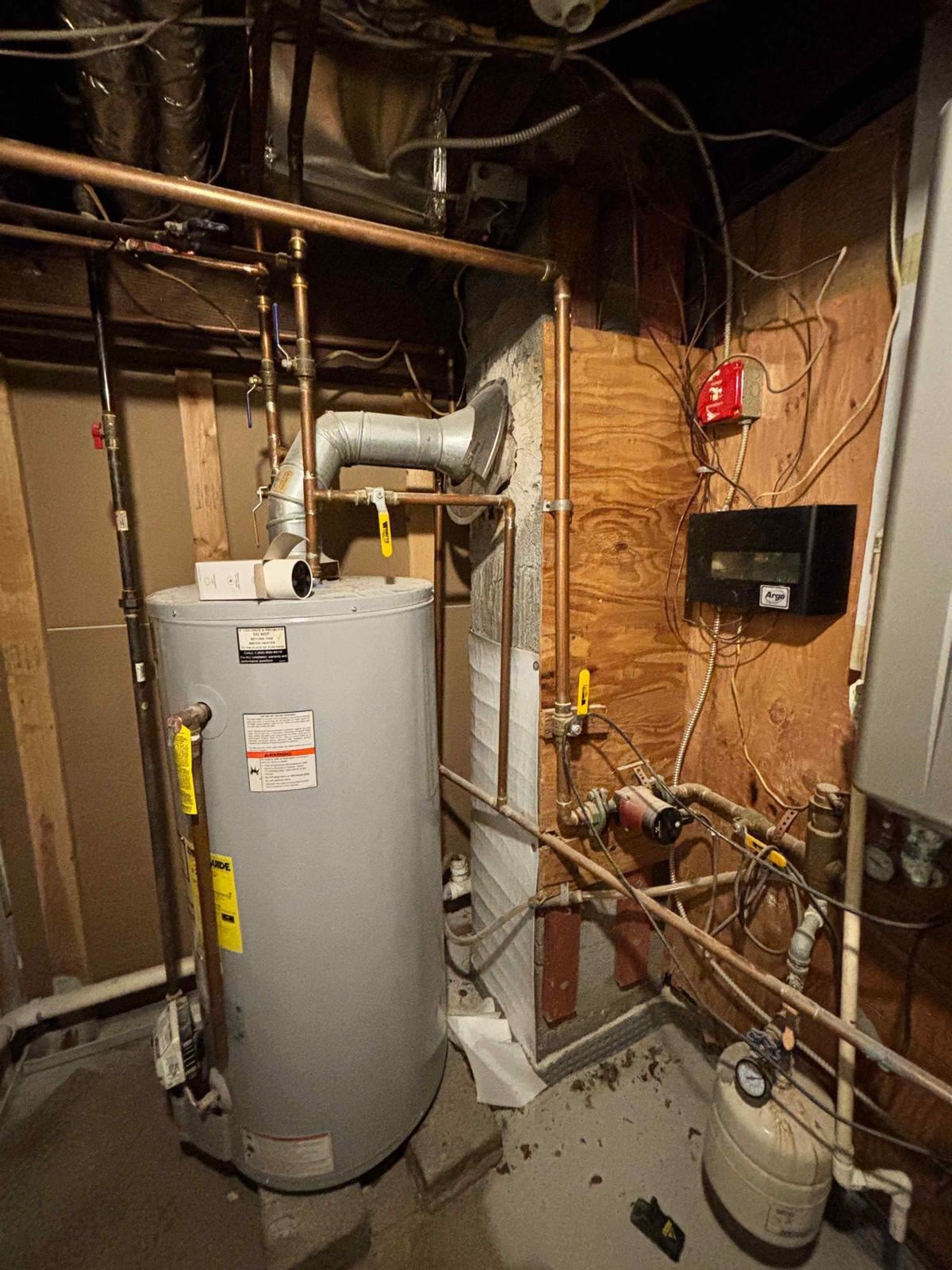
7. Other side of the room - separate gas DHW tank, Argo panel, the
circulator, and the old expansion tank on the floor at right.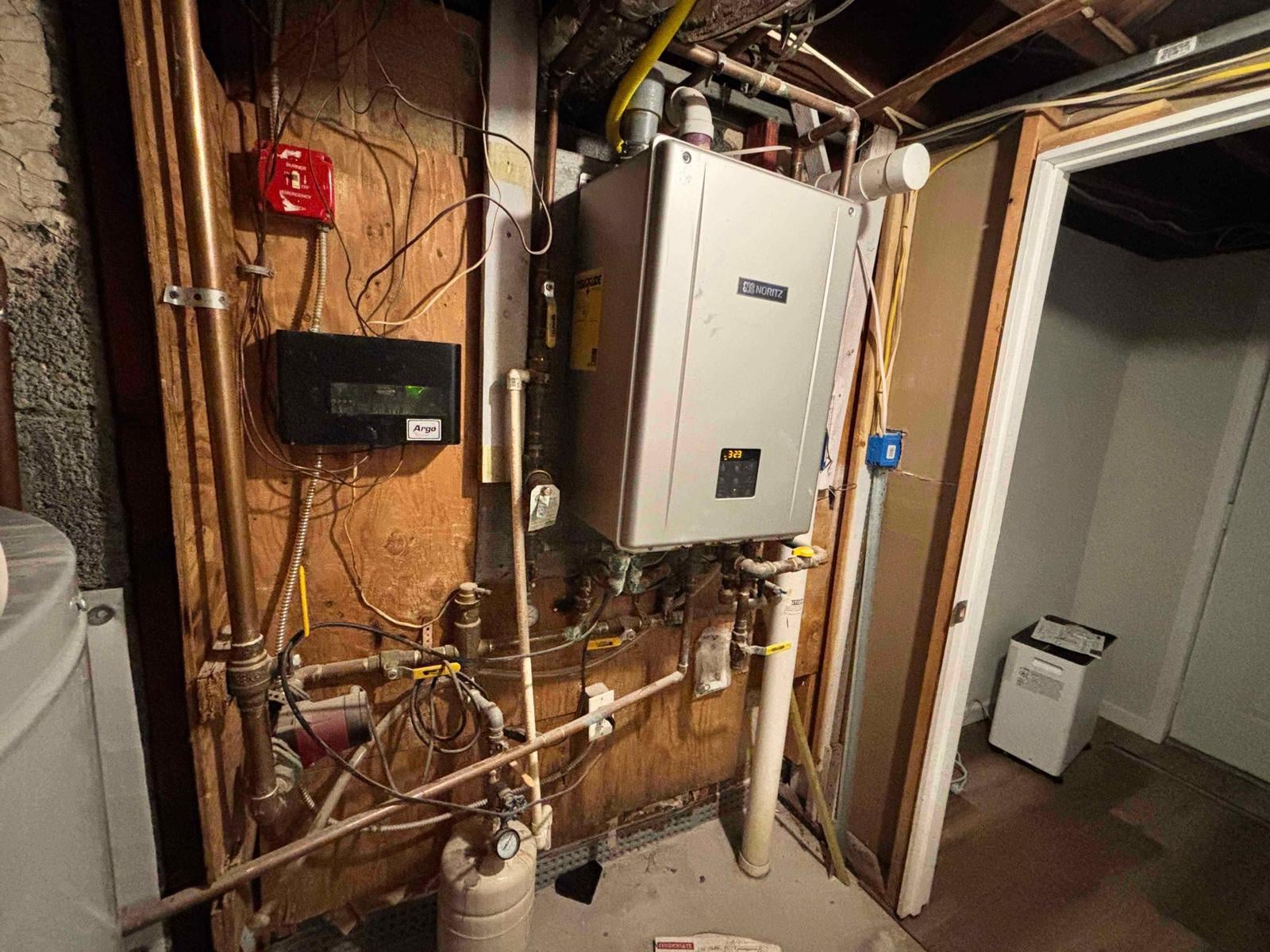
QUESTIONS
- What makes a feeder screen collapse and turn inside out? I assume
flow went backwards through it. What drives that? - If a domestic tank (40-ish psi pre-charge) was on a loop running
15-20 psi, am I right that the diaphragm never moved and I effectively
had NO expansion capacity for years? And would that have had the
relief valve lifting and reseating every cycle - dumping water, the
feeder making it up, over and over? If so, is the relief valve seat
likely wrecked by now and weeping on its own, even with a correct tank
fitted? It was never replaced. - Is 15 psi cold fill enough with the attic coil three floors above the
boiler? My arithmetic says that leaves the coil at roughly 2 psi,
which sounds like air vents up there ingesting air rather than
purging it. - The tank is on the floor several feet below the boiler, and there's
both an internal boiler pump and a separate circulator (photo 7). How
do I confirm the tank is on the right side of the pump? If it's
wrong, could the pump be pulling the top of the system toward zero
every time it runs? - Could years with no flushing in an iron system silt up the boiler's
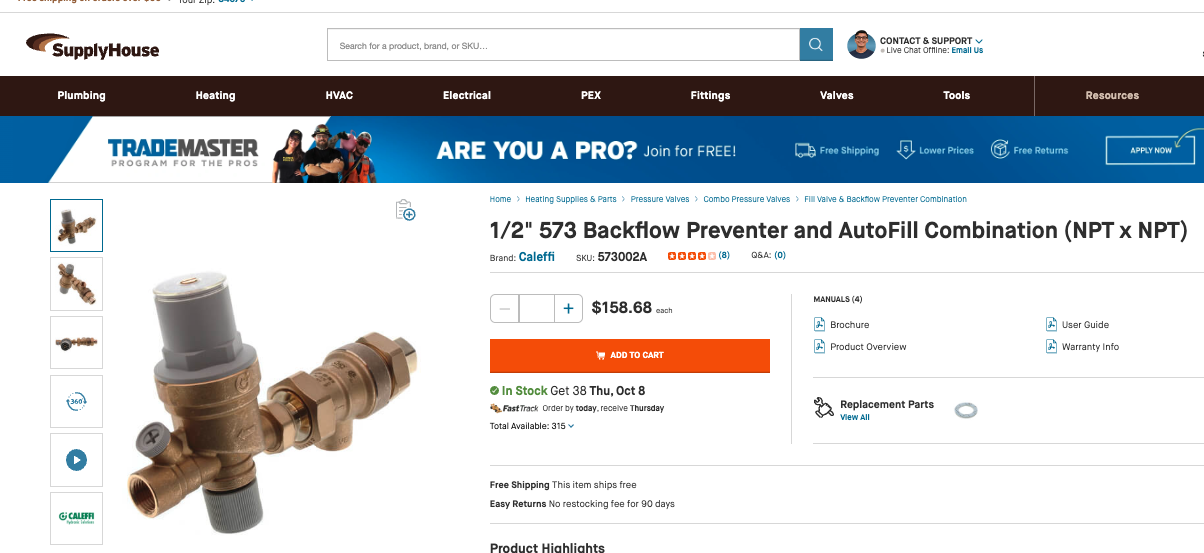
pressure sensor and give me a false E54 rather than an actual leak? - A contractor has proposed capping the internal auto-feeder entirely
and fitting a standard external fill valve with backflow preventer on
the loop, to get past the 600-second timeout. Reasonable, or is that
just hiding a leak I haven't found?
Tell me what to photograph and measure Wednesday and I'll get it.
Thanks.
Comments
-
water that is rusty like that could be an indication that the system is taking on fill water often. A leak in the system or the relief popping from wrong expansions tank pre charge
Which could also mean the boiler is sludged
Id run a hydronic cleaner through the system, Fernox is one brand
You want 5 psi at the highest point
.433 x the height to the AH, add psi
The boiler needs to pipe primary secondary if it has an onboard pump, as combi do
Nothing wring with a dhw expansion if it is charged properly
The external fill valve, connected at the expansion tanks
Bob "hot rod" Rohr
trainer for Caleffi NA
Living the hydronic dream1 -
Thank you - that's extremely helpful.
Two follow-ups.
On pre-charge: the new Amtrol #30 went in last year and the invoice says
nothing about setting the charge. Factory pre-charge on those is 12 psi
and the fill was set to 15. So I may have the same problem again with a
different tank. I'll check the Schrader valve this week.On primary/secondary: this is the part I don't know how to assess. There's
the boiler's onboard pump plus a separate circulator and four zone valves
on an Argo panel. What should I photograph so you can tell whether it's
piped primary/secondary or not? I'm at the unit Wednesday and I'd rather
shoot the right things once.Also - the invoice from last year says the fill was set to 15 psi. I
haven't verified that myself and I'll read it Wednesday. If the rise to
the attic coil is roughly 30ft, 0.433 x 30 + 5 puts it nearer 18 psi, but
I'll measure the actual height rather than guessing at both ends.One thing nobody has addressed: the old auto-feeder inlet valve's rubber
filter screen was found collapsed and turned completely inside out. Does
that tell you anything on its own?0 -
It is wise to put a pressure gauge on an expansion tank and confirm the pressure. Before you install it.
A 12 psi, if in fact it was 12, with 15 fill pressure it will still accept some expansion as the water heats. The intention of an expansion tank is to "accept expansion" as the water or fluid is heated. While staying 5 psi or so below the relief valve setting. There are tables and formulas to calculate the "acceptance volume" based on fill pressure and pre-charge pressure.
Amtrol actually uses 28 psi max. with a 30 psi relief valve in their calculator.
In chilled water systems you can actually under charge the tank pre set allowing some initial fill water to enter the tank. So as the water cools, contracts, you still maintain some positive pressure.
We do the same with solar thermal expansion tanks, allow a small amount of glycol into the tank so as system temperature drops in winter we don't go to gauge 0 psi.
I don't know much about the onboard auto-fill, some Euro style fill valves have a rubber check to act as a backflow device. Maybe that failed.
Ideally you want the fill valve connected the point of change. So pumps cannot change the pressure at that point.
Yes it is possible to pull a negative pressure which could allow fill water to constantly enter when a pump runs, whick keeps the relief seeping and even more fill water.
You have a valve on the expansion tank, drop the tank, add a tee and put the fill/BFD there.
 Bob "hot rod" Rohr
trainer for Caleffi NA
Living the hydronic dream1 -
That lands. 54 is low pressure, 57 is the feeder open past 600 seconds -
so they're two halves of one event rather than two separate faults.And the part I hadn't thought through: if the feeder runs a full ten
minutes and the pressure still doesn't come up, the system isn't simply
low on water. Ten minutes of fill would refill this loop several times
over. So either it's leaving as fast as it arrives, or something is
holding the pressure down at the sensing point while the feeder runs.Which leaves three, and they look distinguishable:
- a leak, or the relief seeping -> decay test with the fill shut off
- the pump pulling that point negative -> depends where the fill tees in
- the feeder restricted again -> last year repeating, and a symptom
either way
Two questions:
- If I move the fill/BFD to a tee at the expansion tank, does that on
its own rule out a leak, or should I still run the decay test first?
I'd rather not fix one cause and assume it was the only one. - Still hoping for the primary/secondary answer. Onboard pump plus a
separate circulator and four zone valves on an Argo panel. What should
I photograph Wednesday so you can tell? I only get one trip down there.
Also - the invoice from last year says 15 psi cold, 20 psi hot. Against
your 28 psi ceiling that sounds like the tank was accepting expansion
properly at that point, which points away from the tank. I'll re-measure
rather than trust a year-old number.Wednesday I'll post: where the fill valve tees in relative to the
expansion tank, the relief valve discharge, and the near-boiler piping.0 -
yes you certainly want to rule out a leak first off. That is fairly easy to do, with an overnight test.
A bucket under the pressure relief valve tube tells if it seeps or discharges ocassionally. That is a cheap and easy fix if the valve is seeping
It takes a few conditions to pull a negative pressure. Low fill, a high head circ and the placement of the circ in relation to the exp tank. It’s not common, but a possibility
Bob "hot rod" Rohr
trainer for Caleffi NA
Living the hydronic dream0


Categories
- All Categories
- 87.8K THE MAIN WALL
- 3.3K A-C, Heat Pumps & Refrigeration
- 59 Biomass
- 430 Carbon Monoxide Awareness
- 133 Chimneys & Flues
- 2.2K Domestic Hot Water
- 6K Gas Heating
- 124 Geothermal
- 170 Indoor-Air Quality
- 3.8K Oil Heating
- 79 Pipe Deterioration
- 1.1K Plumbing
- 6.7K Radiant Heating
- 396 Solar
- 16.1K Strictly Steam
- 3.5K Thermostats and Controls
- 56 Water Quality
- 51 Industry Classes
- 51 Job Opportunities
- 18 Recall Announcements