Welcome! Here are the website rules, as well as some tips for using this forum.
Click here to Find a Contractor in your area.
If our community has helped you, please consider making a contribution to support this website. Thanks!
Indoor wood boiler to on demand radiant floor

First time poster but have found myself on this site countless times over the years so I figured it’s time to sign up. Anyways although not typically recommended I have a on demand water heater heating my 3,000 sqft house and 1,400 sqft garage and working awesome. I knew this would only be a backup when installed and now it’s time to hook up the wood boiler. However having the water heater I don’t have any mixing valves for my loops. My question is how can I use a mixing valve on my loop coming from my wood boiler if a good portion of the time I won’t have a heat usage. Taking 180 water from the boiler, sending it to the house at 120 and it returning pretty close to the same temp I’m not understanding how that works. Any help would be great thanks
Comments
-
Simplest is a 4 way mix valve that can do both mix down the 180f to your floor heat and mix up on the return so the wood boiler doesn't get the 100F return.
You can do the same thing with two regular thermostatic mix valves.
0 -
what size indoor boiler? What is the total heat load?
Do you have a buffer tank?
Bob "hot rod" Rohr
trainer for Caleffi NA
Living the hydronic dream0 -
125,000btu conventional wood boiler. I was considering a small buffer tank for a hydraulic separator.
0 -
Get a bigger buffer tank. Get a good system for mixing your supply water temperature down. Do proper "batch" burning i.e. load the wood boiler and burn it all up and store the BTUs in the tank, floor and house. Repeat.
0 -
It is hard to regulate the output of a wood fired boiler, so a buffer becomes an important component.
How much water does the boiler hold? Is it a gasification type? Those really want long hot burn cycles.
What is your smallest zone that could call on?
Some good design info and piping diagrams here.
Bob "hot rod" Rohr
trainer for Caleffi NA
Living the hydronic dream0 -
it is a non gasifier boiler. I believe it holds about 150 gallons. Smallest zone is 4 250ft loops in a concrete slab for the bedrooms.
0 -
So for that zone, figure .50- .65 gpm per loop,that is 2-2.6 gpm, so maybe that load is 20,000 btu/hr.
Is the 125,000 btu the iput or boiler output. At maybe 50% efficiency, if you have dry hardwood?, a 125,000 input boiler nets you around 62,000 btu/hr, fired to it's max.
So you see the mismatch the boiler wanting to send 60,000 btu somewhere but the zone is taking only 20,000 or so.
So basically the boiler runs up to it's limit, maybe 180- 190 and shuts off air and blower and smolders or goes out.
Once you use it for a while you learn to build a fire to the size of load, or how cold it may get.
But the buffer acts as a battery. Charge it up to 100%, boiler goes off, and you draw from the battery.
The tank size will dictate how long you can run before firing again.
Bob "hot rod" Rohr
trainer for Caleffi NA
Living the hydronic dream0 -
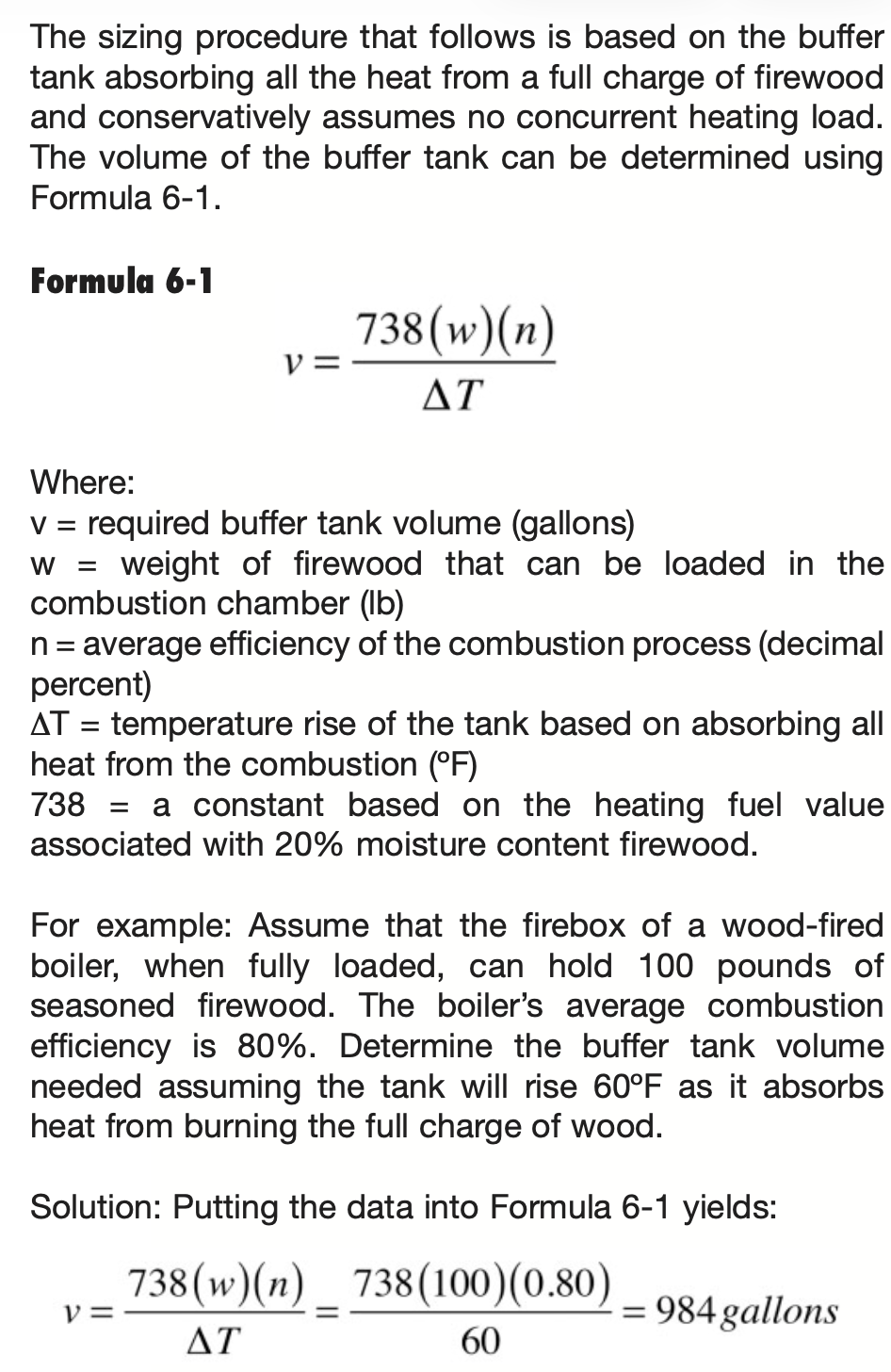
Here is a formula for sizing a buffer.
Basically this shows what size tank to take the boilers output if there are suddenly no heat calls. You want to save the firebox worth of heat, not pop a relief valve and blow it out.
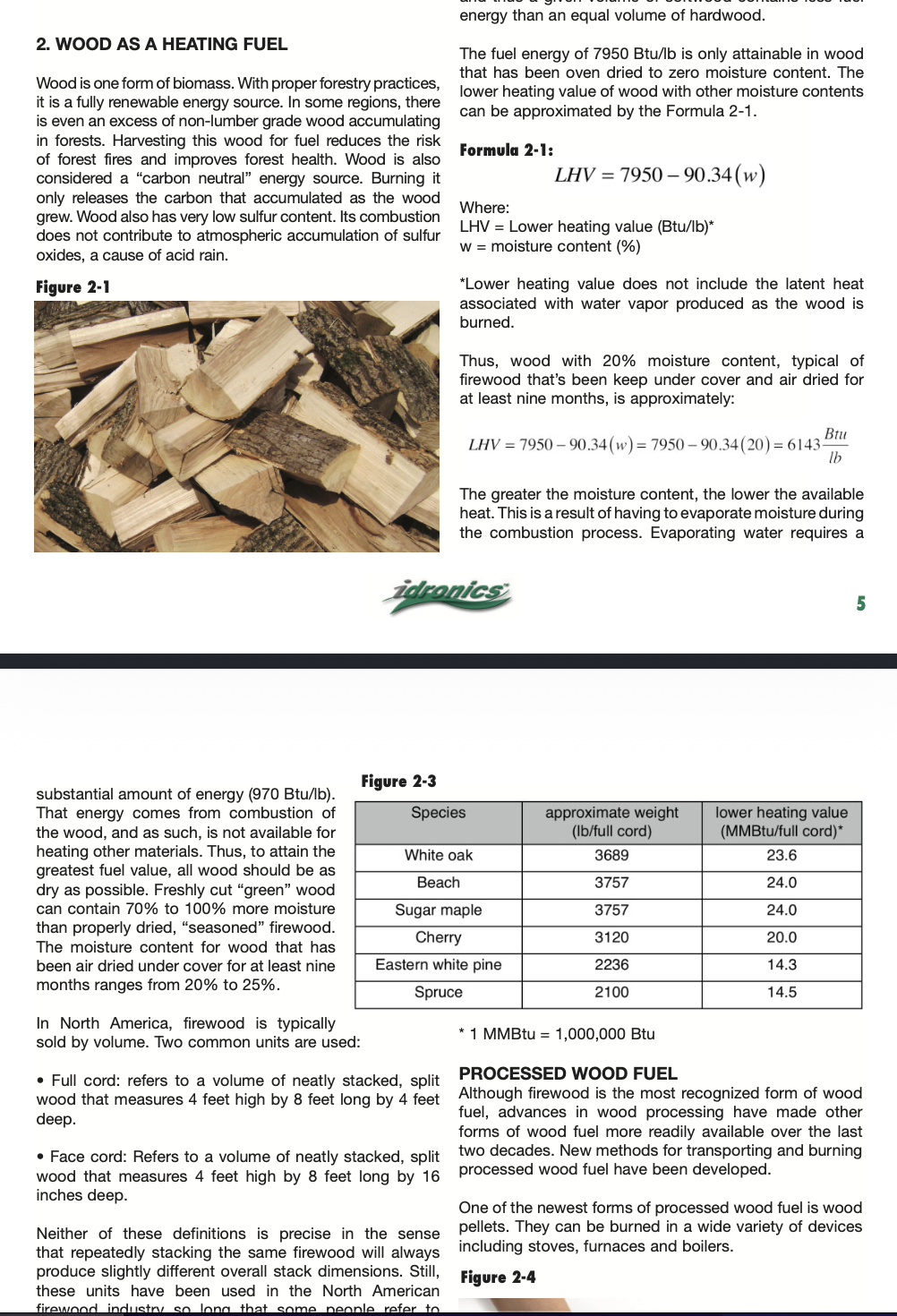
The worse operating condition is to jam the firebox full of wood and expect the boiler to behave. So use this formula with a realistic load of wood you might fire up on the average day. Maybe 30- 40 lbs? Depends on the wood species.
You really, really want dry firewood to avoid creosote problems.
 Bob "hot rod" Rohr
trainer for Caleffi NA
Living the hydronic dream0 -
Fuel management is a huge portion of the act of operating an effective wood boiler heating system. Timely acquisition of the wood, the species and size, drying, storing, and "batch-burning" it is essential for safe and effective heating. A properly sized buffer tank is an invaluable component "between" the boiler and the house. Find a great firewood purveyor and/or be "real good" at acquiring/handling it yourself. A real big buffer tank (a bit smaller if pressurized) is "your friend."
0


Categories
- All Categories
- 87.8K THE MAIN WALL
- 3.3K A-C, Heat Pumps & Refrigeration
- 60 Biomass
- 430 Carbon Monoxide Awareness
- 133 Chimneys & Flues
- 2.2K Domestic Hot Water
- 6K Gas Heating
- 124 Geothermal
- 170 Indoor-Air Quality
- 3.9K Oil Heating
- 79 Pipe Deterioration
- 1.1K Plumbing
- 6.7K Radiant Heating
- 397 Solar
- 16.1K Strictly Steam
- 3.5K Thermostats and Controls
- 56 Water Quality
- 51 Industry Classes
- 51 Job Opportunities
- 18 Recall Announcements