Welcome! Here are the website rules, as well as some tips for using this forum.
Click here to Find a Contractor in your area.
If our community has helped you, please consider making a contribution to support this website. Thanks!
WM EGH-125 - LWCO Probe-Only Options?

Yet another preventative maintenance cycle has come due and I say a little prayer before I attempt to disassemble the McDonnell 67 and hope that I get lucky again and none of the eight tiny screws that hold in the float shear off, followed by another prayer that I can gently scrub all of the accumulated crap out off of the float and out of the delicate folds of that weird articulated sleeve that supports the float without putting a hole in anything.
I again asking myself why I continue with this foolishness. On the left side of my ~11 year old Weil-McClain EGH-125 steam boiler I have a Safgard 400 (in tap “C”) as my back up LWCO and removing and cleaning that probe is a dream compared to this MM 67 mess.
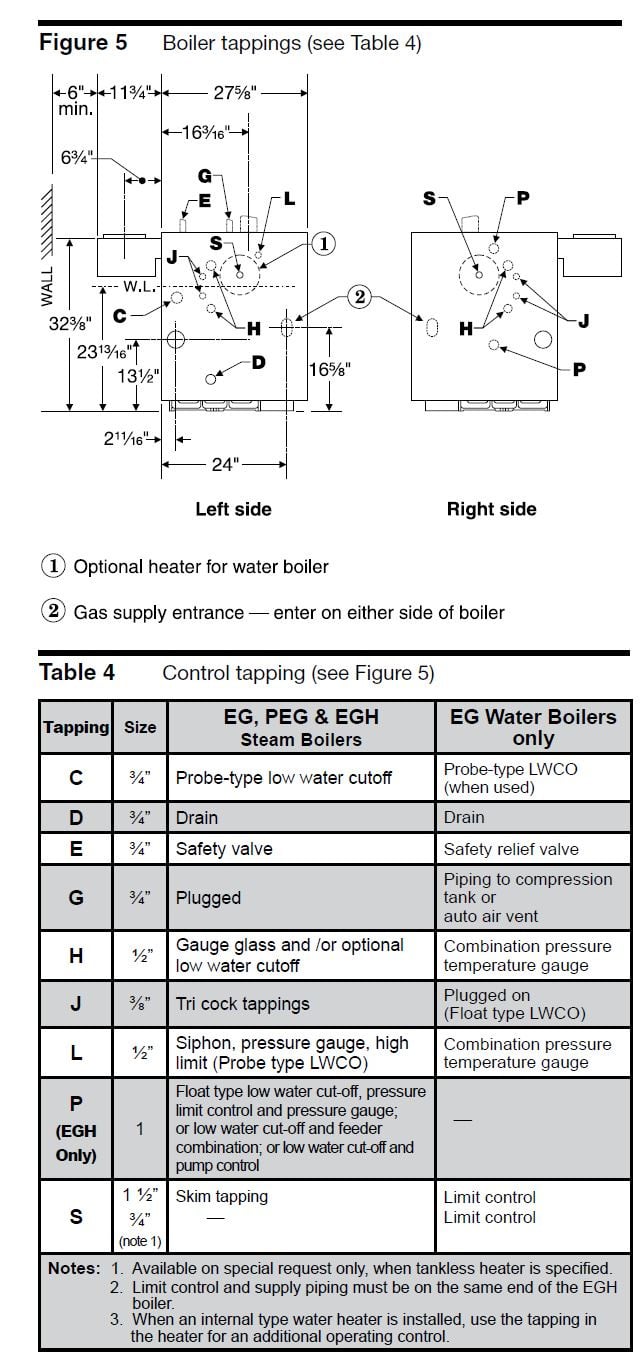
Is there any reason I can’t install another probe type LWCO in place of the where the lower sight glass goes into the right side of the boiler in place of the MM 67 (the lower hole of tap “H”)? I figure I would use a model with a manual reset to alert me if the primary LWCP was failing to shutdown the boiler.
I am aware of the Hydrolevel 711 system that is a direct swap for the MM67. However, I would prefer not needing to do any weekly water removal. (I like to do one big blow down in my yearly maintenance to try and get all of the accumulated crap out, not small removals that just add in what to me seems like unnecessary make-up water.)
The MM 67 is installed in the right side “H” tap holes along with the sight glass.
I have a Hydrolevel VXT water feeder installed. I planned to have it controlled by the probe LWCO installed in the "C" tap on the left side.
The pressuretrols are installed into their own tap “L” on the left side.
Thanks in advance for any help, suggestions, and/or criticism.
Comments
-
Check the lower "J" tapping. The diagram shows 3/8" but some EGH boilers have a 1/2" tapping there. It's far enough above the "C" tapping that a primary probe LWCO will work there, though you might need to use a remote probe to clear the sight glass. Yes, you can get 1/2" probes. Then use the "C" tapping for your secondary. We've done this.
0 -
If the cost of the new control doesn't bother you then change it out. I agree the #67 is not the easiest thing to service and parts are sky high.
Never Seize on the screws and gaskets will make the 67 easier to service.
0 -

Wow, IMO, seems like much more drama than the situation deserves. You should not come anywhere close to breaking off those screws, they don't get wet and they don't need to be super tight.
I'd rather have a mix of technology if redundant LWCO is needed. And if you have repaired as much electronics as I have, I'd rather have the float and the verification of actual operation.
My McDonnell Miller #67 is over 50 years old. I use reusable silicone rubber gaskets.
I guess you like what you like.
National - U.S. Gas Boiler 45+ Years Old
Steam 300 SQ. FT. - EDR 347
One Pipe System0 -
Thanks everyone for the comments/suggestions/ideas.
Yes, I am absolutely being dramatic. But it is just one more time consuming task that I would rather avoid. I would not mind keeping the 67 if I thought it was an upgrade, but I have had the 67 fail both fully on and off over the years and had zero failures with the probe type Safgard. Though I will admit it does give a good feeling when doing a blow off on the 67 during the heating season and see that it does actually shut the boiler off and the water feed comes on, it is not that easy to test a probe type LWCO.
Thanks for the tip on using anti-seize not just on the screws, but on the gasket on the MM 67 to make disassembly easier. I have never purchased a gasket, I have just been using Hercules blue Block as my gasket, which works great, but it once again adds time to the overall cleanup time. I have always been concerned about using any petroleum based sealer (like anti-seize) on this boiler, I did not want to risk harm to the rubber seals between the boiler sections.
Steamhead, thanks for the tip on checking the "J" tap hole size, that would certainly be the easiest, with me only needing to remove one old, possibly seized in plug. The plan I previously described would mean I would need to remove several plugs to move the sight glass around.
Any opinions on which is better/more reliable, 120v vs 24v controls? Currently this boiler has a mix of 120v for the MM 67 and the pressuretrols, with the Safguard, pilot module, and auto-flue dampener all being 24v.
Thanks again for the information.
0 -
If you put Never Seize on the gaskets you will find you can use them over with no issue
0 -
i wonder if using a pH supplement to get the PH up to 9 or so might lessen the fouling of the 67?
Bob
Smith G8-3 with EZ Gas @ 90,000 BTU, Single pipe steam
Vaporstat with a 12oz cut-out and 4oz cut-in
3PSI gauge0 -
The water in our area is very hard with lots of dissolved Mg and Ca. The only boiler treatment that I do is adding sodium hydroxide (lye) to adjust the pH to the 8-9 range. This seems to protect the metal in the boiler itself from any significant corrosion.
When I take apart the MM 67, I don't see big, bark like corrosion on the inside of the cast iron body of the controller. The biggest problem I have is this soft sludge that accumulates in the articulated metal folds of the float that will eventually either bind it up or down.
This system is in a huge, 3 story ~1860 Victorian building with wet returns and a motley collection of heating system changes as the buildings heating system was converted multiple times over its life. There seems to be a never ending amount of this mud like sludge, which I assume is mostly iron oxide, that slowly gets pushed into the boiler from the hundreds of feet of piping and old radiators.
I have just come to terms with this issue and I am just happy I don't currently have any leaks and the sludge seems to keep slowly moving in the system and plugging any of the returns.
0 -
Do you have any idea of how much make up water the system takes? Minimizing that and flushing the returns and boiler may help the system.
Frequently make up water is not added due to major leaks but from a bunch of small leaks that add up like radiator valve packings and leaking air vents.
0 -
I just added in a VXT water feeder in place of the old MM 101A with one of the goals being to know how much new water is actually going into the system. Sadly, I won't have a complete answer to your question until May 2027.
0


Categories
- All Categories
- 87.8K THE MAIN WALL
- 3.3K A-C, Heat Pumps & Refrigeration
- 60 Biomass
- 430 Carbon Monoxide Awareness
- 133 Chimneys & Flues
- 2.2K Domestic Hot Water
- 6K Gas Heating
- 124 Geothermal
- 170 Indoor-Air Quality
- 3.9K Oil Heating
- 79 Pipe Deterioration
- 1.1K Plumbing
- 6.7K Radiant Heating
- 397 Solar
- 16.1K Strictly Steam
- 3.5K Thermostats and Controls
- 56 Water Quality
- 51 Industry Classes
- 51 Job Opportunities
- 18 Recall Announcements