Indirect vs reverse indirect

I have a project coming up that's a tri-fuel system (outdoor wood boiler, electric boiler, and condensing LP boiler) and it has multiple micro zones which would short cycle both the gas and electric boilers without a buffer. 2 person household with minimal DHW usage, but high flow shower heads and a large soaker tub so when it's needed, it needs to be a significant amount. I am tossing back and forth between a smaller <20 gallon buffer tank coupled with a separate 20-30 gallon indirect tank, and a Turbomax 30-3 or 50-3. The Turbomax would obviously save space, money, and piping, but I have some reservation about the efficiency when on gas or electric. Does Thermo 2000 have some sort of a chart that shows tank temp vs DHW outlet temp at X GPM with Y BTU or something like that? Just wondering about tank temp vs DHW output temp, if it's more or less efficient one way vs the other. I have plenty of experience with indirects but have never laid hands on a reverse indirect, so any input would be appreciated.
Comments
-
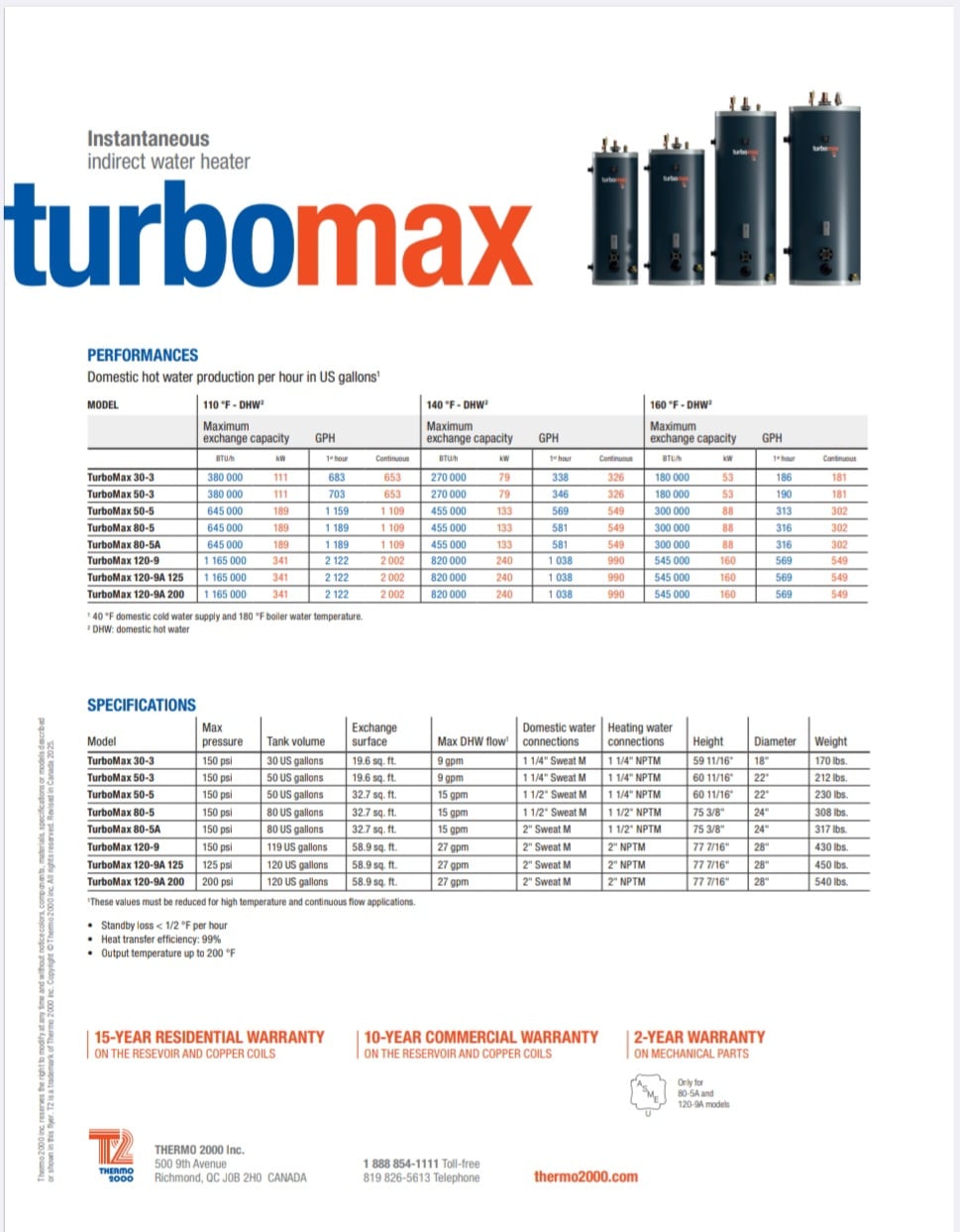
This is based on 180° boiler water temperature. Limit on a reverse indirect should be within 10° of the boiler limit setting (typically 180°). And don't forget the domestic T&P. I can't tell you how many I've seen without one because the installer mistook the 30 psi valve for a T&P. If the domestic is 3/4", I always went with a 1.25 x 3/4 x 3/4 sweat tee. Then a 3/4 street x female for the T&P out the top. They obviously need a mixing valve on the domestic side. Same fittings off the cold side but a drain valve instead of relief valve.
0 -
the boiler in that table is probably much larger than what you'll have so you likely need a big tank to cover that load.
0 -
Some of the important parameters are missing from this statement:
"I have a project coming up that's a tri-fuel system (outdoor wood boiler, electric boiler, and condensing LP boiler) and it has multiple micro zones which would short cycle both the gas and electric boilers without a buffer. 2 person household with minimal DHW usage, but high flow shower heads and a large soaker tub so when it's needed, it needs to be a significant amount. I am tossing back and forth between a smaller <20 gallon buffer tank coupled with a separate 20-30 gallon indirect tank, and a Turbomax 30-3 or 50-3."
I will fill in the ones that will work for you:
I have a project coming up that's a tri-fuel system (outdoor wood boiler that has a 250,000 BTU Capacity, electric boiler that has a 150 kW electric element bank, and condensing LP boiler that has a 399,000 maximum capacity) and it has multiple micro zones which would short cycle both the gas and electric boilers without a buffer. 2 person household with minimal DHW usage, but high flow shower heads and a large soaker tub so when it's needed, it needs to be a significant amount. I am tossing back and forth between a smaller <20 gallon buffer tank coupled with a separate 20-30 gallon indirect tank, and a Turbomax 30-3 or 50-3.
With those sizes on the three boilers, you will have no problem making enough hot water and heating a 900 sq ft 2 bedroom Ranch home. But I doubt your home is that small or your boilers are that big.
Would you be able to be a little more specific on your heating equipment?
Edward Young Retired
After you make that expensive repair and you still have the same problem, What will you check next?
0 -
375k output wood boiler (which is also heating 3200 SF of outbuilding)
180k input mod/con boiler
28kw/ 95k output electric boiler
Design space heating load is 63k @-30*F for 5200 SF. The rest of the capacity is for the snowmelt which is 7 zones and has a combined load of approximately 520k, though it's unlikely that every zone will run together unless available BTU allows- space heating and DHW are priority.
I have since located the performance data for the Turbomax and can get more than enough capacity from the 30-3 using any one of the boilers with a <140* SWT to the tank which eliminates most of my concern regarding efficiency. The jury is still out, however, on indirect vs reverse indirect in terms of performance.
0 -
You will not get even close to the recovery that you think if your going to supply 140 degree boiler water to the tank. You can call it a reverse indirect all you want but a turbo maxx is a instantaneous hot water heater. if you dont supply 180 degree water in the tank you are going to reduce the capacity of the domestic hot water. All the numbers are based on 180 degree supply.
The other thing with a Turbo maxx is being an instantaneous water heater the more GPM that flows thru the tank coil the less temperature rise you will have. and you need a big BTU output to keep the boiler temp up. i don't know how your controlling the boilers but the electric is a no and the MOD/CON is considered really small for this application. You can even see that with the BTU recommended from there charts. I hope your staging the boilers and not thinking one will do the job
 1
1 -
or you need probably the 120 gallon turbomax to store enough heat for your needs.
0



Categories
- All Categories
- 87.6K THE MAIN WALL
- 3.3K A-C, Heat Pumps & Refrigeration
- 59 Biomass
- 430 Carbon Monoxide Awareness
- 125 Chimneys & Flues
- 2.2K Domestic Hot Water
- 5.9K Gas Heating
- 121 Geothermal
- 169 Indoor-Air Quality
- 3.8K Oil Heating
- 78 Pipe Deterioration
- 1K Plumbing
- 6.6K Radiant Heating
- 396 Solar
- 16K Strictly Steam
- 3.5K Thermostats and Controls
- 56 Water Quality
- 51 Industry Classes
- 51 Job Opportunities
- 18 Recall Announcements