Welcome! Here are the website rules, as well as some tips for using this forum.
Click here to Find a Contractor in your area.
If our community has helped you, please consider making a contribution to support this website. Thanks!
The math isn't mathing!
Comments
-
i know i keep asking this, but has anyone done a manual j yet so you know what you're trying to accomplish?
0 -
This first floor floorplan is different from the other floor plan you have provided. I will use this new plan for all the rest of my comments.
There is a large difference in the way you show the piping arrangement to the radiators and what a monoflo® piping arrangement might look like. What you have drawn looks like a series loop.
I will point out the difference in the following diagram. the violet lines are the 3/4" main pipe in the series loop and the MonoFlo® diagrams. On the Left MonoFlo® diagram you can see the tee locations on each radiator takeoff and the smaller 1/2" take off pipes from each tee branch.
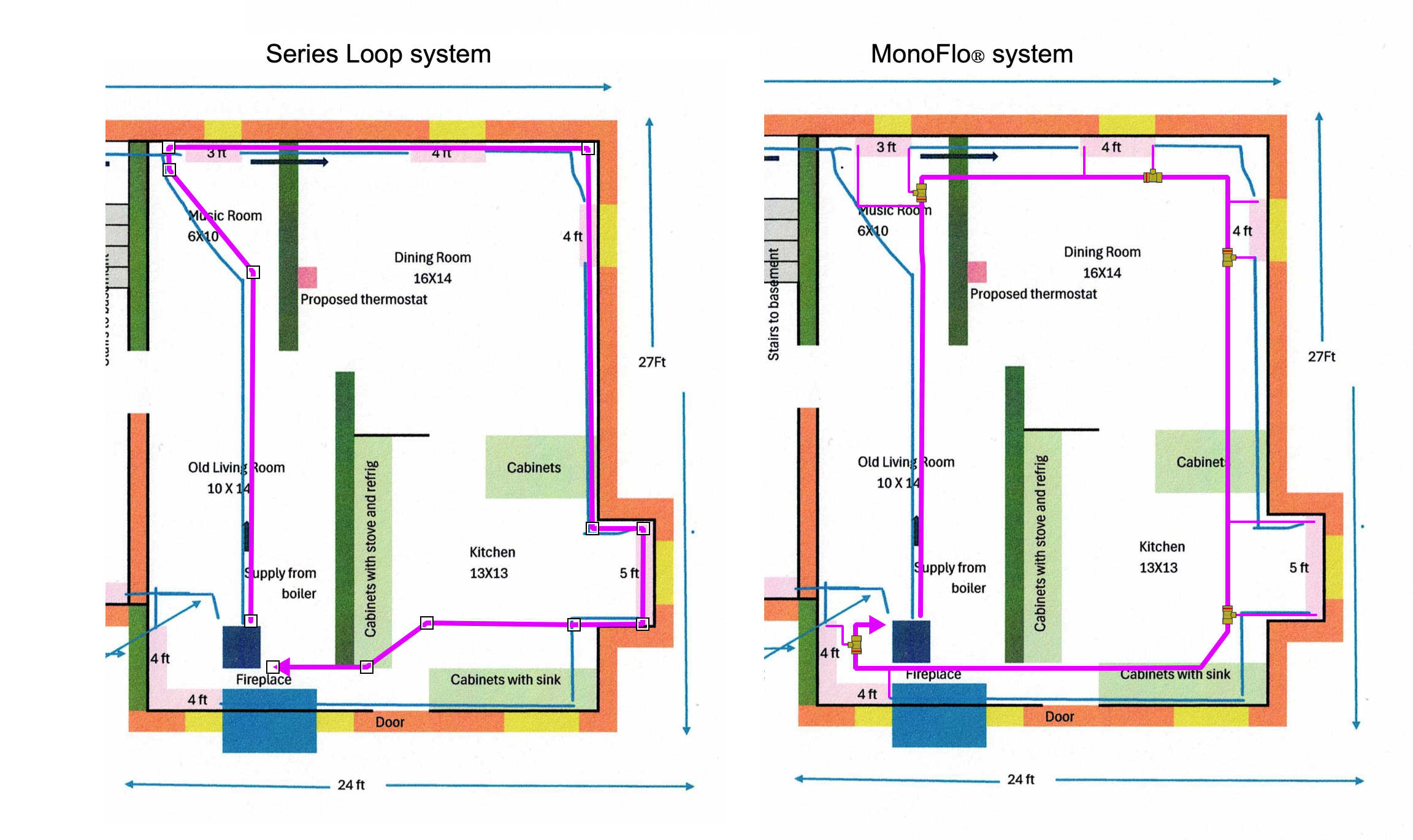
This is my first question as a point of clarification. Since you drew it like a series loop and mentioned MonoFlo® in your description, I want to be sure I’m giving you good advice. Can you clarify whether or not you have MonoFlo® tees in your original system from the old 1930 or both the 1930 and 1980 sections?
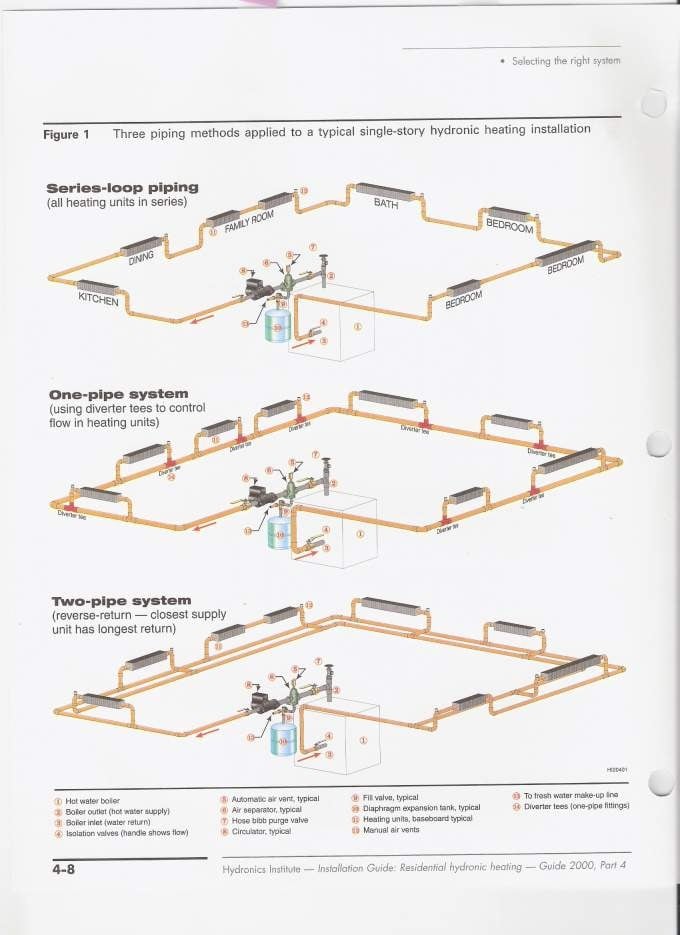
This is a diagram from the I=B=R Hydronics Installation and Design Guide 2000 that I use to train new technicians. Looking at the first and second diagrams you can easily see how they are different.
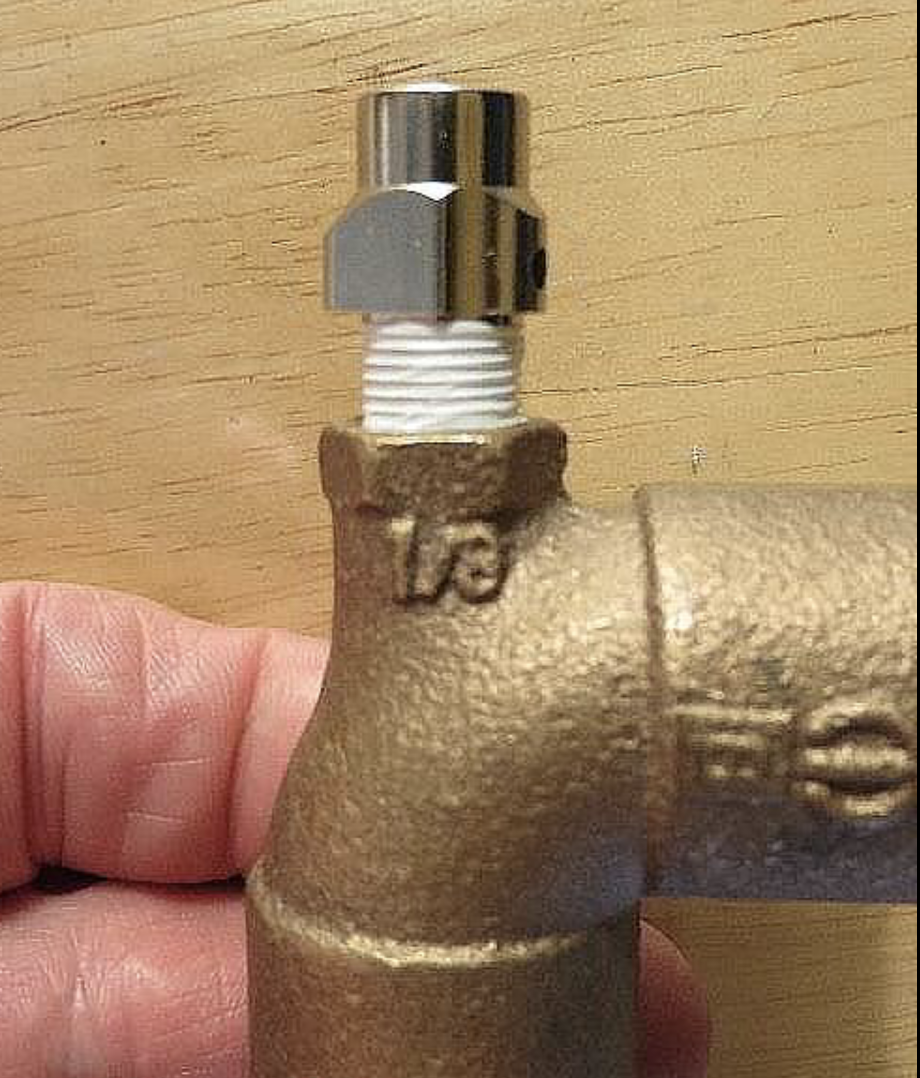
If you have the MonoFlo® design that the Guide shows as to One-Pipe system then you will need every baseboard radiator to have a vent to get rid of the air at each high spot. like this photo:
Edward Young Retired
After you make that expensive repair and you still have the same problem, What will you check next?
0 -
My next observation is that the newer area has more radiator capacity per square foot than the older area. This seems counterintuitive, as one might expect the older area—likely having less insulation—to require more radiator capacity per square foot.
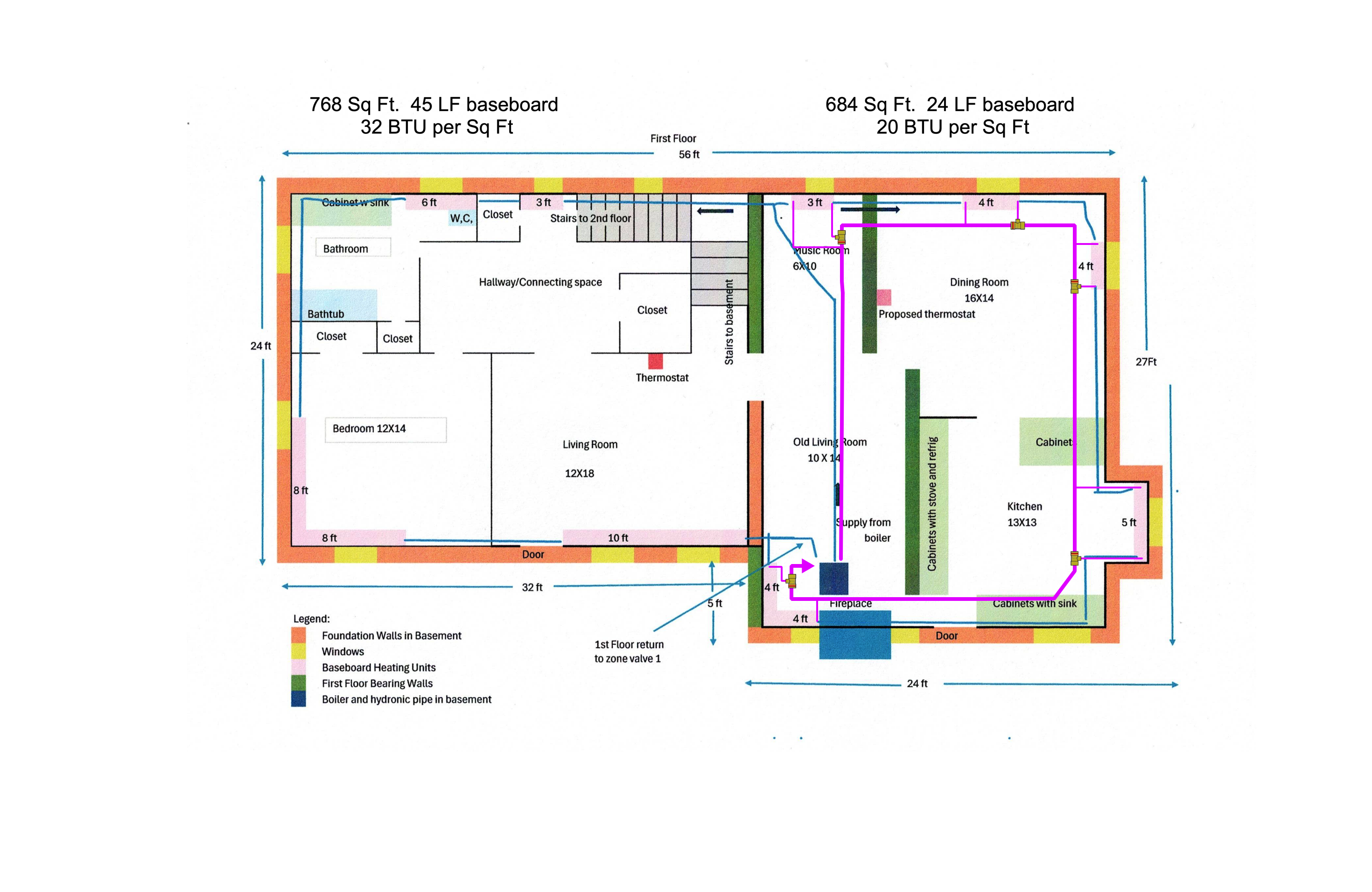
It would make sense that the older section is colder than the newer section when using the same thermostat. Placing those two sections on separate zones would also make sense. However, you still may not get the heat you need for the older section. You may want to consider adding a Kick-space Heater under a kitchen cabinet to increase the emitter capacity on that side of the first floor. This is the best time to do it while the system is drained.
A heat loss calculation would also help in diagnosing your problem.
Edward Young Retired
After you make that expensive repair and you still have the same problem, What will you check next?
0 -
It IS monoflo on the first floor. I did not show it exactly…my apologies. It is, in fact, the newer section of the house that is colder, which may be counterintuitive.
Part of what I'm doing at this time is insulating the basement walls, in the newer section. The back section is in a hill—only the top 2 ft of basement wall is above ground. As you move forward, it turns into a walkout basement in the front.
When it is very cold (10F or below), the basement is probably in the 50's.
0 -
Have you posted photos of typical emitters in the older and newer sections of the house? If the older section has cabinet style convectors and the newer has baseboards, that accounts for the difference in linear footage. The convectors have multiple tubes in wider elements and higher heat output per linear foot than baseboards.
—
Bburd0 -
do the emitters have 1 or 2 monoflo tees on them? the shorter sections probably should have 1 tee and the longer sections should probably have 2 or 1/2" tees on the short sections and 3/4" tees on the long sections.
going around with a clamp thermometer could tell you a lot about how much flow what is getting. it might be underradated when it is 0 but when it is 30 it should be able to keep up and get it toasty in there.
is there a good tight damper on the fireplace? if that it drafting much of anything it can pull a lot of heat out.
0 -
The fireplace has a wad of fiberglass insulation stuffed in above the damper (yes, it's in bad shape) plus foam board under the damper. Long term plan is a modern gas log insert with outside air for combustion—but the budget isn't available yet. Chimney refurb would be needed. The boiler and water heater feed into a common flue with a new liner in it.
I'll go down and look closely at the tee situation. I THINK there are monoflo tees on the inlet end of all the emitters—3/4 inch main with 1/2 inch up/down to them. The main before the tee is either 1 inch or 1-1/4.
0 -
taking temps with a clamp on thermometer at both ends of emitters or the connections to emitters and at various points on the loop will give you a lot of information about if you have enough flow. if the delta is 40 or 50 f degrees from one end of the loop to the other or one end of an emitter to the other you're not getting nearly as much output as you could be with more flow.
0 -
Something like this and either a thermometer or dmm that supports a thermocouple. i think the little version of this cost about half that price when i bought it ~8 years ago.
0 -
IMHO you need more baseboard especially on the FF. With the open stairway the FF is helping the second floor heat. I agree with splitting the FF zone but I doubt that will cure your problem but will probably make things more comfortable if you add the baseboard. I would do both.
0 -
The heating improvements I have in mind, and will depend on finding the $ to do them are either/both of the following:
- Put in a modern, sealed, outside air source gas log system in the fireplace. With the known chimney repairs/improvements, probably on the order of $10K +
- Insulate the basement walls, especially in the 'new' (front) section, and add one of several heating options to the basement, to at least keep the basement at 60-65F on the coldest days. Insulation + heat will probably be at least 5K, if not approaching 10K. Heat options would be (a) a "garage" type Hydronic unit, (b) Mini-split (advantage for dehumidification in the summer or c) Some kind of electric 220V unit. This may also involve things like basement window replacement.
Both are ideal. The budget will be the issue.
0 -
the manual j with 50 on the other side of the floor and 60 on the other side of the floor won't be that different, most of your loss is through the walls and infiltration
0 -
Ok, guys, first of all, thanks for all the patience as I try to learn how all this works. I purchased a cheap 'clamp on' temperature device, and have 2 questions:
- Typically, what would you add to the temperature on a clamp on measurement to approximate actual water temperature inside the pipe (copper pipe)?
- An initial check shows the DeltaT between the main supply and main return (all zone valves open) of between 12 and 15F, at 34F outside air temp, inside temp around 64F, set points at 68F.
- Aquastat set at 190F/20F differential
I will go around and get more readings as I have time to do so.
0 -
check temperature right at the heat emitters also. That temperature will determine the amount of heat output
Generally the delta t will be wide on first start up it closes up as the heat emitter and room warms up. So plan on the delta moving around.
The delta is an indicator of heat being transferred to the room
Bob "hot rod" Rohr
trainer for Caleffi NA
Living the hydronic dream 1
1 -
and of the flow in the emitters. with it being monoflo you want to see the delta t be fairly small across the emitters but if there isn't enough flow to split in to the emitters then the delta in the emitters will be large and you will lose a significant amount of output.
0 -
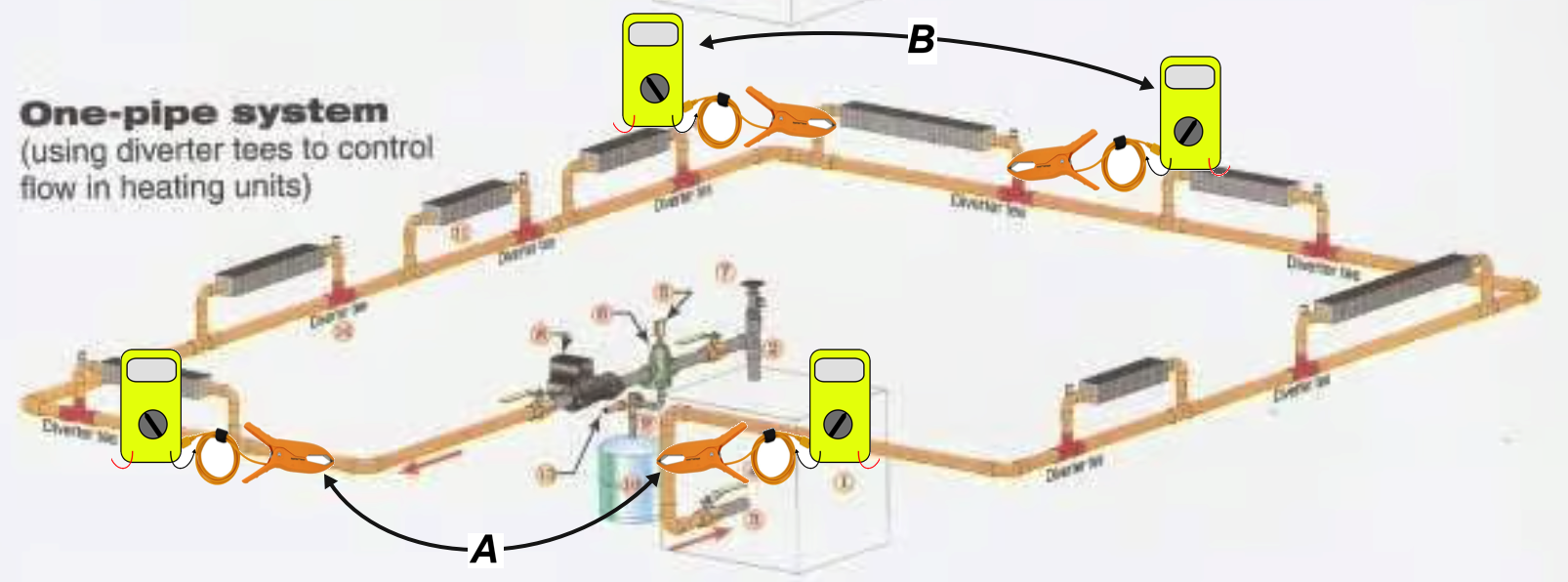
Here are the two places you want to measure the temperature difference (ΔT). A is the complete system ΔT, and B is the individual radiator ΔT. You should measure B on all the radiators to properly diagnose your system.
Edward Young Retired
After you make that expensive repair and you still have the same problem, What will you check next?
1 -
Alot of post here , late to the show so here we go . In my years installing and trouble shoot issue when i come to mono flow system they should be dealt w a little respect being it seems to me that mono and series baseboard system are too different animals and usually dont play well together flow /pressure drop thang usually have way different flow characteristics one really just pipe w not much piping resistance in comparisons to a mono flow system w a pressure drop through each mono flow tee, Long ago after dealing w many installs for others and over the years and a little reading and thought i figured the easiest way which worked for me on my jobs . Its really nothing fancy except to think a bit . Usually i will always treat a mono flow system as it own ,the temptation of adding a zone valve and working off one pump is usually the issue . A seperate pump for the mono flow and one for the baseboard and never had a issue in over 30 years of doing it this way . I have seen to many to count jobs where adding a baseboard zone to a existing mono flow will have issues unless your gonna spend a fair share on balancing and flow raters and a ecm pump . Just make it a 2 pump system and your issues will disappear . Easiest way i ve trouble shoot it is if your second floor baseboard zone are satisfied while both zones are calling and your td across your mono flow is increasing it s due to water being lazy and taking the less restrictive course . This comes from the land of additions and add levels to existing older homes and the cheapest price usually wins and doing it as fast as possible goes w the job ain t no money if your gonna think and go slow plus its got to be cheap so the gc can add a bundle to the money to get his share , truth be told it extremely common and most mech know that it s a lost cause money wise and move on the real fix costs and most want a cheap miracle never happens especially these days makes zero sense to work for nothing while franchise places are all just bout the money and how to build a business and sell to corporate oh yeah get ya on a service contract excellent steady income love it . There are not many chiefs out there just indians looking for money for the chief . Peace and good luck clammy
R.A. Calmbacher L.L.C. HVAC
NJ Master HVAC Lic.
Mahwah, NJ
Specializing in steam and hydronic heating0




Categories
- All Categories
- 87.8K THE MAIN WALL
- 3.3K A-C, Heat Pumps & Refrigeration
- 60 Biomass
- 430 Carbon Monoxide Awareness
- 133 Chimneys & Flues
- 2.2K Domestic Hot Water
- 6K Gas Heating
- 124 Geothermal
- 170 Indoor-Air Quality
- 3.9K Oil Heating
- 79 Pipe Deterioration
- 1.1K Plumbing
- 6.7K Radiant Heating
- 397 Solar
- 16.1K Strictly Steam
- 3.5K Thermostats and Controls
- 56 Water Quality
- 51 Industry Classes
- 51 Job Opportunities
- 18 Recall Announcements