wiring for honeywell / residio VR8345Q4563 two-stage to supplant VR8204A2001 on williamson GSA-125

the documentation for two stage operation is kind of spare in the installation guide.
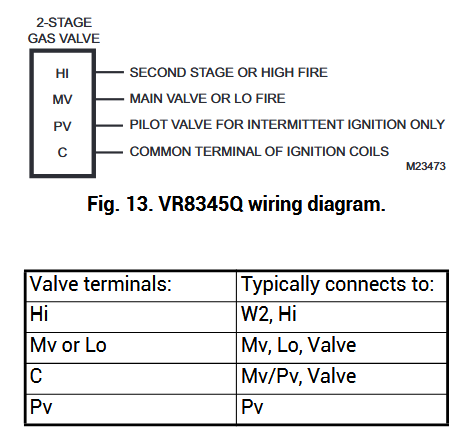
Its funny the two-stage valve has a 3 conductor plug almost identical to the single stage i'm replacing with terminals labeled Pilot Valve (PV) -Blue wire, Common (I assume, actually labeled in small letters PV/MV) - White wire , Main Valve (MV) - Red Wire. And the three conductor plug fits in the new valve, but the strange thing is that the little raised plastic interference on the end of the plug to prevent you from plugging it in the wrong way is on the opposite end of the plug on the new valve as the old walve so it plugs in backwards.
I'm just going to make a new harness from individual conductors with 1/4" female space terminals and matching wire colors for consistency for the time being and first trial in accordance with the clear labeling of the terminals. but i know folks have made this conversion for this and/or the similar weil mcclain EG series, so just wondering if others notice this anamoly.
I'm also pretty clear that the MV terminal actually calls the low-stage because there is a side pony terminal on the VR8345Q that is label "HI". I talked to Residio who confirmed this, although not with the robust familiarity I would have preferred. Again, I can work it out by experiment, just seems like they could make it more clear in documentation which seems to concede it once in the fine print whereas I would lead with this–albeit this is full line documentation, they might have been well advised to have separate documentation or pages for the two-stage valve within the line.
additionally, although for now i'd honestly be happy running this a one-stage on the low stage, i can't find a theory of ops that tells me if high stage requires power to both stages, or whether i should have it drop the low stage. again, i got a "i think you need both" from residio. be nice if they were sure. maybe this isn't a big sector and the vast majority of the install instructions are not for the "Q" variant which is the only two stage. there are numerous other single stage versions of the same valve.
of course it isn't an 8245 because they don't make an 8245Q, i.e. two stage, version in 1/2". it would be really nice if they had a little better explanation for their model numbers. I kind of assumed that the "2" is 1/2" input and the "3" is 3/4" input but thats just me making an empirical guess, they might be more sequentially related designations for BTU rating or . . . who knows.
anybody got anything for me on this? just like to fill in my database using the crowd source where the manufacturer is a little thin. And grinding my axe about how boiler makers ought to have more two stage worked out for these boilers anyway. I've been firing this at around 1.7" WC for a couple of months by cranking down the input valve and i'm clocking that from the gas meter as delivering 107,000. get more stable water line, dry steam, it is a tamee and more effective animal that, with this radiation, condenses at about the same rate it steams. little sacrifice in efficiency. of course are no adjustments on the air gates and while less gas pulls less air the ratio isn't precise and i'm getting excess air. the CO2 only comes down to 11% but the lack of slugging and short cycling has way made up for that. and i'm not getting lazy flame pulling away from burner outlets so I'm actually happy with this as single stage but I can't see that anyone offers a readily available comparable intermittent pilot single stage valve that adjusts down that low (and this experience really gets me wondering, this is the 125 nameplate input and they offer the same block with a 150 input which seems nuts to me. maybe with a lot of pumping you could take BTUs off at that rate with good high delta hydronic application, but I think this would be better off with a 100,000 btu burner at 3.5" WC. that's an out strategy alternative I have it the back of my mind: to remove and plug one burner tube and fire with original valve..)
final anamoly i note is that most valves i've seen have a screw on cover over the regulator adjustment. this has a light push on plastic cover and used a 2.5 mm allen wrench for adjustment. i guess honeywell made it that way so they have the seals figured out and they just use the plastic as a dust/debris cover.
brian
Comments
-
You seem to be in Boiler OEM Engineering territory. There may be other factory documentation for Boiler OEM Engineers that field techs / public do not normally need. Too much information often causes confusion in some situations. And the Boiler OEM can do their own experiments in a Lab environment.
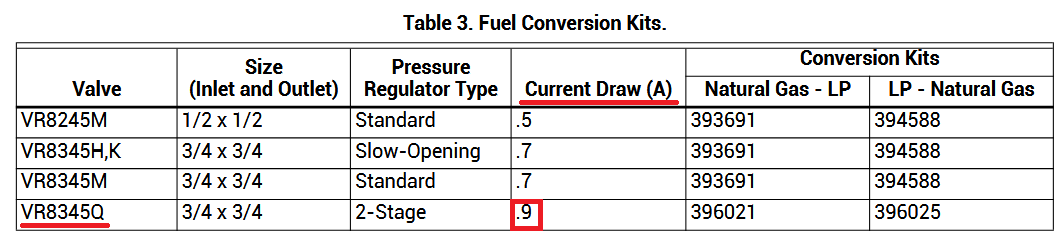
As far as High / Low stage control I'd use the stated current draw as a clue. There may be some logic or sequence to the Gas Valve for safety that you need to deal with. How are you going to control the High / Low stage transitions ? Steam pressure, time, both ? I'd think you would want high fire to get things going then reduce to low fire. Also maybe depends on how long the boiler has been off and system load (outdoor reset). Sounds like some PLC type fun to me.
 National - U.S. Gas Boiler 45+ Years Old
Steam 300 SQ. FT. - EDR 347
One Pipe System0 -
@109A_5 of course i'm interested in the numerology in the name, but i had noticed the draw and imagined that probably meant that coils ran in series.
i admit i don't think fig. 12 and 13 is where i saw the reference to main as low fire. i think I was higher in the instructions but it was similiar, it called out Main but had Lo in parenthesis. And the bus does not look as indicated or implied in fig. 12 with the 4 teriminals in a row. rather the three terinals are in one bus obviously cribbed from a single stage valve and the single stage plug fits it (although by the labels it plugs in backwards as I mentioned so unless I figure the secret of releasing the brass female spades that snap into the plastic male assembly of the harness I'd have to cut and cross the blue and red wire so I think i'll make a new harness. then there is a completely separate two terminal bus with one of the terminals labeled Hi and I assume the other would be another common.
with all the verbiage in these things it would be really handy in the case of many controls if they would give a better theory of ops although I get that most often field work is just taking out a control and putting in one that matches. although even if not necessarily adding feature or function, sometimes you can't get the exact match.
my original plan was to trigger the stages using a Dwyer DH3 style vapor pressure gauge with two switching stages. seemed like a perfect control only the one I put on there breached its seal in no time. The documentation seemed to say that it could handle being expose to 30 lbs although the measurement range was up to 50" WC and I had it on a pigtail. Although some one of the steamheads on here (although I don't think literally @Steamhead) has a dwyer electronic gauge running naked on a long riser, so I don't know what happened but i'm jaded and $200 bucks poorer (and can't really see this as a permanent solution as they supplanted the DH3 with DHCs, similar function but plastic instead of aluminum case with maxium expousre limit of 6 pounds. Still theoretically in the range but don't like the plastic with the heat. The Dwyer guys at AHR told me to send it in so they could take a look but I might be back to the original Dwyerstat idea on one of the lost threads on here when they changed platform. I got a clip of it off the wayback machine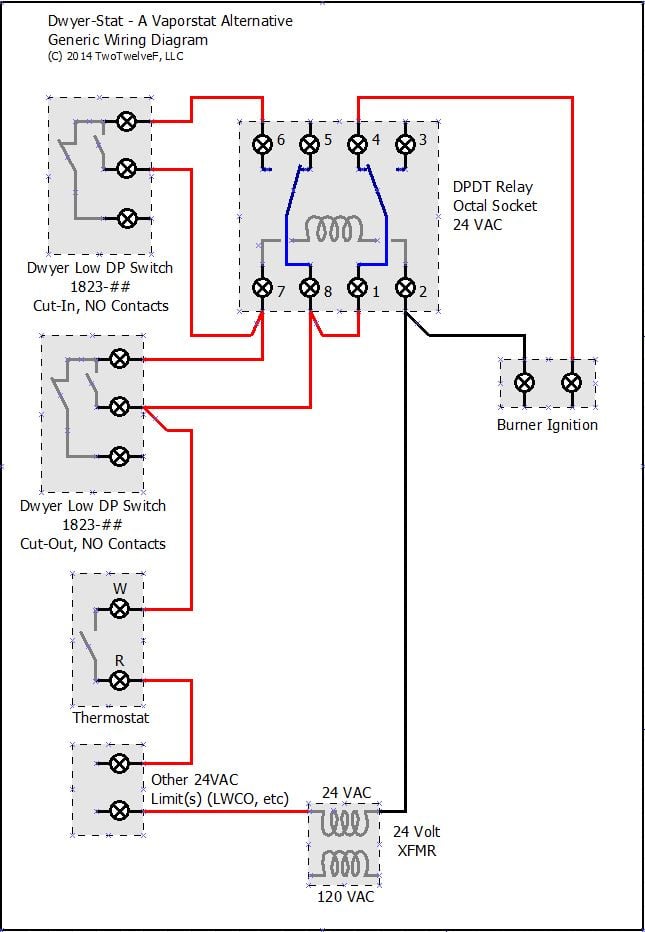
Anyway, while i worked on the control strategy i have been running the thing at the approx equivalent of low all season and it is a little slower to make steam but not bad. we just moved the morning pickups 1/2 hour earlier and once steaing it matches the condensation nicely so it just purrs along in low while the thermostat is calling–delivering nice dry steam.
So given my disappointment with the DH3, where I have to buy old stock off ebay anyway, I've backburnered my hopes that that would be the perfect two stage steam controller. Of course while Dwyer said they thought it ought to work, these controls are used most often for monitoring differential pressures to insure that clean rooms are maintaining slight positive air pressure. And since domestic steam boiler manufacturers are generally not focused on two-stage operation Dwyer's incentive to consider repurposing these as OEM or regular aftermarket controls in the steam market is non-existant.
admittedly, this boiler was a scratch and dent from the era a few years back when williamson was not putting outlets in each end section so while i maintained 3" to header I didn't have the ability to further reduce steam velocity by using a twin riser setup. I've had nothing but grief with these new smaller designs that are really just repurposed hydronic boilers* in terms of dry steam and stable water levels–despite skimming at commissioning and regular thereafter downfire has been the most reliable answer but industry seems uninterested.
brian*possible exception of megasteam in terms of designed for steam, but I haven't put one in and burnham got behind the eight ball with some reputational problems with its once 'cast iron' cast iron boilers. although couple supply houses and contractors been singing their praises to me. still, burnham has focused this on oil and virtually all applications I have are natural gas or propane so at the outset I'd have to repower them adding further to the higher cost and you have to wonder again if the manufacturer wants to even support that option (if they are at the installer show in NYC next week I'll follow up on that. If you are going to make a steam boiler aimed at a small segment of the market to begin with, i'd at least increase your target market by offering commonly available fuel types.
0 -
@archibald tuttle , we've been telling Burnham that since the MegaSteam came out. They just won't listen. Hard to believe they can't see oil is a declining market.
0 -
@Steamhead couldn't think i was the only one who thought of it. let's keep at it. meanwhile i'd like to see better 2 stage support for the atmospheric natural gas steam offerings.
0 -
I Googled " residio VR8345Q4563 data sheet " found this page and there is a Literature tab that has more Marketing Collateral and Technical Documents. Maybe there is some documentation there more to your liking,
Maybe I'm missing something (maybe more even comfort), why the two stage ? If the boiler is correctly sized why would you need the two stage ? A correctly sized boiler won't build pressure. Is your boiler oversized ?
I have multiple eBay NOS Dwyer Magnehelics, so far no seal issues.
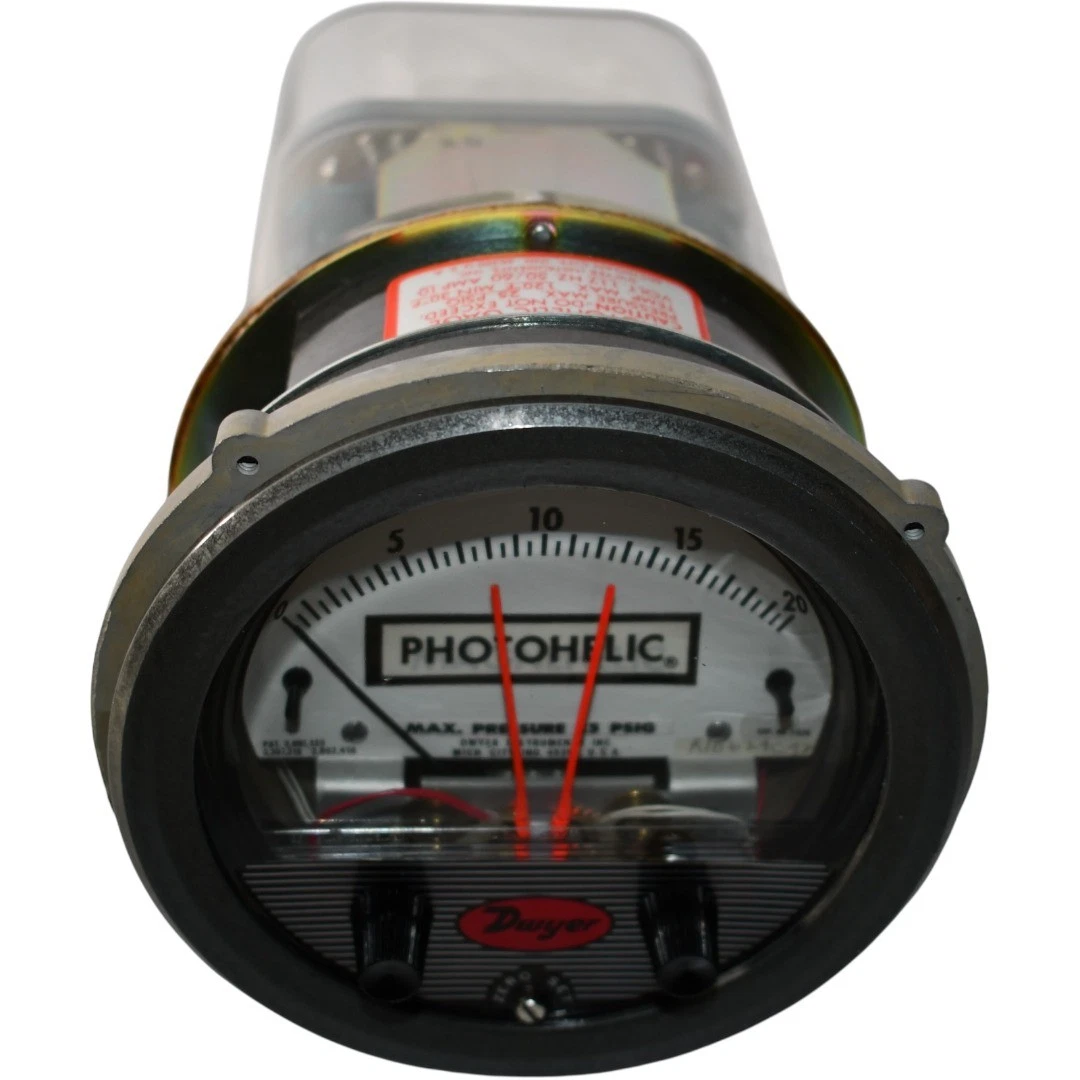
The Dwyer-Stat concept is much like the Dwyer Photohelic series.
 National - U.S. Gas Boiler 45+ Years Old
Steam 300 SQ. FT. - EDR 347
One Pipe System0 -
so this is 125,000 btu boiler and at low stage i'm clocking about 107,000 and that is maintaining about 10" WC steam with the whole system hot. it is probably tiny bit different in terms of condensing when the house temp is 60 after setback vs. 68 or 70 (for that matter you might be able to institute low or high firing from staging in a thermostat that knows the indoor temperature); but essentially i'm looking for low fire to balance condensation. whether i have high fire for pickup or just wait longer for the system to reach equilbrium hasn't been that much of an issue in my experience.
most of the systems i run don't build pressure and rather than try to stop and start them around really low pressures i'm looking for a firing rate that will balance condensation-and thus maybe i don't need the digihelic with switches so much as for accurate vapor pressure readings. I'm crestfallen that the DH3 gave out in a few weeks. it was so sweet to be able to watch the steam pressure with accuracy in those really low ranges. And the dual benefit is this tends to be a firing rate that reduces surging and wet steam in today's 'steam' boilers that don't have notable steam chests or always facilitate double risers. To the extent the boiler is oversized, that can be so in terms of btu input but as far as water storage, stable waterline, etc. the boiler is still undersized from my perspective. So if im willing to talk the customer through front-end anticipation, i don't really need two stage, i just need low fire. But the two stage could allow for a difference between pickup and maintaining steam.
as an aside, there are themostatic (that is responsive to room temp) air valves and even steam zoning valves and the occupancy habit of turning off rooms or portions of building (and really nice thing about steam is you don't have to worry about freezing although in my experience this mostly doesn't result in rooms that get to freezing but on design cold nights if you aren't running the baseboard in some portion of the house, way more conceivable to get a freeze up, i've seen it just with deep setbacks on baseboard) so two stage could also be effective in these circumstances although careful balance with adjustable vents returns to the idea of getting a single ideal firing rate. but no matter how much calculation you do, this is going to established emperically.probably it wouldn't be a bad idea if some range of combustion air adjustment were provided on atmospheric boilers to allow the best combustion settings even at a lower firing rate, but i haven't seen an atmospheric that isn't fixed ratio in a while. when you think about it, most power burners installed in a boiler offer a range of firing rates even though there is a recommended one. you can adjust the gas pressure on atmospherics within a modest range but that is mostly aimed at getting the best approximation of nameplate firing and combustion effectiveness. If you want to set the input btus for steam operational stability, the good old adjustable air collars on the burner tubes would be handy to help keep combustion efficiency best targeted while keeping CO and NOx under best control. maybe these adjusters are an example of things people mess with who don't know better or think its just a matter of flame color and maybe if they were included you want limits on their adjustment; but if we are going to combustion check everything as we do these days and not depend on the out of the box set (which i'll admit was my practice for years with atmospherics), why dont we have air adjustments. i don't think they need to be over engineered to adjust all tubes at once although i guess i could imagine such a system, it is easy enough to set half a dozen tubes to the same setting. my 2¢
brian
0


Categories
- All Categories
- 87.8K THE MAIN WALL
- 3.3K A-C, Heat Pumps & Refrigeration
- 59 Biomass
- 430 Carbon Monoxide Awareness
- 132 Chimneys & Flues
- 2.2K Domestic Hot Water
- 6K Gas Heating
- 124 Geothermal
- 170 Indoor-Air Quality
- 3.8K Oil Heating
- 79 Pipe Deterioration
- 1.1K Plumbing
- 6.7K Radiant Heating
- 396 Solar
- 16.1K Strictly Steam
- 3.5K Thermostats and Controls
- 56 Water Quality
- 51 Industry Classes
- 51 Job Opportunities
- 18 Recall Announcements