Formula , what sized plate heat exchanger to use

70k boiler,
600 gallons water
trying to get temp from 55 degrees to 85 degrees
going to primary secondary boiler loop to a plate heat exchanger with its own pump? (guessing so)
what sized plate heat exchanger to use and what pump?
Comments
-
Again, I'm not an expert, just a homeowner/mechanical engineer. You might want to mention for others who haven't read your previous thread that this is for a church baptismal pool that will be heated overnight, so there will be a long (12 hour?) period during which the 600 gallons gets heated. So the heating process can be quite gradual. That volume of water will need about 150,000 BTU to be heated by 30 degrees, so with a 60,000 BTU/hr output, it will take at least 2.5 hours, and longer to account for heat loss along the way.
Next question is what size are the pipes in the secondary loop to/from the pool, as that could limit your gpm flow rate in the secondary loop. I think you said 2" copper? If so, the limiting factor is probably the heat exchanger, as the pressure drop through the HX will dominate.
0 -
149,940 btu's/ hr. But assuming 70k @80%, 56k, you can only flow about 3.75 gpm.
1 -
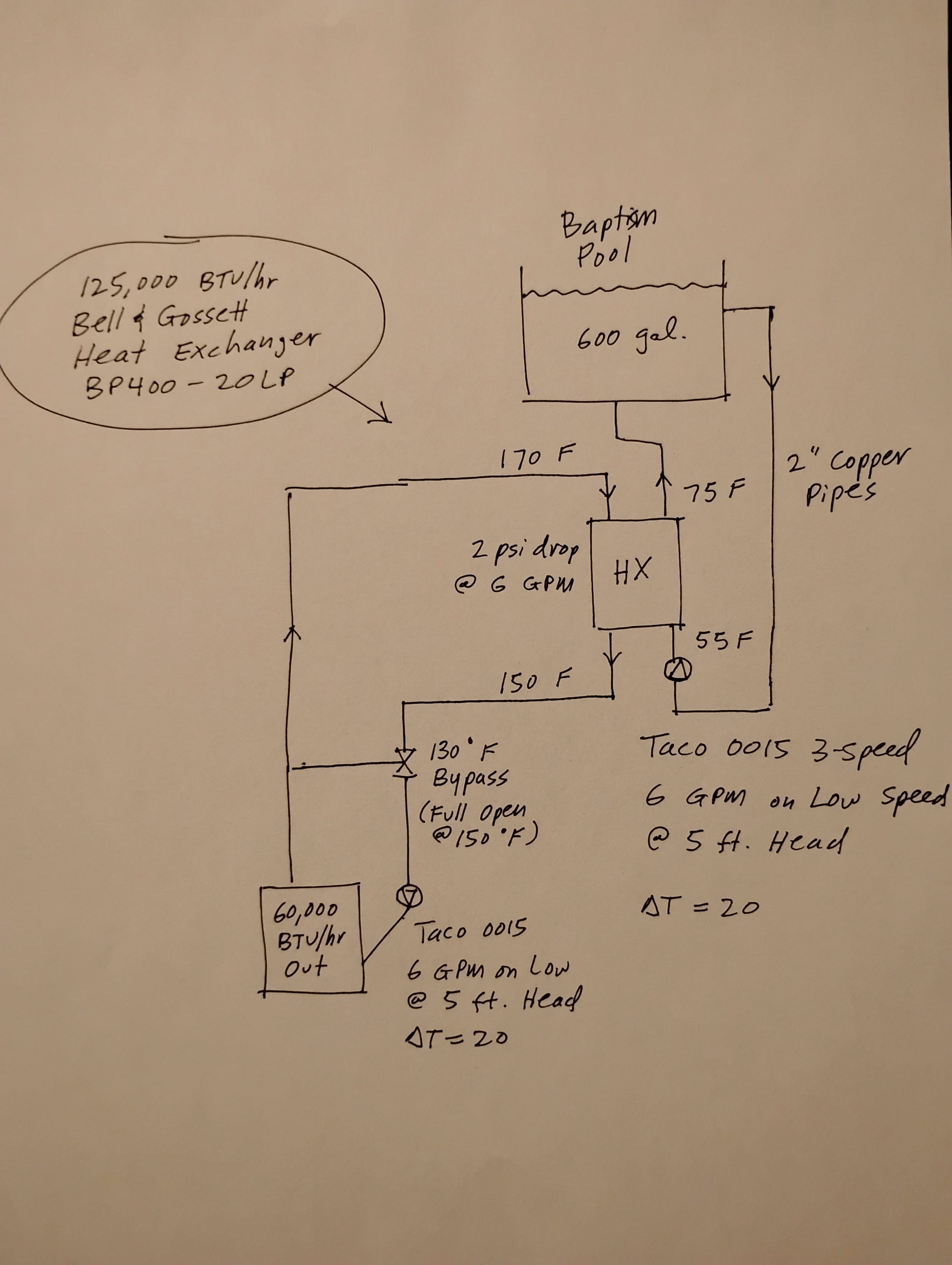
A pool heater may well be your best option, as being discussed on the other thread. But since you asked about heat exchangers, here's a possible option using a Bell & Gossett 125,000 BTU/hr heat exchanger (BP400-20LP). The HX is oversized in order to reduce the pressure drop to something reasonable so you don't need bigger circulators.
Again I'm not an expert, and don't build anything based on this. The experts can tell you what I got wrong. 😀
But with a 60,000 BTU/hr boiler output, for a delta T of 20 F, you'd need 6 gpm in both loops. With your large diameter (2") piping, you'll have very little head loss, most of which will be through the heat exchanger. The above heat exchanger has a pressure drop of about 2 psi (5 ft head) at 6 gpm. That's a fairly low head, so you can use a small circulator like a Taco 0015 3-speed set on Low. The variable speed means you can increase to Med or Hi if you want higher flow rate and lower delta T through either loop.
The bypass is an ESBE thermostatic bypass valve with a cartridge that starts to open at about 130 F and is fully open at about 150 deg F. Once the boiler heats up and the bypass is fully open, you'd have a return temp of about 150 and a supply temp of about 170 at 6 gpm.
Again, this is just a starting point for discussion with experts, which I am not. And, the pool heater is probably more sensible as you don't have to do all the bypass and heat exchanger piping.
 1
1 -
@jesmed1 thank you for the drawing and great info. This is what I'm looking for! But yeah the pipes are 2 " copper. And I look forward to how this progresses. Appreciate everyone's time.
The pool heater will not work. There is no room in the chimney for a 6"
0 -
@HydronicMike where did the 56k come from and the 3.75 GPM? Just trying to figure it out. Thank you
0 -
Again, do not build anything off that drawing until an expert like @EdTheHeaterMan or @hot_rod looks at it and tells you what's wrong with it. I think the general idea is correct, but they may have some comments on the HX or circulator sizing. Or they may tell you it's totally wrong! So wait until tomorrow when they come take a look…
Meanwhile, as an improvement for flow control, you would probably want a globe valve on each loop to fine tune the flow rate/delta T. That along with a 3-speed circ should give a full range of temp and flow adjustment.
Also note that the 170 supply temp and 150 return temps I put on the drawing would represent conditions when the boiler loop had heated up enough for the bypass to open fully. But depending on when you start the secondary circulator, it might never get that hot. If you started both loops simultaneously, the oversized HX might keep the primary loop from ever getting that hot. But the bypass would still protect the boiler return temp.
1 -
-
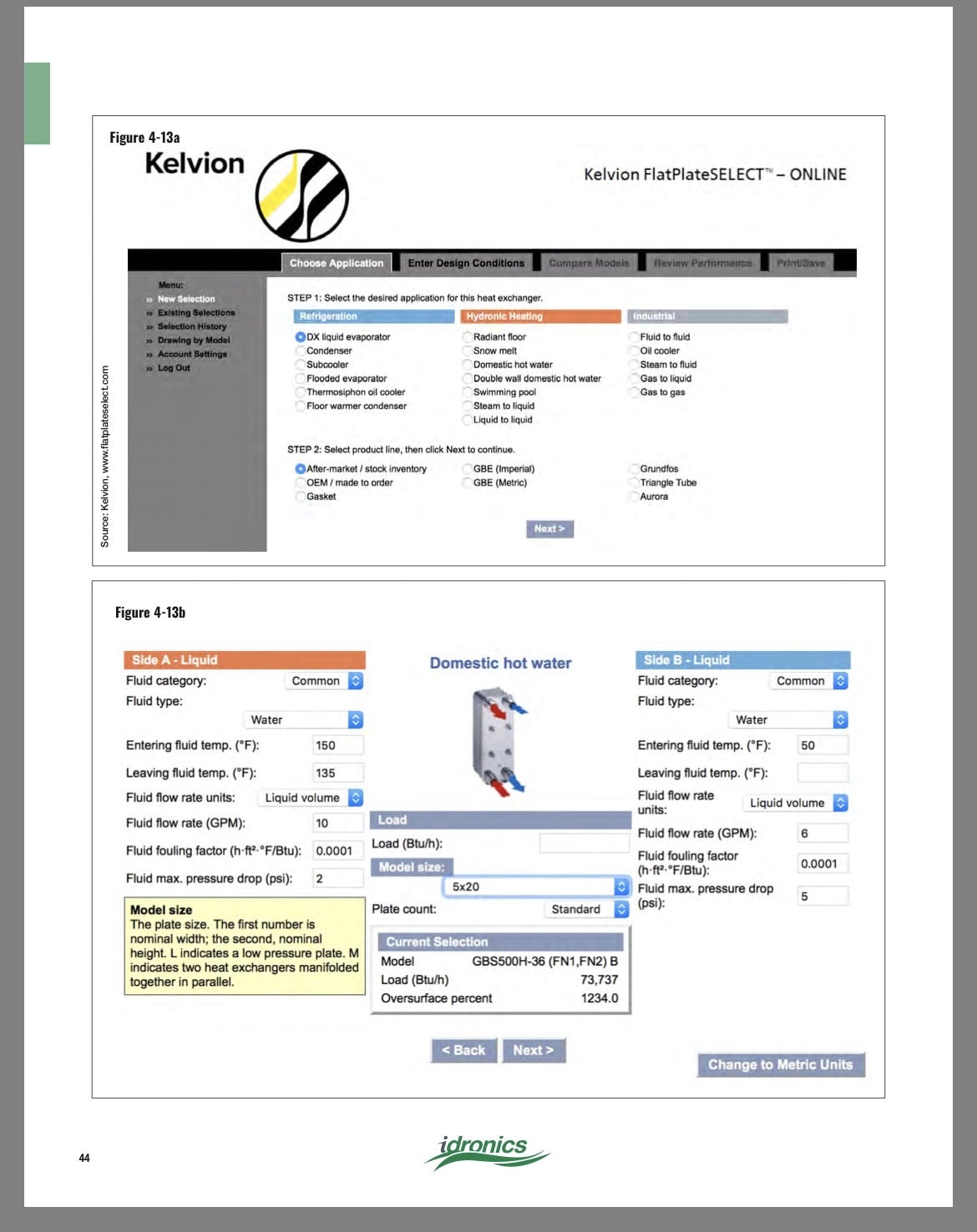
the very best way is to use one of the free online sizing software programs
You need flow data and some temperatures Im guessing a 5x10 20 plate would move all that boiler can offer
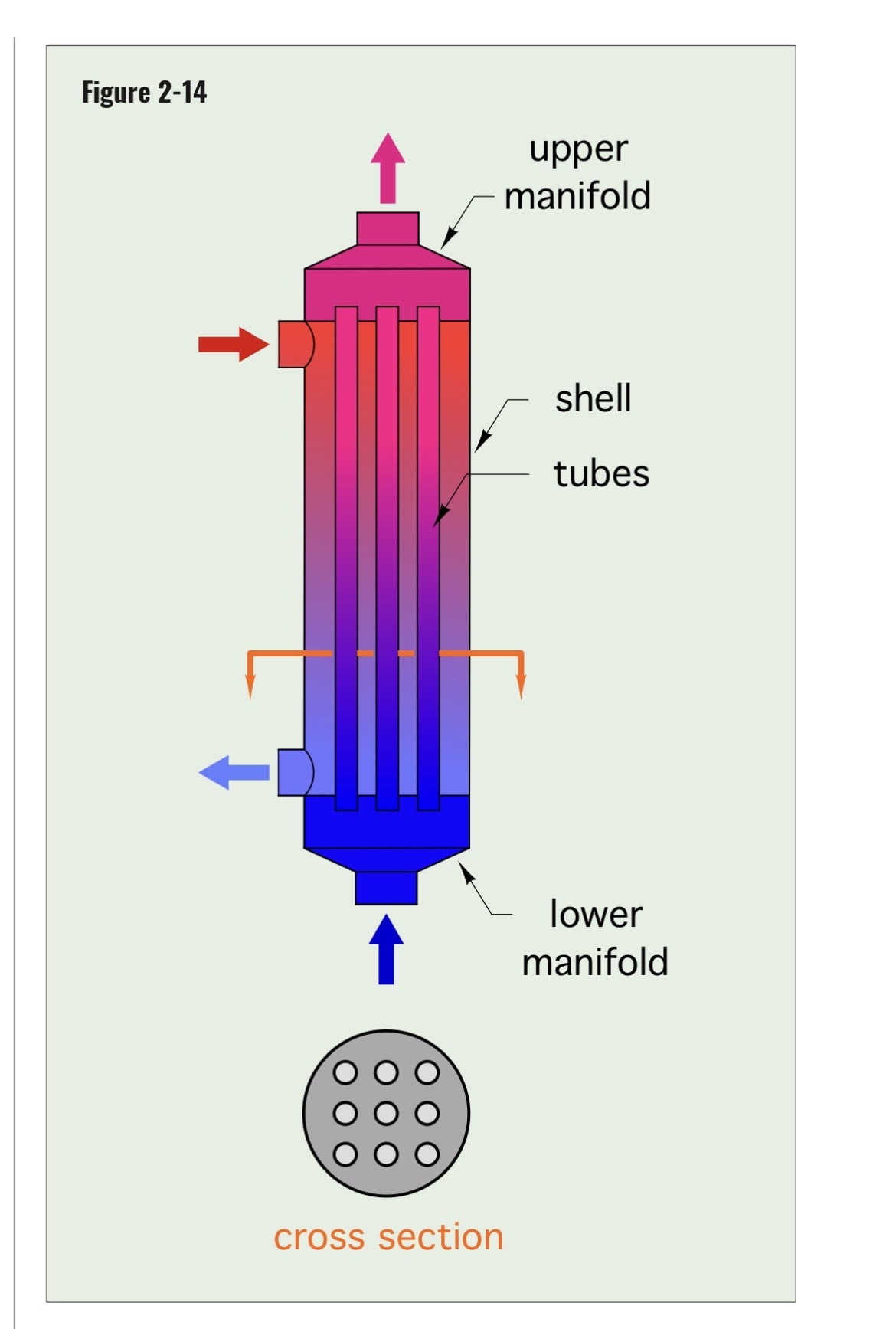
Shell and tube are commonly used for pool and spa as they have 2” connections for high flow
Your limitation will be the boiler output
 Bob "hot rod" Rohr
trainer for Caleffi NA
Living the hydronic dream0 -
I played around with this Taco heat exchanger calculator.
https://apps.tacocomfort.com/bhe.html
Here are my inputs:
Primary inlet temp: 170 Primary outlet temp: 150
Primary flow rate: 6 gpm
Secondary inlet temp: 75 Primary outlet temp: 95 (representing end of pool heating cycle when heat transfer through HX is lowest)
Secondary flow rate: 6 gpm
BTU transfer rate: 60,000 BTU/hr
The Taco calculator then shows you a number of different flat plate heat exchangers, with the results you'll get from the above inputs. With their TB10T heat exchanger, which is about 5"x11" and 10 plates, the above parameters are all met, with a pressure drop of 3-4 psi (7-10 feet head).
The B&G 125,000 BTU HX I linked to above has a smaller footprint (about half the area) but has 20 plates, so double the plates (and almost triple the thickness). Thus should have similar heat transfer capacity at lower pressure drop (I calculated around 2 psi at 6 gpm from the numbers on their spec sheet).
0 -
If the pool size is 600 gallons and your cold fill water is 55°F, and you want to heat it to 85°F, the simple math is that you need about 150,000 BTU to do that.
600 gal × 8.34 lb/gal = 5,004 lb × 30°F = 150,120 BTU total
If you have a 40,000 BTU output heater, then you will complete the process in less than 4 hours. However, that does not account for heat loss once the pool water temperature rises above the ambient temperature. Assuming the pool is indoors and the ambient temperature does not drop below 60°F, then during the second hour you will need to account for some loss based on: the surface area of the pool, the temperature of the air surrounding the piping, and finally evaporation. You may need to add roughly 15,000 BTU per hour for part of the second hour and through the third and fourth hours.
As far as the heat exchanger is concerned, I believe @hot_rod indicated that a 5 × 10 × 20 plate exchanger with 1" ports will handle anything the boiler will put out. I actually used a Weil‑McLain WMPH-125 for a job like this once. (Yours could be smaller) Unfortunately they no longer offer that product, and the Triangle Tube company they sourced it from is also no longer in business. Bell and Gossett has a BP410-20LP that should work for you.
For the pump you might use a Taco 007 circulator pump or a Grundfos UPS15‑58 circulator pump on low speed on the closed-system boiler side. On the open system side, you may want something that will provide a higher flow rate for the best heat-transfer performance. A stainless steel hydronic pump such as the Taco 006‑ST4 stainless steel circulator could work, or the Grundfos UPS15‑58 circulator pump on medium speed, although you may find that the cast-iron pump will need replacement more often in that application.
Any cast-iron boiler with about 45,000 BTU DOE output or 38,000 BTU AHRI Net output should work, since the Net rating already includes the 15% piping and pickup factor.
If the 600 gallons is correct then you can do this with:
- Crown AWR070B by Velocity Boiler Works (or the AWR038B with a 6 hour heating time)
- Taco 007 (or equal) comes with the boiler
- Bell and Gossett BP410-20LP
- Taco 006-ST4 for the pool side of the HX
- You may also want to look at plastic pumps that are common in the Pool and Spa industry to see if there are lower cost options there.
I selected a dependable, low cost boiler since you are not operating it year round for space heating or domestic hot water. These parts should do the job for you. But perhaps @hot_rod may have some better ideas. He has more experience with more projects under his belt.
Edward Young Retired
After you make that expensive repair and you still have the same problem, What will you check next?
 1
1


Categories
- All Categories
- 87.8K THE MAIN WALL
- 3.3K A-C, Heat Pumps & Refrigeration
- 59 Biomass
- 430 Carbon Monoxide Awareness
- 132 Chimneys & Flues
- 2.2K Domestic Hot Water
- 6K Gas Heating
- 124 Geothermal
- 170 Indoor-Air Quality
- 3.8K Oil Heating
- 79 Pipe Deterioration
- 1.1K Plumbing
- 6.7K Radiant Heating
- 396 Solar
- 16.1K Strictly Steam
- 3.5K Thermostats and Controls
- 56 Water Quality
- 51 Industry Classes
- 51 Job Opportunities
- 18 Recall Announcements