Welcome! Here are the website rules, as well as some tips for using this forum.
Click here to Find a Contractor in your area.
If our community has helped you, please consider making a contribution to support this website. Thanks!
Pre-heating Taco X-Pump manifold return glycol mix via solar

Dear Forum,
I have an existing (recently installed) system with Taco X-Pump exchanging heat with my DHW.
My DHW is a stratified tank powered by Sanden Sanco2, which produces about 16K BTU/h and supplies 140F+ water. Not enough to heat about 2000sqft of slab (currently configured with one zone and about 900sqft and doing good, but it's spring weather already)
It was planned to supplement existing DHW with 7 3ftx5ft Solar Collectors, which are typical copper backed tube collectors.. used.. likely from the 70's. They're going to be hung vertically on the south facing wall of my solar roof car port. Not perfect angle, but should be good enough for winter, and initially thought to be a drain back system, which it can still be, as heat storage is below.
I've come up with a 'desired' design, which I need help with on how to control things, and probably some (not much) convincing to simplify.
I want to take advantage of existing glycol and associated infrastructure in the line, plus I'd like to avoid preheating DHW, although I've been back and forth on the thought.
DHW tank is meant to be stratified. Sanco produces higher efficiency at lower temps. Sanden starts working with middle of the tank is 113F and stops when bottom of the tank (where it draws water) reaches 126F. It fills it from the top.
- Heating glycol hence minimizes need to pull water from DHW AND counting on it to put some of that 'free' heat into the slab
- I Have instant heater in case some water pulled from top of the tank is too cold (and/or there is no sun).
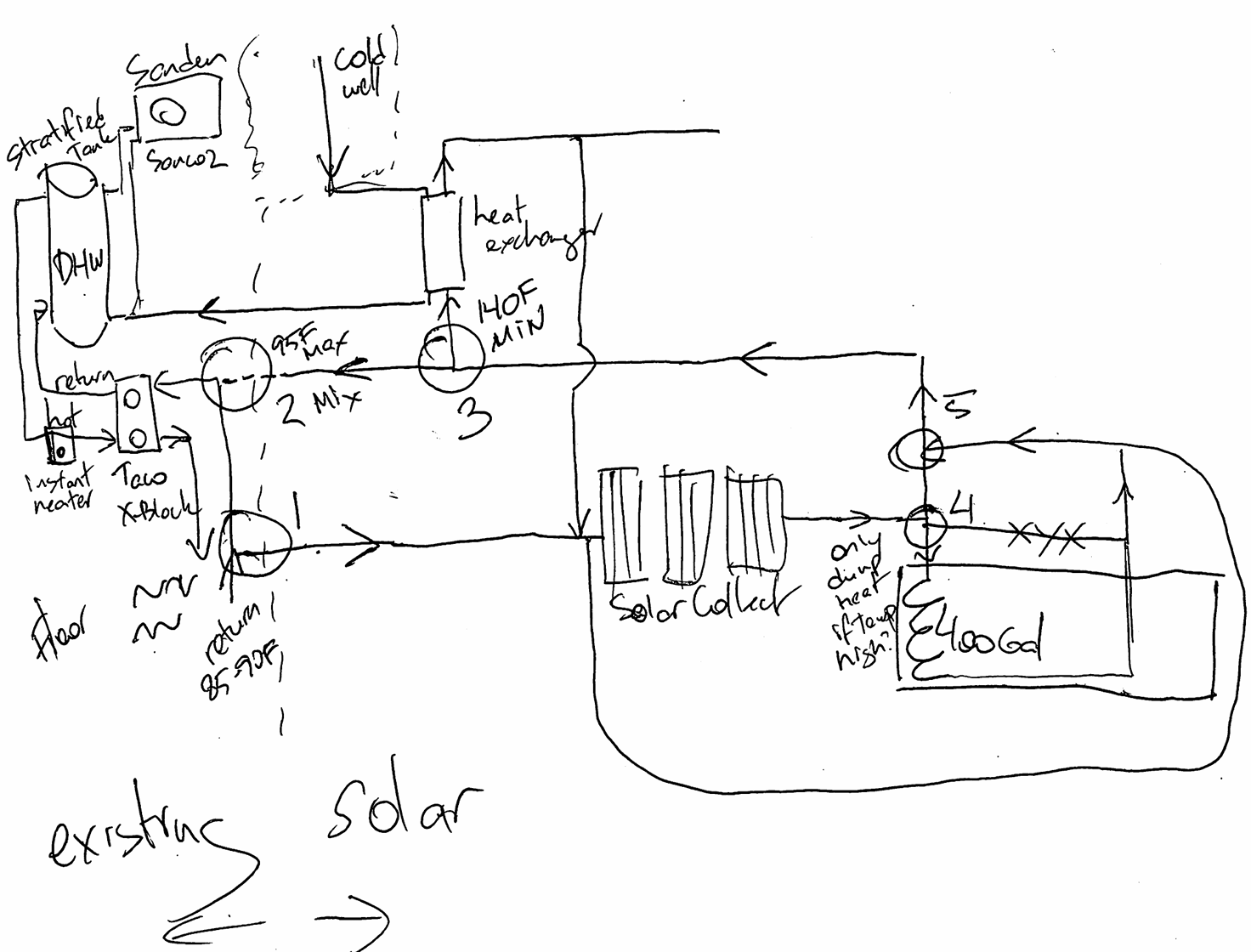
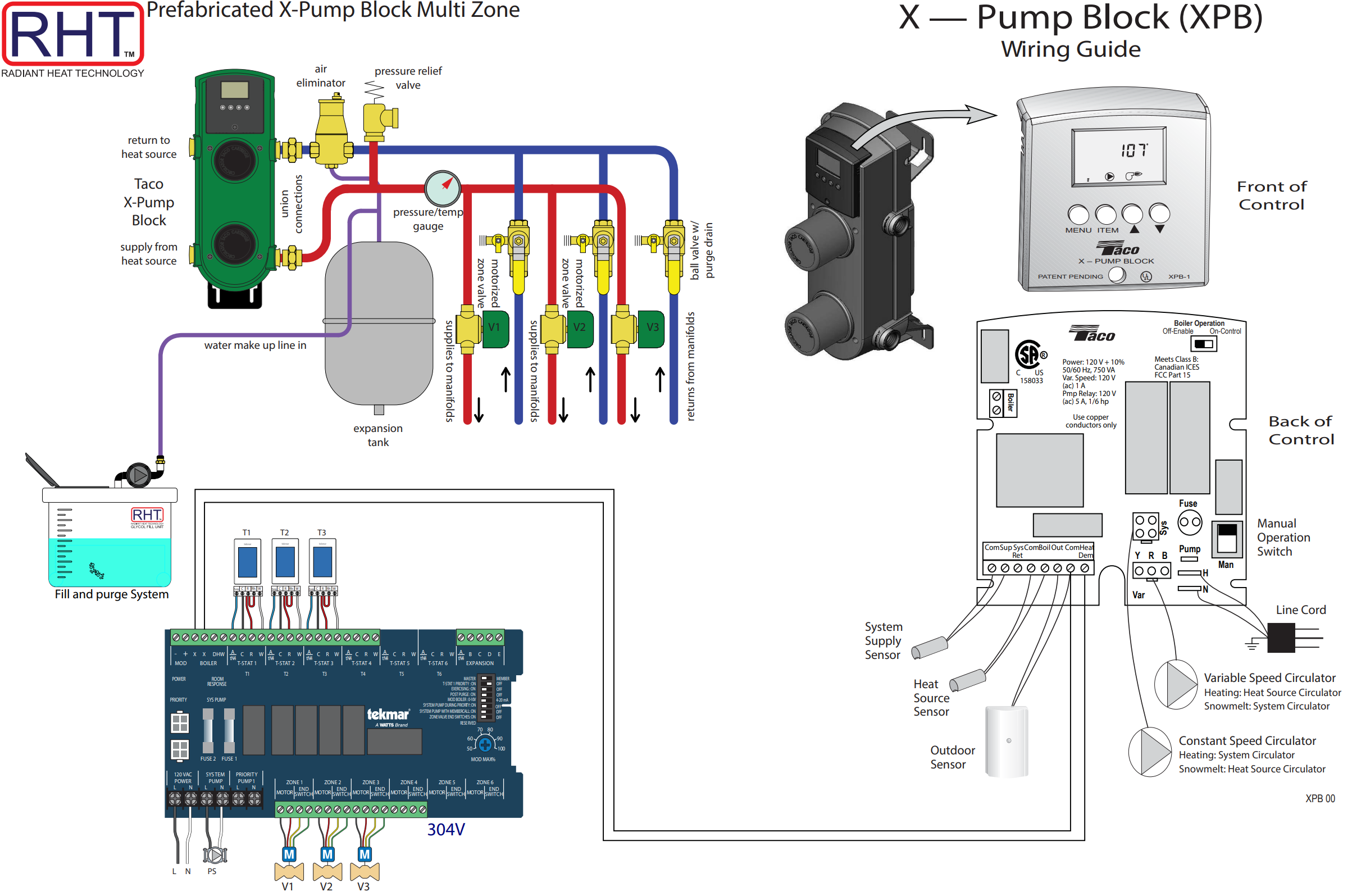
Attached is a copy of diagram of Taco prefab unit from the manufacturer (BlueRidge) plus my hand drawing of left side (existing minus manifold and other details, including rest of DHW omitted) and right side (rough design needing feedback). I basically plan to reroute (when conditions are met) all my glycol return outside to solar (right side of the diagram). I labeled and circled five junctions that I need help with. The thermostat controller is Tekmar 304V. Heating system pressure is <15PSI. The numbered bullets below are mapped questions to numbered junctions in the hand drawing.
- Do I need anything to get glycol mix to start moving outside at this junction? It can either be a valve with an actuator, similar to Taco Zone Sentry valve or the controls downstream might be sufficient.
- We don't want the return to be more than 95F. I thought this is a tempering valve, but if my 'hot' supply is actually cold (e.g. no sun or no heat storage) wouldn't it make it wide open on the 'hot' side
- We do want to heat exchange with DHW under certain conditions. In the winter we'd probably want to set it to <100F and in the summer we'd probably want it to set to 130F plus (drawing says 140F min). For simplification purposes maybe we want that minimum temp to be slightly higher than what we preheat to Taco so that the floors get priority (let's say Min 100F). I don't know what control(s) to use to achieve min temp.
- This one is something I have some doubts about. I drew it up so that glycol passes through panels and can go straight back to the system before starting to heat the massive 400 gal milk tank, at this point we'd want a minimum 100F to flow back, and rest dumped into the water. Ignore the X X X cross outs, we obviously need a tube for mixing coming from the tank.
- This should be night mode when I no longer pass through solar collectors, but only draw from the tank. Would I need a 6 right before solar collectors?
Lastly, I need to circulate my glycol when Taco x-block is not circulating. I cannot make taco-x circulate, as glycol will have nowhere to go when all zone valves are closed, and it's too cold, so I need another pump, unless it's circulation won't screw up with Taco pump it needs to ensure it operates (for DHW preheating only) only when Taco circulation pump is not.
Your feedback would be greatly appreciated. Please, feel free to criticize. You won't hurt my feelings.
Comments
-
A Sanco2 system in the wild. Lots of talk about these but don't often see one. The issue most people run into is unless the RTW is very cold, you won't get nowhere near the 16k nameplate out of the unit. I think even their own docs only show about 8k for space heat which won't get you far even in a low load house.
Probably not the answer you are looking for, but the simplest is a PV MPPT controller to a water tank like this (many out there, first I found from quick google):
This avoids any of the hydronic bits plus dealing with typical solar thermal issues. With fancier setup, you can also use the PV for house loads when not needed for heat. You can add the element to your existing tank or have a 2nd buffer tank downstream of the Sanco.
0 -
I'm going to rain on your parade. A 450 square foot collector will net about 50,000 BTU per day in the heating season. Multiply that out by the cost per BTU of your alternative heating sources and the length of your heating season and you'll find it never pays for itself.
I'm with @Kaos that if you want to do solar, do solar electric. Especially if net metering is available where you are.
0 -
You can get resistance elements that wire right to the PV module. Insert those into the milk tank
Generally you need a dozen st panels or more to do much heating in the winter,
Short days, cold ambient, vertical mount are all working against you
When you look at btu output ratings on ST panels, that SRCC rating is btus per day, usually 6 hours of sun. So a days worth of work may get you an hours worth of heat.
Best use of st is to preheat the dhw, that is a small and everyday load.
Bob "hot rod" Rohr
trainer for Caleffi NA
Living the hydronic dream0 -
I appreciate your criticism.
I already have two solar systems, with and without batteries (SolarEdge and SolArk) totalling about 20kW and spread around my roof, solar canopy and my wood shed, and a great NetMetering plan (get credit for every W overproduced). The batteries, powering my help out during power outages, which are common in our rural area. I haven't had to use the generator much in 8 years I had solar/batteries powering my critical panel.
The instant heater inline serves as the heating element some of you suggested due to Sanco2's low capacity.
I already have high sunk costs into plumbing and heating, particularly pex and associated manifolds in basement slabs and the fancy/expensive heat exchange system referenced above. I bought the SanDen few years back, but didn't get around to hook it up until just a few weeks ago. It don't lose capacity, but it's COP varies 2-5 depending on temps. The recommended heating load is 10k BTU, btw. If I had to do it again I'd consider something like a SpacePak that can do heating and cooling and much higher capacity and don't pump coolant gas into the house, which apparently likes to leak (yeah, but also $$$). My main heating was a 2.5ton multi-zone mini-split until it leaked gas again recently , and I just got by with a wood stove and space heaters and haven't had time to circle back to it.
I got pretty close last year with paying nothing for electricity with 700$ total for the year in 2025 (I heat and cool with electric and I am in broader DC vicinity). This year won't be as good as space heaters are a lot less efficient than mini-split, plus mini-split was spinning wheels w/o gas as well.
I realize my heating solar plans may not cover all needs, but may cover most shoulder seasons and get me to minimize money spent on electric. I can add more solar collectors, as used ones are cheap, and I have plenty of space.
I don't think the incremental system cost here is significant, most of the money has already been spent, but I'll certainly look into making this as simple as possible to minimize further cost as the ROI is questionable. I will also reconsider the solar angle. Winter optimal is 55.
I was trying to avoid it, but if I had to, I'd use a wood boiler to dump heat into that milk tank on 'cloudy days'. Wood is abundant where I am at, and I enjoy splitting it by hand.
0



Categories
- All Categories
- 87.9K THE MAIN WALL
- 3.3K A-C, Heat Pumps & Refrigeration
- 60 Biomass
- 430 Carbon Monoxide Awareness
- 133 Chimneys & Flues
- 2.2K Domestic Hot Water
- 6K Gas Heating
- 124 Geothermal
- 170 Indoor-Air Quality
- 3.9K Oil Heating
- 79 Pipe Deterioration
- 1.1K Plumbing
- 6.7K Radiant Heating
- 397 Solar
- 16.1K Strictly Steam
- 3.5K Thermostats and Controls
- 56 Water Quality
- 51 Industry Classes
- 51 Job Opportunities
- 18 Recall Announcements